Synthera: A Living, Affordable Therapy for Cancer
Inspiration
Cancer has touched my life in a deeply personal way. I’ve seen people I love go through the intense physical and emotional toll of traditional treatments like chemotherapy and radiation. Beyond the pain and side effects, I saw the financial strain these treatments placed on families — especially in a place like Iowa, where I live.
Iowa has the second-highest cancer rate in the United States. That statistic isn’t just a number to me — it’s a reflection of the urgency for smarter, more accessible solutions. I didn’t want to stand by while people in my own community and around the world continue to suffer or go untreated due to cost, toxicity, or lack of innovation.
I was inspired by synthetic biology — specifically the idea that we could use engineered life forms to precisely and safely target disease. What if we could take something as safe and familiar as a probiotic and turn it into a programmable, living drug? That’s how Synthera was born: not just as a scientific project, but as a mission to make cancer treatment smarter, safer, and radically more affordable.
What It Does
Synthera is a capsule containing engineered probiotic bacteria that seek out and destroy tumors from within the body — like a guided missile, but alive.
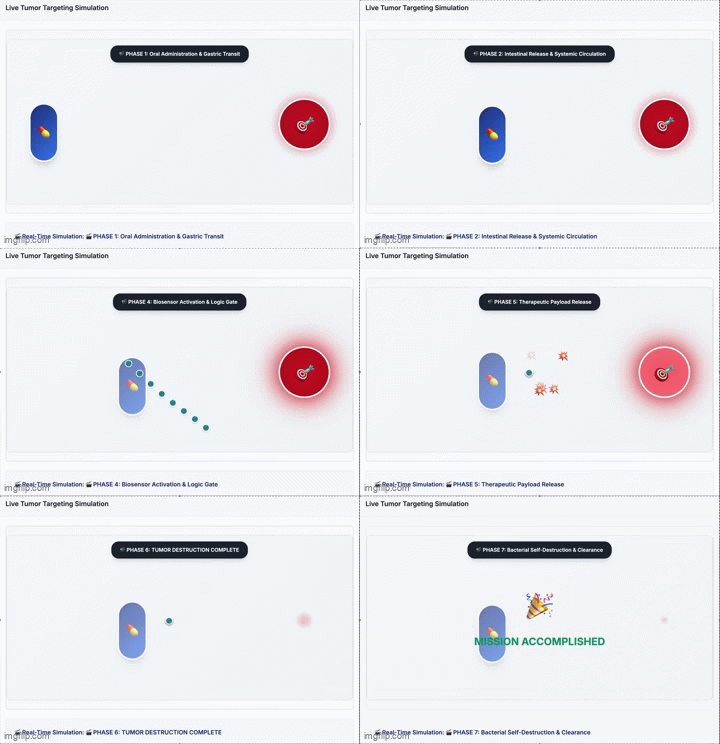
Once ingested, the capsule dissolves, releasing the engineered bacteria into the body. These bacteria are designed to detect key signatures of the tumor microenvironment, including:
- Low oxygen levels (hypoxia)
- High acidity (low pH)
- Lactate accumulation, a hallmark of cancer metabolism
When they detect these conditions, the bacteria begin producing and releasing a combination therapy payload, including:
- Cancer-killing molecules (e.g. toxins specific to tumor cells)
- Immune-stimulating proteins that rally the body’s natural defenses
- Angiogenesis inhibitors that block the formation of new blood vessels feeding the tumor
After delivering their payload, Synthera’s engineered bacteria self-destruct using built-in triple kill-switches, ensuring they don’t persist in the body or environment. The result: a targeted, transient, and trace-free therapeutic intervention.
How I Built It
- Genetic Circuit Design: I used E. coli Nissle 1917, a probiotic strain already approved for human use, and designed tumor-sensing genetic circuits using CRISPR and synthetic biology tools.
- Biodegradable Delivery System: I modeled a PLGA (poly(lactic-co-glycolic acid)) capsule to encapsulate the bacteria, enabling controlled release after ingestion.
- Interactive Simulations: To make the system easier to understand, I built visual simulations of the therapy’s journey — from capsule delivery to tumor sensing to immune activation.
- Cost Modeling: I created a realistic cost-of-production model using current biotech manufacturing techniques to prove Synthera could be made for under $10 per dose.
Challenges I Ran Into
- Translating Complexity: Cancer biology is incredibly complex. One of the hardest parts was simplifying that science into a visual, understandable story without sacrificing accuracy.
- Biosafety Engineering: Working with live bacteria, even safe strains, requires extra care. Designing robust, multi-layered safety mechanisms — like the triple kill-switch — was a top priority.
- Time Constraints: Balancing scientific rigor with the fast pace of a hackathon meant making strategic decisions about scope and feasibility.
- Affordability as a Core Goal: It wasn’t enough to make this idea scientifically sound — I wanted it to be something real people could actually afford. That meant careful decisions around design, production, and delivery.
Accomplishments I’m Proud Of
- Created a full end-to-end therapeutic concept — not just a molecule, but a delivery system, safety model, and clinical vision.
- Designed multiple biosafety layers, including genetic kill-switches, capsule encapsulation, and metabolic control of bacterial growth.
- Demonstrated a cost-per-capsule under $10, which is thousands of times cheaper than many current cancer therapies that can range from $20,000 to over $100,000.
- Developed Synthera as a platform, not a one-off — meaning it can be adapted to treat many different types of cancers.
What I Learned
- Tumor microenvironments are more than just a challenge — they can be a targeting mechanism. Their unique conditions allow for condition-specific activation of therapies.
- Synthetic biology gives us tools to create responsive, programmable treatments that are unlike anything in traditional medicine.
- Good science needs good communication. I learned how important it is to tell a compelling story that can reach beyond the lab to investors, clinicians, and patients.
- Working at the intersection of disciplines — biology, engineering, design, and healthcare economics — is where real innovation happens.
What’s Next for Synthera
Build Proof-of-Concept Prototypes
- Start with testing the engineered bacteria in tumor organoid models (3D tumor simulations in the lab).
- Start with testing the engineered bacteria in tumor organoid models (3D tumor simulations in the lab).
Preclinical Biosafety & Delivery Testing
- Evaluate targeting, therapeutic release, and kill-switch functionality in controlled animal models.
Partner with Oncology Accelerators
- Collaborate with biotech incubators and cancer research labs to take the idea from concept to trial.
- Collaborate with biotech incubators and cancer research labs to take the idea from concept to trial.
Expand the Platform
- Adapt Synthera to different cancer types by swapping out payloads and tuning sensors to different microenvironments.
- Adapt Synthera to different cancer types by swapping out payloads and tuning sensors to different microenvironments.
Work Toward Global Access
- Design supply chains, licensing models, and manufacturing pipelines to make Synthera accessible in low- and middle-income countries, not just in wealthy clinics.
Why This Matters
Too many people — especially in underserved communities and rural states like mine — are left behind by modern cancer treatments. Synthera is my attempt to change that.
By combining cutting-edge science with a relentless focus on accessibility, safety, and cost, I believe Synthera could be part of the next generation of cancer therapy:
- Not just high-tech, but high-impact
- Not just innovative, but inclusive
- Not just possible, but necessary
Built With
- animation-loops
- arrow-functions
- backdrop-filter
- box-shadow
- browser-apis
- cdn-(cloudflare)
- css-animations
- css-custom-properties
- css-gradients
- css-grid
- css3
- cubic-bezier-transitions
- dom-manipulation
- event-listeners
- flexbox
- font-loading
- glassmorphism-design
- html5
- javascript-es6+
- keyframe-animations
- linear-gradients
- mathematical-geometry-generation
- mouse-event-handling
- object-destructuring
- overflow-control
- position-absolute
- procedural-3d-modeling
- progressive-enhancement
- radial-gradients
- requestanimationframe
- responsive-design
- rgba-colors
- template-literals
- text
- three.js
- touch-events
- transform3d
- vanilla-javascript
- viewport-meta-tag
- webgl
- z-index-layering

Log in or sign up for Devpost to join the conversation.