-
-
-
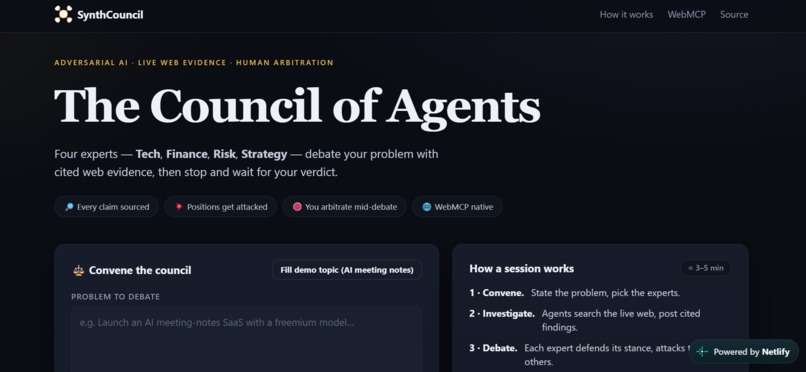
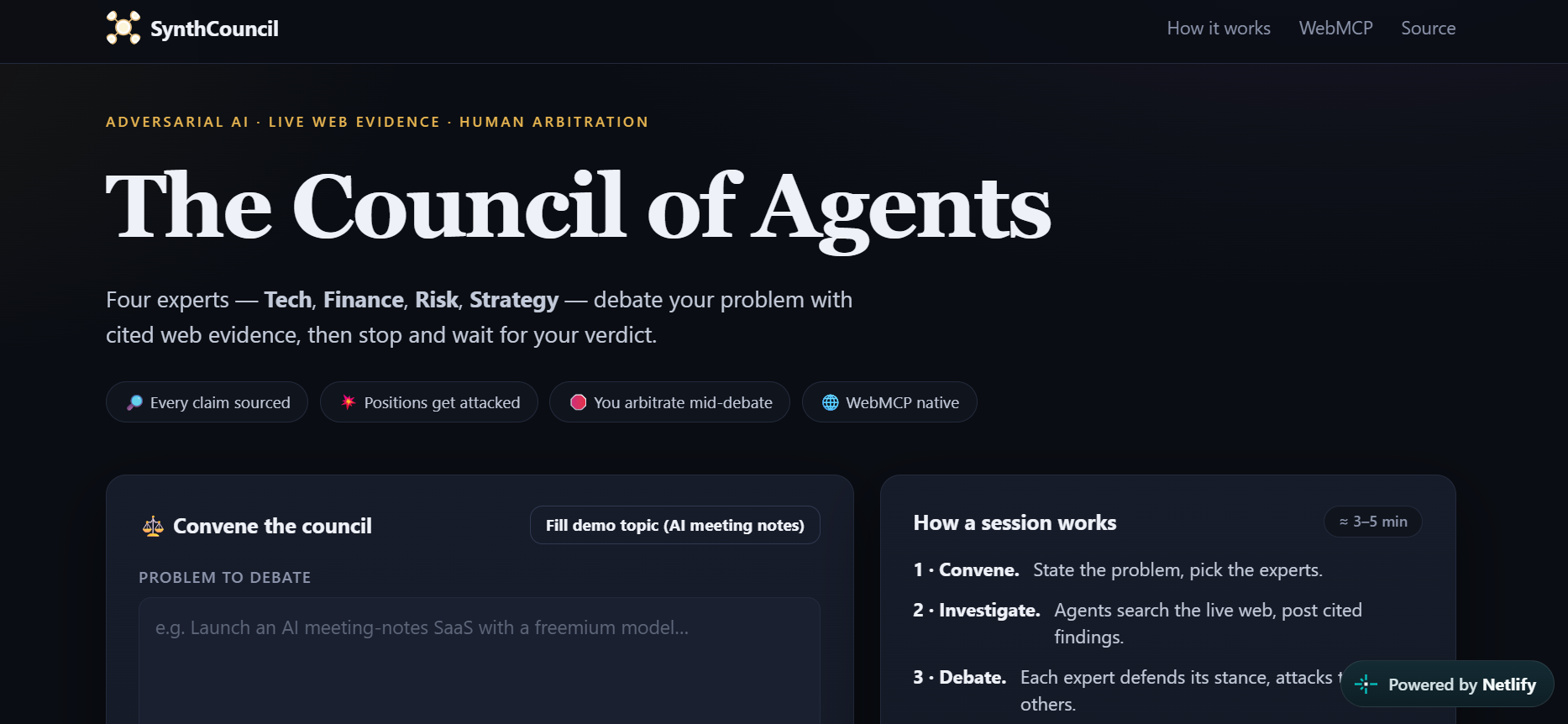
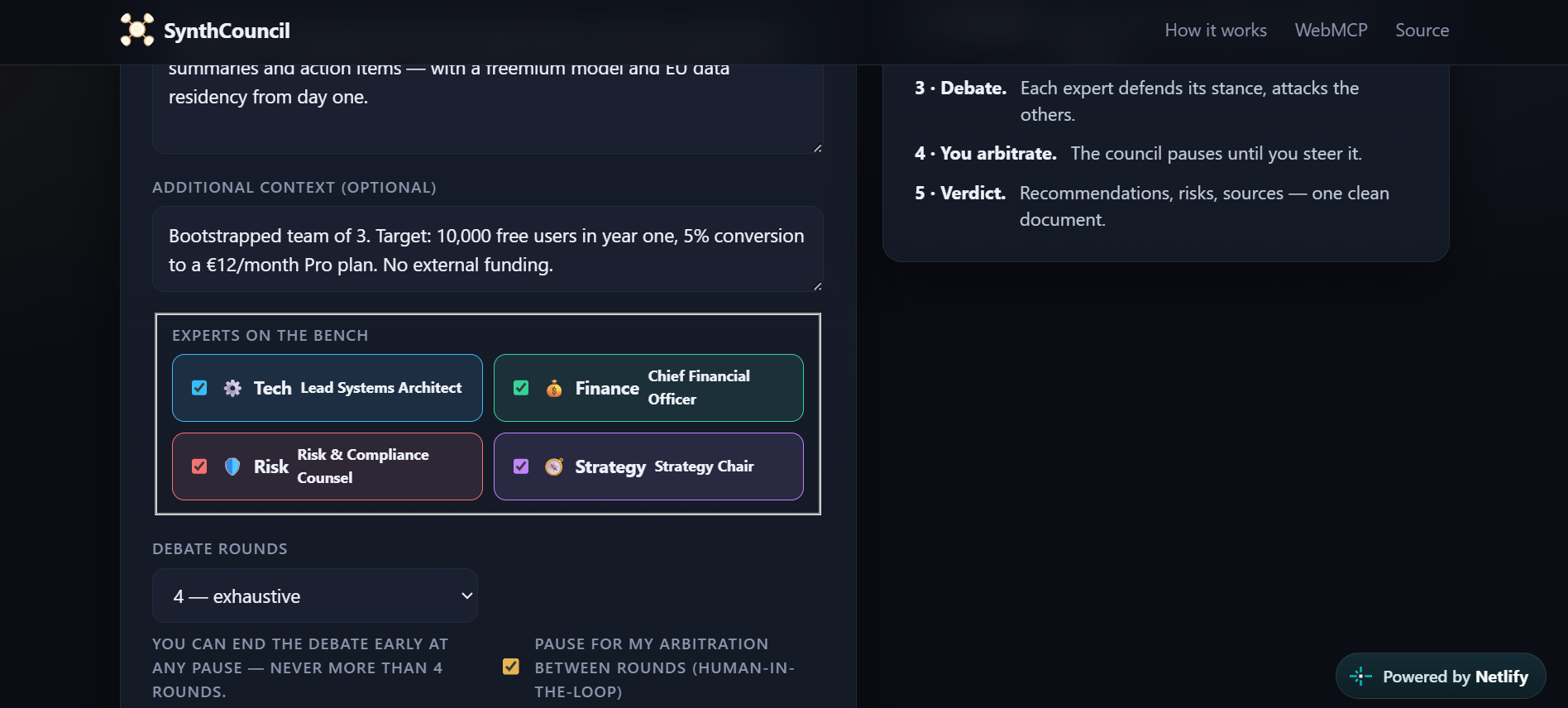
Landing page & session setup: define your problem, pick your expert panel, and configure debate rounds.
-
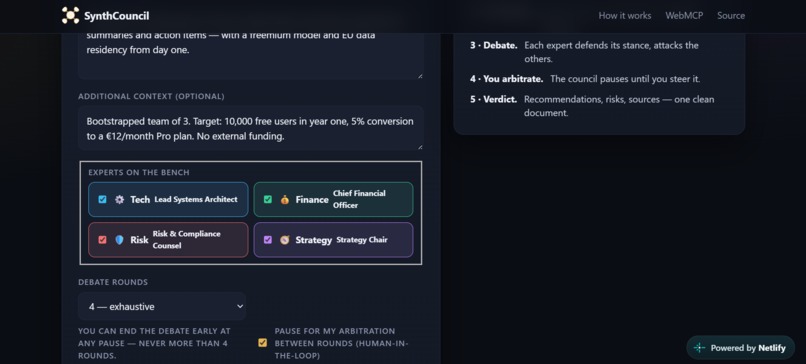
Injecting real-world context and constraints for the AI council to analyze.
-
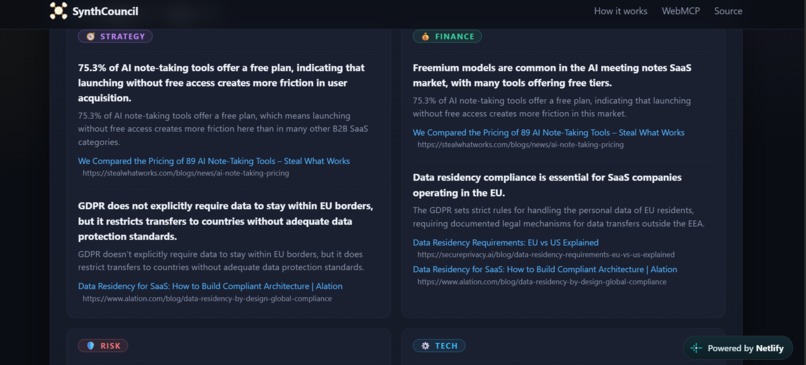
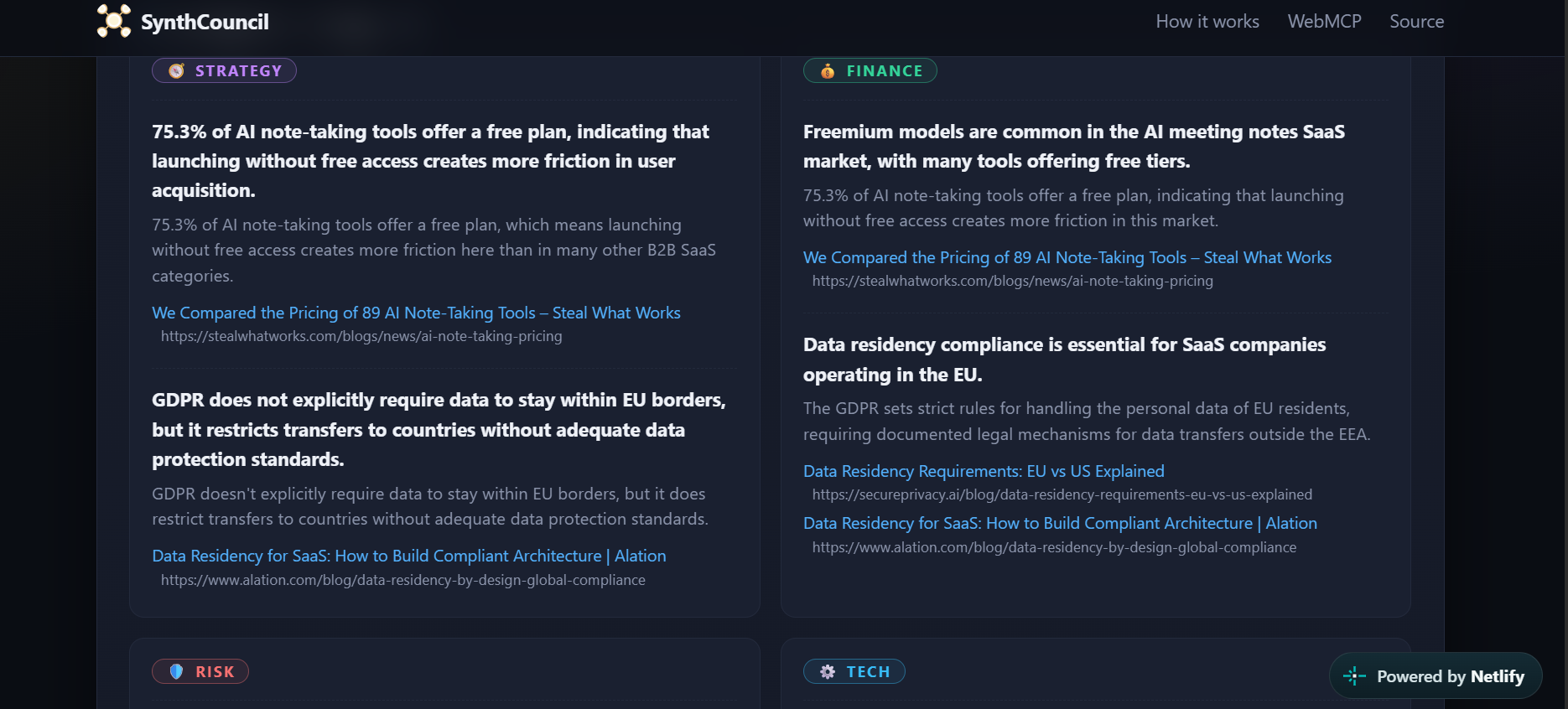
Live web investigation: experts stream real-time findings and cited URLs.
-
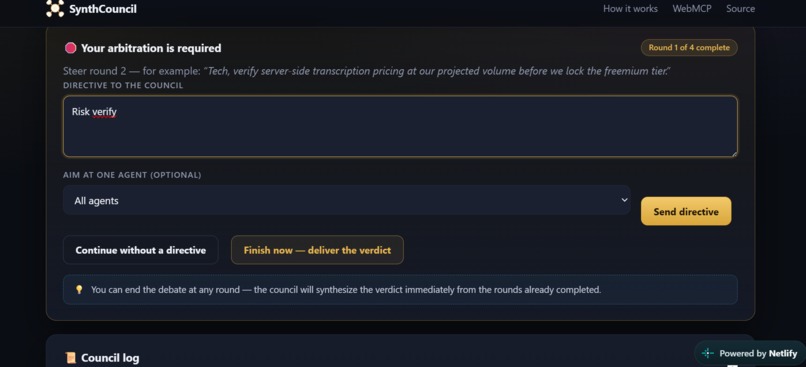
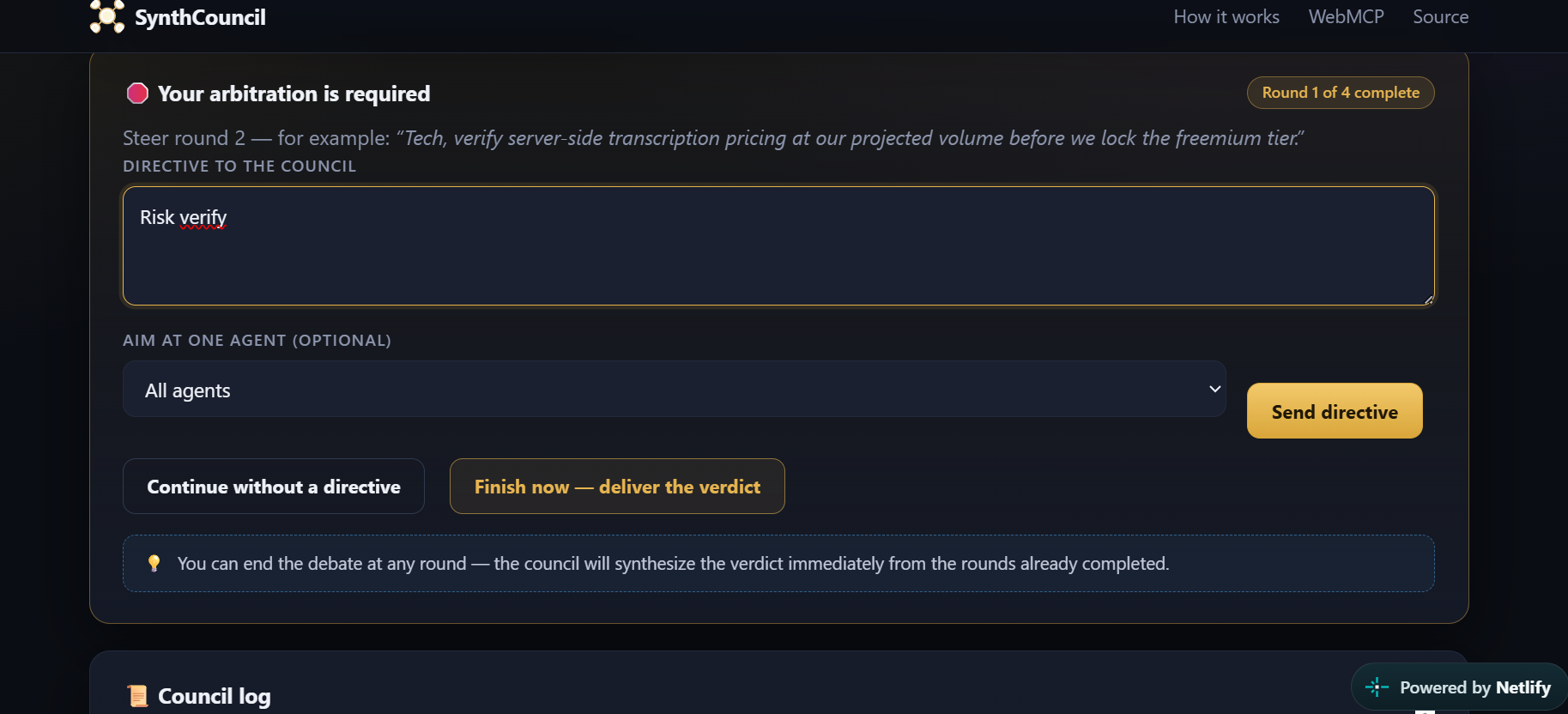
Human-in-the-loop arbitration: pause mid-debate to steer agents, redirect focus, or deliver the verdict early.
-
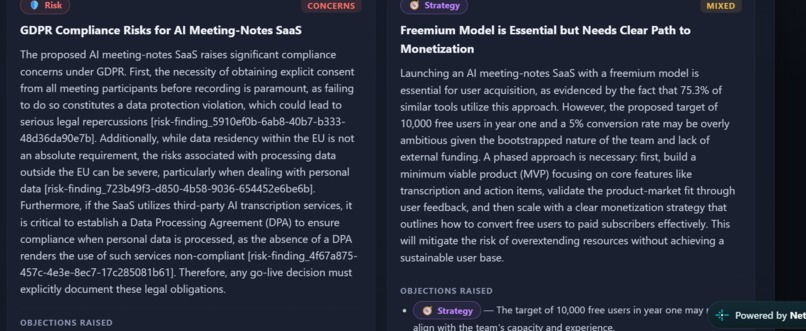
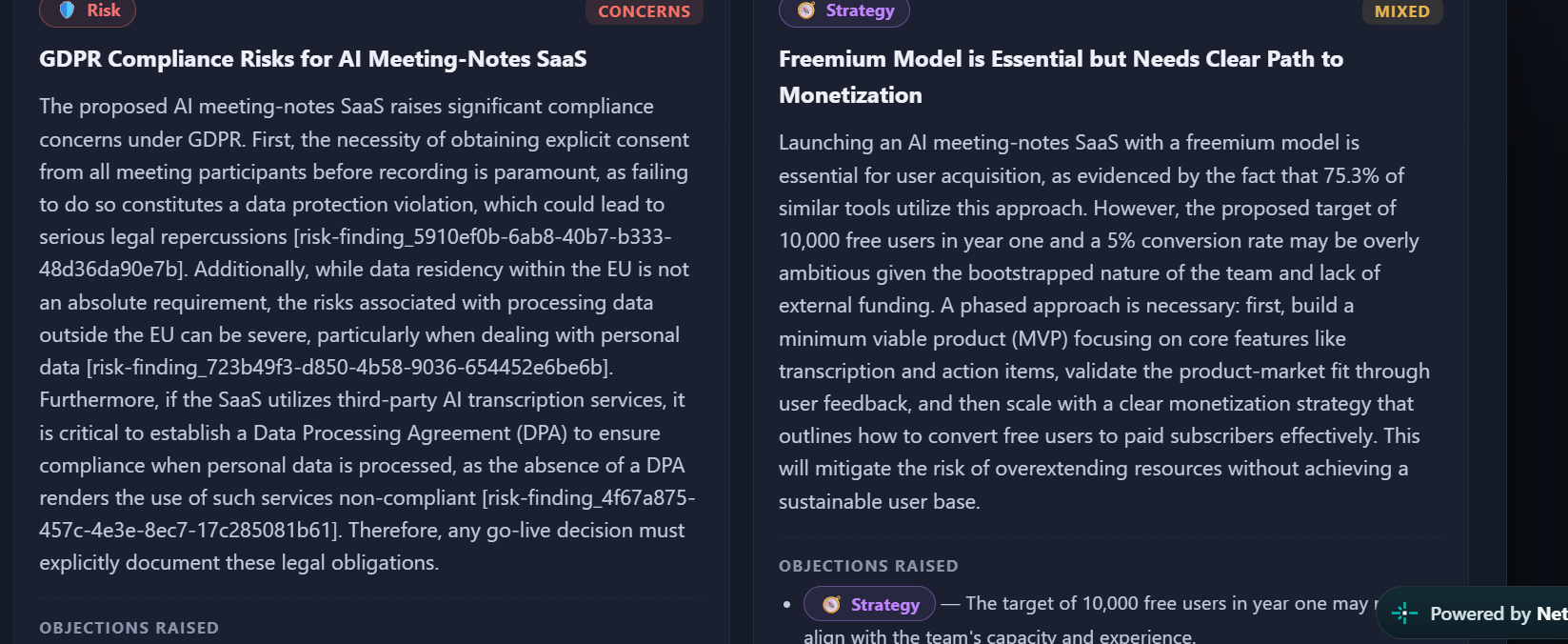
Adversarial debate: agents challenge assumptions, flag risks, and debate strategies.
-
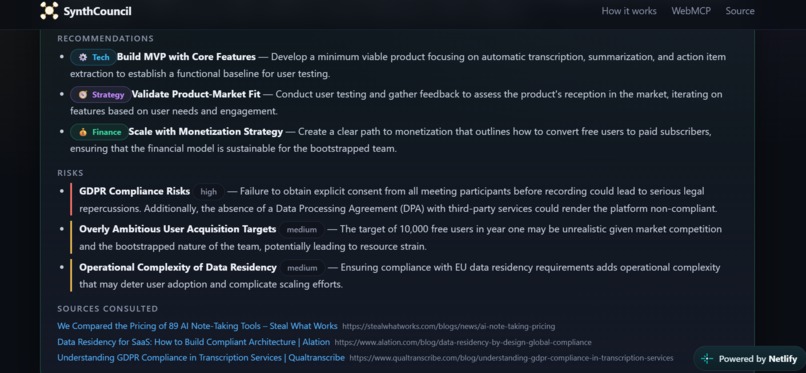
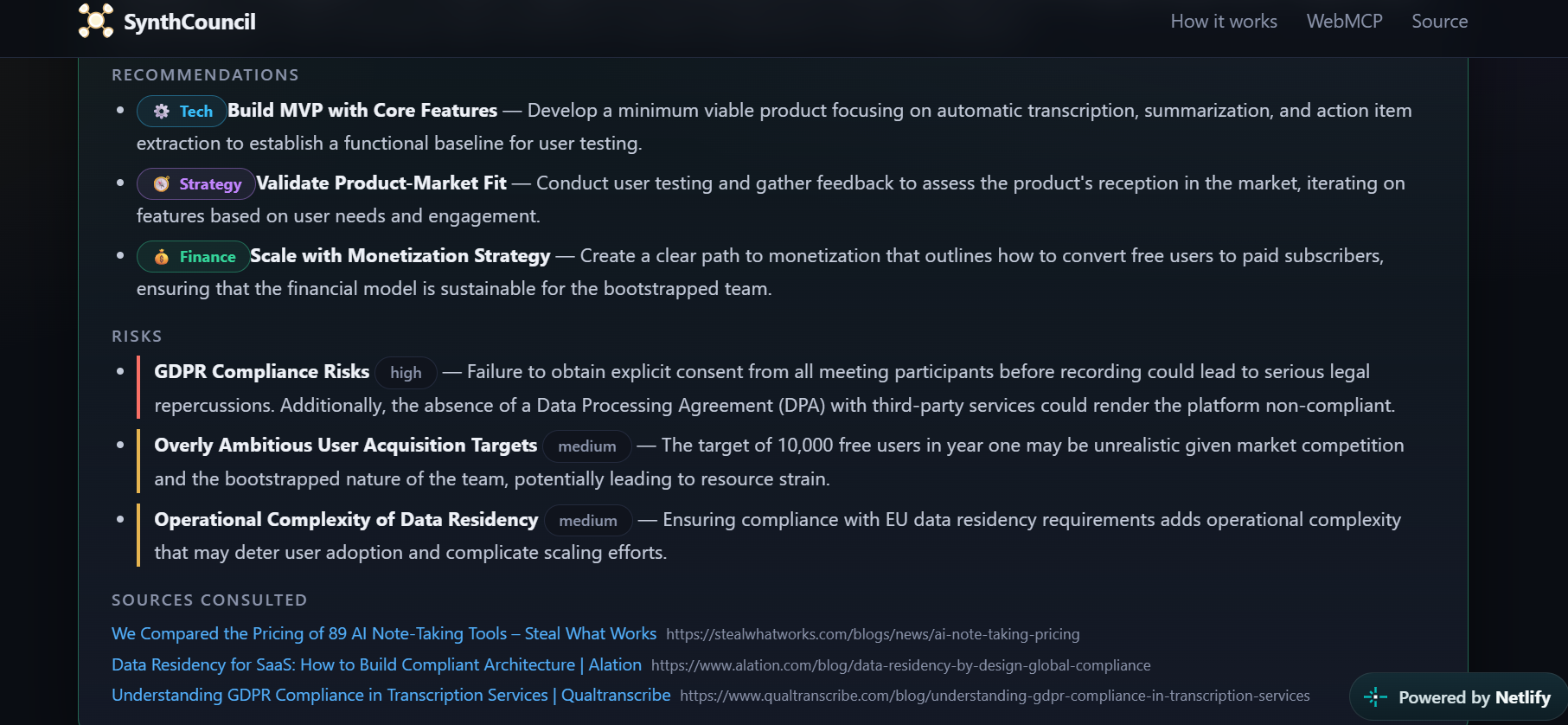
Zod-validated verdict with actionable recommendations, severity risks, and verified sources.
-
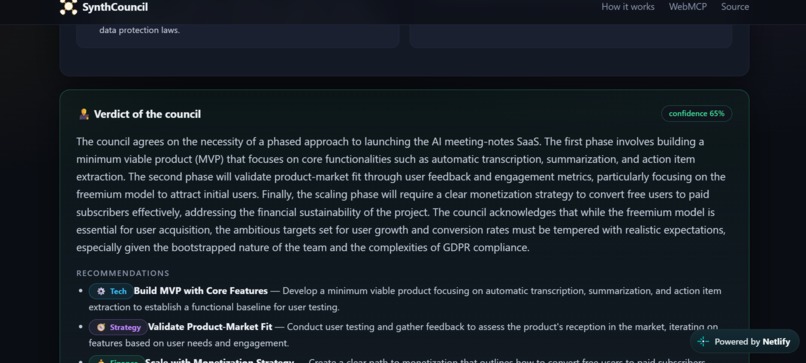
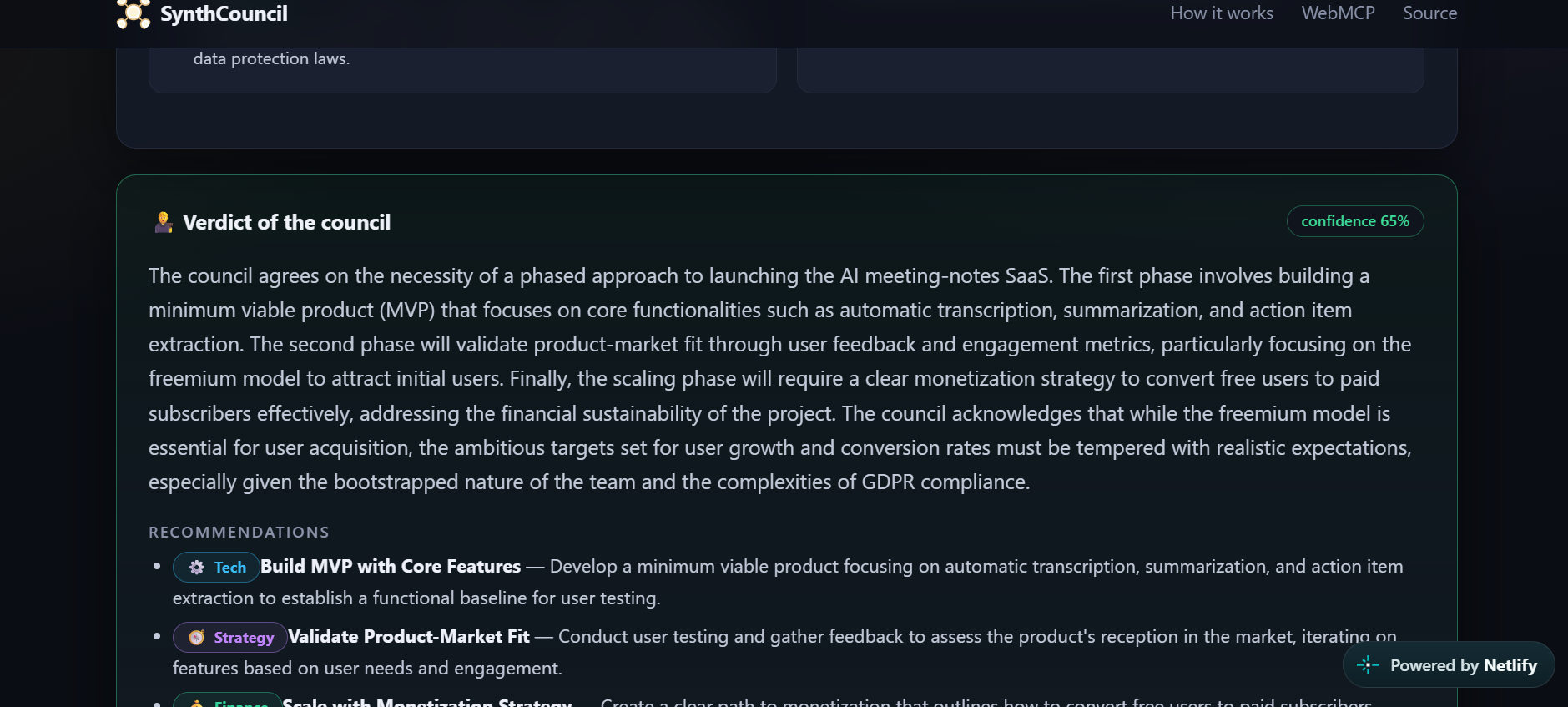
Comprehensive executive summary delivering consensus and strategic direction.
Inspiration
We’ve all been there: you ask an AI for advice, and it instantly agrees with everything you say, echoing your thoughts back to you. That feels nice, but it's dangerous for serious decisions. We realized that what builders and founders actually need is friction, rigorous cross-examination, and diverse perspectives—not a digital yes-man. That’s why we built SynthCouncil.
What it does
SynthCouncil is an adversarial multi-agent AI council designed to stress-test your toughest problems. Four distinct virtual experts—Tech, Finance, Risk, and Strategy—simultanéously analyze your query, scrape live web evidence to back up their claims, and brutally challenge each other's assumptions in structured debate rounds.
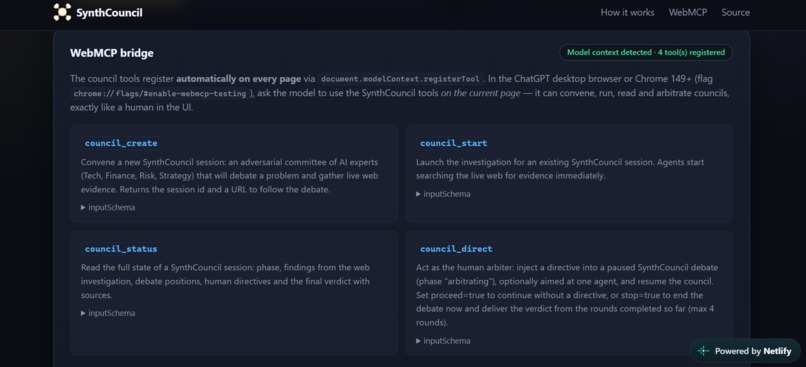
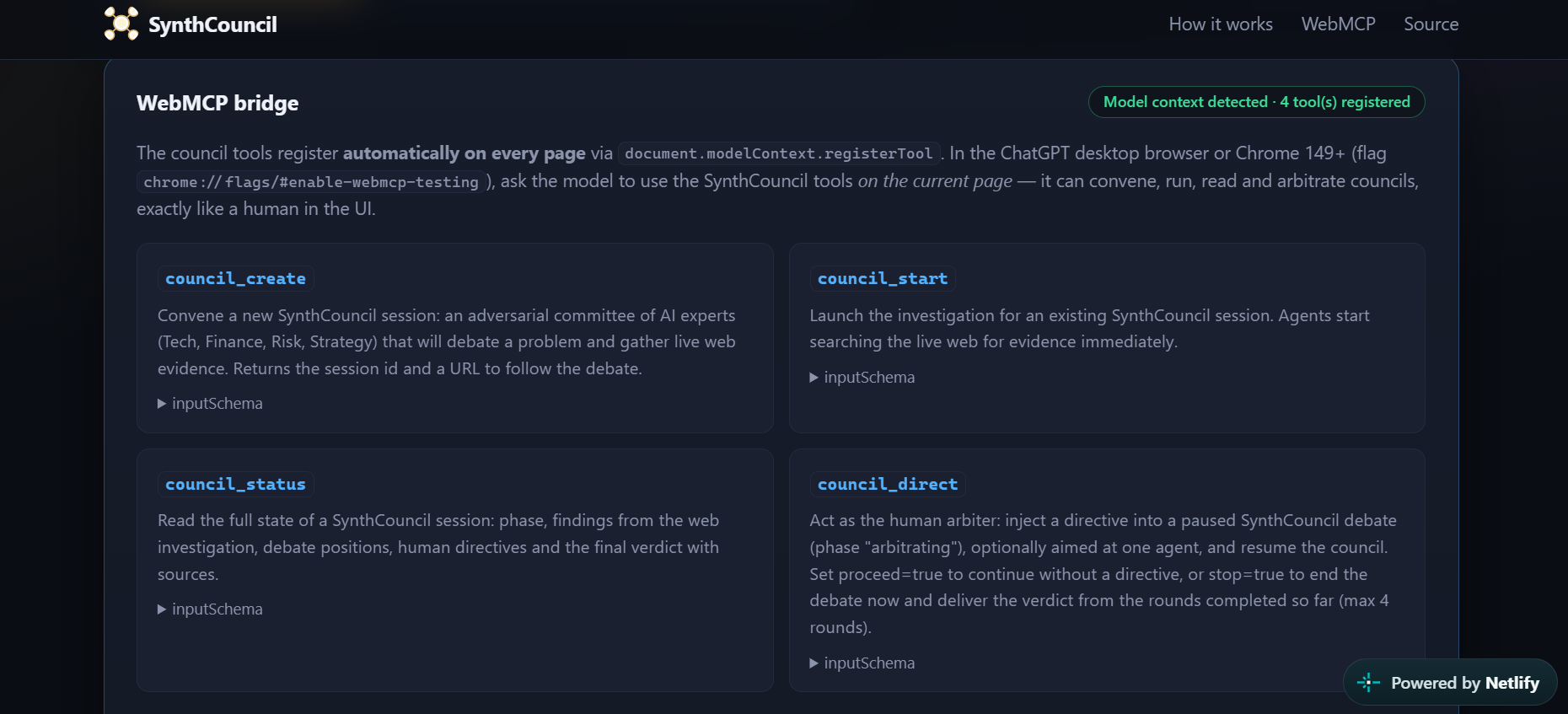
The best part? It operates under your complete supervision using a human-in-the-loop architecture. No agent moves forward or makes arbitrary decisions without your explicit direction. Once you have enough insights, you can wrap up the debate early and receive a clean, Zod-validated verdict complete with actionable owners and clickable sources. Plus, it's fully WebMCP-native, meaning an AI-enabled browser can drive the entire council autonomously.
How we built it
We designed SynthCouncil as a modern monorepo to keep things modular and clean:
- Frontend: Built with Astro and React for a lightning-fast, sleek, minimal UI supporting both dark and light modes.
- Backend: Powered by Node.js, Express, and GenKit, orchestrating asynchronous agent loops and Supabase (PostgreSQL) for persistence.
- AI & Evidence: Powered by OpenRouter (using GPT-4o-mini for speed and intelligence) coupled with a robust live-search web fallback mechanism.
- Deployment: The API lives on Render via an infrastructure-as-code Blueprint (
render.yaml), while the static frontend is distributed globally via Netlify.
Challenges we ran into
The hardest part was orchestrating the delicate balance between autonomous multi-agent friction and human control. Managing asynchronous state streams without breaking the UI, synchronizing environment variables safely across Render and Netlify, and preventing LLMs from generating placeholder URLs when search context gets tight tested our patience. We solved it by enforcing strict Zod validation schemas and building graceful error-handling fallbacks.
Accomplishments that we're proud of
We are genuinely proud of building a fully functional, production-ready adversarial architecture from scratch in record time. Going from a conceptual multi-agent debate to a live, deployed app complete with a WebMCP bridge and a clean human-in-the-loop workflow feels amazing.
What we learned
Building SynthCouncil taught us that multi-agent systems are only as good as their orchestration layer. Giving humans the power to inject context and steer debates midway transforms an AI from a simple novelty into a truly powerful decision-making utility.
What's next for SynthCouncil
We want to expand the roster of expert personas, integrate deeper custom tool-calling capabilities, and refine the WebMCP browser extension to make autonomous agent collaboration even more seamless.
Built With
- astro
- css
- duckduckgo
- express.js
- groq
- node.js
- openrouter
- postgresql
- react
- render
- supabase
- tavily
- typescript
- webmcp
- zod


Log in or sign up for Devpost to join the conversation.