-
-
screenshot-city
-
screenshot-workspace
Inspiration
Agents should not have to infer meaning from pixels and click coordinates. SynSpace explores a better model: give an agent structured access to a spatial world while keeping the human in control of every consequential change.
What it does
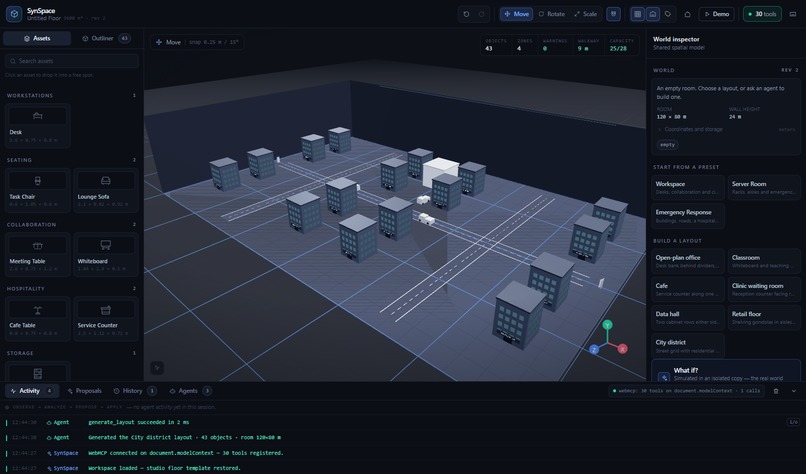
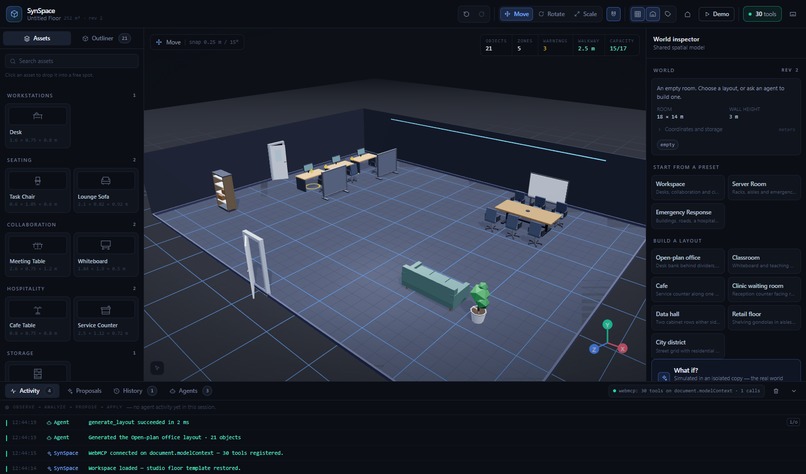
SynSpace is an agent-native 3D spatial workspace. A person and an AI agent work on the same room, office, or city layout. The agent can inspect objects and zones, measure walkways and clearances, check constraints, run isolated what-if scenarios, and propose changes. Nothing is applied until a human approves it; approved changes are attributed, logged, and undoable.
How we built it
We built SynSpace with React, TypeScript, Vite, Three.js, React Three Fiber, Tailwind, and Zustand. The app centers on one versioned world document shared by the UI, spatial-reasoning engine, scenarios, and WebMCP tools. It exposes 30 typed tools through document.modelContext, with the W3C WebMCP polyfill used for live testing today.
Challenges we ran into
The hardest part was making AI collaboration safe and trustworthy instead of merely impressive. We needed deterministic spatial checks, isolated scenario forks that cannot mutate the live world, stale-proposal detection, and explicit human approval before any agent change can land. Native WebMCP is not yet broadly available in browsers, so we also had to ensure the polyfill path exercises the same real tool handlers.
Accomplishments that we're proud of
A genuinely shared world document—no drift between the human’s view and the agent’s model. Deterministic constraint evaluation for collisions, spacing, egress, clearance, and walkway width. Human-gated proposals with before/after metrics, revision-based staleness checks, and single-step undo. Runtime asset definitions: an agent can create a new primitive-based asset type without changing application code. 82 automated checks across spatial logic, scenarios, proposals, persistence, custom assets, and WebMCP integration.
What we learned
Structured tools change the quality of agent interaction. When an agent can query real objects, dimensions, and constraints, it can reason in terms people care about rather than guessing from a screen. We also learned that good agent UX needs visible boundaries: simulation before modification, evidence before approval, and reversibility after action.
What's next for Synspace
We want to add multi-user collaboration, server-backed persistence, richer geometry and asset import, continuous constraint feedback while dragging, and support for native WebMCP as browsers adopt it. Longer term, we see SynSpace becoming a practical workspace for layout planning, facilities design, retail environments, and other spatial decisions where humans and agents need to reason from the same source of truth.

Log in or sign up for Devpost to join the conversation.