-
-
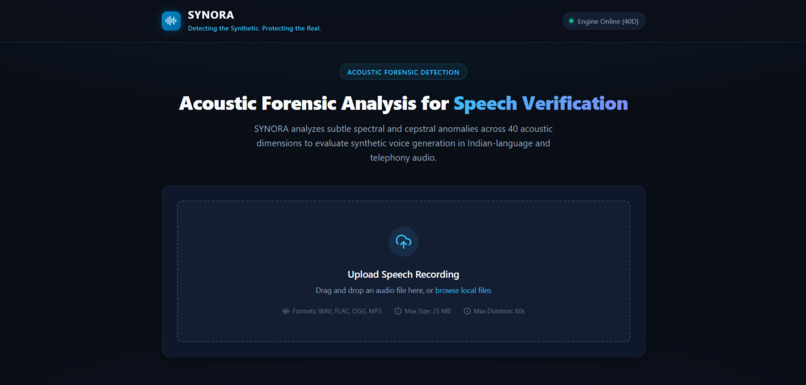
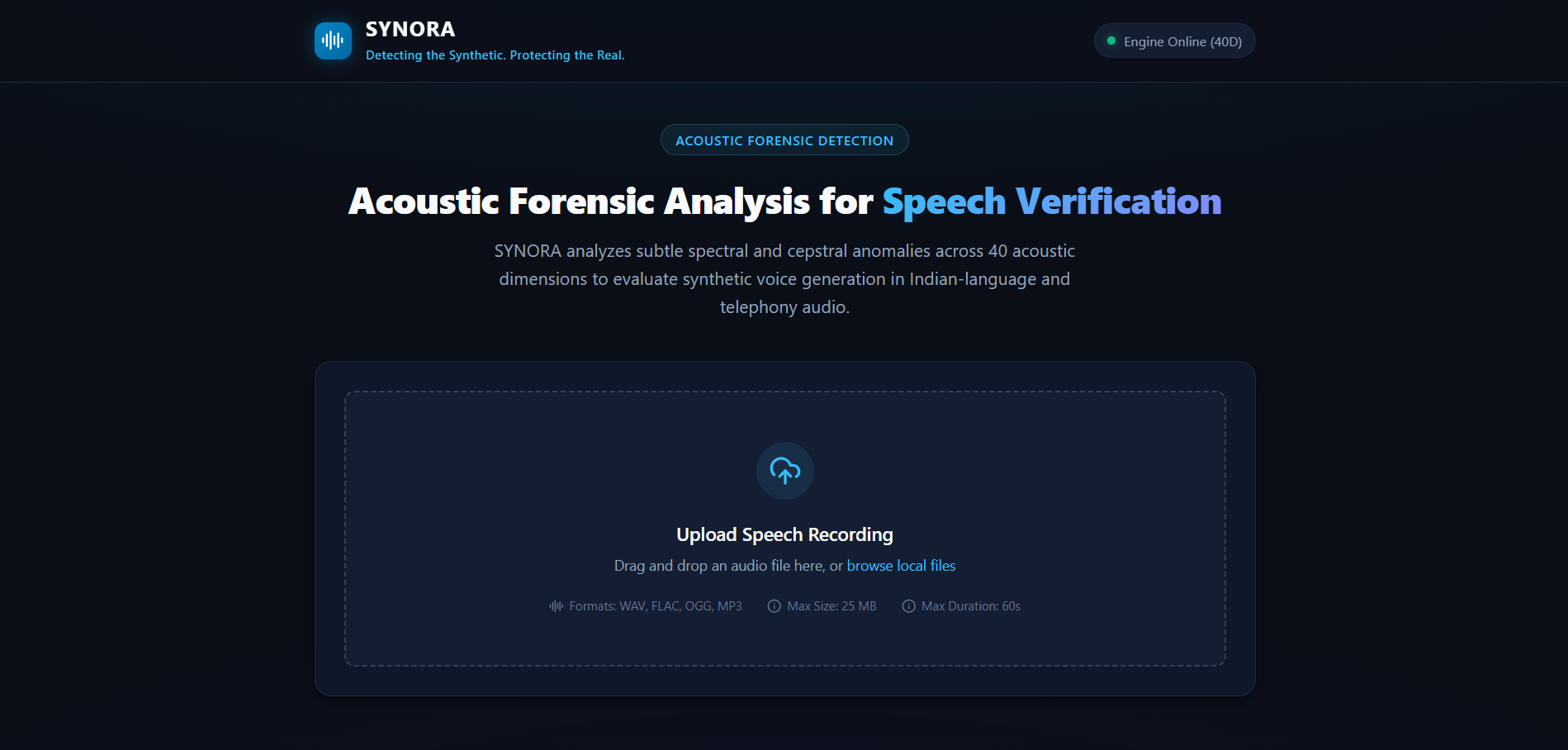
SYNORA home page
-
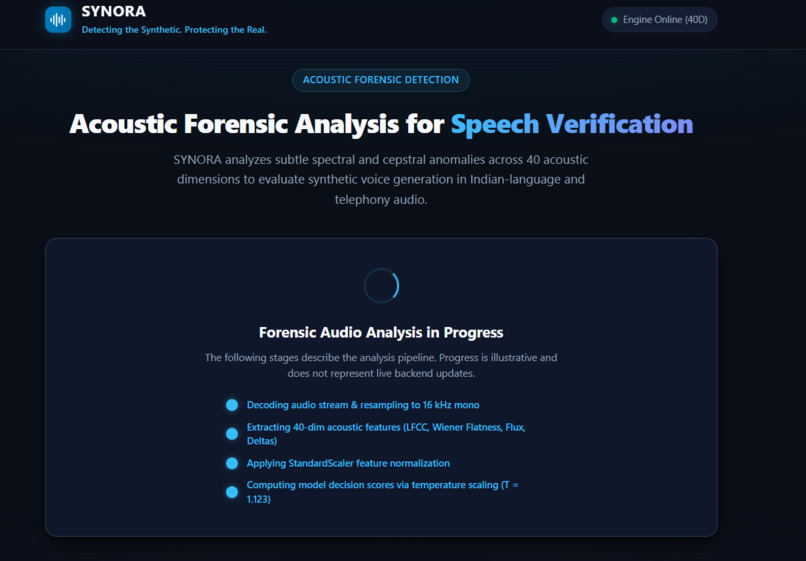
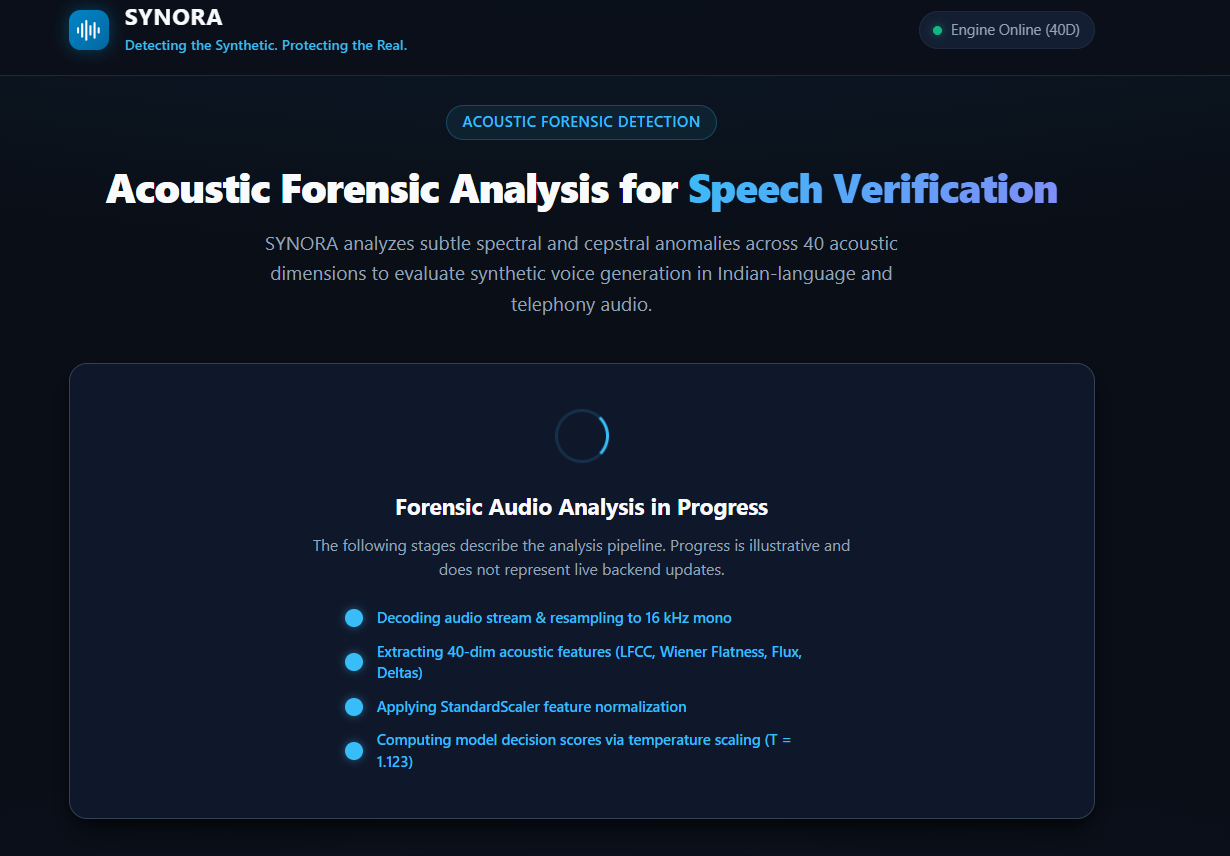
Forensic Audio Analysis
-
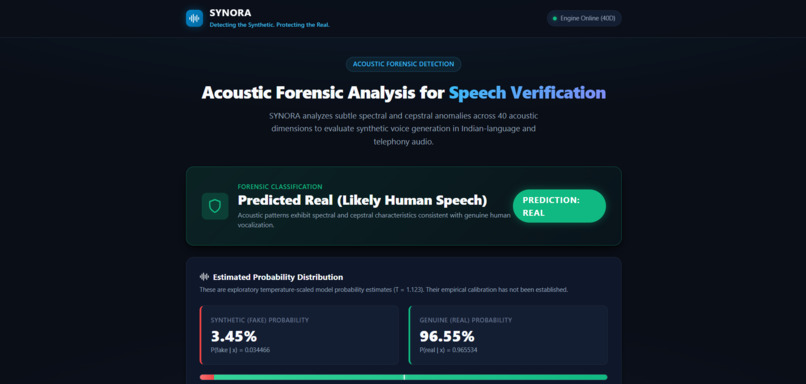
Acoustic Forensic Analysis for Speech Verification
-
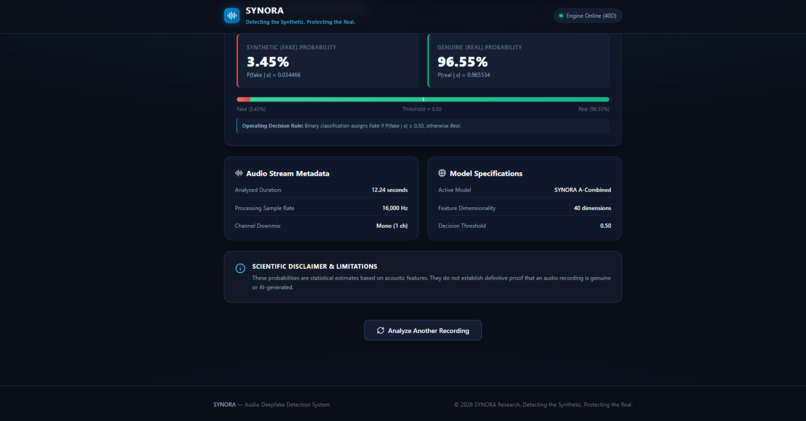
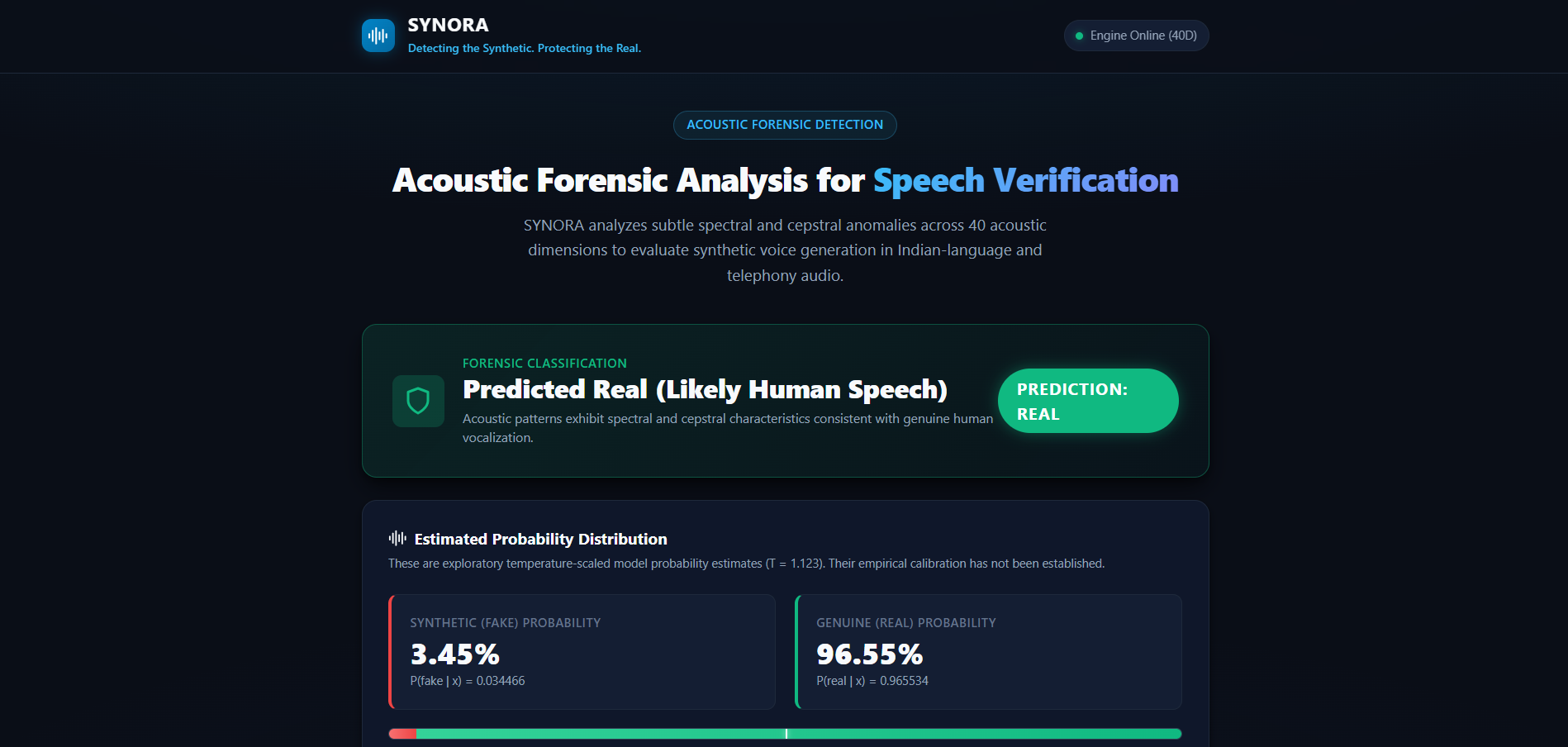
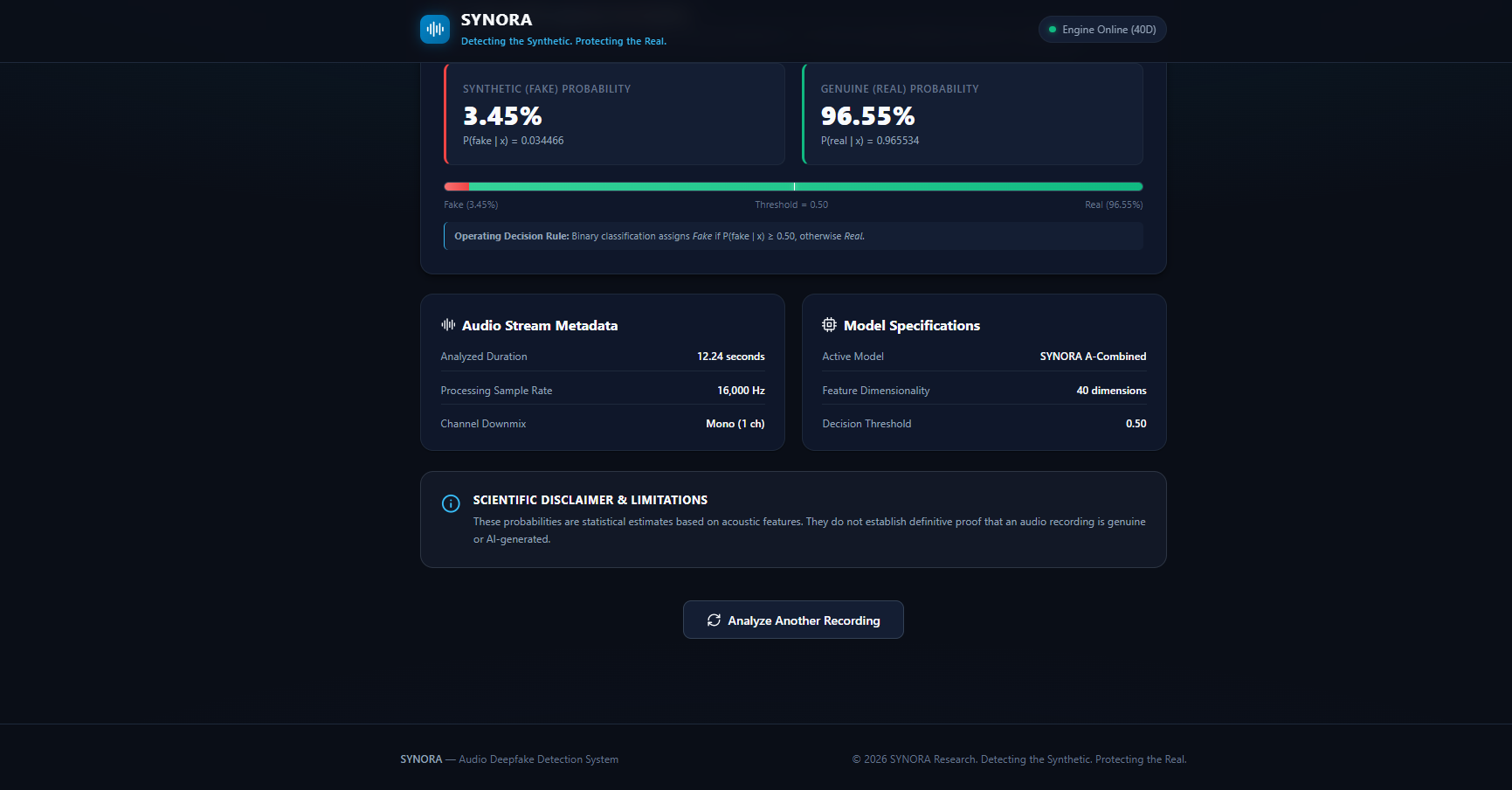
Estimated Probability Distribution
About SYNORA
We live in a time when AI can generate voices that sound almost identical to real people. While this technology has many positive uses, it also creates a serious problem: how can we know whether the voice we are listening to is actually human or AI-generated?
That question inspired us to build SYNORA.
SYNORA is an AI-powered audio detection platform designed to analyze voice recordings and estimate whether they are real human speech or AI-generated audio. Our goal was to explore how machine learning can help address the growing challenge of synthetic voice detection.
How We Built It
We built SYNORA using Python, machine learning, and a web-based interface.
The system takes an audio recording, processes it, and extracts 40 acoustic features that capture different characteristics of the voice. These include MFCC-based features, LFCC, sub-band energy, spectral flatness, and spectral flux.
We then use a trained Logistic Regression classifier to analyze these features and produce an estimated probability distribution for real and AI-generated speech.
We developed a FastAPI backend to handle audio processing and model inference, along with a React-based frontend that allows users to upload recordings and view the analysis results.
We also worked on separating our development, calibration, and test datasets to make our evaluation more meaningful and reduce the risk of data leakage.
Challenges We Faced
One of our biggest challenges was that detecting AI-generated speech is not as simple as identifying whether a voice sounds natural.
Modern voice-generation systems can produce remarkably realistic speech. Different recording devices, background noise, compression, and telephone-quality audio can also affect the characteristics of a recording.
We learned that a model performing well on familiar samples does not necessarily mean it will perform equally well on voices it has never encountered.
This pushed us to investigate dataset diversity, speaker overlap, evaluation methodology, and the limitations of our current model rather than relying only on accuracy scores.
What We Learned
Building SYNORA taught us that developing an AI system involves much more than training a machine learning model.
We gained practical experience in audio processing, feature extraction, model evaluation, backend development, deployment, and understanding data leakage. Most importantly, we learned to be careful about how we interpret model predictions and why they should not be treated as absolute proof.
SYNORA is our step toward exploring a practical solution to the growing challenge of AI-generated voice detection. We know there is still room for improvement, and that is what makes this project worth continuing.
Our vision is simple: help people look beyond what they hear and question whether a voice is truly real.
Built With
- api
- artificial
- audio
- deepfake
- detection
- fastapi
- intelligence
- javascript
- learning
- logistic
- machine
- processing
- python
- react
- recognition
- regression
- rest
- scikit-learn
- signal
- speech
- typescript
- vercel
- vite
