Inspiration
What it does
How we built it
Challenges we ran into
Accomplishments that we're proud of
What we learned
What's next for Synex.health
Synex.Health
💡 Inspiration
Healthcare is not only about diagnosis and treatment. Behind every patient visit, hospitals handle a large amount of administrative work—patient registration, appointment scheduling, document verification, insurance processing, provider credential verification, compliance checks, and record management.
We were inspired by the idea of using AI and automation to reduce this administrative burden so that healthcare staff can spend more time on meaningful patient and operational activities.
This led us to build Synex.Health, an AI-powered healthcare administration platform designed to automate repetitive workflows and make healthcare operations faster, more reliable, and easier to manage.
🚀 What is Synex.Health?
Synex.Health is an AI-powered healthcare administration and workflow automation platform.
It is designed specifically for administrative operations rather than replacing an existing Electronic Health Record (EHR) system.
The platform helps automate workflows such as:
- Patient registration and administration
- Appointment scheduling
- Intelligent doctor assignment
- Provider credential verification
- Healthcare document verification
- Insurance verification
- Compliance monitoring
- Billing administration
- Staff management
- Bed allocation
- Notifications and workflow updates
- AI-generated administrative summaries
Instead of requiring staff to manually check every document and perform every verification step, Synex.Health uses AI agents, OCR, APIs, databases, and workflow automation to handle these processes.
🤖 How We Use AI
A key part of Synex.Health is its AI-agent-based architecture.
Different agents are responsible for different administrative tasks.
Patient Registration Agent
The agent helps process patient registration information and validates the required details before storing them in the system.
Appointment Booking Agent
The appointment agent checks doctor availability and helps schedule appointments based on available slots.
For existing patients, the system can also use previous appointment information to help suggest a suitable doctor.
Document Verification Agent
Healthcare administration involves many documents. Our system uses Tesseract OCR to extract information from uploaded documents and AI-based validation to identify missing or inconsistent information.
Examples include:
- Aadhaar/document identification
- Insurance cards
- Consent forms
- Prescriptions
- Other mandatory administrative documents
Credential Verification Agent
Provider credential verification can require checking multiple pieces of information.
Synex.Health combines document extraction, validation logic, and AI assistance to verify provider credentials. Where external verification services are unavailable, the system can use an AI + OCR-based fallback workflow.
Insurance Verification Agent
The platform is designed to process insurance-related information and assist with verification before the claim moves through the administrative workflow.
Compliance Agent
The compliance workflow checks whether required documents and information are available before allowing an administrative process to continue.
Notification Agent
Once a workflow reaches an important state, the system can trigger notifications and updates for the relevant users.
🏗️ How We Built It
Synex.Health follows a modular architecture combining a modern web application with AI-powered automation.
Frontend
We built the frontend using:
- React 19
- TypeScript
- Vite
- Tailwind CSS
- React Router
- TanStack Query
- Axios
- React Hook Form
- Zod
- Recharts
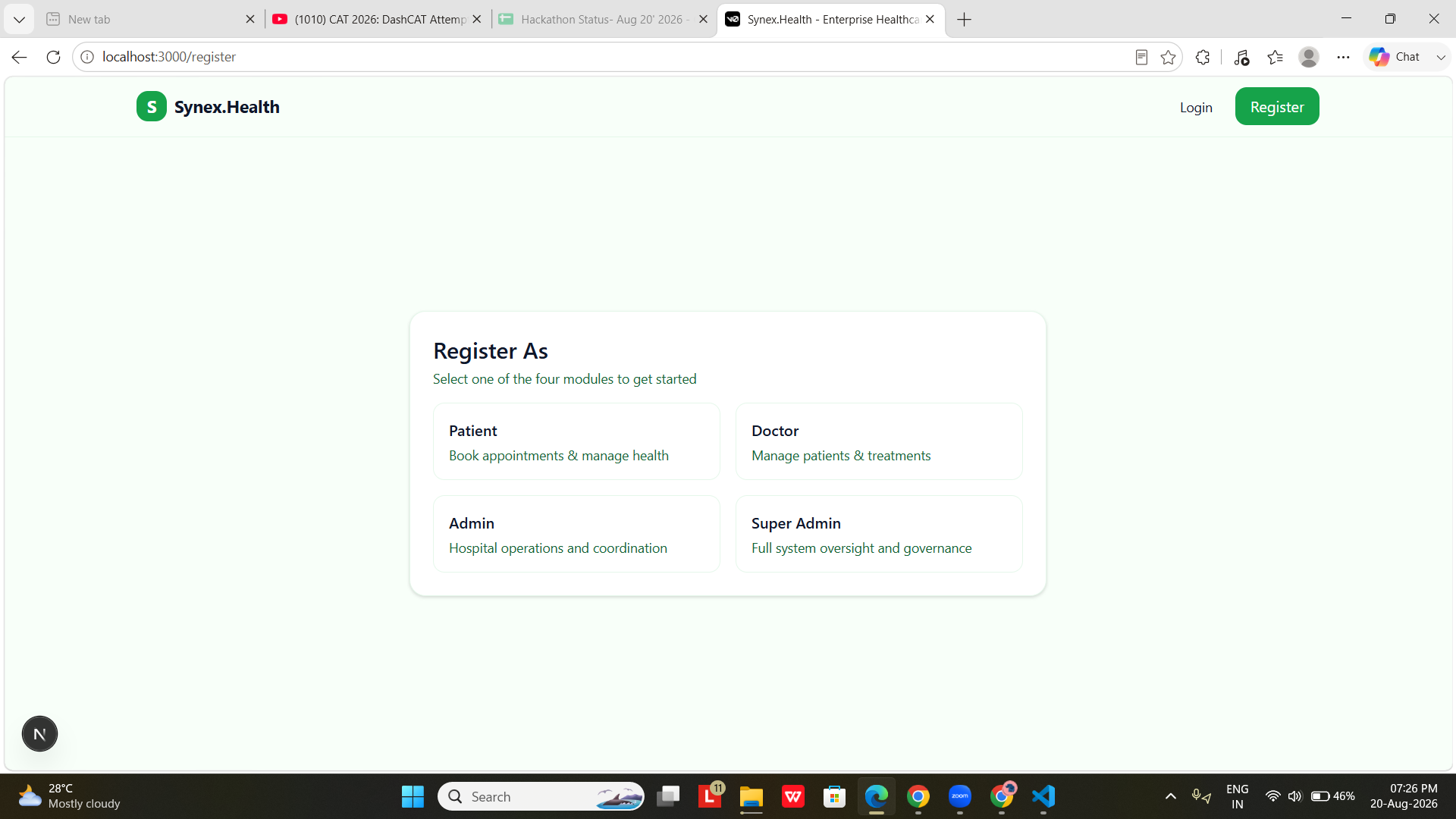
The frontend provides role-based interfaces for patients, doctors, and administrative users.
Backend
The backend is built with:
- Python
- FastAPI
- SQLAlchemy
- Alembic
- Pydantic
- JWT Authentication
- Role-Based Access Control
FastAPI provides the API layer connecting the frontend, database, AI services, and automation workflows.
Database
We use PostgreSQL to manage structured healthcare administration data such as patients, doctors, appointments, documents, credentials, insurance information, and workflow states.
AI & Document Intelligence
Our AI layer combines:
- Gemini API
- Tesseract OCR
- LangChain
- Retrieval-Augmented Generation (RAG)
- AI agents
- Prompt-based workflow logic
OCR extracts information from documents, while AI helps interpret, validate, summarize, and route the extracted information.
Automation
We use n8n and SNS Workbench to design and orchestrate automation workflows.
This allows individual AI agents to work together rather than functioning as isolated features.
🔄 Example Workflow
A typical document verification workflow can work like this:
Upload Document → OCR Extraction → Data Validation → AI Verification → Compliance Check → Database Update → Notification
For example, when a patient uploads an insurance document:
- The document is uploaded to the platform.
- OCR extracts relevant information.
- The extracted information is parsed and validated.
- The AI agent checks the required fields.
- The insurance workflow verifies the available information.
- The compliance workflow determines whether the document satisfies the required criteria.
- The result is stored in the database.
- The appropriate user receives a notification.
This reduces repetitive manual checking and creates a more structured workflow.
🧠 What We Learned
Building Synex.Health taught us that developing an AI application is much more than connecting an LLM to a user interface.
We learned how to:
- Design AI-agent workflows for real-world processes
- Integrate OCR with AI-based document processing
- Build REST APIs using FastAPI
- Connect AI services with relational databases
- Implement authentication and role-based access control
- Use RAG for context-aware AI workflows
- Design automated workflows using n8n and SNS Workbench
- Validate AI-generated outputs using structured schemas
- Handle failures and fallback mechanisms in AI systems
- Design modular architectures where individual agents can be independently improved
Most importantly, we learned that AI works best when combined with deterministic validation and workflow logic, especially in domains where accuracy and consistency are important.
🧩 Challenges We Faced
One of our biggest challenges was integrating multiple technologies into a single reliable workflow.
We faced challenges involving:
AI API Integration
Connecting external AI services and handling API permissions, access restrictions, and failures required additional debugging and fallback strategies.
OCR Accuracy
Real-world healthcare documents can contain different layouts, image qualities, fonts, and handwritten or poorly scanned information. Making OCR output reliable enough for downstream processing was challenging.
Agent Coordination
Each agent has a specific responsibility, but real workflows require agents to communicate and pass validated information between stages.
Designing these dependencies while avoiding unnecessary AI calls was an important architectural challenge.
Data Validation
LLMs can produce flexible outputs, while healthcare administration requires structured information. We addressed this by combining AI reasoning with validation schemas and deterministic business rules.
Workflow Reliability
An automated system should not fail simply because one external service becomes unavailable. Therefore, we designed workflows with validation and fallback mechanisms wherever possible.
🌟 What Makes Synex.Health Different?
Synex.Health is not intended to be another EHR.
Instead, it focuses on the administrative layer around healthcare operations.
The core idea is:
Let healthcare staff focus on people while AI handles repetitive administrative workflows.
By combining AI agents + OCR + RAG + workflow automation + structured validation, Synex.Health provides a foundation for automating complex administrative processes.
🔮 Future Scope
We envision expanding Synex.Health with:
- More advanced healthcare document understanding
- Integration with verified external credential databases
- Automated insurance claim processing
- Intelligent billing assistance
- Advanced compliance monitoring
- Multi-hospital workflow management
- AI-powered operational analytics
- More specialized healthcare agents
- Cloud-native deployment with scalable storage
- Improved audit trails and explainable AI decisions
Our long-term goal is to build an intelligent administrative infrastructure that can connect different healthcare workflows while keeping security, reliability, validation, and human oversight at the center.
❤️ Our Vision
Synex.Health aims to make healthcare administration smarter, faster, and less repetitive through responsible AI automation.
We believe the future of healthcare is not about replacing people with AI. It is about augmenting healthcare teams with intelligent systems that take care of repetitive work and allow people to focus on what matters most.
Built With
- alembic
- amazon-web-services
- api
- css
- docker
- fastapi
- gemini
- jwt
- langchain
- learning
- machine
- n8n
- ocr
- postgresql
- python
- rag
- react
- sns
- sqlalchemy
- tailwind
- tesseract
- typescript
- workbench

Log in or sign up for Devpost to join the conversation.