-
Synergy Analyser
-
🎯 Inspiration
Understanding large codebases is one of the biggest challenges developers face. We've all been there—staring at thousands of lines of code, trying to understand how everything connects. Traditional documentation quickly becomes outdated, and manually tracing dependencies is tedious and error-prone.
We built Synergy to solve this problem: What if you could instantly visualize any Python codebase and get AI-powered explanations for every component?
🚀 What it does
Synergy transforms Python repositories into interactive visual diagrams with four core features:
- Instant Analysis: Paste any GitHub URL and get a complete codebase visualization in seconds
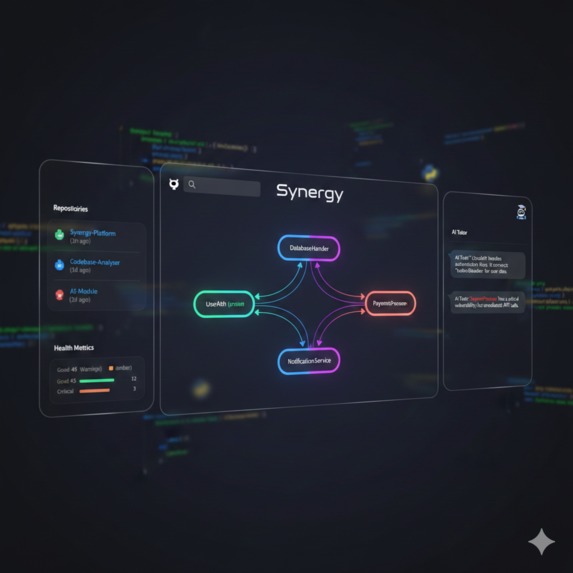
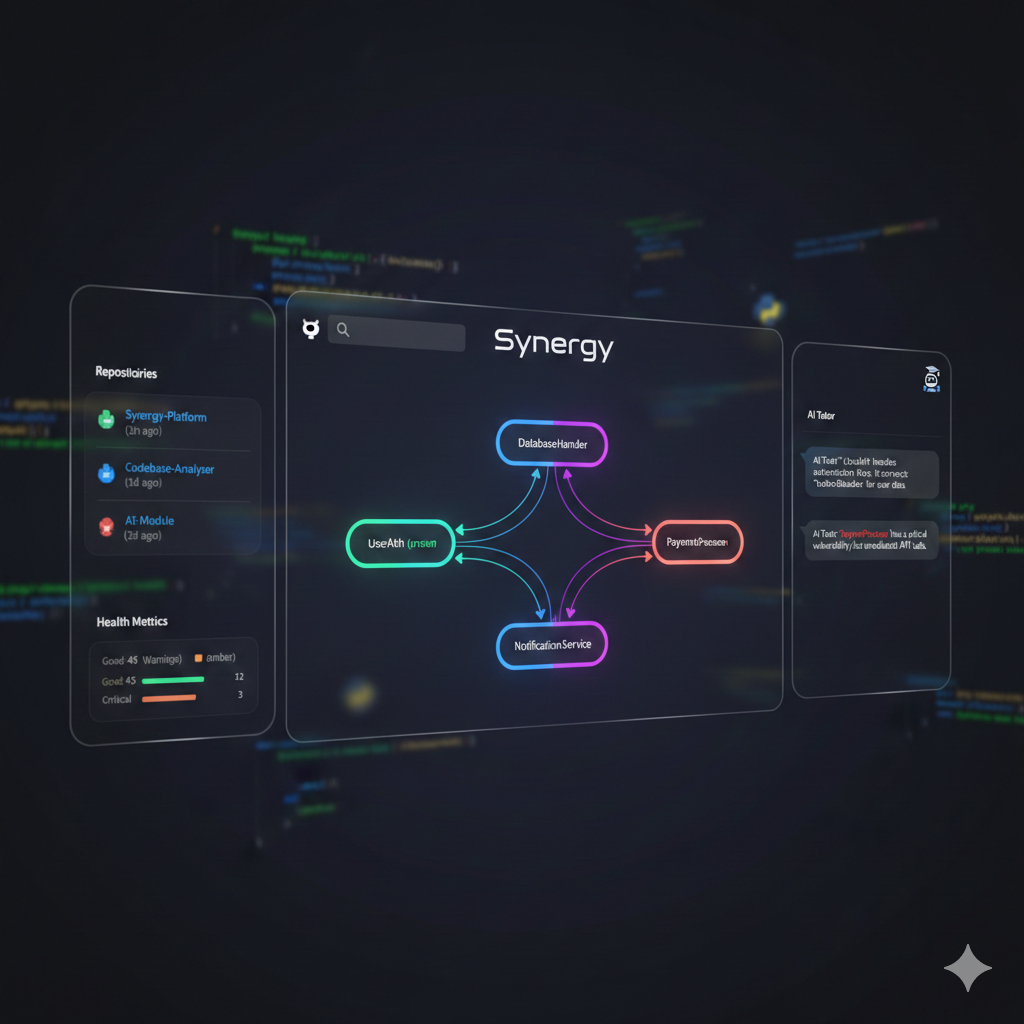
- Interactive Diagrams: Pan, zoom, and click on any class or function to explore dependencies with health indicators (good ✅, warnings ⚠️, critical 🔴)
- AI Code Tutor: Click any node to get intelligent, context-aware explanations powered by OpenRouter's LLM APIs
- MCP Integration: Expose analysis capabilities to AI assistants (Claude Desktop, Antigravity) via Model Context Protocol for seamless codebase exploration
The system automatically detects classes, functions, imports, and relationships, then renders them as a beautiful Mermaid diagram. Each component is analyzed for complexity and potential issues, giving you instant insights into code health.
🛠️ How we built it
Architecture: Full-stack application with Docker containerization for seamless deployment
Backend (Python + FastAPI):
- Custom static analysis engine that parses Python ASTs to extract code structure
- Graph database (NetworkX) to model relationships between components
- Mermaid renderer that converts code graphs into interactive diagrams
- OpenRouter integration for AI-powered code explanations using state-of-the-art LLMs
- MCP (Model Context Protocol) server exposing 10+ tools for codebase analysis:
analyze_codebase: Analyze any local Python projectsearch_nodes: Find classes/functions by nameget_node_neighbors: Explore dependencies (upstream/downstream)find_path: Trace dependency chains between componentsget_context_bundle: Retrieve source code + dependency signaturesscan_external_api_surface: Map all 3rd-party library usage- Dual transport modes: stdio (for Claude Desktop) & SSE (for web clients)
- RESTful API with CORS support for seamless frontend communication
Frontend (React + Vite):
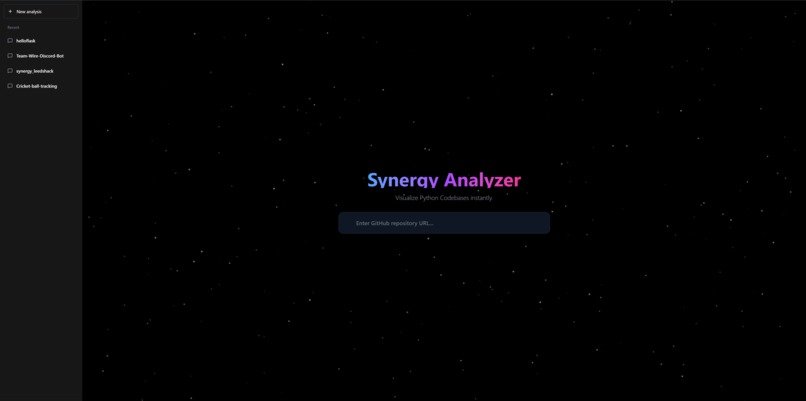
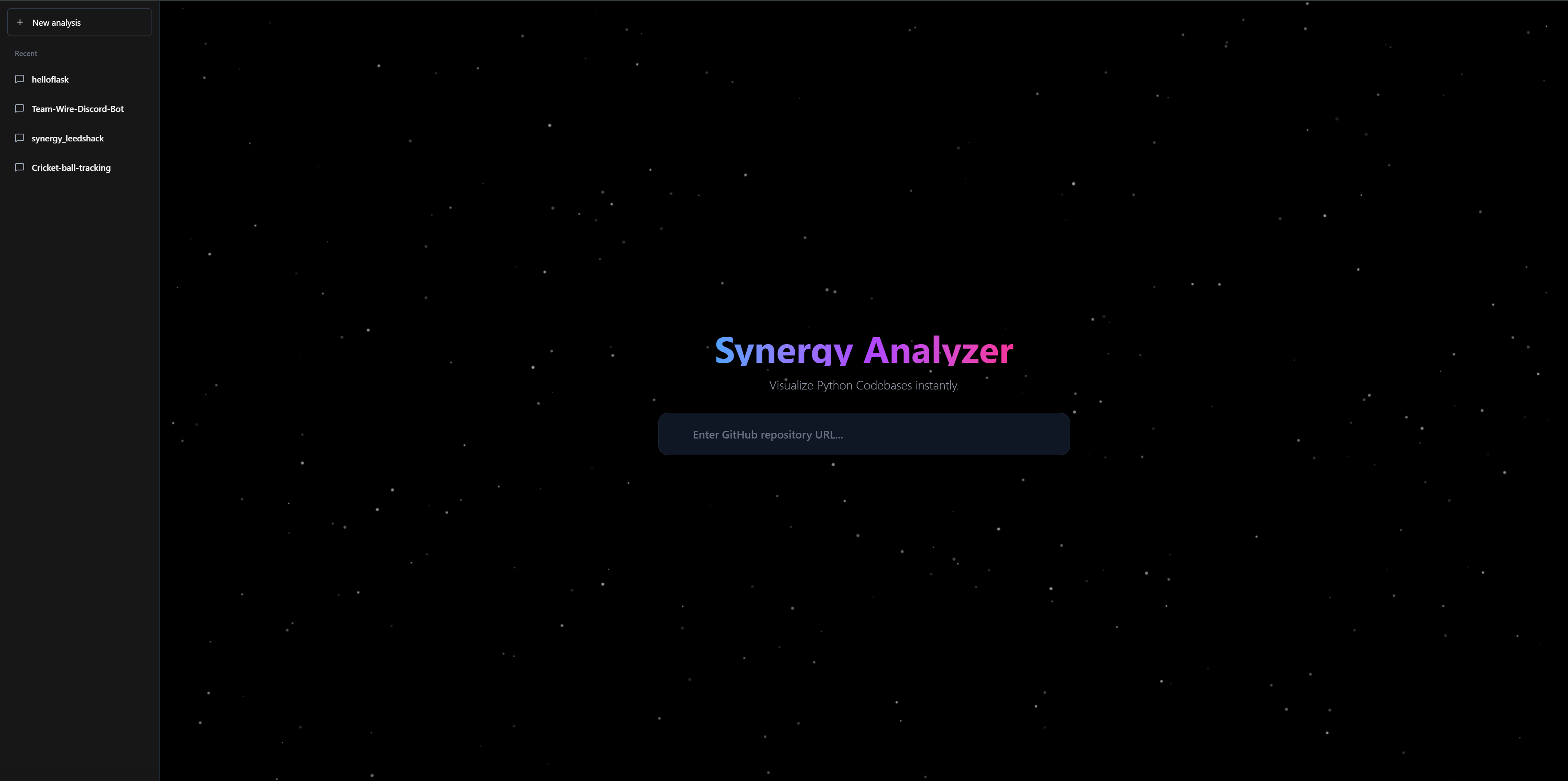
- Modern ChatGPT-inspired UI with dark mode, glassmorphism, and smooth animations
- Interactive Mermaid diagrams with custom zoom, pan, and click handlers
- Real-time analysis with loading states, error handling, and progress indicators
- Sidebar navigation showing analysis history with timestamps
- Health dashboard displaying code quality metrics at a glance
DevOps & Infrastructure:
- Docker Compose for one-command deployment (
docker compose up) - Volume mounting for hot-reload development without rebuilding
- Environment variable management for secure API key handling
- Multi-stage builds optimized for production deployment
💡 What we learned
AST Parsing is Complex: Python's dynamic nature makes static analysis challenging. We had to handle edge cases like dynamic imports, decorators, metaclasses, and runtime type annotations.
Mermaid Has Limits: Large diagrams (>15,000 characters) crash the renderer. We implemented size warnings, optimization strategies, and future plans for intelligent node filtering.
Docker Networking Magic: Ensuring the frontend can communicate with the backend across Docker networks required careful CORS configuration and understanding of Docker's internal DNS.
Python Version Hell: We hit a wall with networkx not supporting Python 3.14.1 due to breaking changes in dataclasses. Docker saved us by providing a controlled Ubuntu 24.04 + Python 3.13 environment.
LLM Integration Nuances: Balancing response quality with API rate limits required implementing fallback mechanisms, mock modes for development, and graceful error handling for quota exhaustion.
State Management in React: Properly propagating
graphIdbetween components for the AI tutor required careful debugging and understanding of React's state lifecycle.
🏗️ Challenges we faced
Challenge 1: Graph Rendering Performance
- Problem: Large repositories (like Flask with 100+ classes) generated diagrams too big to render, causing browser crashes
- Solution: Implemented size limits (15,000 chars), performance warnings, and are exploring graph simplification algorithms
Challenge 2: Node Click Detection in SVG
- Problem: Mermaid's generated SVG structure made it difficult to attach click handlers to specific nodes
- Solution: Custom event delegation system that parses node IDs from SVG elements and maps them back to code components
Challenge 3: Cross-Origin Resource Sharing
- Problem: Frontend running on port 5173 couldn't call backend API on port 8000 due to CORS restrictions
- Solution: Configured FastAPI middleware with wildcard origins for development (will restrict in production)
Challenge 4: Empty Graph IDs in AI Tutor
- Problem: The AI tutor was receiving empty
graph_idvalues, causing 404 errors when trying to load code - Solution: Added comprehensive debug logging, fixed state propagation in React, and improved error messages with available file listings
Challenge 5: Docker Hot Reload
- Problem: Changes to code required full Docker rebuilds, slowing down development
- Solution: Implemented volume mounts for
src/andsrc_web/directories, enabling instant code updates
🎓 What's next for Synergy
Immediate Roadmap:
- ✅ MCP server with 10+ tools for AI assistant integration (COMPLETED)
- ✅ Fix AI tutor graph_id propagation (COMPLETED)
- 🔄 Implement graph filtering to handle large codebases (hide stdlib, collapse modules)
- 🔄 Add diff visualization to compare code structure across branches
Future Vision:
- Multi-language support: Extend beyond Python to JavaScript, TypeScript, Go, Rust, and Java
- Collaborative features: Share visualizations with teams, add annotations, and enable real-time collaboration
- CI/CD integration: Automatic diagram generation on every commit with GitHub Actions
- Advanced analytics: Cyclomatic complexity, code coverage overlay, and technical debt indicators
- VS Code extension: Inline diagram generation and AI explanations directly in your editor
- Export options: PDF, PNG, and interactive HTML exports for documentation
Long-term Goals:
- Architecture evolution tracking: Visualize how your codebase structure changes over time
- Dependency risk analysis: Identify circular dependencies and suggest refactoring opportunities
- Team insights: Show which parts of the codebase are most actively developed or need attention
🔬 Research & Development Opportunities
Building on Synergy's graph-based analysis foundation, we've identified five key research directions for team expansion:
1. Big Data ML + Cross-Language Generalization
Focus: Train Graph Neural Networks (GNNs) on extracted graph data to enable multi-language support
- Map Python AST patterns to C#, JavaScript, and Java structures using transfer learning
- Predict missing edges in dynamically-typed languages via pattern recognition
- Deliverable: ML models achieving 85%+ accuracy in cross-language dependency prediction
- Impact: Enable Synergy to analyze polyglot codebases without language-specific parsers
2. Cybersecurity Threat Modeling
Focus: Extend analysis engine with vulnerability detection and blast radius visualization
- Build
SecurityScannermodule that maps CVEs to specific graph nodes - Visualize "Vulnerability Heatmap" showing exploit propagation paths
- Integrate with National Vulnerability Database (NVD) for real-time threat intelligence
- Deliverable: Interactive security overlay showing dependency chains affected by known CVEs
- Impact: Enable security teams to prioritize patching based on actual code usage
3. Enterprise Scaling + Hierarchical Agents
Focus: Scale MCP server to handle 1000+ concurrent requests with sub-linear latency
- Implement Redis caching for frequently-queried graph patterns
- Design hierarchical agent architecture for distributed analysis across microservices
- Optimize graph storage using compressed sparse row (CSR) format
- Deliverable: Benchmarks showing <100ms response time at 10,000 QPS
- Impact: Enable enterprise adoption with SLA guarantees
4. Consultancy + Automated Auditing
Focus: Generate automated architectural audit reports for consulting engagements
- Build "Architectural Linter" detecting anti-patterns (God classes, circular deps, tight coupling)
- Generate PDF audit reports with executive summaries and technical deep-dives
- Conduct user studies comparing manual code review vs. automated analysis
- Deliverable: "State of Open Source Architecture" report aggregating patterns from 1000+ repos
- Impact: Enable consultants to deliver data-driven recommendations at scale
5. Production SaaS Infrastructure
Focus: Transform prototype into commercial-grade multi-tenant platform
- Implement OAuth2/SAML authentication with role-based access control
- Build usage-based billing system integrated with Stripe
- Deploy multi-region infrastructure with CDN distribution for diagrams
- Achieve SOC 2 Type II compliance for enterprise customers
- Deliverable: Production deployment serving 10,000+ users with 99.9% uptime
- Impact: Enable commercial launch and revenue generation

Log in or sign up for Devpost to join the conversation.