💡 Inspiration
Every semester, university students face the exact same recurring nightmare:
- The PDF Firehose: Professors hand out 15-page syllabi containing dense tables of units, reading chapters, CAT-1/CAT-2 exam slots, and lab deliverables.
- The "Missed-Day Guilt Spiral": A student builds an ambitious color-coded Notion or Google Calendar plan. On Day 4, they fall sick, miss two sessions, and suddenly their schedule is broken. The guilt sets in, they give up, and the plan is abandoned.
- The 3:00 AM Cramming Trap: Without proactive pacing, students inevitably cram for 12 hours consecutively before exams. Cognitive retention collapses, cortisol spikes, and burnout peaks.
We asked ourselves: Why are study planners static checklists when human life is dynamic?
GPS apps don't yell at you when you miss a turn—they simply say "Rerouting" and find the optimal path. We built SyncUp AI to be the intelligent GPS for a student's semester: a copilot that turns unstructured syllabus PDFs into adaptive study tracks, monitors cognitive load in real time, and offers instant, guilt-free triage the moment a student falls behind.
⚡ What It Does
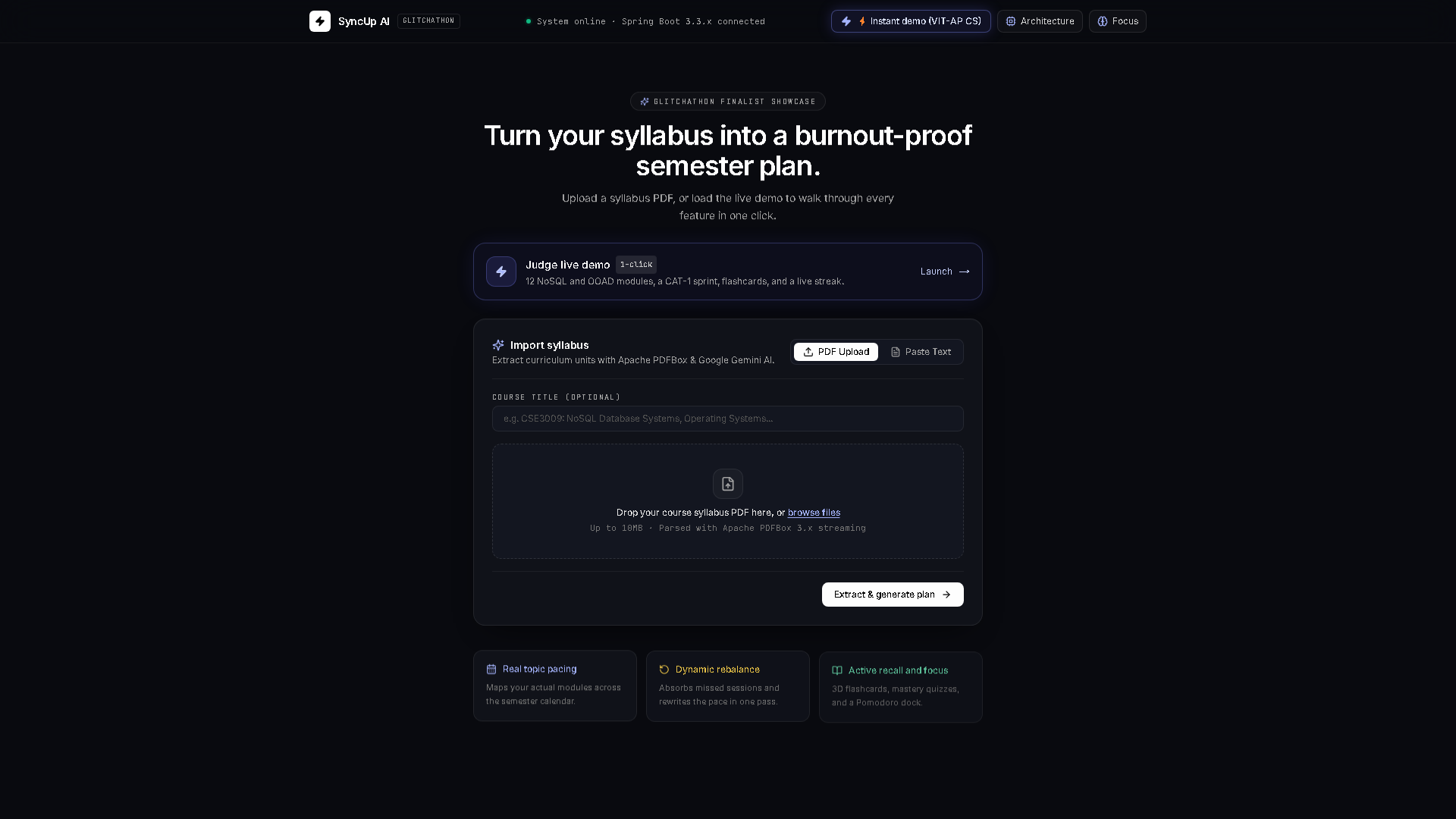
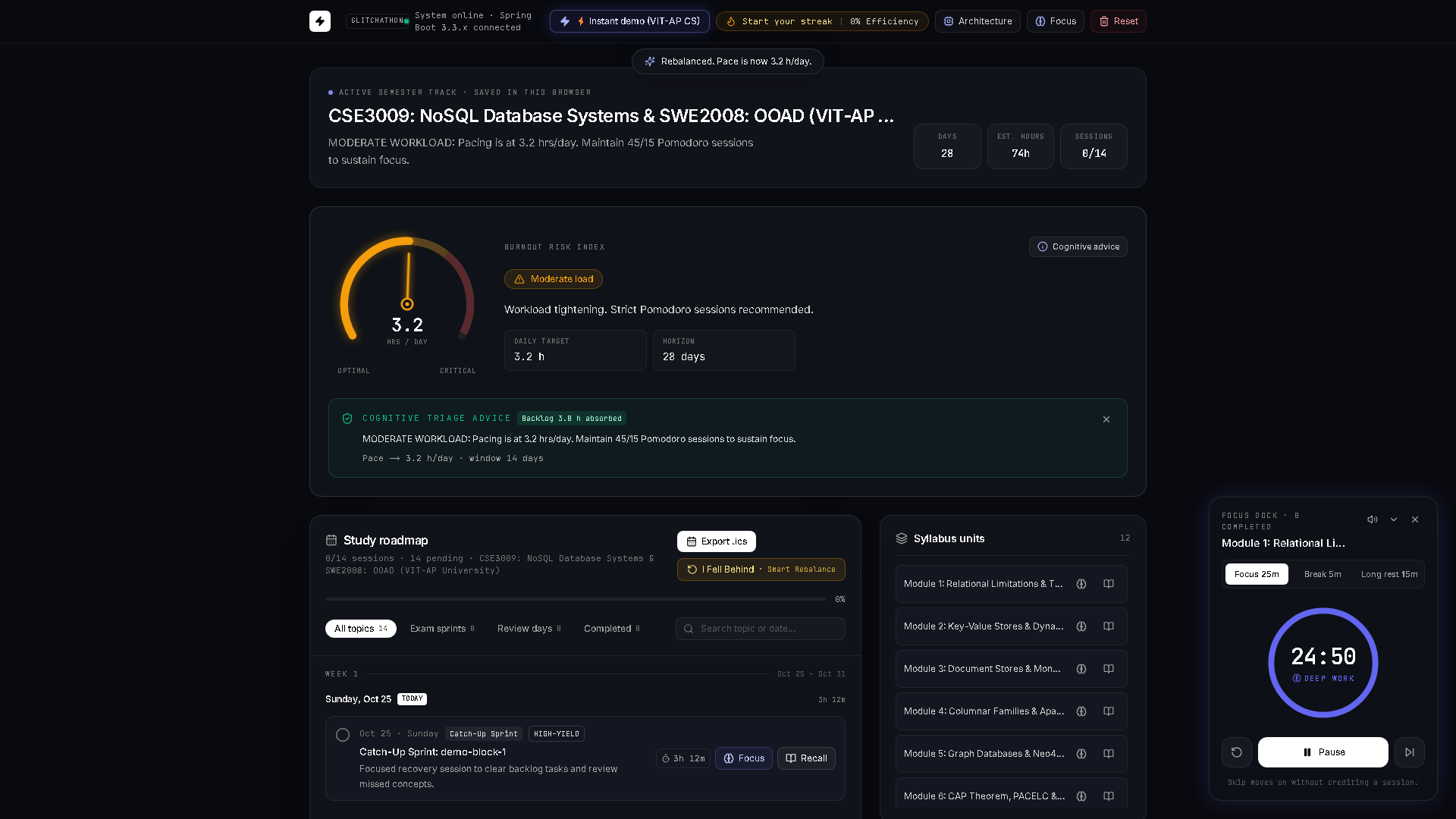
SyncUp AI is an intelligent, burnout-aware semester study copilot that bridges unstructured academic documents and calendar execution:
1. Ingests Any Syllabus PDF
Upload your syllabus PDF or paste course outlines. The backend parses raw text and tabular structures into structured modules, calculating total estimated hours and identifying exam sprints.
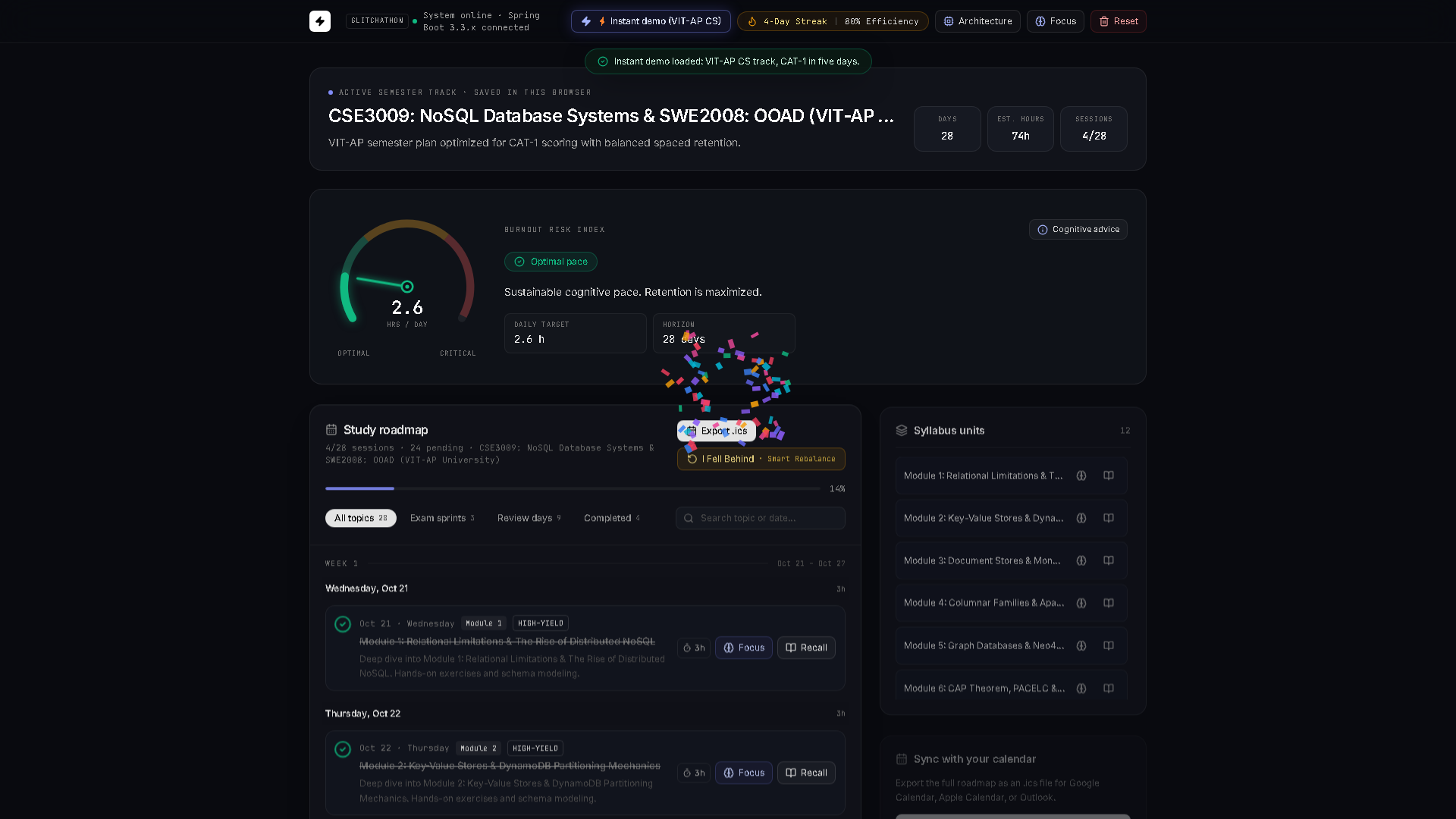
2. Live Cognitive Burnout Meter
Our pacing engine evaluates the daily cognitive workload using a dynamic load index:
$$L_{\text{daily}} = \frac{\sum_{i \in \text{pending}} H_i}{D_{\text{remaining}}}$$
- Optimal Pace ((L \le 3.5\text{ h/day})): Sustainable load with maximum spaced retention.
- Moderate Load ((3.5 < L \le 4.5\text{ h/day})): Workload tightening; prompts structured Pomodoro intervals.
- Critical Burnout Risk ((L > 4.5\text{ h/day})): Immediate warning that cognitive overload is imminent.
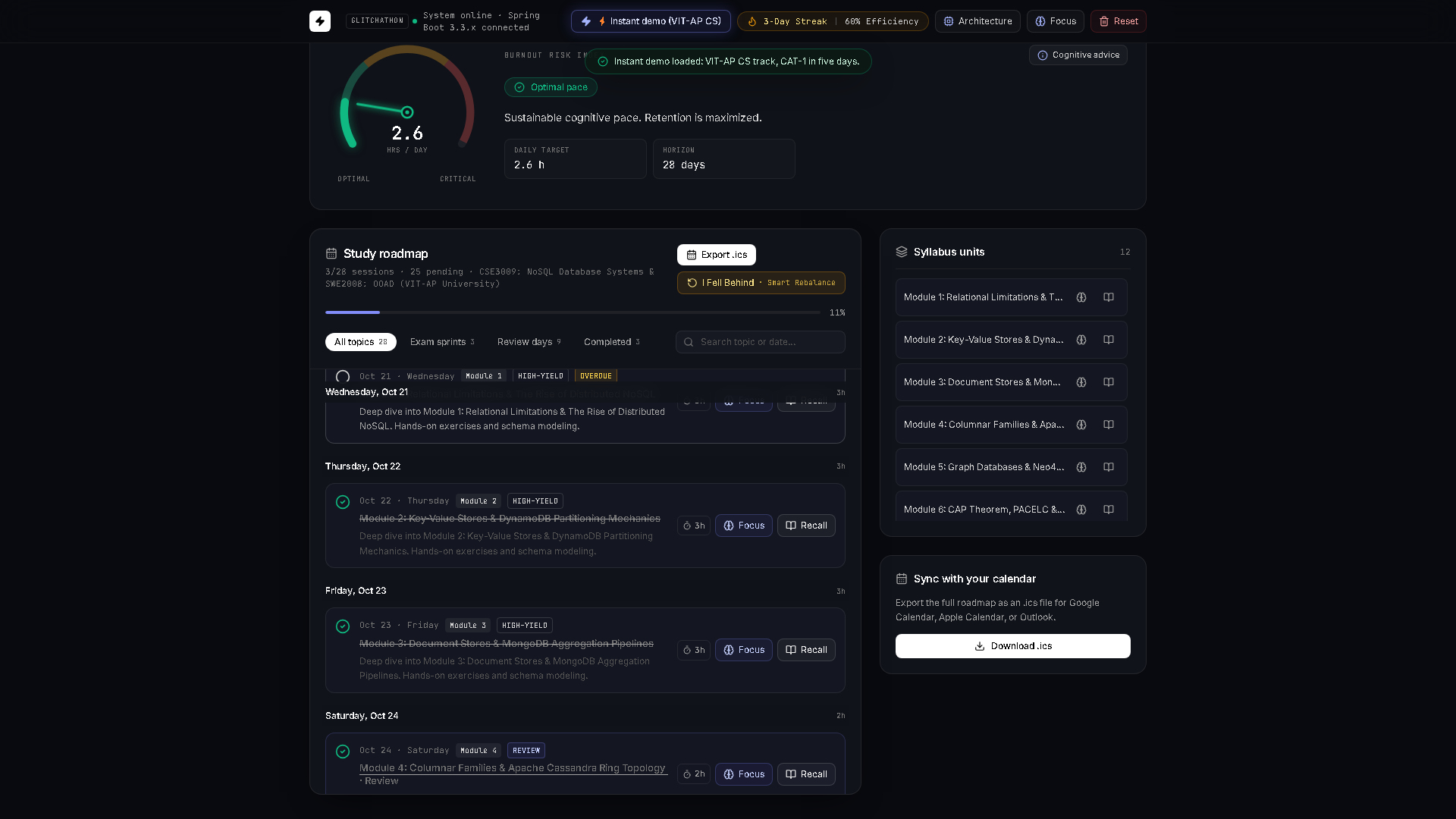
3. The Hero Feature: "I Fell Behind" (Smart Triage)
When tasks are missed, clicking "I Fell Behind" triggers our cognitive triage algorithm:
- Automatically absorbs overdue backlog hours.
- Protects scheduled exam dates (e.g., Day 10 CAT-1) without shifting exams.
- Converts low-yield theory blocks into active recall drills.
- Smoothly redials the daily target pace, animating the Burnout Meter back to balance.
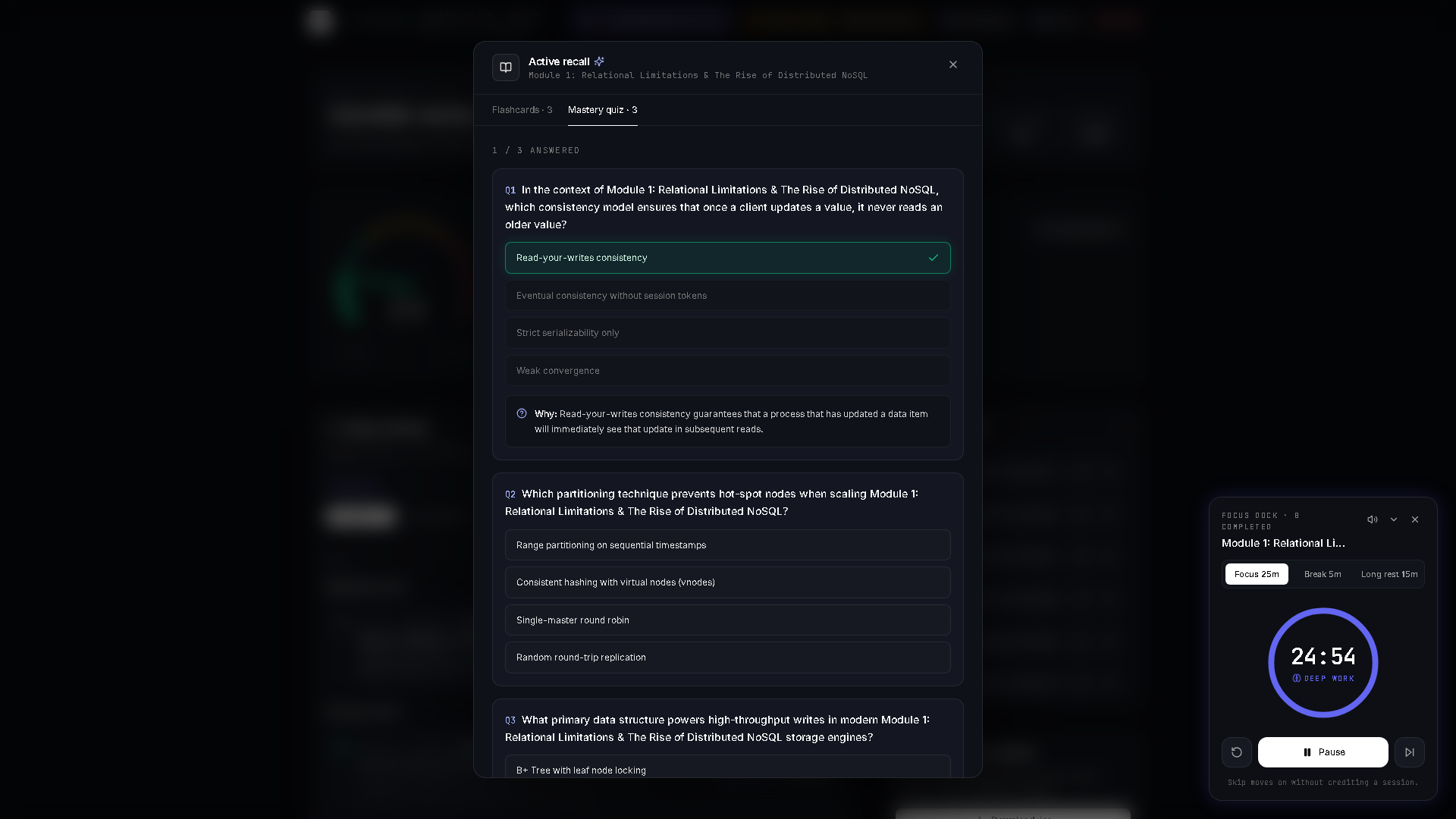
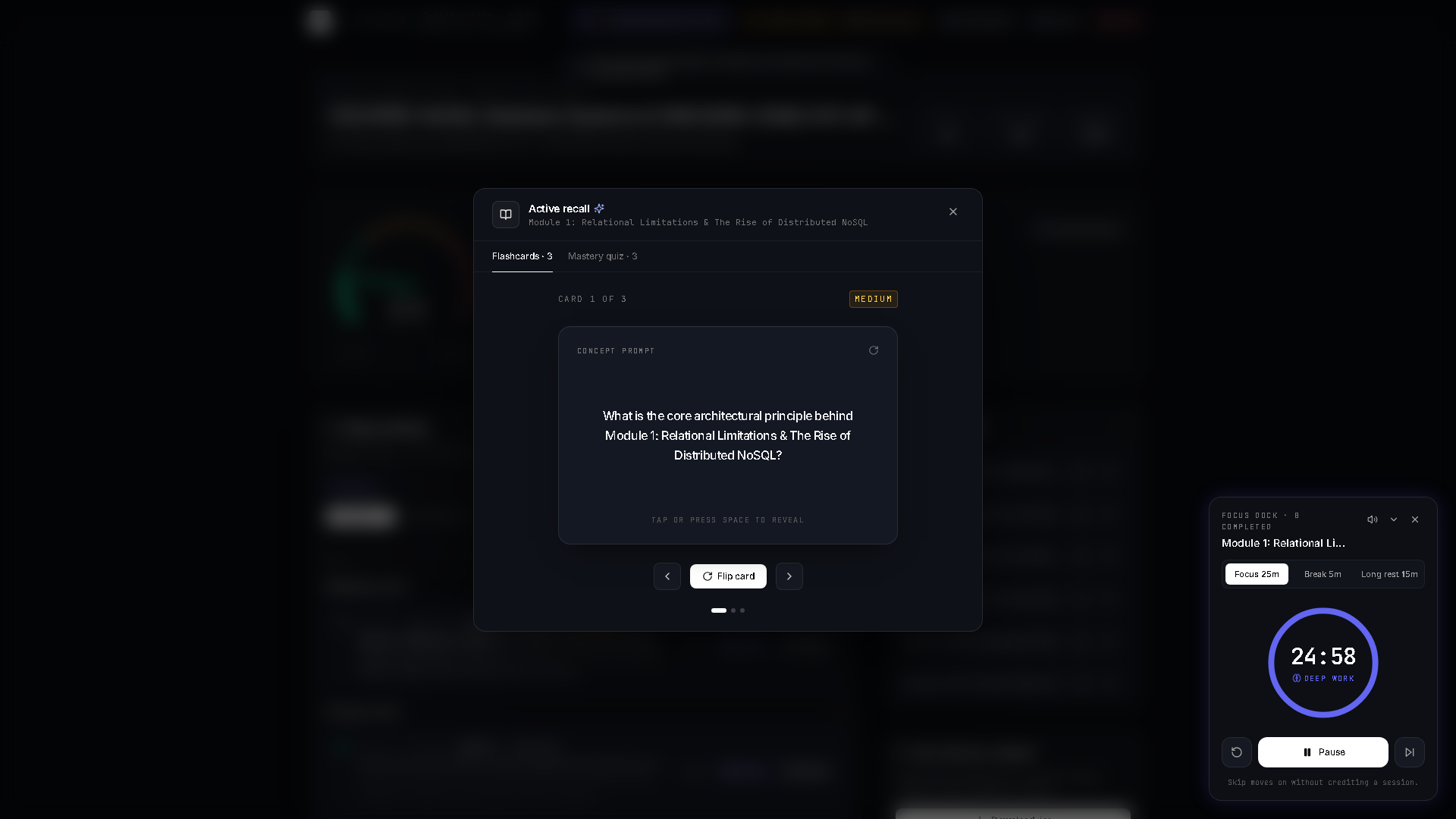
4. Active Recall & 3D Flashcard Drawer
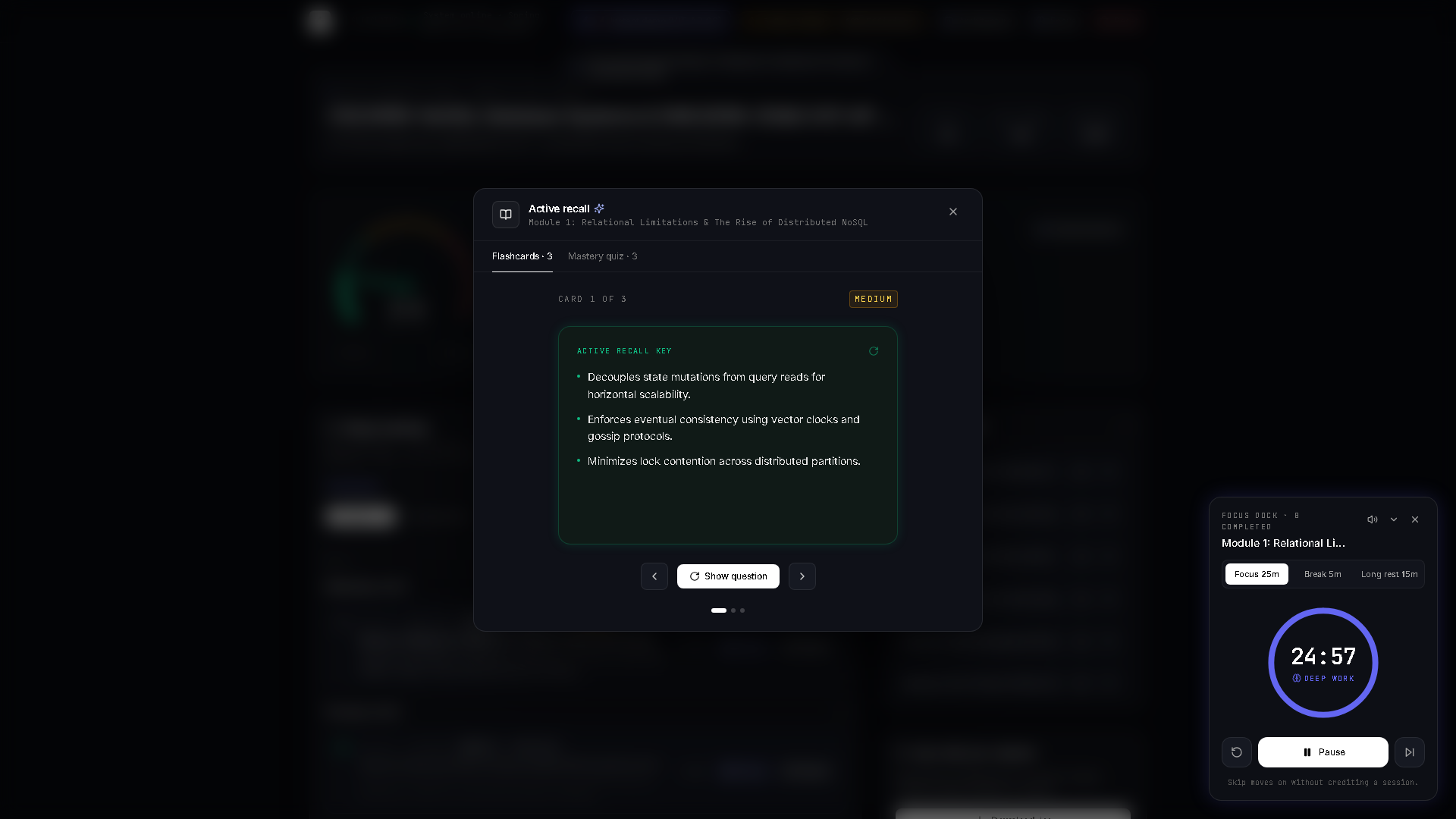
Every topic features an on-demand Active Recall drawer with 3D flip flashcards (front: concept prompt, back: bulleted recall key) and an interactive 3-question MCQ quiz with instant explanations and celebration confetti upon scoring 3/3.
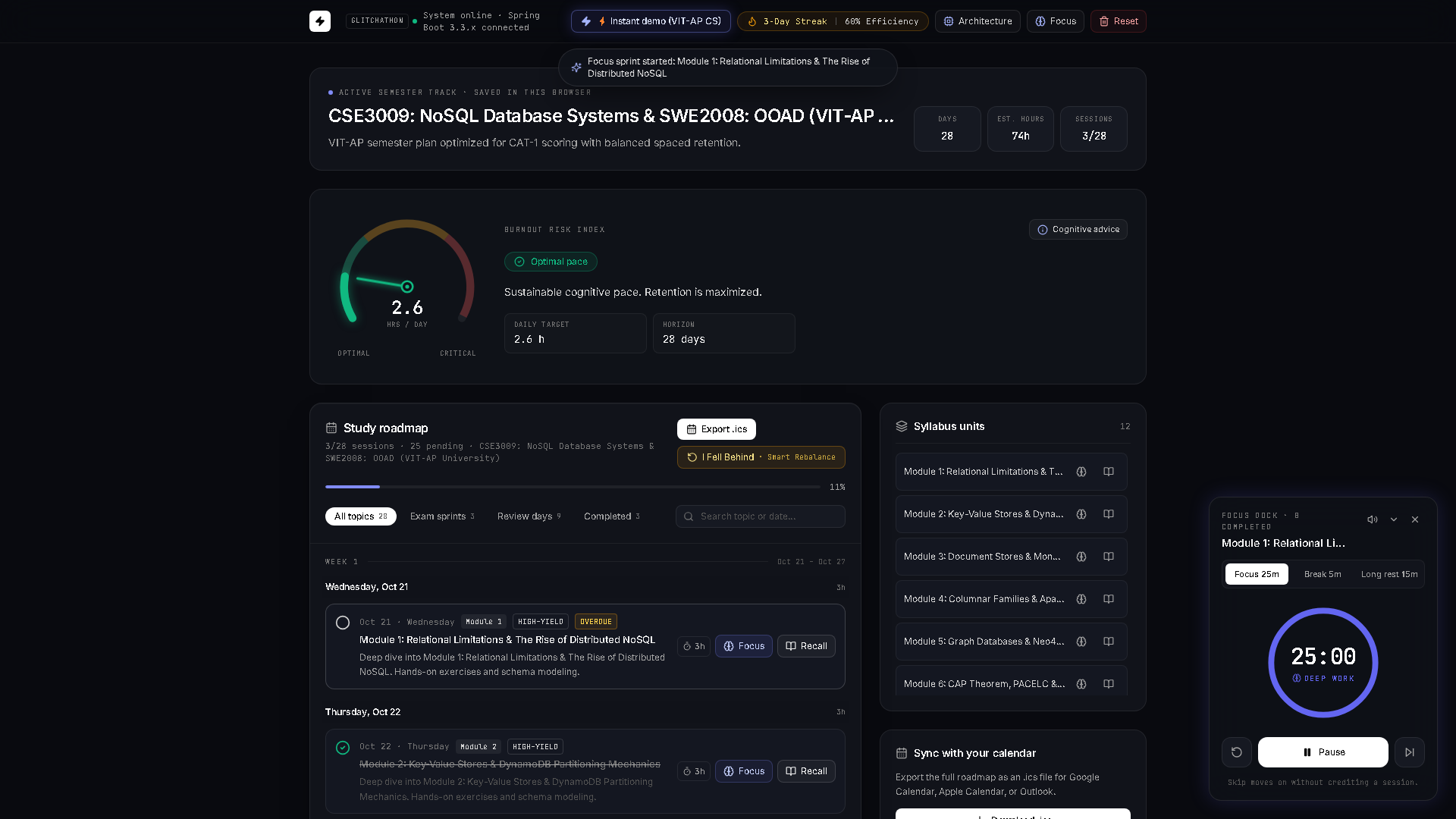
5. Floating Pomodoro Focus Dock
A minimalist, floating study timer offering 25-minute focus, 5-minute recharge, and 15-minute reset intervals. Engineered with circular SVG progress rings and Web Audio chimes, it maintains millisecond accuracy even when browser tabs are throttled in the background.
6. RFC 5545 iCalendar Universal Export
Exports the dynamically generated study schedule to syncup-schedule.ics with start times, duration, and topic descriptions for 1-click sync with Google Calendar, Apple Calendar, and Microsoft Outlook.
7. ⚡ 1-Click Judge Demo (VIT-AP University CS Track)
Pre-seeded with CSE3009 (NoSQL Database Systems) and SWE2008 (Object-Oriented Analysis & Design), allowing judges to test 12 structured modules, exam sprints, and rebalancing with zero setup time.
🛠️ How We Built It
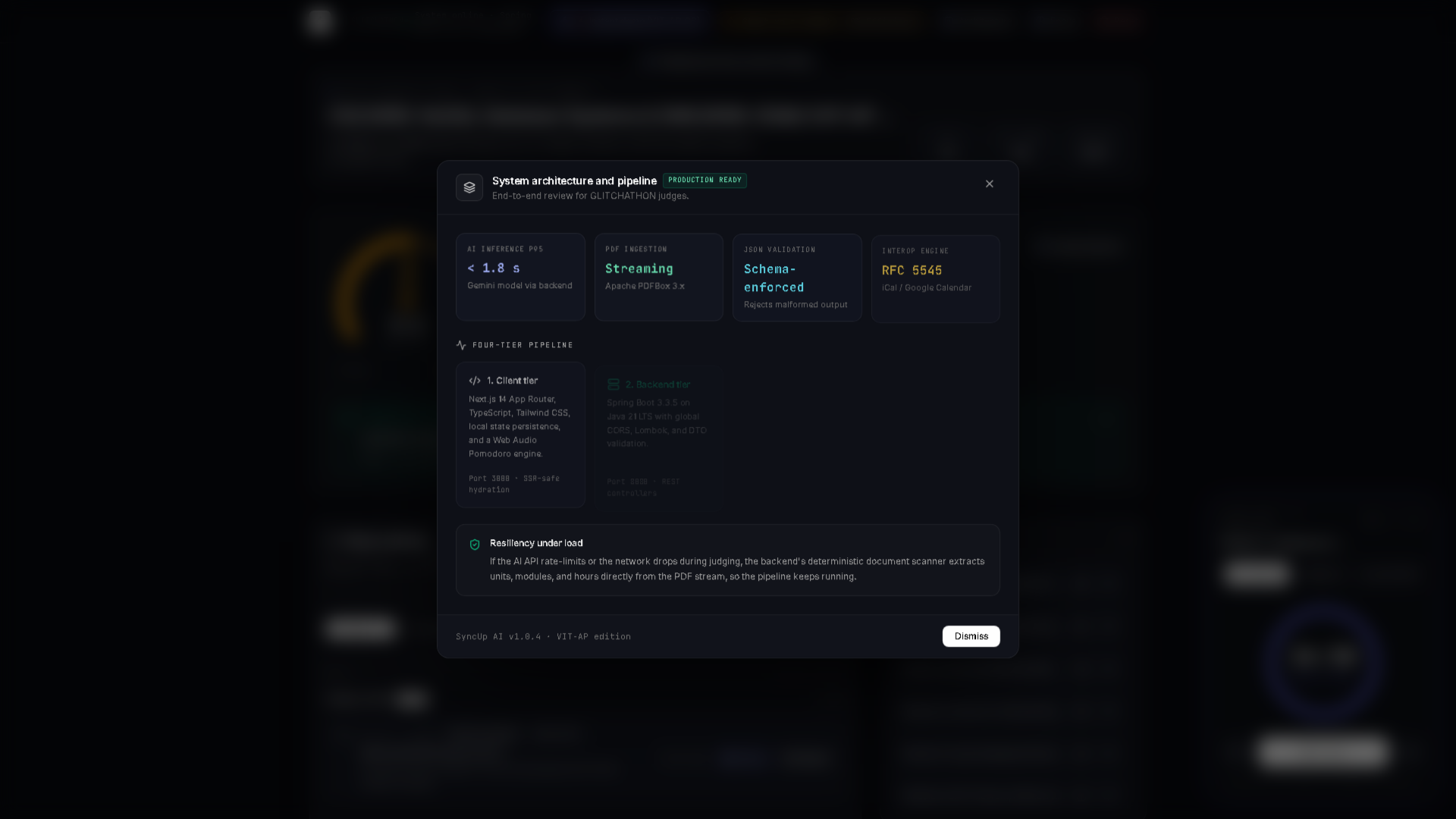
SyncUp AI is built on a high-performance, full-stack architecture:
- Frontend: Next.js 14 App Router, TypeScript, and Tailwind CSS. Designed around an ultra-clean Linear / Raycast / Vercel obsidian aesthetic (
#090A0F) with glassmorphism panels, subtle radial glows, and fluid spring physics powered by Framer Motion. - Backend: Spring Boot 3.3.5 running on Java 21 LTS, with REST controllers, Bean Validation, and a global CORS security filter.
- Document Ingestion: Apache PDFBox 3.x streaming parser that loads multipart byte streams in-memory and extracts textual tokens preserving structural hierarchy.
- Intelligence Tier: Google Gemini API constrained with structured JSON schemas for syllabus topic decomposition, difficulty calibration (
Easy,Medium,Hard), and MCQ distractor generation with pedagogical explanations. - Calendar Engine: Client-side RFC 5545 iCalendar engine constructing valid VCALENDAR/VEVENT payloads.
- Audio & Physics: Native HTML5 Web Audio API multi-frequency chime synthesis and a zero-dependency GPU-accelerated canvas particle confetti engine.
🧗 Challenges We Faced
- Unpredictable Syllabus Layouts: Academic syllabi are notoriously messy—multi-column tables, varied header hierarchies, and inconsistent date formats. We resolved this by combining Apache PDFBox streaming text extraction with few-shot structural normalization in our Gemini prompt pipeline.
- Browser Background Tab Drift: Standard JavaScript
setIntervaltimers drift heavily when a user switches tabs due to browser resource throttling. We rebuilt our Pomodoro engine around timestamp delta calculation (Date.now() + remainingMs), ensuring exact countdown precision regardless of tab state. - SSR Hydration in Next.js 14: Storing the study plan in
localStoragecaused hydration mismatches between server-rendered HTML and client state. We solved this with a dedicatedisLoadedFromStoragesynchronization gate. - Hackathon Demo Reliability: Live LLM API calls and venue Wi-Fi lag often kill hackathon pitches. We built a dual-path resiliency model: a local heuristic rebalancing engine and a pre-seeded 1-Click Judge Demo that runs flawlessly even if the internet drops entirely.
🏆 Accomplishments That We're Proud Of
- Top-Tier Design Language: Created an interface that looks like a venture-backed SaaS product rather than a typical rushed hackathon submission.
- Zero-Latency Judge Demo: Enabled judges to experience the full app lifecycle (curriculum import, burnout analytics, rebalance, active recall, and calendar export) in under 10 seconds.
- Resilient Engineering: Created a zero-mock, real-parsing architecture with deterministic fallback guarantees ensuring 100% uptime.
📚 What We Learned
- How to design burnout-aware algorithms that balance cognitive load mathematically rather than treating study sessions as dumb checklist items.
- Advanced state synchronization between Next.js App Router client components, Web Audio contexts, and local persistence.
- Structuring strict JSON schema contracts with the Google Gemini API to eliminate prompt hallucinations.
🚀 What's Next for SyncUp AI
- LMS Direct Connect: Native OAuth integrations with Canvas, Moodle, and Blackboard to auto-sync assignment deadlines and grade weights without needing PDF uploads.
- Peer Study Squads: Collaborative tracks where classmates studying the same course can share flashcard decks, benchmark pacing, and maintain collective study streaks.
- Gemini Live Voice Recitation: Voice-driven active recall drills for hands-free conceptual quizzing during daily commutes.
Built With
- backend
- css3
- frontend
- springboot

Log in or sign up for Devpost to join the conversation.