-
-
SyncShift Project Media
This project is submitted under the business category.
This project was developed by Dung Chi Le and Zachary Wellen for the business track of the hackathon.
Inspiration
As an international student and campus worker at Truman State University, I'm legally capped at 20 hours of work per week. Every semester my schedule changes — new classes, exams, club commitments — and when emergencies happen, calling out means my manager is stuck scrambling for coverage through group chats. We looked at every scheduling tool on the market and found the same problem: they're all built for managers, not employees. Nobody had built something that actually understood a student worker's life. That gap was our inspiration.
What it does
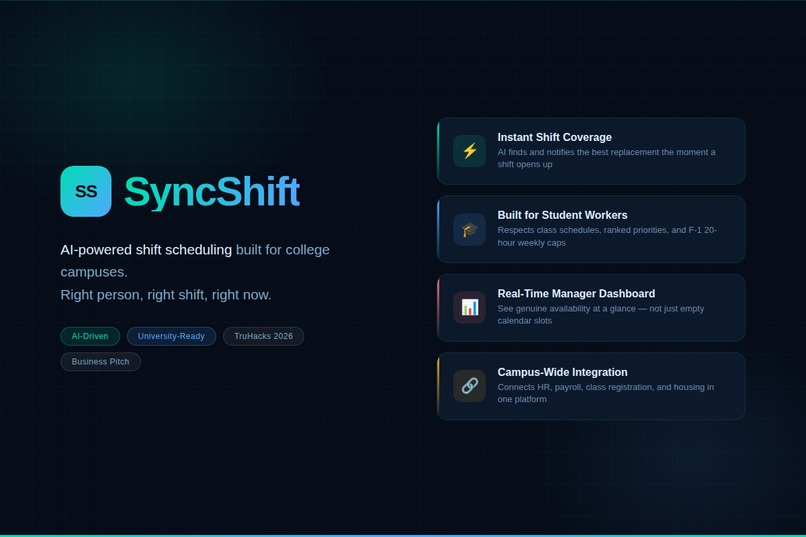
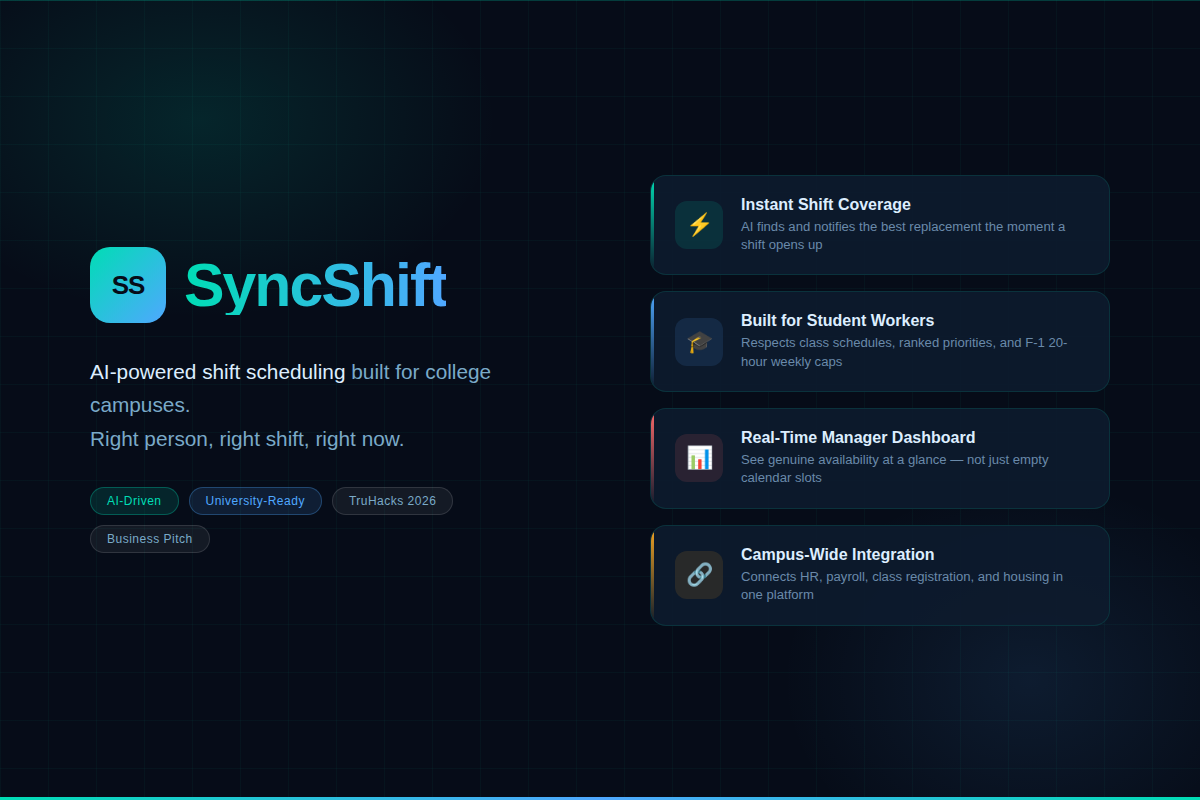
SyncShift is an AI-powered scheduling platform built for both managers and student employees. Workers input their classes, clubs, and commitments ranked by priority, and managers assemble schedules just like any other tool. The difference kicks in when something goes wrong — when a student cancels a shift, SyncShift's AI algorithm instantly scans every eligible employee's real-time availability, accounting for their class schedules, ranked priorities, and remaining work hours. It notifies the best match first. That person can accept or pass — if they decline, the next best candidate is notified automatically. No phone calls. No group chats. No coverage gaps. It also enforces the 20-hour weekly cap for F-1 international students automatically, eliminating the risk of accidental violations.
How we built it
We designed SyncShift around two core components: a dual-sided scheduling interface and an AI matching algorithm. The employee side allows workers to input and rank all their commitments — classes, clubs, other jobs — creating a live availability profile. The manager side provides a real-time dashboard showing genuine availability at a glance. The matching algorithm works similarly to Uber's dispatch system — when a shift opens, it ranks eligible employees by availability score, proximity to the required hours, and priority conflicts, then notifies them sequentially until the shift is covered. We also designed the system to integrate with existing campus HR, payroll, and class registration systems to create a unified campus workforce platform.
Challenges we ran into
The biggest challenge was designing an algorithm that could handle the complexity of student schedules — no two weeks look the same, and availability isn't just about being free at a given time. We had to account for ranked priorities, weekly hour caps, and last-minute changes simultaneously. Another challenge was positioning the product — most scheduling tools are deeply entrenched in manager workflows, so convincing both sides of the market (managers and employees) that a dual-sided platform adds value required careful thinking about the pitch and user experience.
Accomplishments that we're proud of
We're proud of designing a solution that genuinely centers the employee — something the entire scheduling software industry has overlooked. We're also proud of the clarity of the Uber analogy as a way to communicate a complex algorithm simply and effectively. Building out a full business model — from university licensing to SaaS subscriptions to system integrations — in a single hackathon weekend, while also designing a polished pitch and infographic, is something we're proud of as a two-person team.
What we learned
We learned that the best product ideas often come from personal pain points — the frustration of being an international student navigating a 20-hour work cap with an inflexible scheduling system was the clearest signal we needed. We also learned how important it is to frame a technical algorithm in human terms. "AI-powered matching" means nothing to a tired manager at 6 AM — but "just like Uber, it finds the right person automatically" clicks instantly. Simplicity in communication is just as important as sophistication in engineering.
What's next for SyncShift
The immediate next step is building a working MVP and piloting it with campus employers at Truman State University. From there, we plan to expand to other universities across the country through a licensing model, integrating with existing campus HR and class registration systems. Long-term, SyncShift has a natural path beyond universities — any employer relying on part-time or hourly workers with complex availability constraints, such as hospitals, hotels, and retail chains, is a potential market. We also plan to explore predictive scheduling features, where the AI anticipates coverage needs before a cancellation even happens.
Built With
- google-docs
- html
- infographic


Log in or sign up for Devpost to join the conversation.