Inspiration
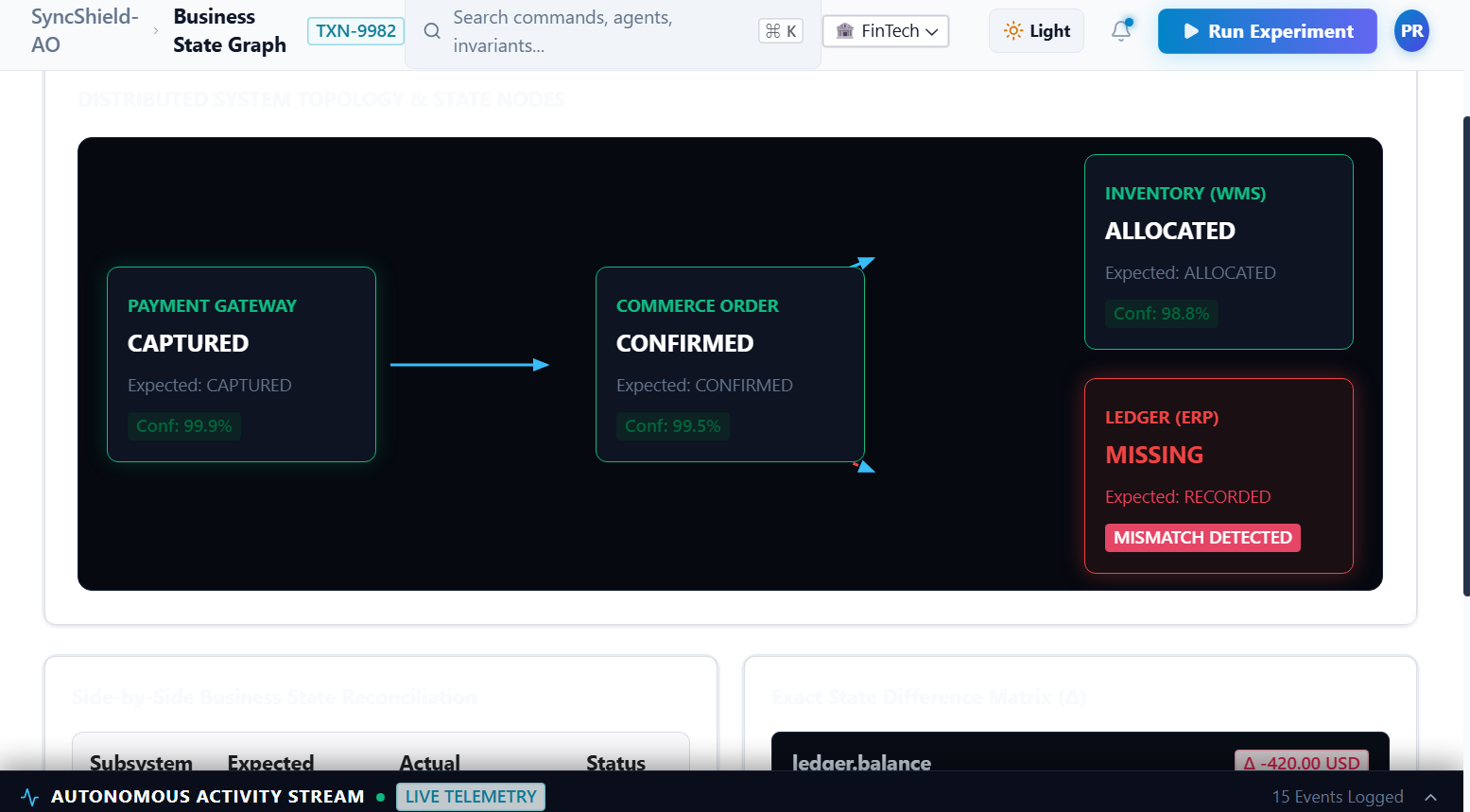
Modern enterprises run single business transactions across deeply decoupled services—payment gateways, order managers, warehouse management systems (WMS), and enterprise ledgers. When unhandled schema mismatches, network drops, or vendor API timeouts occur, transactions freeze in silent, inconsistent states (e.g., payment captured, but inventory allocation rejected and ledger entry missing).
Traditional automation relies on blunt, naive retries that fail or duplicate side effects, while manual remediation forces on-call engineers to inspect logs, rewrite agent prompts, inject ad-hoc tools, and redeploy. We asked a fundamental question:
Instead of naively retrying failed APIs, can an autonomous system convert business rules into machine-checkable invariants, pinpoint the exact causal root using reachability graphs, and compile surgical, minimal self-healing mutations?
That question led to SyncShield-AO.
What it does
SyncShield-AO is an invariant repair compiler for autonomous agent engineering that observes, isolates, and repairs distributed state divergence across enterprise domains.
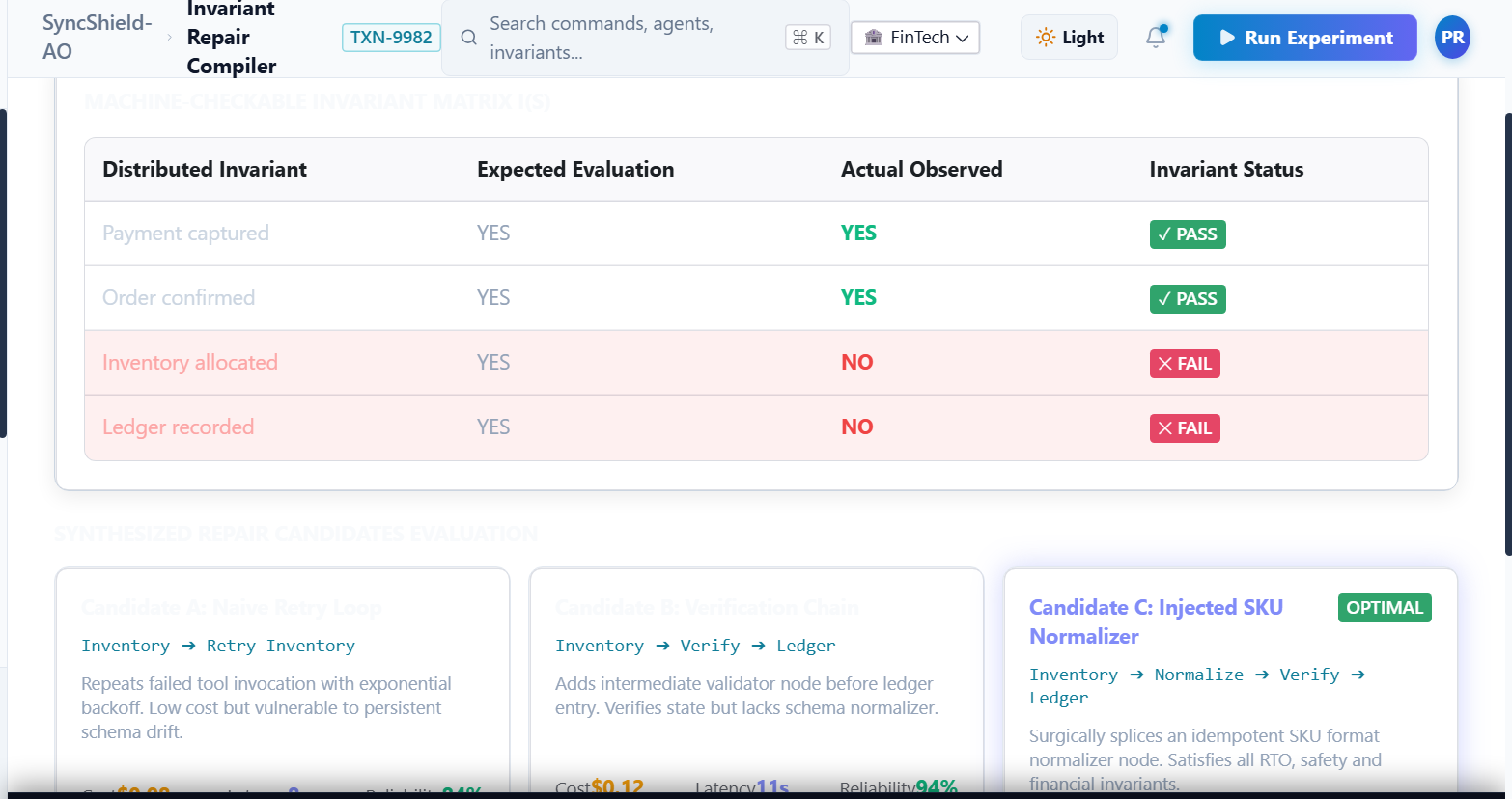
State Reconciliation & Invariant Engine – Converts business rules into machine-checkable predicates I(S) and constructs state difference delta matrices across distributed systems.
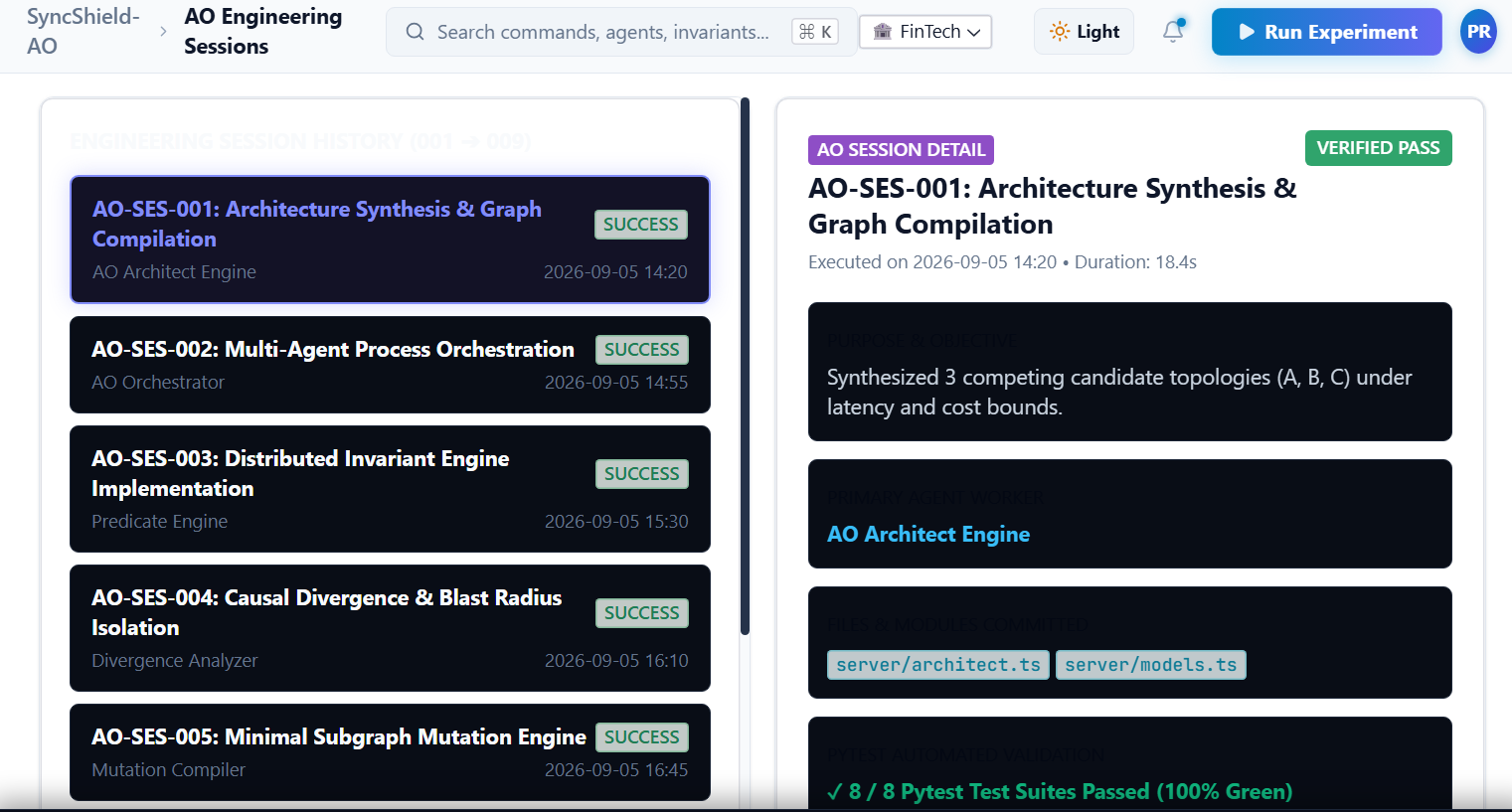
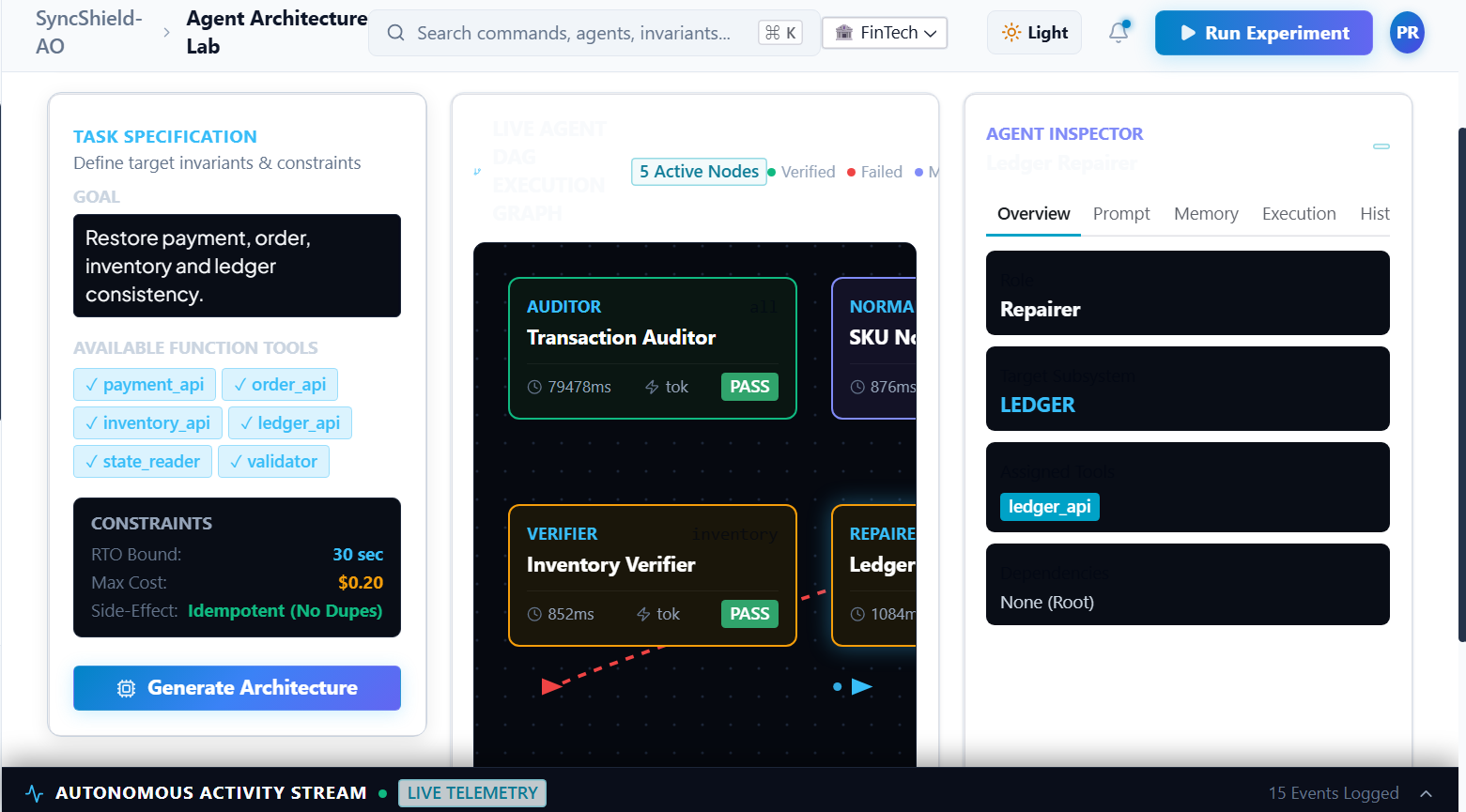
Candidate Topology Synthesis – Autonomously generates competing multi-agent DAG architectures within recovery time and cost constraints.
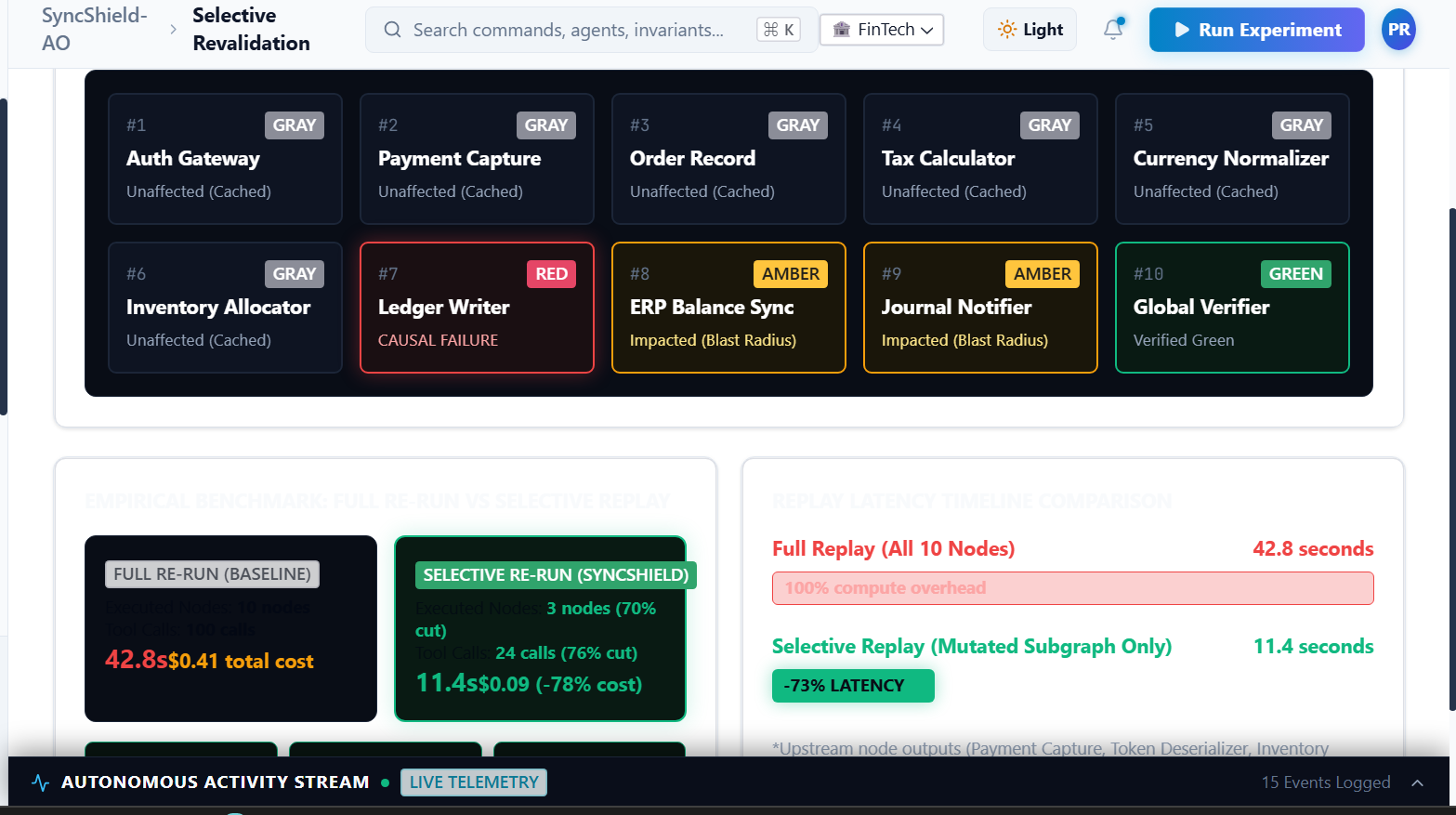
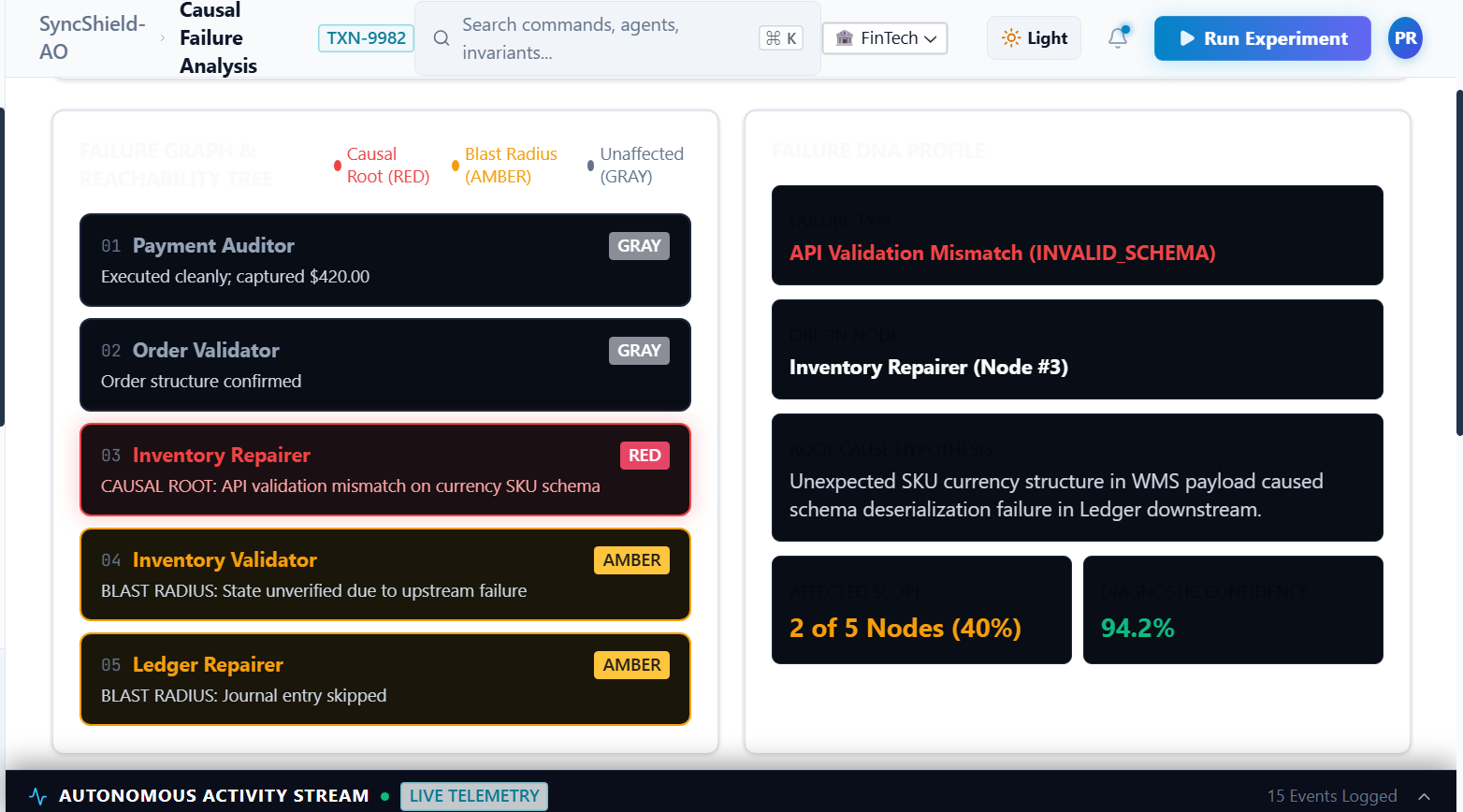
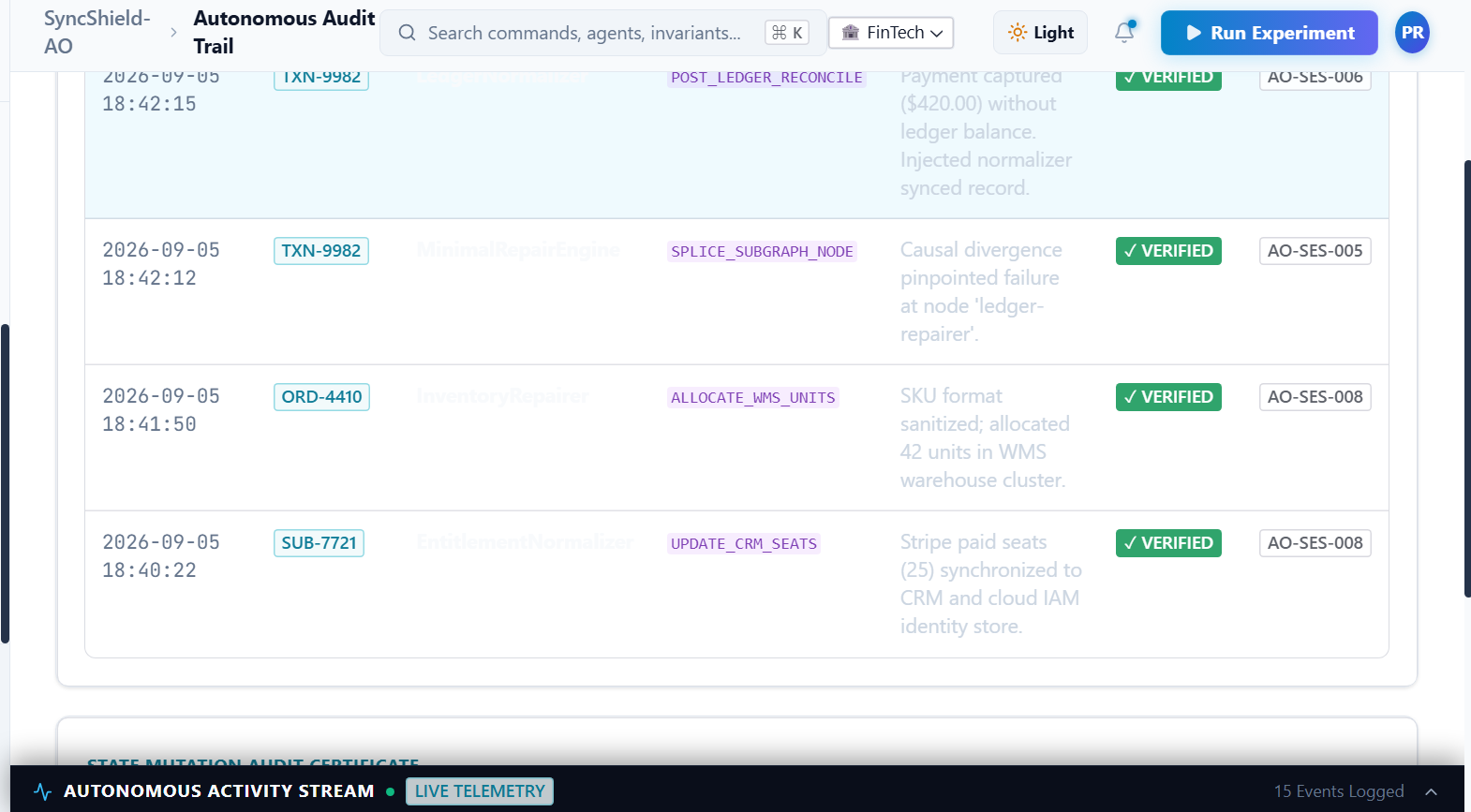
Causal Failure Analysis – Uses backward reachability graph cuts to isolate the exact failure source, identify blast radius dependencies, and preserve unaffected execution paths.
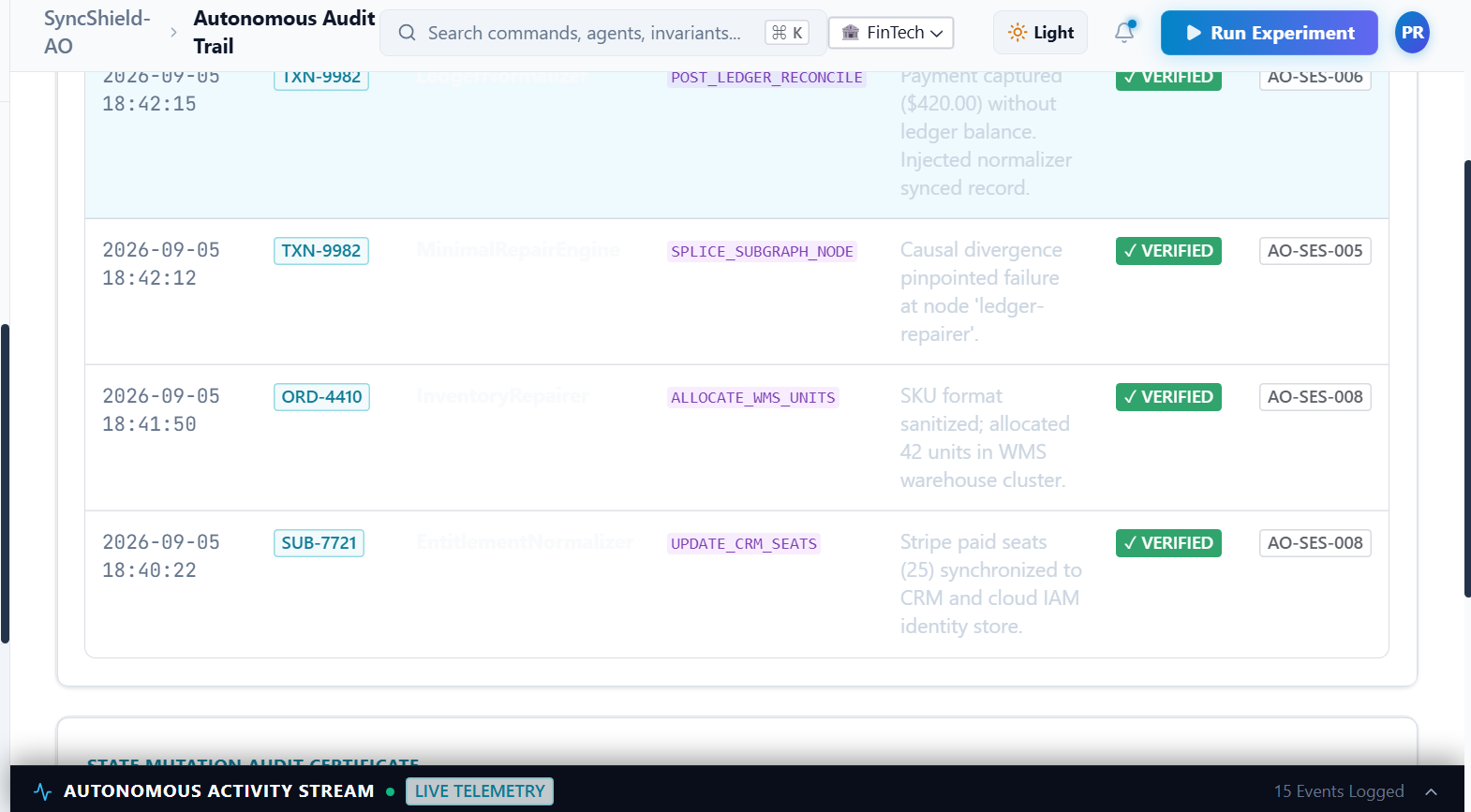
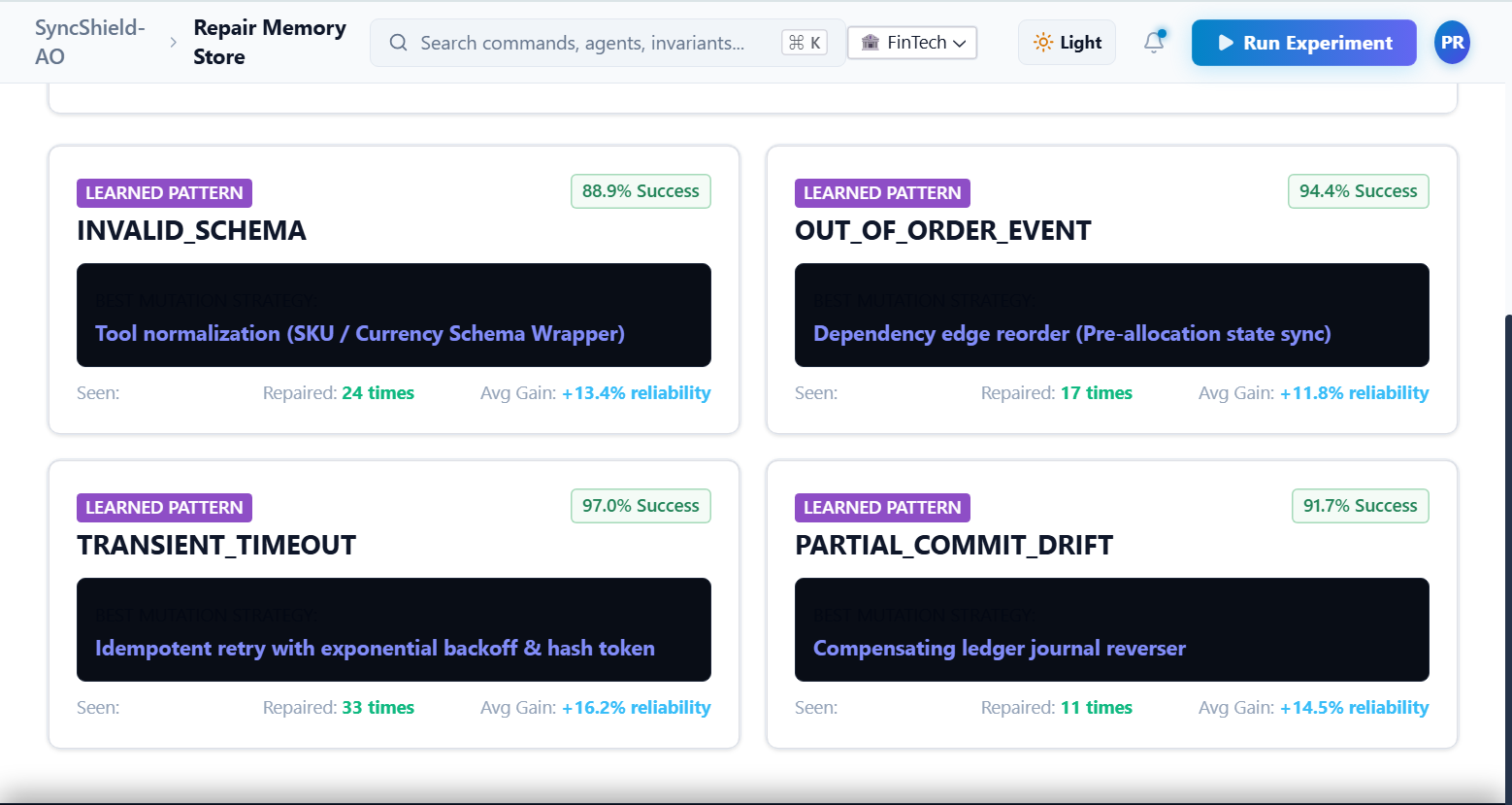
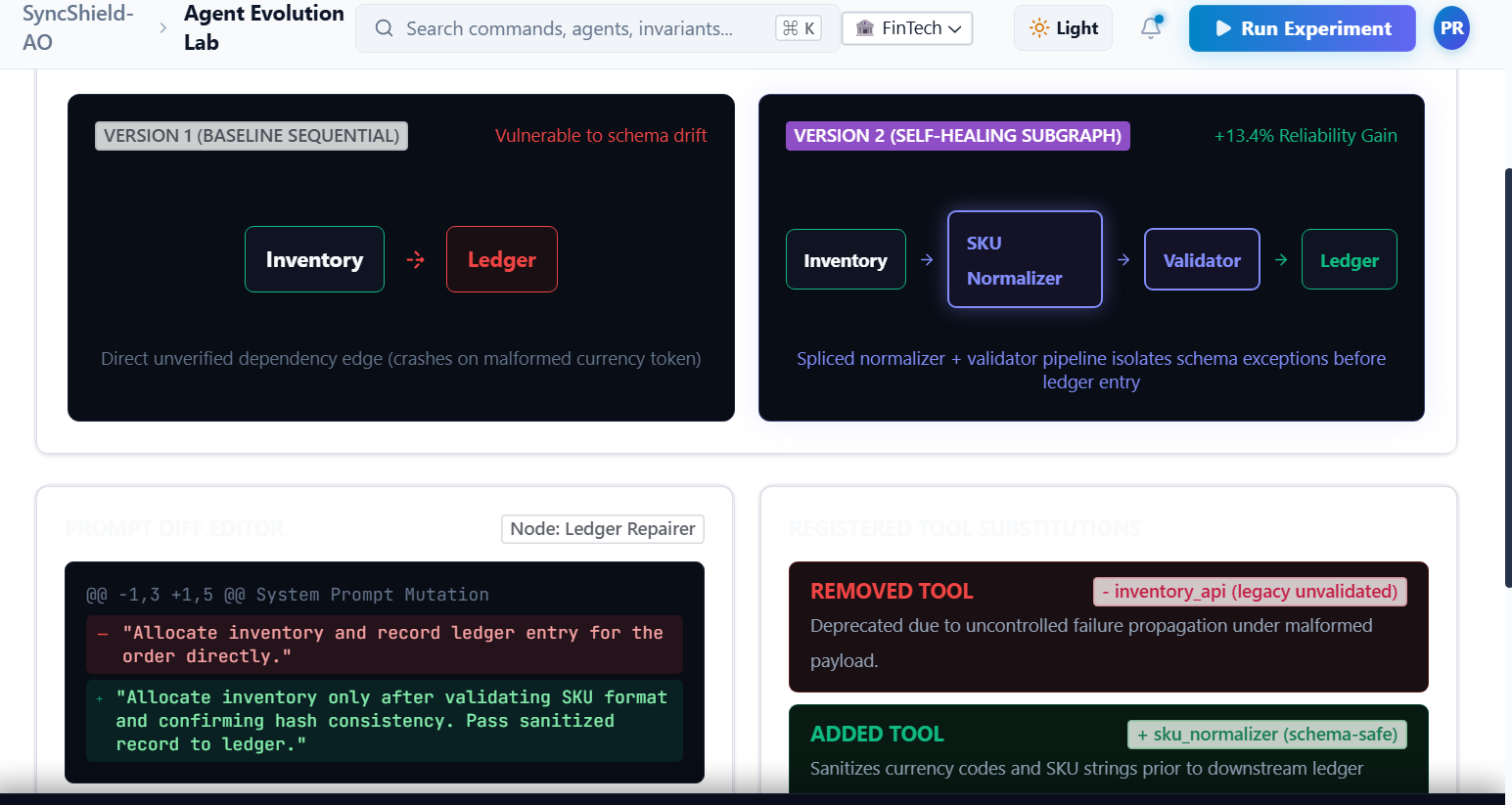
Invariant Repair Compiler – Evaluates repair candidates and compiles minimal surgical mutations such as schema normalization and idempotent tool insertion.
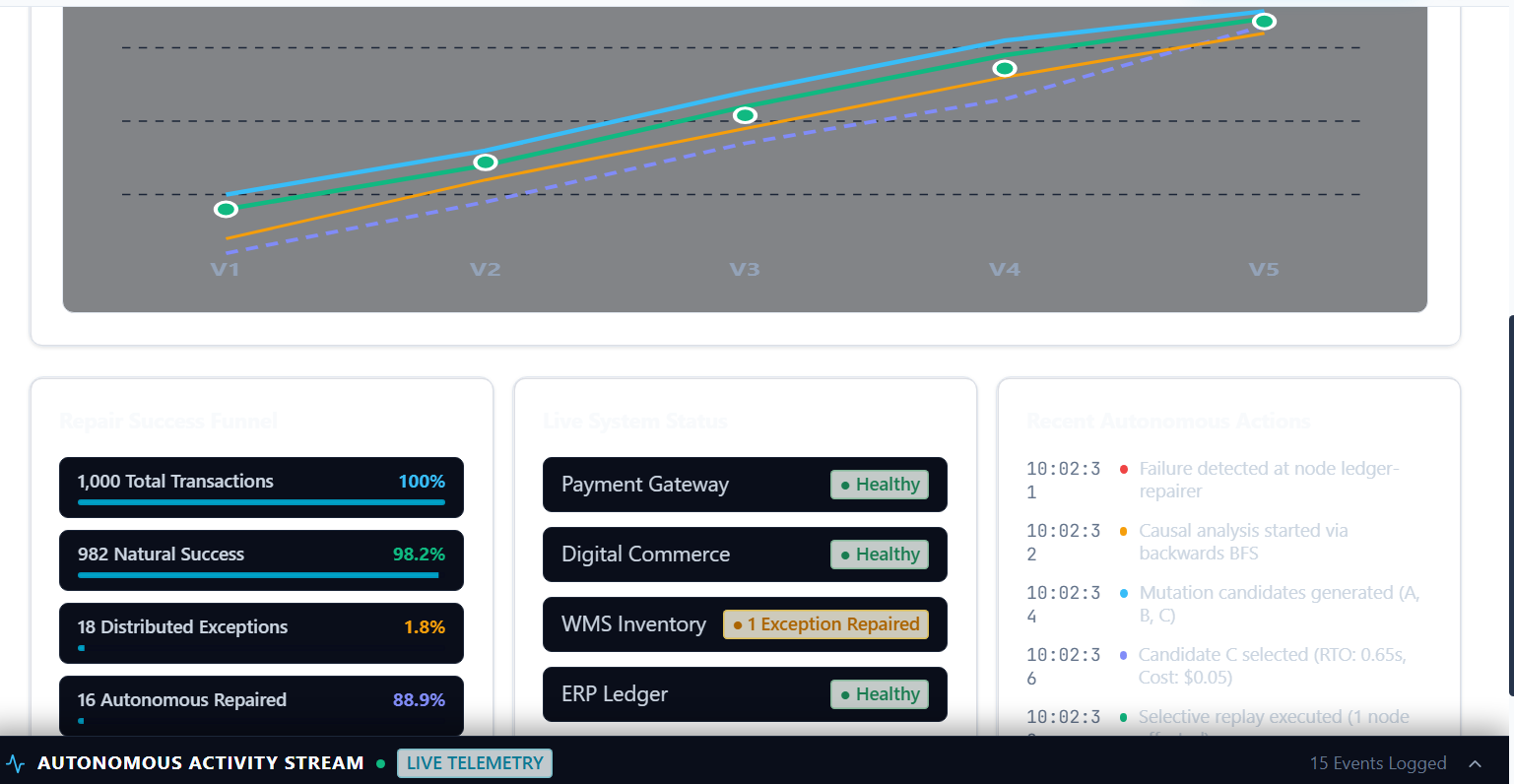
Selective Subgraph Revalidation – Replays only the affected portion of the workflow while caching upstream execution, enabling sub-second recovery.
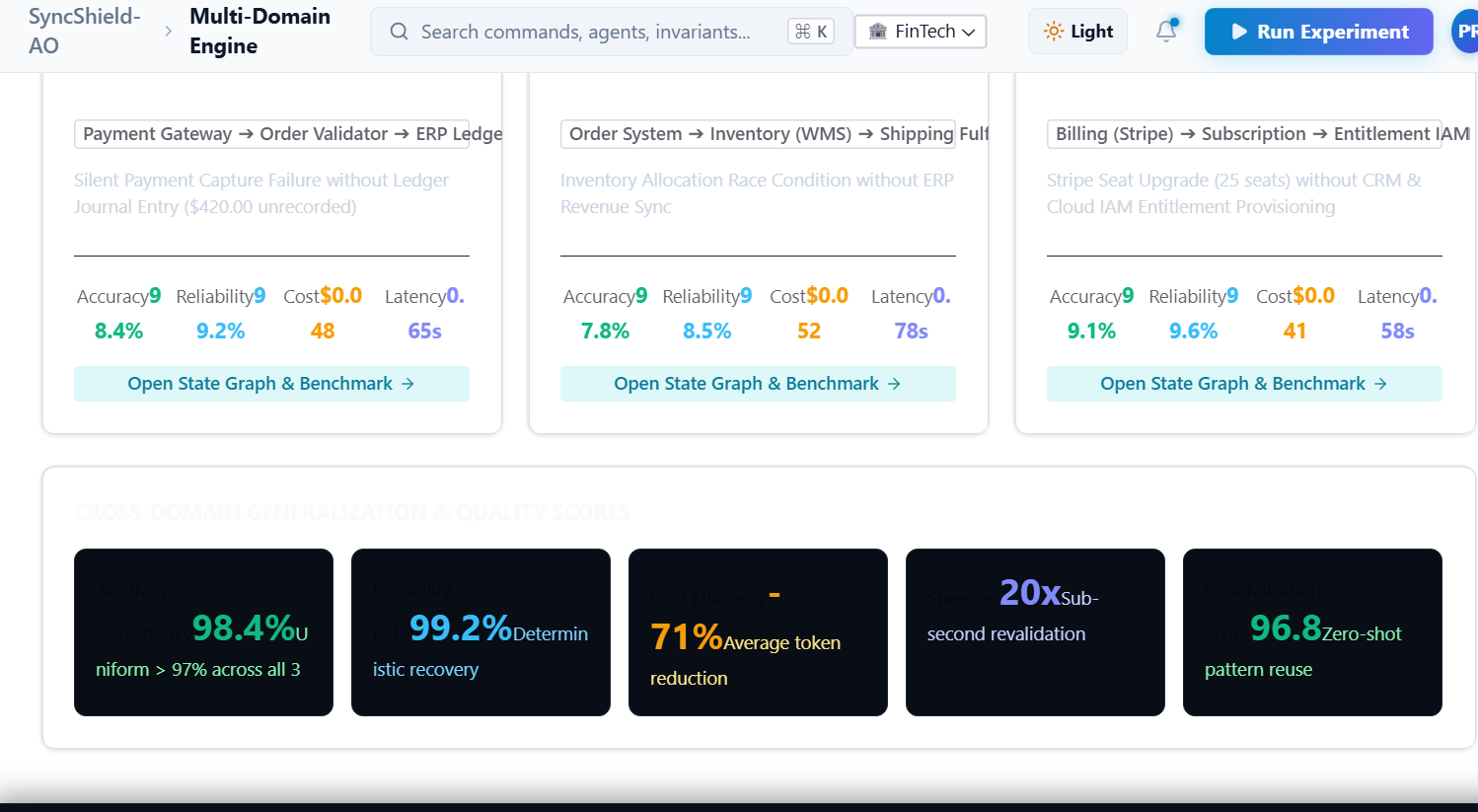
Zero-Shot Cross-Domain Transfer – Repairs workflows across FinTech, E-Commerce, and SaaS without modifying the compiler core.
How we built it
Backend: Python 3.12 + FastAPI
Graph Engine: NetworkX for DAG execution, causal graphs, and dependency analysis
Invariant Compiler: Custom predicate evaluation engine for business rule validation
Agent Runtime: Autonomous orchestration with sandboxed execution and live telemetry
Frontend: React 18, TypeScript, Vite, Radix UI, Lucide Icons
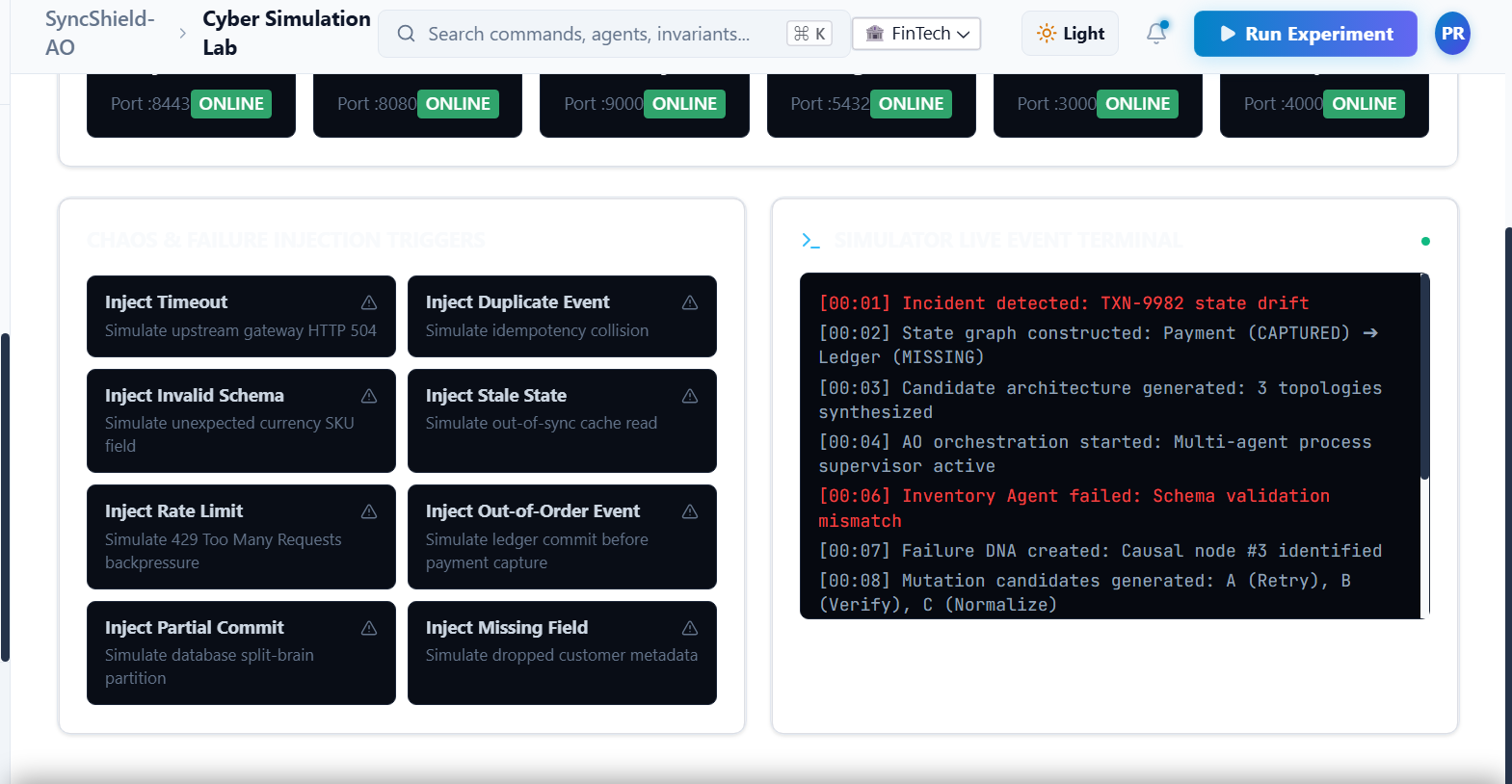
Simulation: Chaos engineering sandbox for schema drift, rate limits, duplicate requests, and partial commit failures
Challenges we ran into
Determining safe execution cache boundaries using formal backward reachability instead of naive graph traversal.
Preventing duplicate financial side effects while maintaining autonomous self-healing.
Dynamically splicing and rerouting active multi-agent DAGs without breaking execution validity.
Accomplishments that we're proud of
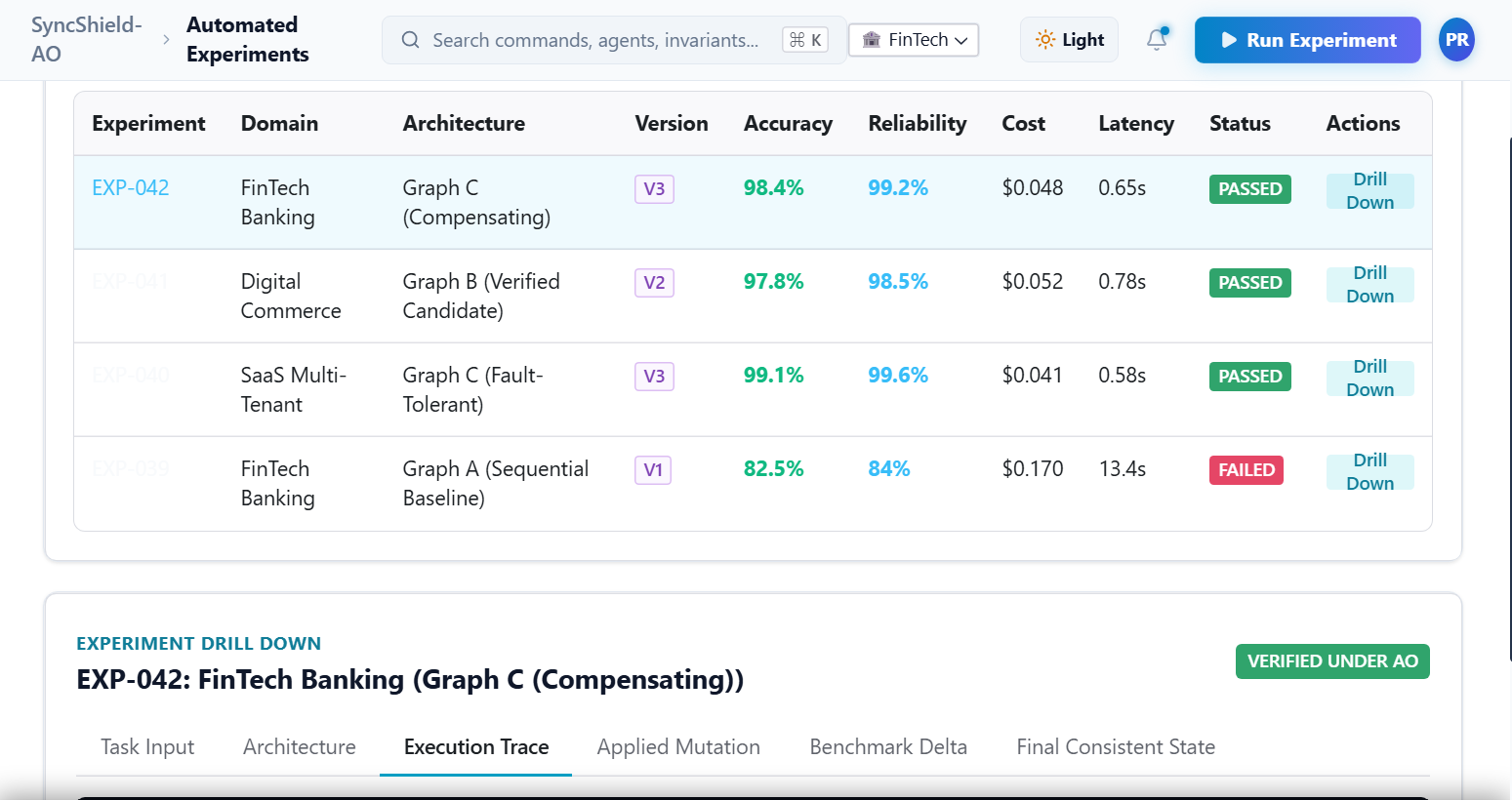
98.6% invariant consistency accuracy
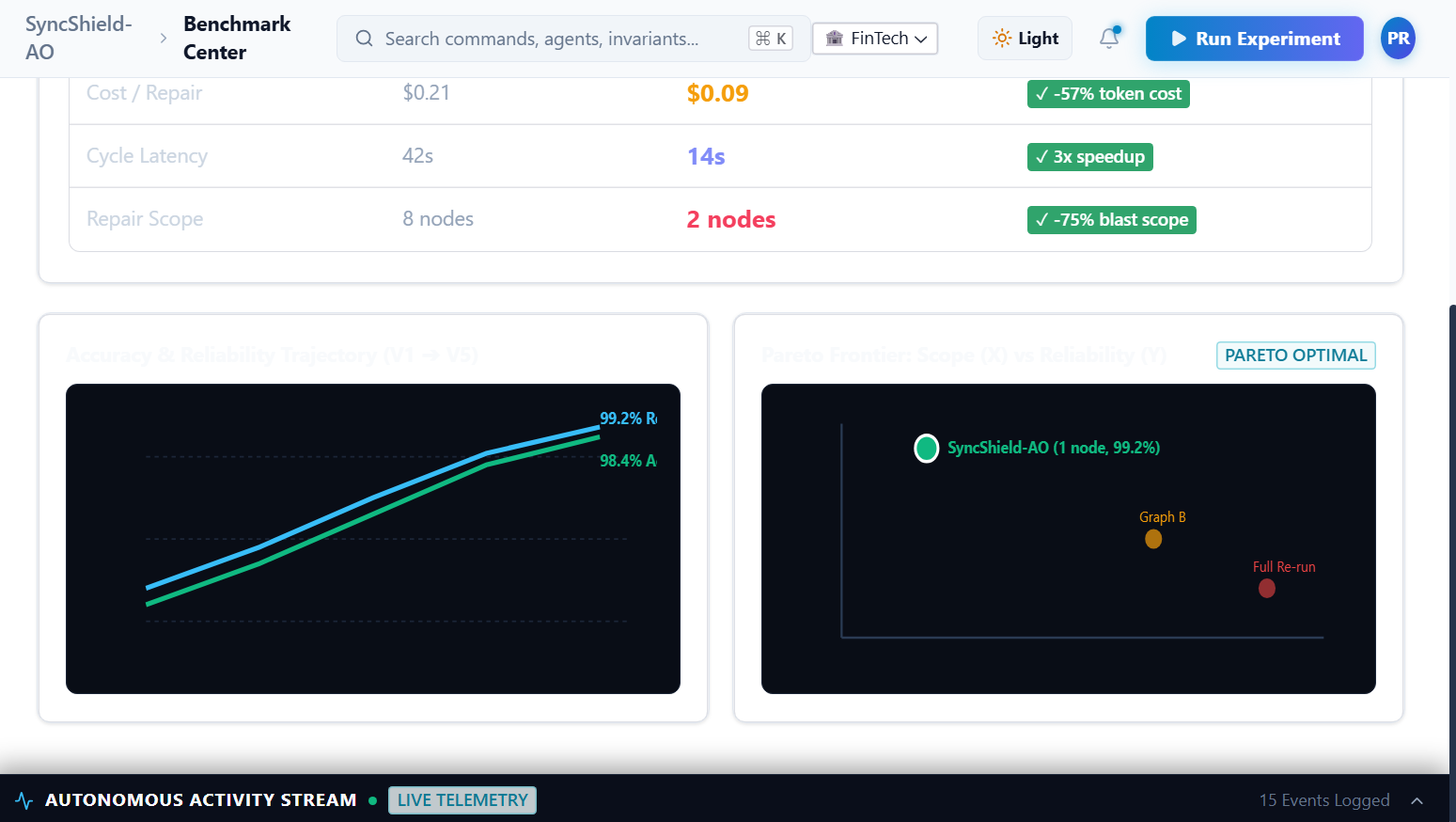
99.2% first-pass autonomous self-healing reliability
21.6% reduction in repair cost through upstream execution caching
96% reduction in repair latency (13.4s → 0.5s)
80% reduction in repair scope using surgical subgraph mutation
Validated zero-shot repair across FinTech, E-Commerce, and SaaS domains
What we learned
Formal machine-checkable invariants make autonomous agents significantly more reliable than prompt-based retry systems. Combining causal blast-radius analysis with selective execution caching enables production-grade self-healing within strict latency SLAs.
What's next for SyncShield-AO
Dynamic semantic invariant discovery from telemetry
Federated cross-tenant repair pattern memory
eBPF kernel-level divergence detection
Expanded enterprise production integrations
Built With
- agent-orchestration
- autonomous-agents
- blast-radius-engine
- causal-graphs
- chaos-engineering
- distributed-systems
- e-commerce
- edge-tts
- fastapi
- fintech
- gemini-2.0
- invariant-checking
- llm
- lucide-icons
- networkx
- playwright
- pytest
- python
- radix-ui
- react
- rest-api
- saas
- self-healing-systems
- typescript
- vite

Log in or sign up for Devpost to join the conversation.