-
-
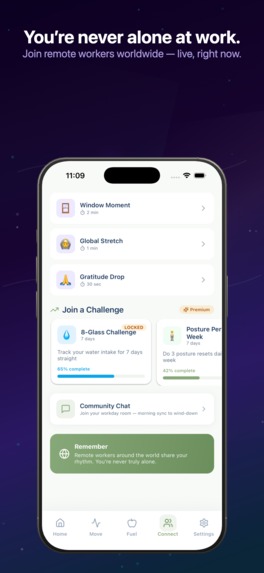
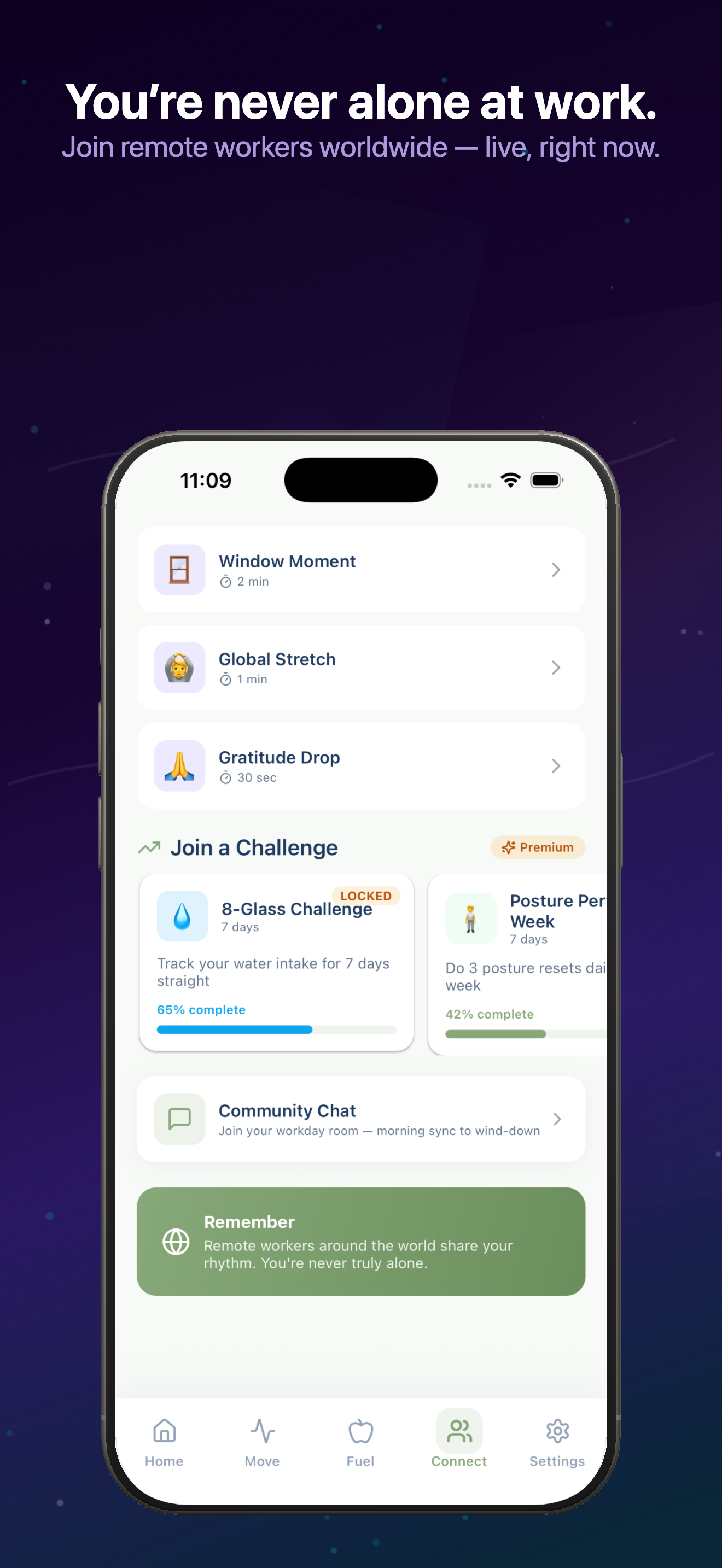
You're never alone at work, not anymore. Join other remote workers worldwide.
-
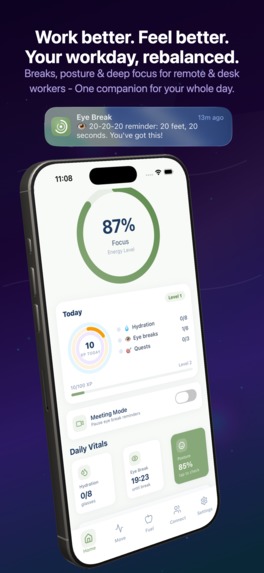
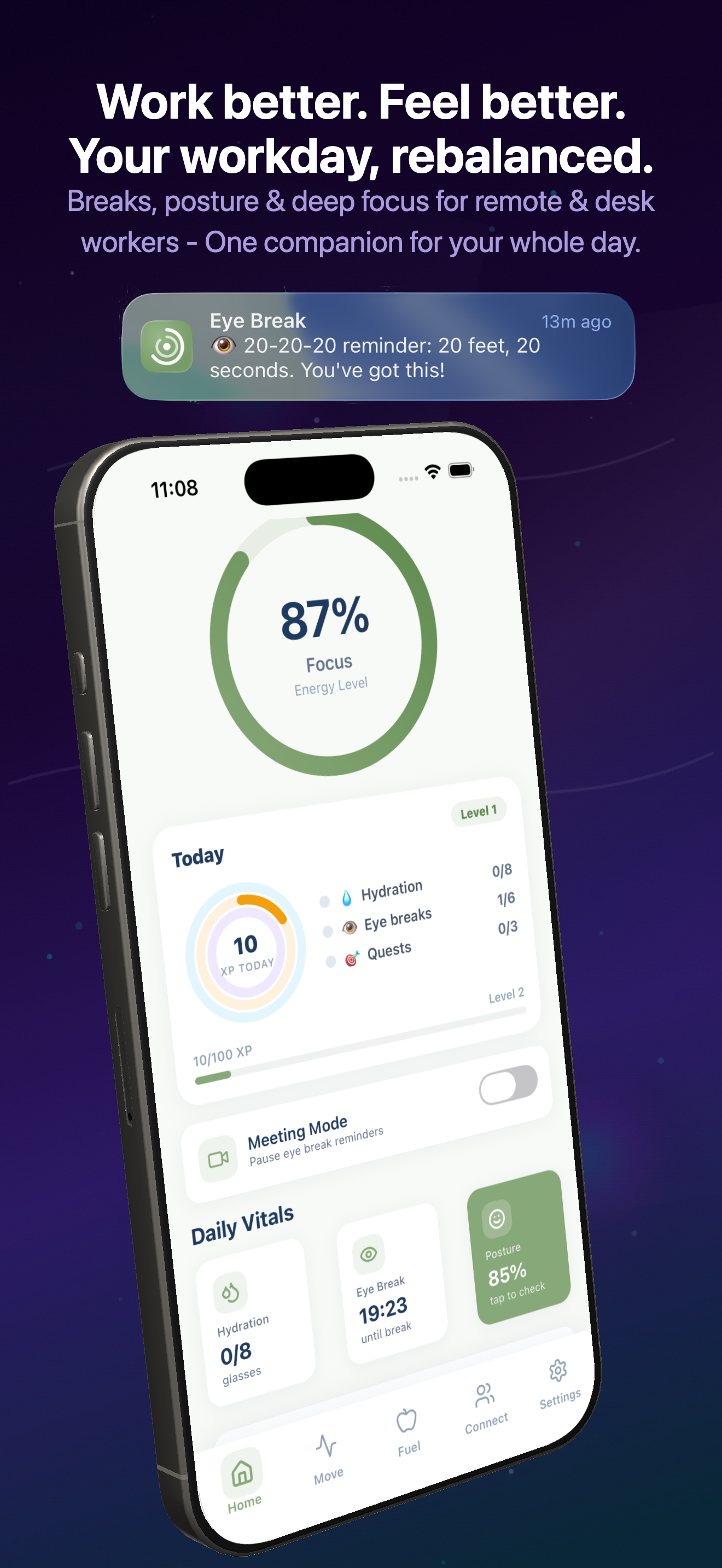
Work better and feel better. Your workday, rebalanced.
-
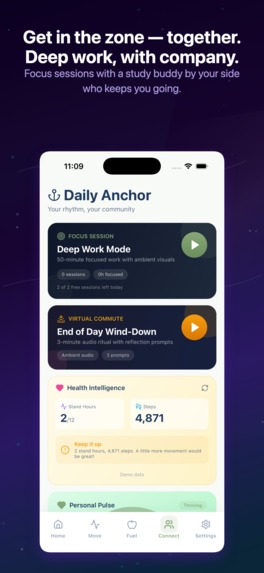
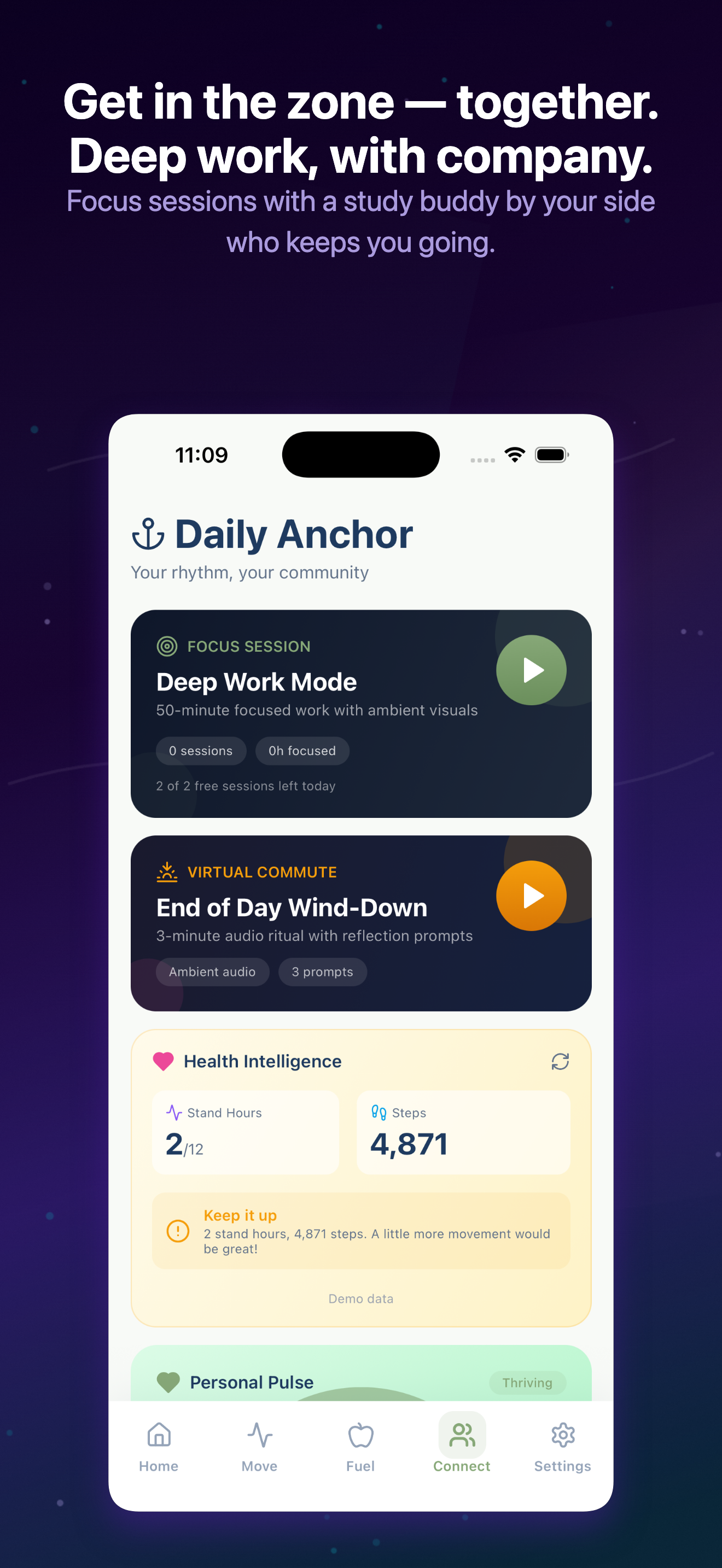
Get in the zone, together with a Pal. Deep work with company.
-
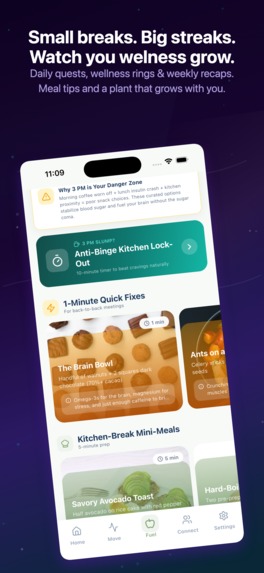
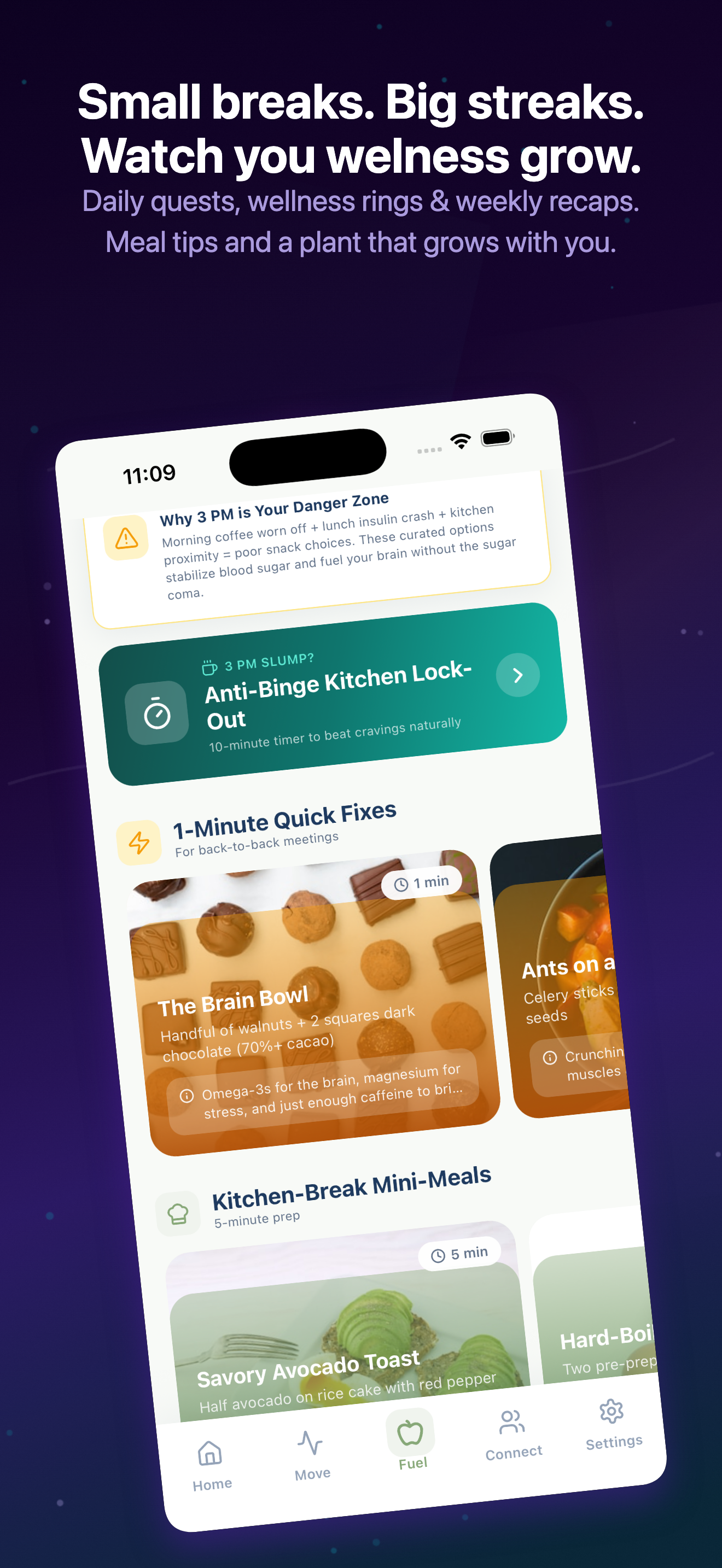
Have small breaks and hit big streaks. Watch your welness grow.
-
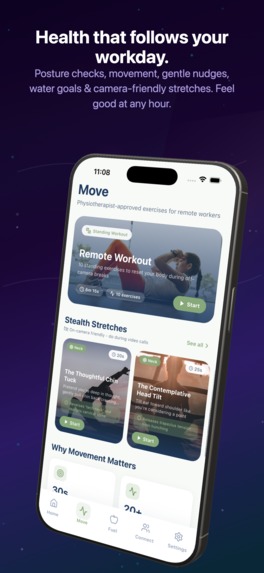
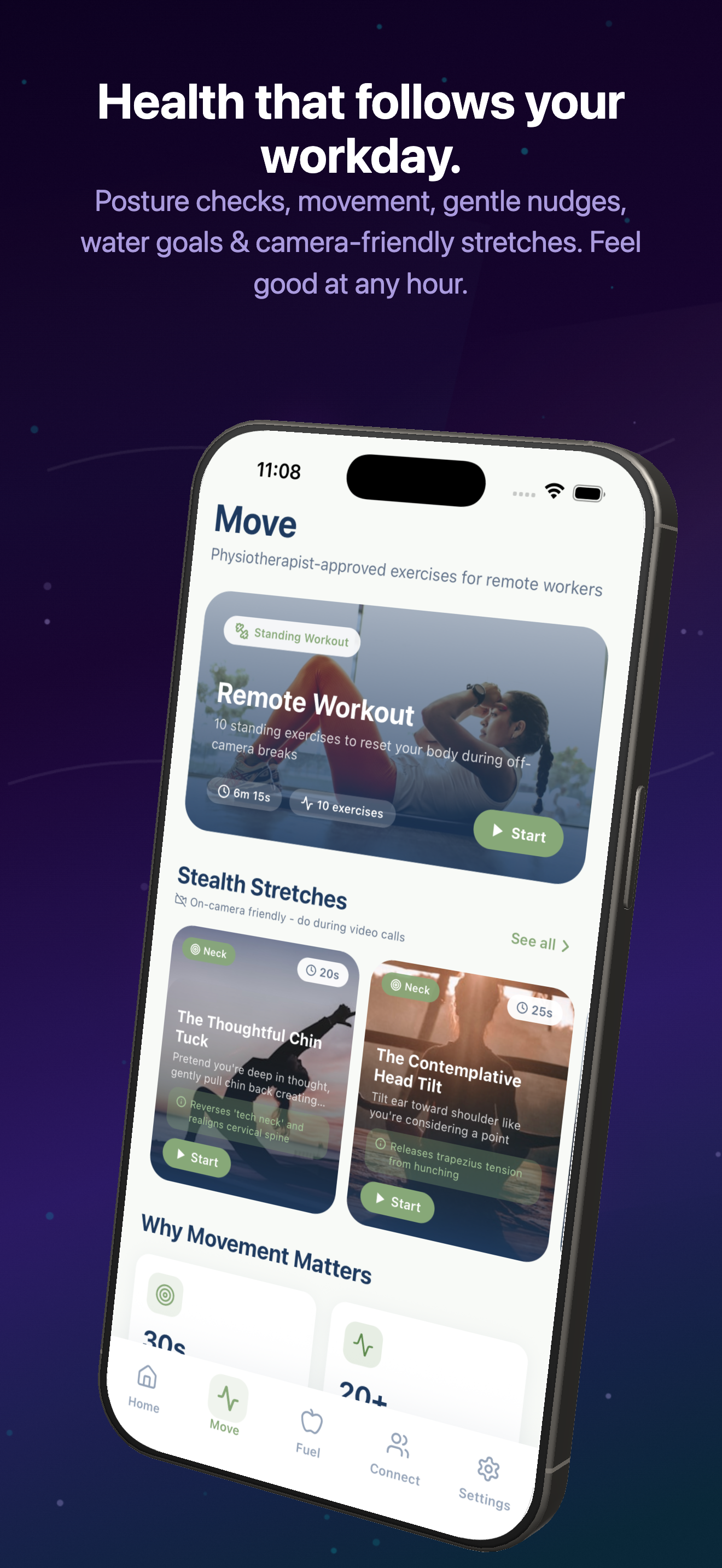
Health that follows your workday. Tips, exercises, quests, meals, etc.
-
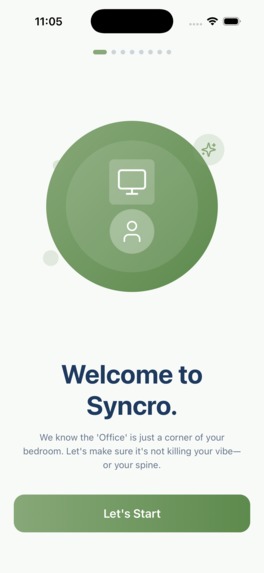
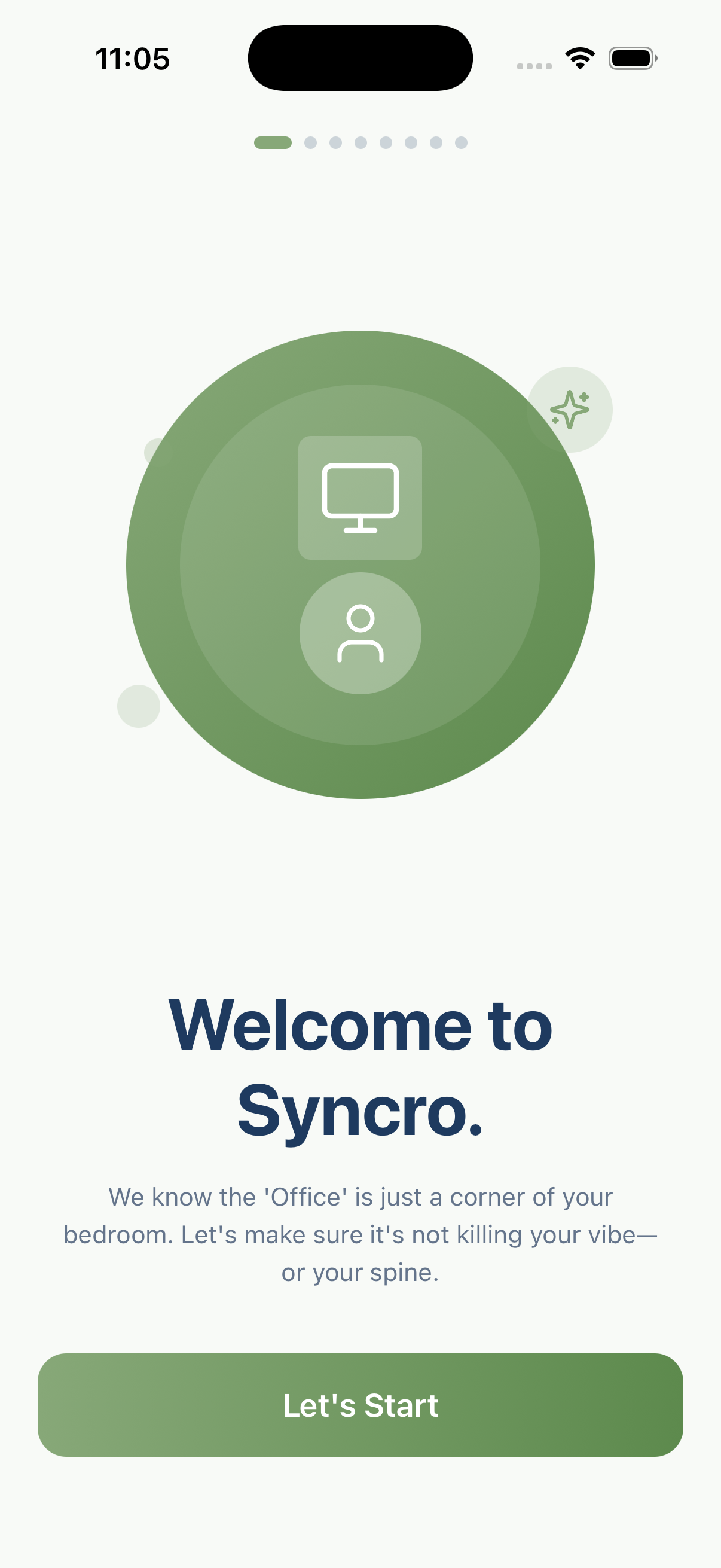
Syncro onboarding - Sync aims to turn remote work into proper remote health and lifestyle balance
-
Syncro App icon - 1024 x 1024
Inspiration
The pandemic turned "the office" into "a laptop on the kitchen table." Millions of people suddenly worked 8–10 hour days with no commute, no walk to a meeting room, and no reason to stand up. The result is a quiet epidemic: screen fatigue, tech-neck, stiff backs, and the loneliness of working in an empty apartment.
The seed of Syncro is the 20-20-20 rule — the ophthalmologist's guideline that every 20 minutes you should look 20 feet away for 20 seconds. It's simple, evidence-based, and almost nobody actually does it. Over a workday of T T minutes, that's a surprisingly demanding schedule:
N
breaks
⌊ T 20 ⌋ N breaks =⌊ 20 T ⌋
For an 8-hour day, that's 24 reminders — which means a reminder app that isn't delightful, personal, and human will be muted in the first hour. That was the design bar we set for ourselves.
What it does
Syncro is a daily wellness companion for remote and desk workers, with five tabs covering the whole workday:
Home — a focus meter, hydration tracking, 20-20-20 eye-break timer with Meeting Mode, posture check-ins, mood logging, daily quests that adapt to your pain areas, and streak tracking. Move — a guided remote workout and "stealth stretches" you can do on camera without anyone noticing. Fuel — the 3pm energy-crisis snack menu and a 30-day brain-nutrition calendar. Connect — the heart of the product: a live global pulse of remote workers, real-time chat rooms matched to your workday phase, deep-work focus sessions, and a virtual office of active coworkers. Remote work's biggest deficit is not physical — it's social. Settings — work schedule, reminder personality (Ninja, Coach, Drill Sergeant), premium status, restore purchases, and account deletion. Syncro monetizes with RevenueCat: a free plan keeps the core habit loop (eye breaks, hydration, posture, 2 focus sessions a day), while Premium unlocks unlimited focus sessions, advanced posture & ergonomic coaching, the nutrition calendar, community challenges and leaderboards, the full weekly wellness recap, and premium reminder styles.
How we built it
Built by one person with a fleet of AI coding agents (vibecode-style: Claude agents reading project docs and writing code autonomously):
Mobile — Expo React Native (SDK 53) with expo-router, Zustand for persisted local state, TanStack Query for server state, NativeWind styling, and react-native-purchases for RevenueCat. Backend — Next.js 16 on Vercel: presence check-ins with IP geolocation, live pulse stats, mood endpoints, and NextAuth Google sign-in. Data — Supabase: Postgres with row-level security, Google OAuth, and Realtime channels for instant chat and the live globe of active users. Monetization — RevenueCat offerings, a premium entitlement, and a custom paywall shown after the user completes their first eye break or focus session — value first, ask later. The architecture is deliberately boring: a mobile client, a thin serverless API, a managed database. No VPS to patch, no servers to babysit.
Challenges we ran into
A paywall with nothing behind it. We had a beautiful paywall from day one — three plans, a value list, restore purchases. Weeks later we realized the terrible truth: nothing was actually gated. Every feature the paywall promised was fully free. We had built a subscription button connected to nothing. Fixing it meant building a real entitlement layer across the entire app: free-tier limits on focus sessions, locked challenge cards, a premium-locked nutrition calendar, and a paywall that appears at the exact moment of first value.
Fake community is a time bomb. A "global community" with zero users looks dead, so we faked it — "Join 47,000+ remote workers," seeded cities on the globe, participant counts everywhere. It wasn't just a trust problem; it was an App Store review problem and a refund problem. The first paying user to notice "12,453 participants" in an empty room would 1-star us into oblivion. We stripped every fake number and made the backend report real counts only.
The invisible backend bug. A database migration had silently dropped the trigger that creates a user profile on sign-up. The app "worked" — but every mobile user was missing a profile row, causing foreign-key failures on chat and mood sync, and every active user showed up as "Anonymous." Cross-device sync was writing to a table that had never been created. The frontend looked perfect while the data layer was quietly rotting.
App Store compliance isn't optional. Shipping for real meant in-app Terms of Use and Privacy Policy, an account-deletion flow (Apple 5.1.1), honest labeling of simulated health data, and an SDK upgrade path (Expo 53 is four majors behind — iOS 26 requires newer).
Accomplishments that we're proud of
A real-time community from scratch — Supabase Realtime chat rooms matched to the user's local workday phase, a live globe of active coworkers, and an honest global pulse. No third-party chat SDK. The trust pivot — we deleted every fabricated number from the product. The community is small and real, and that honesty is now the product. A genuinely adaptive wellness engine — daily quests generated from your pain areas, setup type, and streak; stretches sorted by your ergonomic profile; reminders with three distinct personalities. Cross-device sync — Zustand state pushed to Supabase snapshots and merged back on sign-in, so your day follows you. A production backend live on Vercel with geolocated presence and real user counts — the full stack works end to end. Built solo with AI agents — one person, a fleet of autonomous coding agents, and a shipping mindset.
What we learned
Subscriptions are a trust product. RevenueCat made the plumbing trivial — offerings, entitlements, restore — but the hard part is the contract with the user: gate real value, show the paywall after value is experienced, and anchor pricing on the impulse threshold: $ 39.99 12 ≈ $ 3.33 per month 12 $39.99 ≈$3.33 per month
...a number that feels like "a coffee" rather than "a commitment."
Honest social proof beats invented scale. Small and real beats big and fake — for App Store review, for refunds, and for the community itself. Full-stack apps rot invisibly. The frontend can look perfect while migrations silently break the data layer. Migration hygiene is product hygiene. AI agents compound a solo founder's leverage. The bottleneck wasn't writing code — it was deciding what the product should be, and then auditing what the agents built.
What's next for Syncro - Remote Work Wellness
Launch. App Store submission is imminent: RevenueCat products configured, SDK 56 upgrade, TestFlight, and the launch run. Front-camera posture AI — slouch detection using the camera already in the app, like UPRIGHT but without the $199 hardware. Apple Watch companion + Home/Lock Screen widgets — retention multipliers for a habit app. Real HealthKit integration (steps, stand hours, sleep) replacing the simulated health card. Calendar-aware Meeting Mode — auto-pause reminders when the calendar says you're in a meeting. macOS menu-bar companion — the desktop gap no mobile-only competitor fills. A corporate wellness offering — when the community is big enough, sell the same product to employers, the way Personify and Sprout do. The North Star stays the same: make the remote workday feel a little less lonely, a little more human — one 20-second eye break at a time.
Built With
- deepseek
- expo.io
- html5
- revenuecat
- typescript

Log in or sign up for Devpost to join the conversation.