Inspiration Every day, developers and product owners live through a frustrating reality: the codebase moves at lightning speed, while the documentation sits frozen in time. As a developer, I deal with this problem constantly in my day-to-day work. A feature gets updated in a sprint, the original user story is never revised, and suddenly a massive knowledge gap opens up. I call this "The Drift."
When the Google Cloud Rapid Agent Hackathon was announced, I saw the perfect opportunity to build a solution to a problem I personally face. Driven by my love for the Google ecosystem and my excitement to see how its cutting-edge AI tools could solve real-world workflow fractures, I set out alone to build SyncMind—a platform to permanently bridge the gap between business intent and code reality.
What it does I built SyncMind Knowledge Orchestrator as an autonomous "Source of Truth" agent that actively destroys the communication barrier between Business Analysts (BAs) and Dev teams. Instead of acting as a passive, chat-only retrieval assistant, my platform works in two distinct ways:
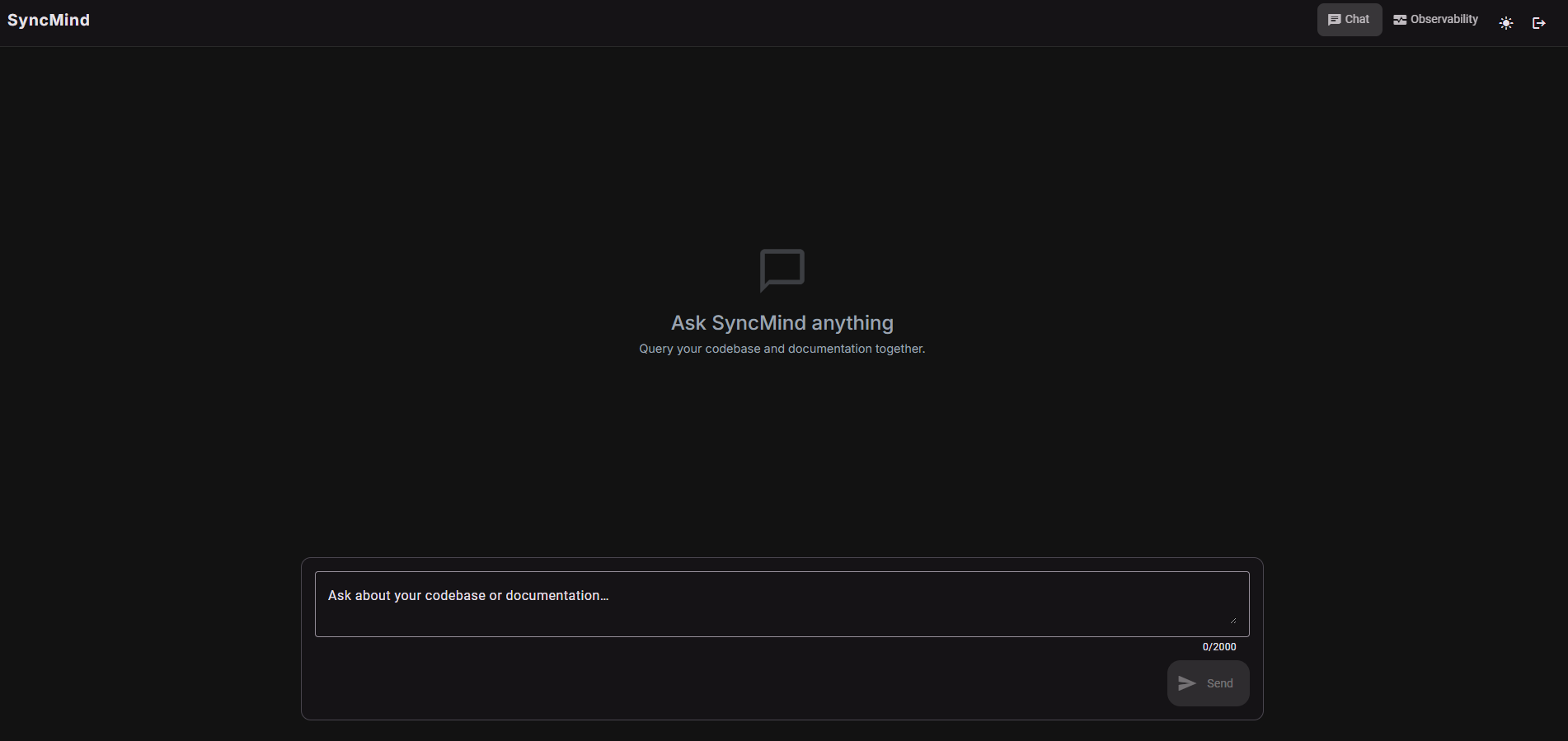
Interactive Knowledge Portal: I designed a workflow that allows non-technical stakeholders to ask plain-English questions (e.g., "How does the checkout tax calculation work?") and get an instant, unified answer synthesized from both the text documentation and the live source code.
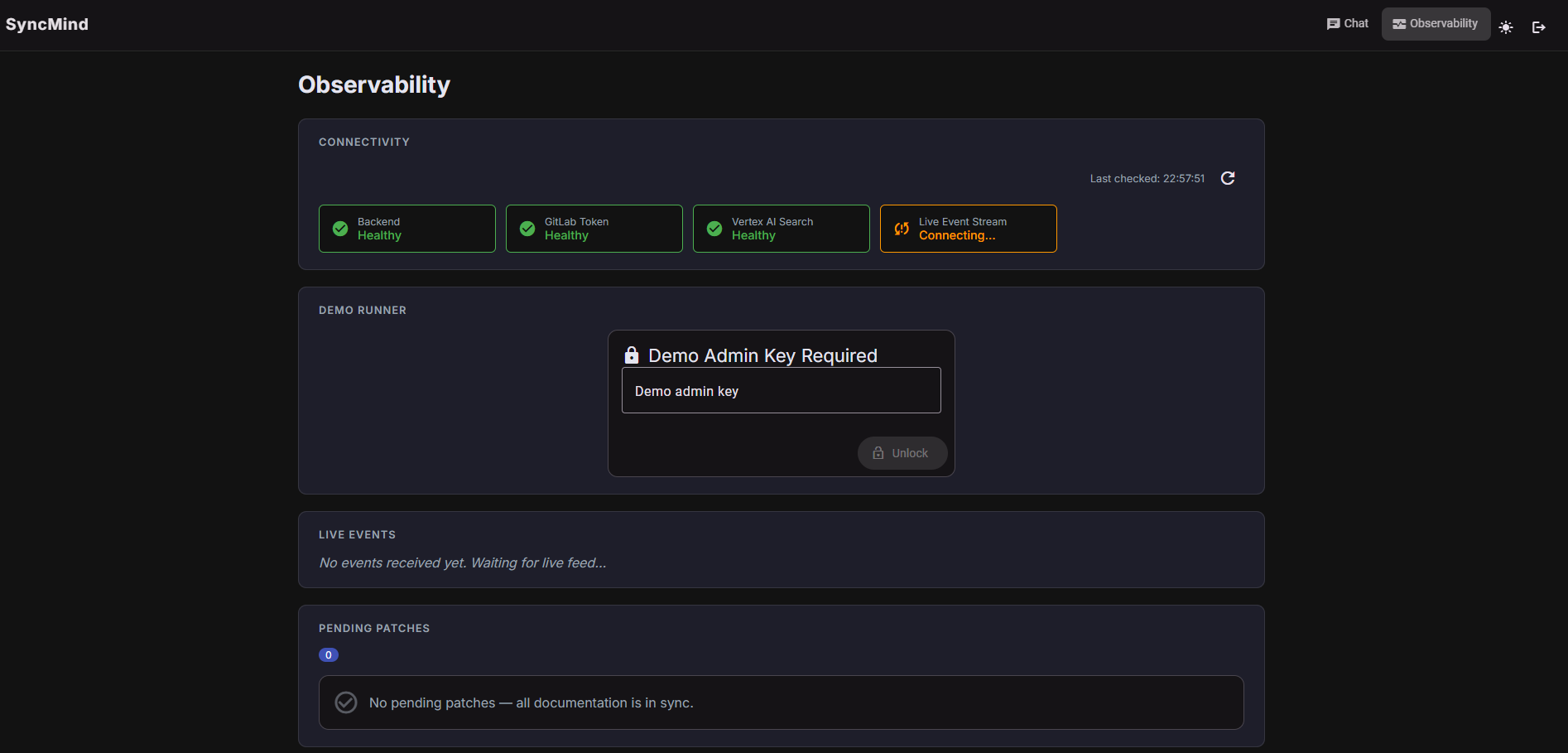
Autonomous Event-Driven Auditing: The moment a developer pushes code or opens a Merge Request, SyncMind intercepts the event via webhooks. It reads the code diffs, cross-references them with enterprise business documentation, identifies if the code has outpaced the docs, and automatically opens an issue with a pre-written Markdown patch to bring the documentation back into sync—completely eliminating human overhead.
How I built it I designed SyncMind with a highly secure, modern, and decoupled architecture:
Frontend: A responsive single-page application I built with Angular, utilizing modern state management to handle real-time streaming agent updates and a dedicated "Drift Dashboard."
Backend & Orchestration: A C# (.NET Core) Web API that I developed to act as the brain. I completely avoided unpredictable, infinite-looping AI behaviors by relying on a deterministic C# router I wrote to safely manage workflows.
Intelligence: Google Gemini, providing the advanced semantic reasoning required to read complex code structures and match them to human business requirements.
Integration Layer: The Model Context Protocol (MCP). My C# backend hosts an MCP client that standardizes data pipelines via JSON-RPC, securely connecting my Gemini core to a Google Vertex AI Search MCP Server (managing my enterprise documentation vector space) and a GitLab MCP Server (for repositories).
Challenges I ran into One of my biggest hurdles was tackling AI Tool Poisoning. Because my agent actively ingests untrusted data from live Git commits and unstructured repository documentation, it was vulnerable to context-switching attacks where malicious strings could hijack the agent’s logic.
I also had to overcome the inherent unpredictability of standard agent "ReAct" architectures, which can easily loop out of control and run up massive API bills, ensuring my deterministic routing layer was flawless.
Accomplishments that I'm proud of As a solo developer, I successfully built an agent that goes beyond chat. It doesn't just answer questions; it manipulates external environments and takes real ecosystem actions by autonomously generating tracking issues and patches directly inside GitLab.
I am also incredibly proud of how I solved my architectural security challenges. By implementing strict context segmentation for Gemini inputs, enforcing a strict least-privilege IAM model for my MCP tokens, and introducing a Staged Approvals workflow (where documentation updates must be human-approved in my Angular UI before writing to production indices), I built a system that is robust, safe, and enterprise-grade.
What I learned This project was a deep dive for me into the massive potential of the Model Context Protocol (MCP) combined with Google Gemini and Vertex AI. I learned that bypassing unconstrained LLM routing in favor of a deterministic backend router written in C# results in a remarkably stable, incredibly fast, and highly predictable agentic workflow. I also gained invaluable experience in isolating untrusted prompt contexts to safeguard my AI applications against modern security vulnerabilities.
What's next for SyncMind SyncMind is just getting started, and I have big plans for it. My next immediate step is to expand my integration ecosystem by building dedicated MCP servers for Jira and Confluence, allowing me to map codebase realities directly to corporate wikis and project management boards. I also plan to introduce predictive drift alerts, analyzing code branches before they are merged to warn developers in real time exactly which documentation paragraphs their new logic is about to break.
Built With
- angular-18
- angular-material
- asp.net-core-8
- c#
- cloud-build
- docker
- docker-compose
- file
- firebase-hosting
- firebase-sdk
- fluentvalidation
- gcr
- github-actions
- gitlab-mcp
- gitlab-rest-api
- gitleaks
- google-cloud-run
- google-gemini
- google-vertex-ai-search
- jasmine
- karma
- modelcontextprotocol
- ngrx-signals
- playwright
- polly
- powershell
- serilog
- signalr
- sse
- swashbuckle
- typescript

Log in or sign up for Devpost to join the conversation.