-
-
Syncless Logo
-
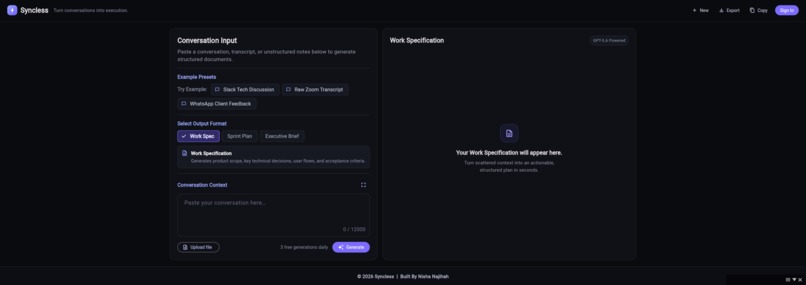
Syncless Main
Inspiration
Engineering teams, product managers, and developers spend hours every week sitting in Slack huddles, Zoom calls, and reading messy meeting notes—only to spend even more time manually translating those discussions into structured tickets, product specifications, and executive updates.
We built Syncless to bridge the gap between team discussions and actual software execution. Syncless turns raw, unstructured conversation context into execution-ready artifacts in seconds, allowing teams to stop spending hours on manual documentation and start building faster.
What it does
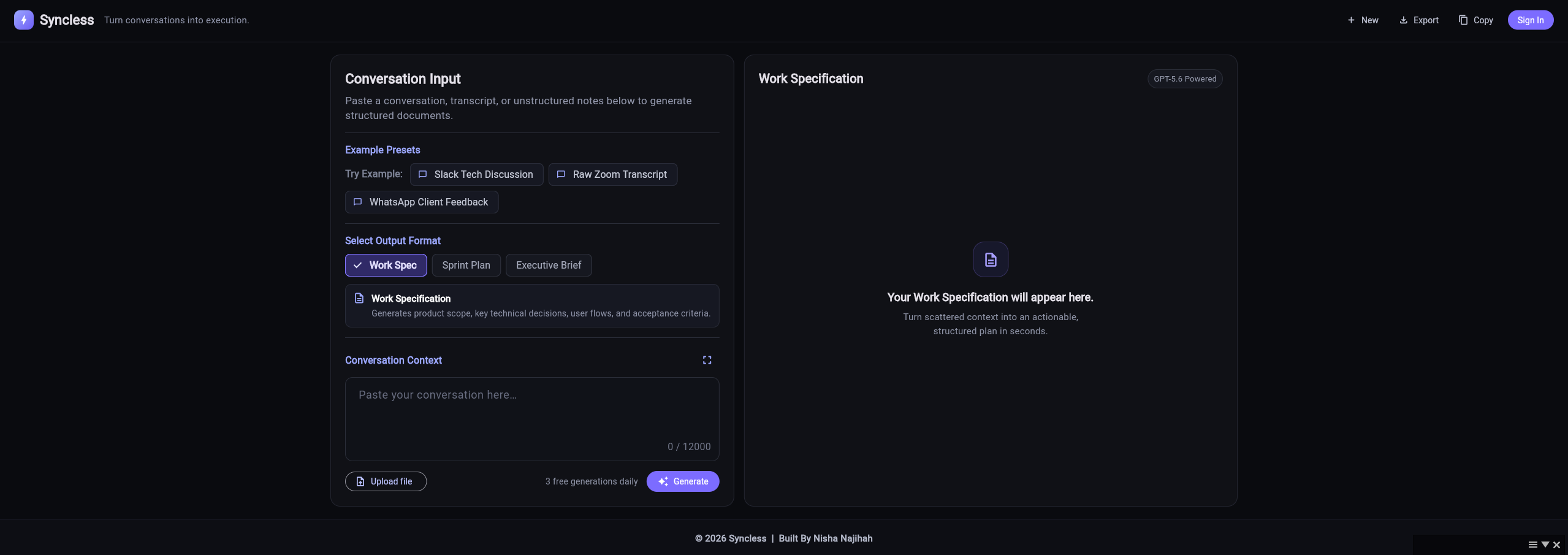
Syncless is an intelligent AI synthesis engine that turns raw meeting transcripts and unstructured notes into three structured execution artifacts:
- Work Specifications: Product scope, technical architectural decisions, user flows, and acceptance criteria.
- Sprint Backlog Plans: Story-point estimated developer ticket breakdowns (title, description, acceptance criteria) ready for Jira or Linear copy-pasting.
- Executive Briefs: High-level summaries, business impact metrics, strategic milestones, and resource estimates for leadership.
Key Highlights:
- Guest-First Workspace Sandbox: Visitors can test example presets, write notes, and explore document modes immediately without annoying upfront sign-up walls.
- Dynamic Format Explanatory Cards: Live helper boxes update in real-time as users switch modes, explaining what each document format produces.
- Fullscreen Context Editor: A dedicated 850x650 modal editor for viewing and editing multi-page transcripts comfortably.
- Top-Sliding Animated Notification Toasts: Custom banner alerts with spring-bounce animation physics (
Curves.easeOutBack) and auto-dismissal. - Resilient Fallback Engine: If upstream AI credit limits or network issues occur during live evaluations, a server-side fallback engine gracefully serves topic-tailored mock documents so testing never fails.
How we built it
- Frontend: Built with Flutter Web using Material 3 dark-first styling and Riverpod 2 for typed, reactive state management.
- Backend: Built with Supabase Edge Functions running on the Deno 2 runtime for secure, serverless execution.
- Database & Security: PostgreSQL 15 with Row Level Security (RLS) and
pg_advisory_xact_locktransaction advisory locking to enforce daily quota limits securely. - AI Core: OpenAI GPT-5.6 Responses API configured with strict JSON Schema enforcement for guaranteed structural output.
Challenges we ran into
- Strict JSON Schema Enforcement: Ensuring that LLM output strictly conforms to nested JSON structures (
confidence,missingInformation,potentialRisks,followUpQuestions) without latency spikes. - Preventing Race Conditions: Stopping concurrent browser tabs or double-clicks from bypassing quota limits, which we solved by implementing PostgreSQL transaction advisory locks.
- Guest-First Routing: Architecting a seamless auth flow where guests can explore all workspace controls freely, but are prompted with an email magic-link popup only when executing protected actions.
- Demonstration Safety: Building an Edge Function fallback layer that catches upstream API error codes (e.g. billing exhaustion or model availability) and seamlessly serves high-fidelity mockups so the app never shows broken screens.
Accomplishments that we're proud of
- Built from Scratch in 1 Day: Designed, developed, and deployed a complete Flutter Web & Supabase Edge platform in a single day for the OpenAI Build Week Hackathon!
- Server-Authoritative Security: Zero client-side API key exposure—all OpenAI and service keys remain strictly on the server.
- WOW-Factor UI & UX: Custom spring-animated top toasts, scaled accessible typography, and dynamic format descriptors.
What we learned
- How to leverage OpenAI's Responses API and strict JSON Schema definitions to get deterministic, typed outputs from LLMs.
- How to write secure serverless Deno functions that proxy requests and protect client-side environments.
- How to design resilient fallback mechanisms that maintain complete UI usability even during external API outages.
- How to control and monitor ChatGPT API usage, manage developer spend limits, and implement user-level quotas to prevent platform abuse.
- And most importantly, that software development is a continuous journey—we are still learning and expanding our knowledge with every build!
What's next for Syncless
- 1-Click Integrations: Direct push to Jira, Linear, Notion, and GitHub Issues.
- Audio Transcript Ingestion: Direct audio processing from recorded Zoom, Google Meet, and Teams calls.
- PDF & DOCX Export Engine: Executive print layout generation for offline distribution.
- Visual Architecture Diagrams: Auto-generating Mermaid.js sequence and flow diagrams alongside Work Specifications.
Built With
- cloudflare
- codex
- flutter
- gemini
- openai
- supabase
- vscode

Log in or sign up for Devpost to join the conversation.