Inspiration
Many students face the challenge of keeping up with their coursework, and institutions like Stanford offer support through various resources. Often, classes provide both lecture slides and videos. While slides offer a quick reference, they sometimes lack context, making them hard to understand without additional explanations. Videos, conversely, provide detailed explanations but can be time-consuming due to unnecessary content. Imagine a solution that merges these resources into a cohesive learning tool.
What it does
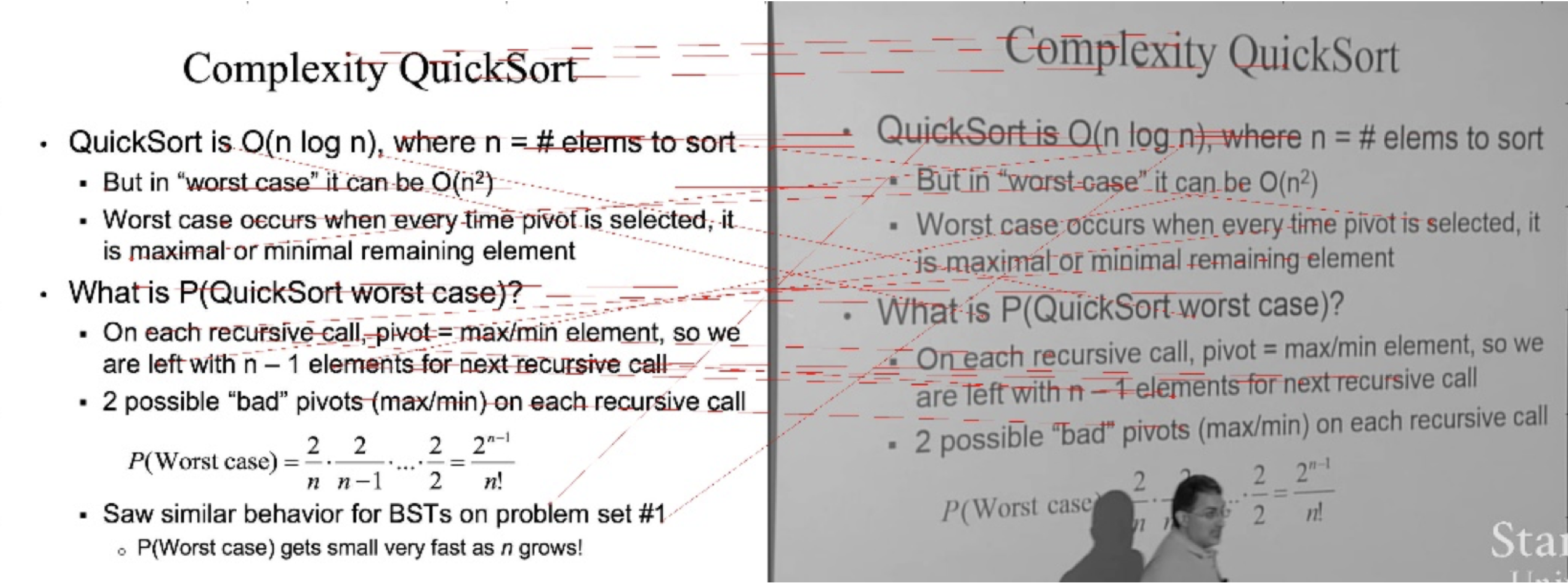
Introducing "SyncLecture," a platform that links lecture videos and slides, enabling students to effortlessly switch between them. When the slides become complex, a student can simply click on a slide to jump to the corresponding video segment where the concept is explained. This integration streamlines the use of class notes, slides, and videos, enhancing study efficiency with a single click.
How we built it
To create SyncLecture, we began by extracting slides from lecture notes using ImageMagick and key frames from videos with ffmpeg. We then employed SIFT for slide recognition in video frames and OCR for text comparison between slides and frames. Combining these techniques, we achieved a reliable mapping between slides and video segments with 90-95% confidence.
Challenges we ran into
Ensuring high accuracy was paramount, yet difficult due to poor video quality or unclear slides. Initially, neither image processing nor OCR provided satisfactory results alone; however, their combination improved performance. A significant breakthrough was achieved by leveraging the sequential order of slides, utilizing dynamic programming to optimize accuracy effectively.
Accomplishments that we're proud of
Our proudest achievement is the high accuracy of SyncLecture, attained with minimal prior experience in image processing. We also developed an intuitive user interface that simplifies the navigation between videos and slides, significantly enhancing the learning experience.
What we learned
We learned that obstacles are inevitable in technology development—from navigating poorly documented libraries to solving complex problems. Despite these challenges, our team's perseverance led to innovative solutions.
What's next for SyncLecture
Our next goal is to enhance the speed of the image processing algorithm, ensuring SyncLecture remains a fast and efficient tool for students.

Log in or sign up for Devpost to join the conversation.