-
-
MainPage
-
Introduction1
-
Introduction2
-
Introduction3
-
Function1
-
Function2
Inspiration
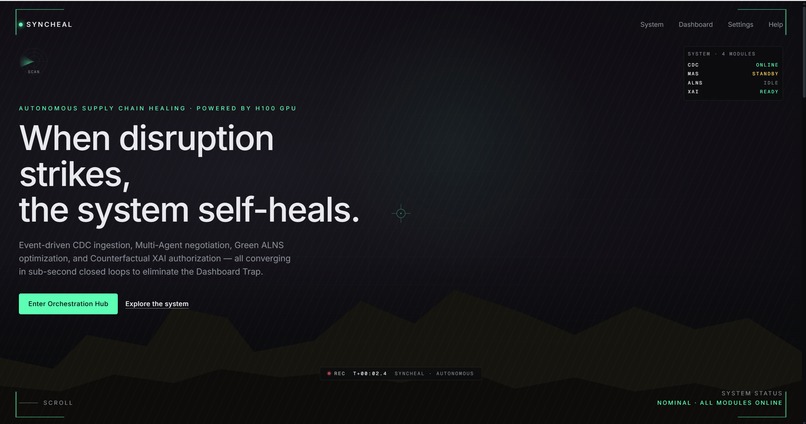
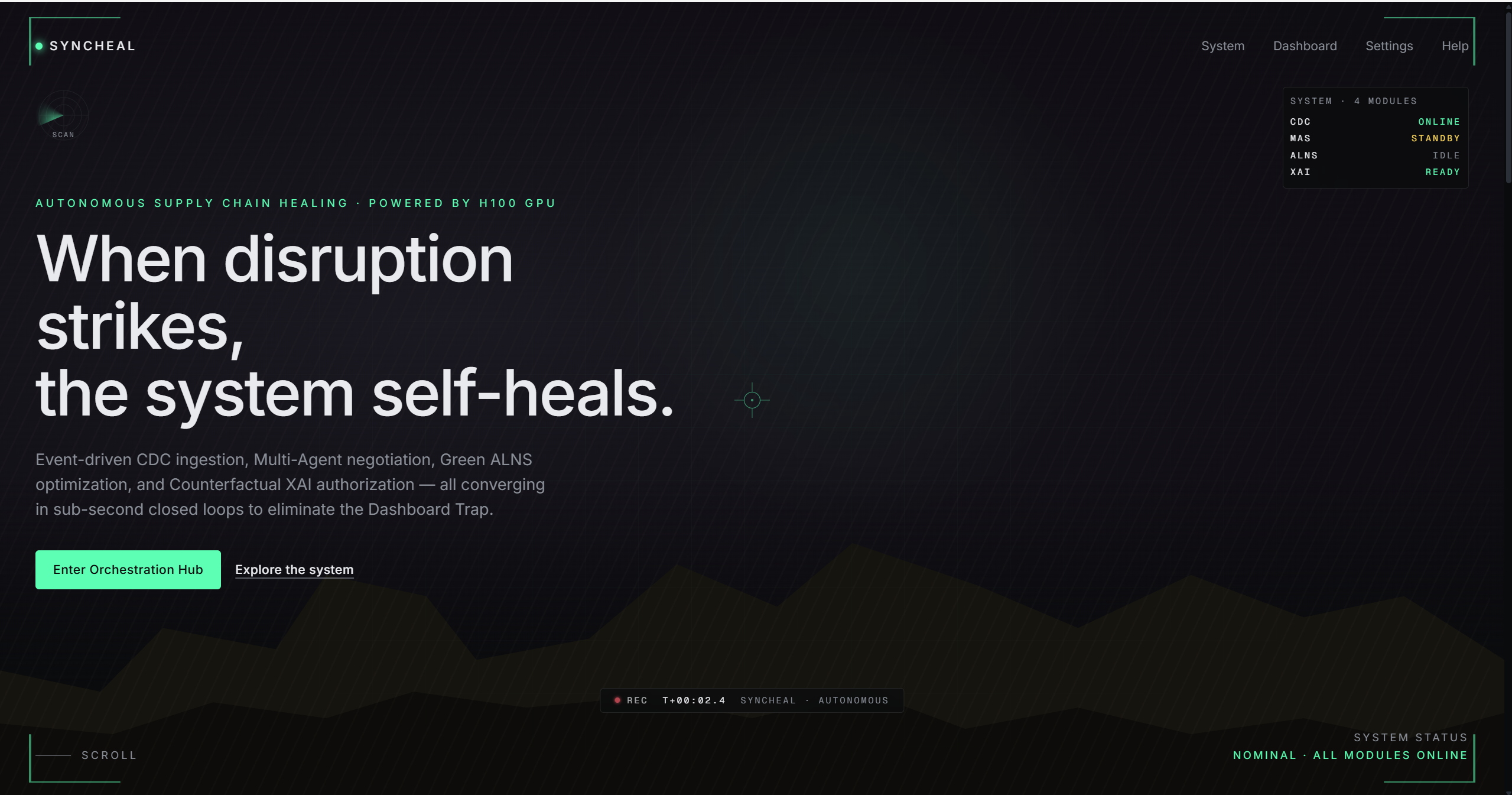
Modern supply chains are fragile, non-linear topology graphs. When a port stalls or a storm hits, today's "control towers" do one thing well: they show you a dashboard while the damage cascades. Gartner calls this the Dashboard Trap — lots of descriptive analytics, zero autonomous execution, no sustainability awareness. We wanted to flip a control tower from something that watches disruptions into something that heals them.
What it does
SyncHeal is an autonomous, "self-driving" recovery layer for logistics networks. The closed loop runs in seconds:
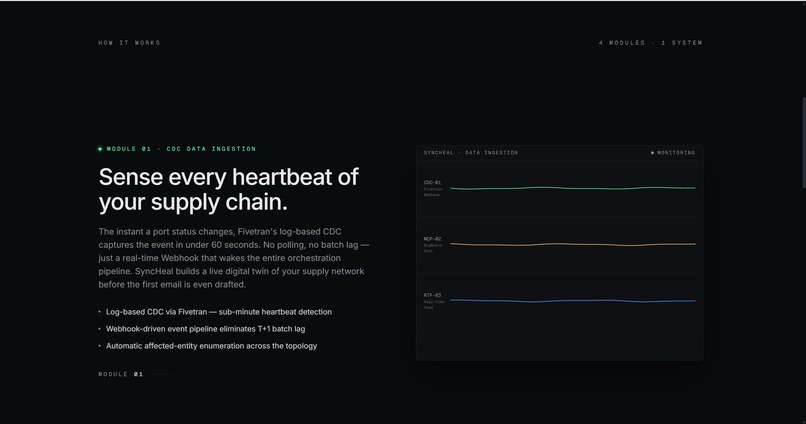
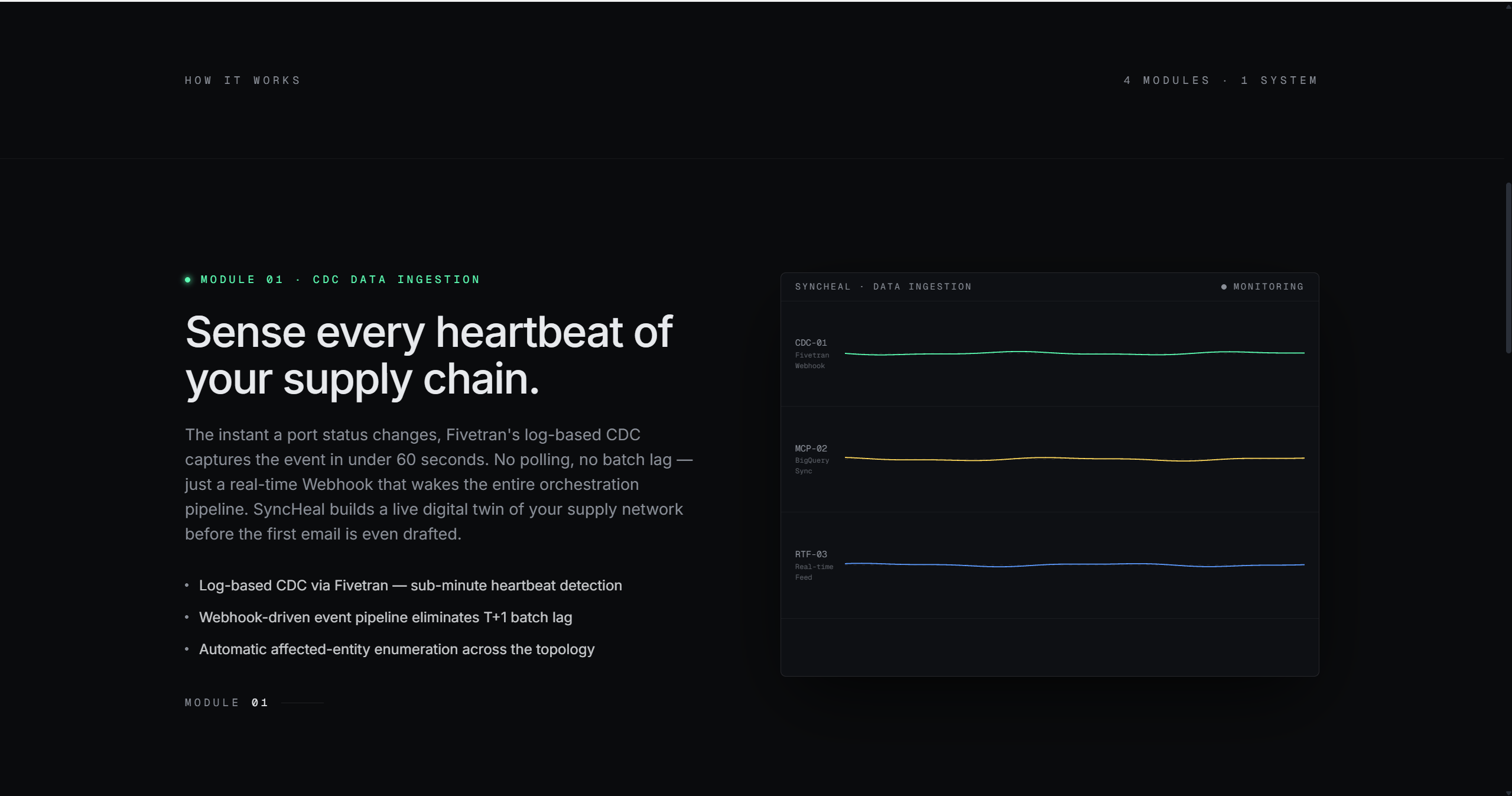
- Sense — Log-based Change Data Capture via Fivetran detects a disruption in under a minute (event-driven webhooks, not T+1 batch polling).
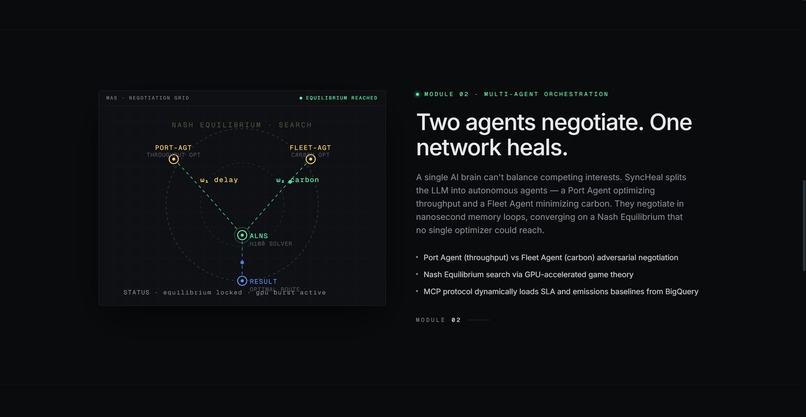
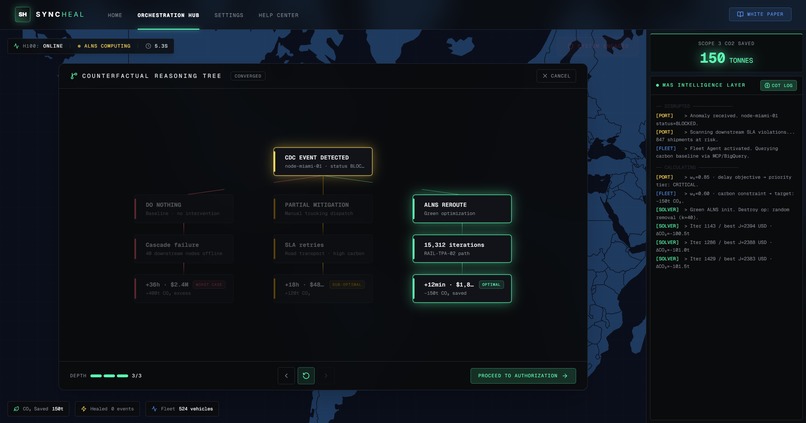
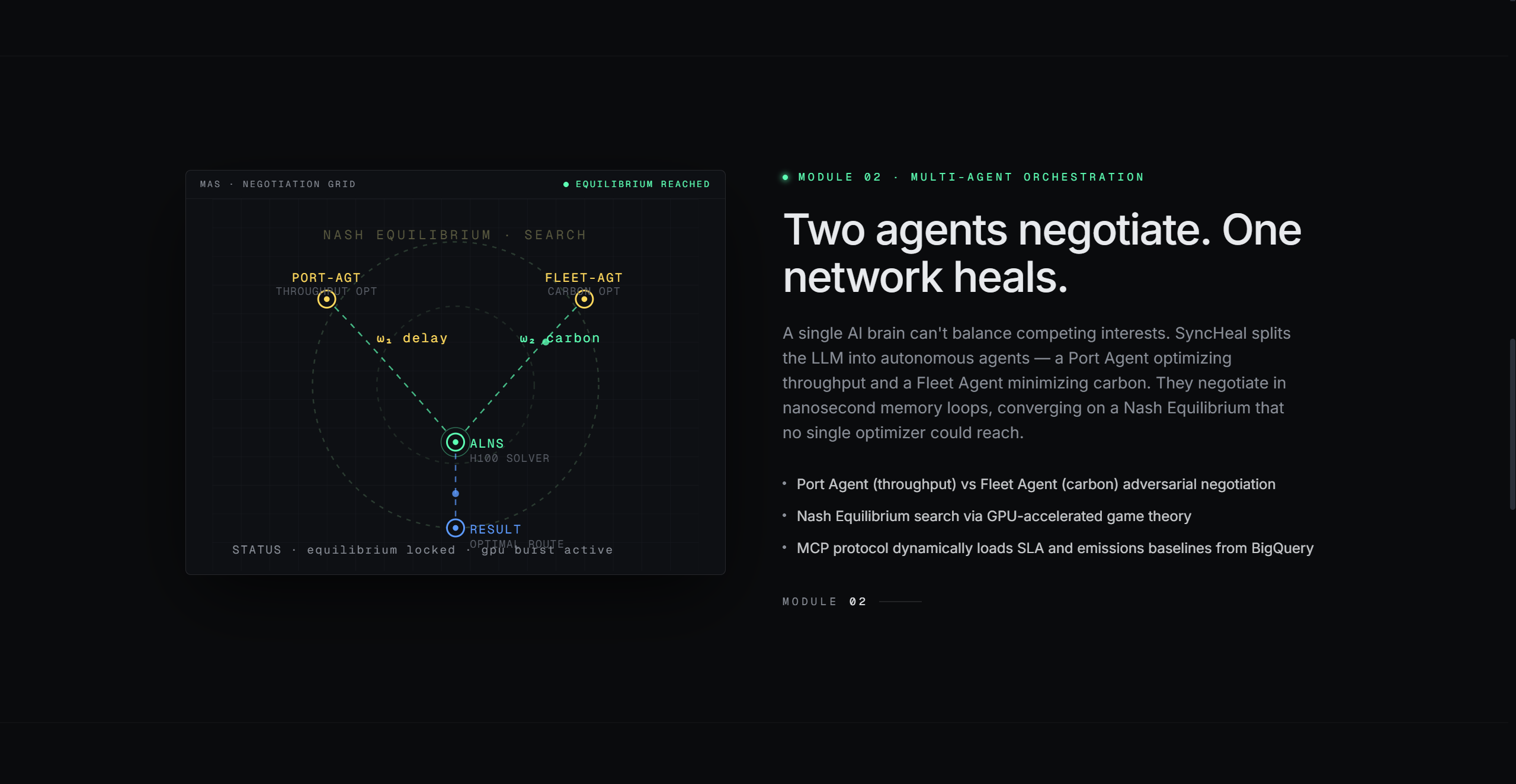
- Reason — A Multi-Agent System splits the LLM into stakeholders: a Port Agent (throughput) and a Fleet Agent (carbon) negotiate to a Nash Equilibrium, pulling SLA + emissions baselines from BigQuery over MCP.
- Solve — A Green ALNS solver runs 15,000+ destroy/repair iterations on A100 GPUs, minimizing a multi-objective cost that makes Scope-3 carbon a first-class penalty term, not an afterthought.
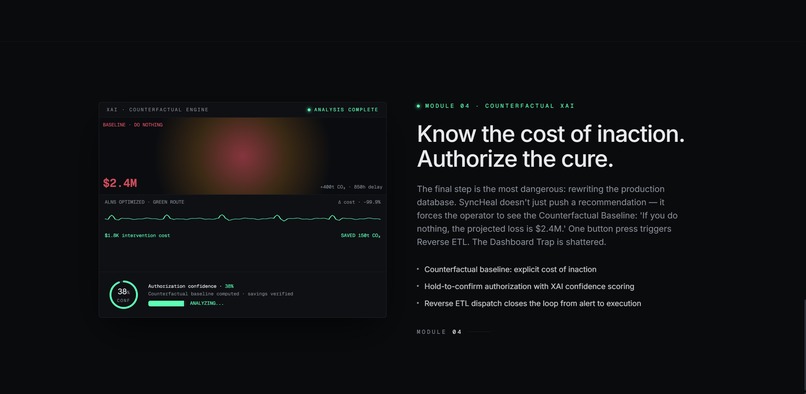
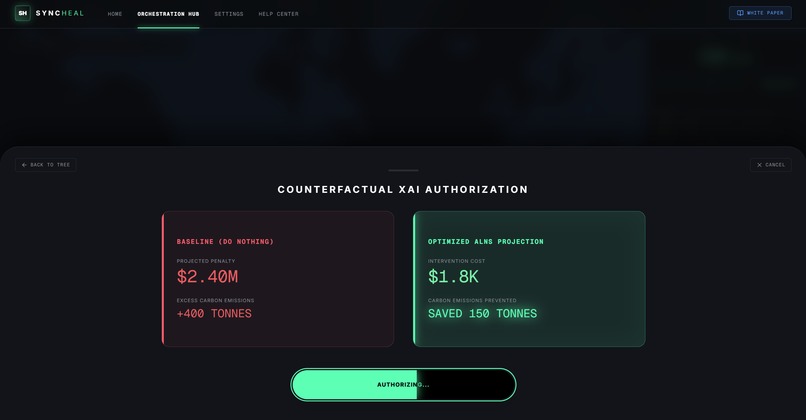
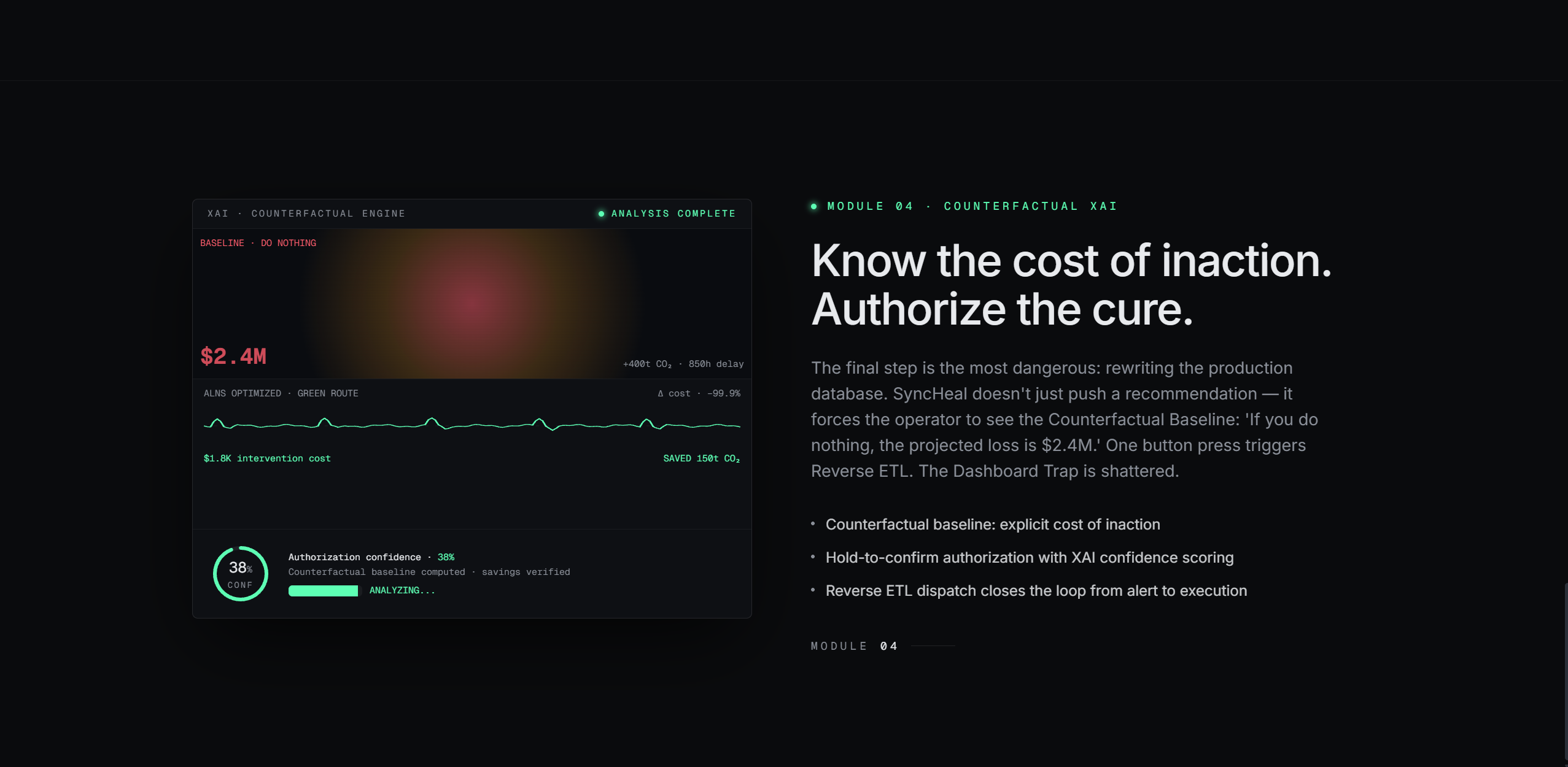
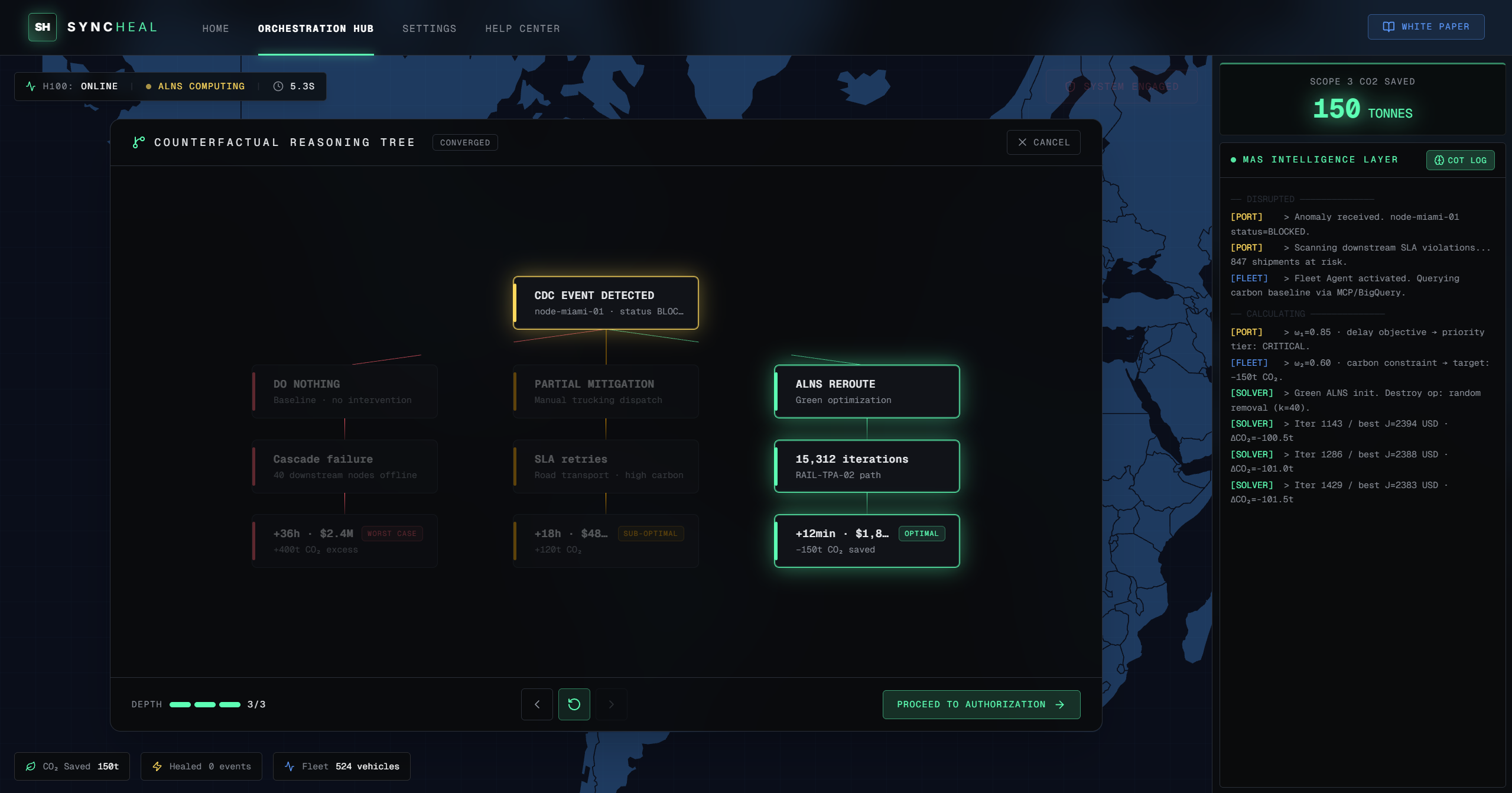
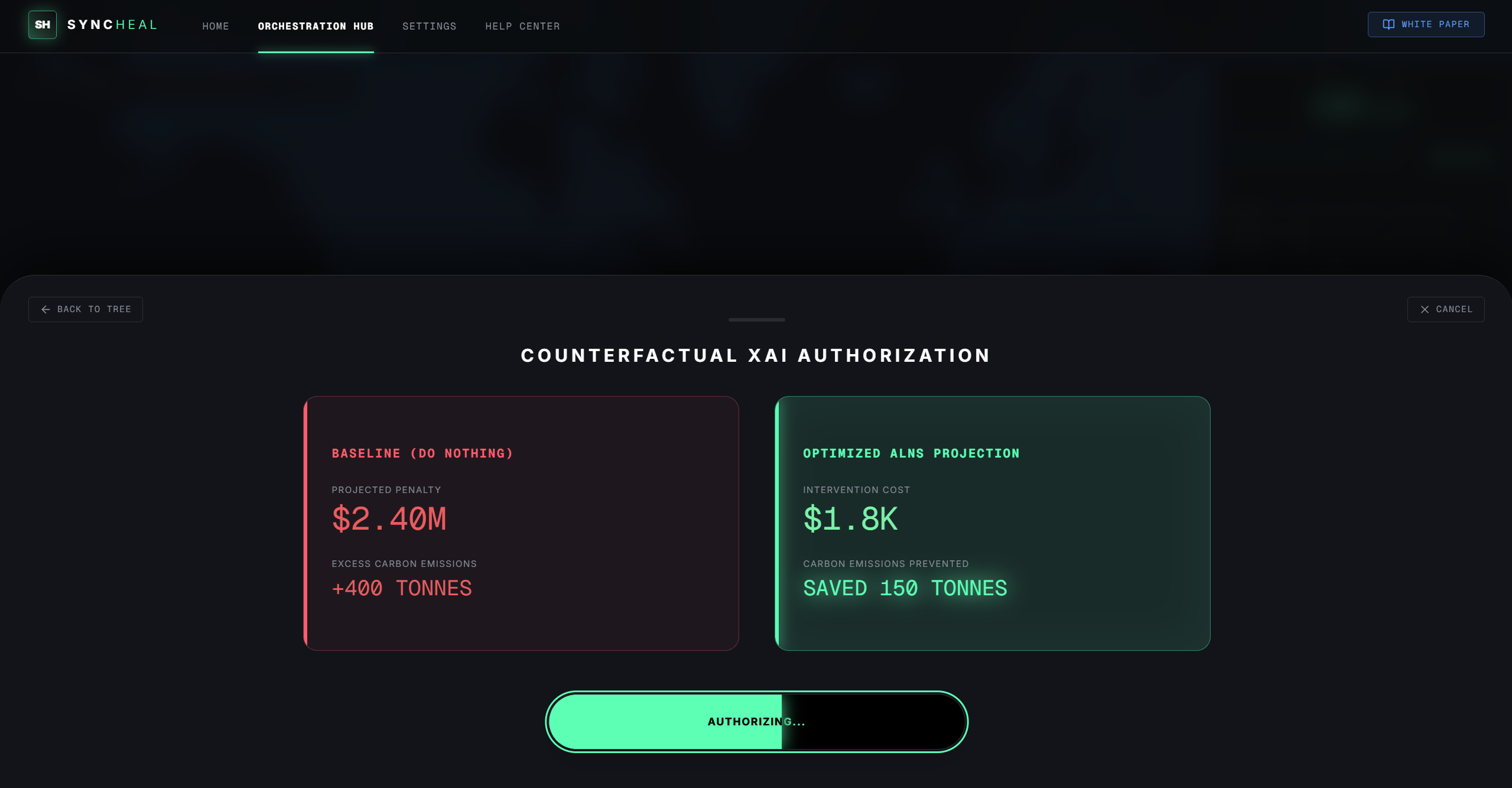
- Explain & Execute — A Counterfactual XAI panel shows the human exactly what doing nothing costs ($2.4M, +400t CO₂) vs. the optimized reroute ($1,800, −150t CO₂). One hold-to-confirm authorization triggers a Reverse ETL write-back that re-routes the fleet for real.
The objective the solver minimizes:
$$\min Z = \sum_{k \in K}\sum_{(i,j)\in A}\big(c_{ij}x_{ij}^k + \alpha\, e_{ij} x_{ij}^k\big) + \sum_{i \in V} p_i \cdot \max(0,\, t_i^k - l_i)$$
where \( \alpha \) is the environmental cost coefficient on Scope-3 emissions \( e_{ij} \).
How we built it
- Frontend: React 19 + Vite + Tailwind CSS, an interactive deck.gl WebGL fleet map, an XState finite-state machine driving the full disruption→heal lifecycle, and an interactive counterfactual reasoning tree with manual playback controls.
- Ingestion: Fivetran log-based CDC → webhook event pipeline.
- Intelligence: Gemini-based multi-agent negotiation, MCP for dynamic context loading from BigQuery.
- Optimization: Green ALNS heuristic solver on NVIDIA A100.
- Execution: Counterfactual ChatOps authorization → Reverse ETL to the production database.
Challenges we ran into
- Designing a multi-objective function where carbon is a real constraint, not decoration — and keeping ALNS convergent under O(N!) state explosion when N > 500.
- Making the reasoning explainable and reversible: the operator can step through the counterfactual tree, go back, and cancel — autonomy with a human firmly in the loop (HRO principle).
- Rendering a 500+ vehicle live fleet without tanking the browser.
Accomplishments we're proud of
- A genuine sense → reason → solve → execute closed loop, not just a dashboard.
- Carbon savings quantified per decision (Scope-3 tonnes), surfaced at the moment of approval.
- A counterfactual XAI authorization UX that a real logistics manager could trust.
What we learned
Prescriptive autonomy only earns trust when it's explainable and undoable. The counterfactual baseline ("here's the cost of doing nothing") is what turns an AI suggestion into an authorized action.
What's next for SyncHeal
Live Fivetran connectors to real WMS/TMS databases, RL-tuned ALNS operators, and a multi-region digital twin.
Built With
- bigquery
- deck.gl
- fastapi
- fivetran
- framer-motion
- gemini
- google-cloud
- mcp
- python
- react
- react-router
- reverse-etl
- slack
- tailwindcss
- typescript
- vercel
- vertex-ai
- vite
- xstate

Log in or sign up for Devpost to join the conversation.