-
-
Logo
-
Concept
-
Prototype design
Our response to the need for large scale SARS-CoV-2 testing
The seed of our project resides in the need for massive testing for the SARS-CoV-2 virus in order to provide the authorities with strong and reliable data to combat the epidemic. The fast spread of this pathogen has found many governments unprepared, and, as of this moment, massive testing of the population is not possible for many countries. Although life-endangered patients should be given testing preference for obvious reasons, this approach is clearly not the optimal strategy as it does not provide us with complete information regarding the actual prevalence of the virus in the general population: from patients with lesser symptoms to asymptomatic population carrying the virus, many citizens are not included in the positive numbers, thinning the statistics and making impossible the determination of the real spread of the COVID-19 for the authorities.
A possible solution for this problem can be found in the analysis of wastewater, as virus components can often be found in the feces of the infected ones. Controlling the presence of the virus in sewage holds great potential as it allows non-intrusive testing for large amounts of people, with one treatment plant sometimes receiving waste from up to more than a million citizens. This approach could be invaluable in the monitoring of the virus during the current pandemic and become a great surveillance method to detect its possible come back in the future. Wastewater testing for SARS-CoV-2 has already been carried out, with positive results, in countries such as the Netherlands, Sweden or the United States.
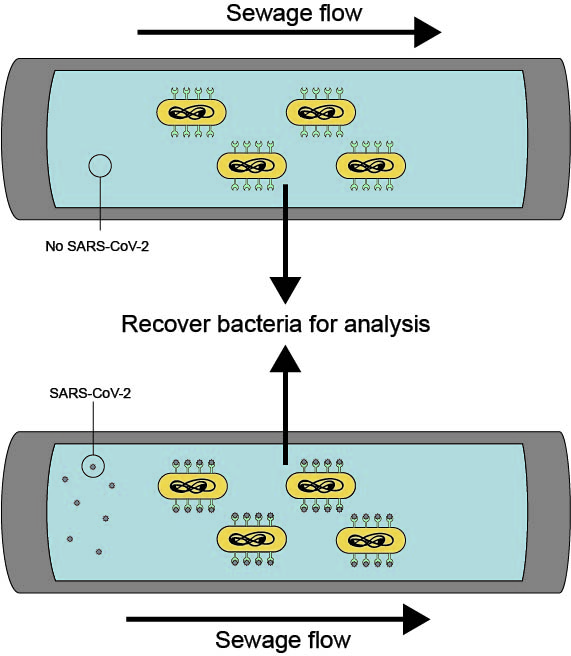
To address this sewage monitoring approach, we were inspired by the Synthetic Biology work of “Programming Controlled Adhesion of E. coli to Target Surfaces, Cells, and Tumors with Synthetic Adhesins” (Piñero-Lambea et al. 2015 ) developed in our lab. In this work the authors describe the generation of an engineered non-pathogenic Escherichia coli bacteria able to specifically bind targets containing a specific antigen. This was accomplished by the incorporation of “Synthetic Adhesins” (SAs) on the bacterial membrane, that confers specific binding to the desired antigen. In short, SAs are chimeric proteins generated by fusing a bacterial membrane protein and a camelid antibody (termed nanobody). This system makes the engineered bacteria display the antibody in their surface, which lets them bind the corresponding antigen for the antibody.
While the cost of production and purification of specific antibodies, especially monoclonal antibodies for standardized testing, can range between hundreds to thousands of euros, the production of these bacteria is trivial, and its cost, negligible.
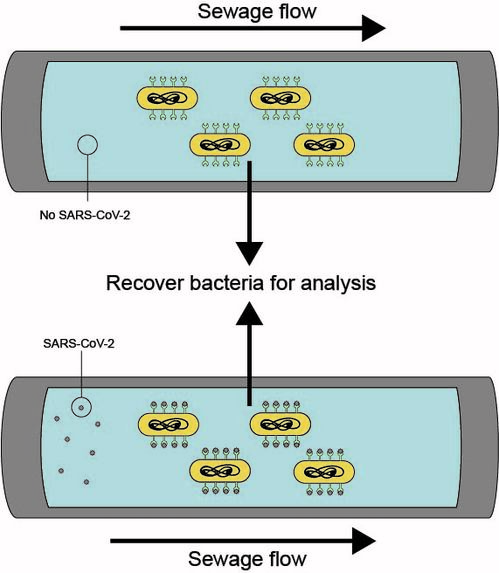
The modular design of this technology allows for easy modification of the targeting: changing the binding target could be as easy as switching the antibody gene for any other antibody sequence desired. This inspired us to think about the possibility of generating non-pathogenic bacteria that bind to SARS-CoV-2 in solution. These bacteria could be used for the immobilization of the virus in sewage, where E. coli is already one of the main bacteria species, or other liquid environments where the virus could be present in very small amounts. Retrieved bacteria would next be processed for virus detection purposes.
The strength of this project resides in the fact that bacteria could be easily cultured and at a really low cost, making the large-scale implantation of this system simple and affordable for any government or private company. Furthermore, due to the modularity of the SAs in the future this system could easily be extended to monitor different virus or other health markers.
So, how does it work?
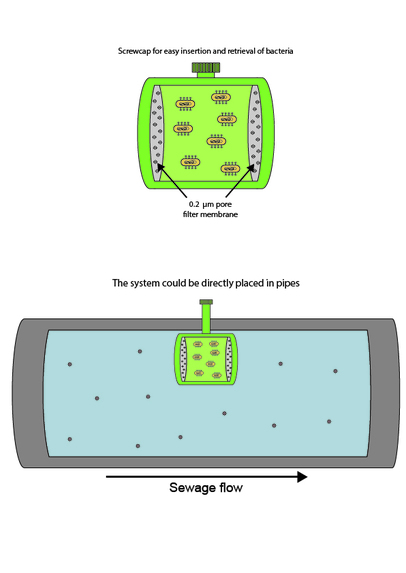
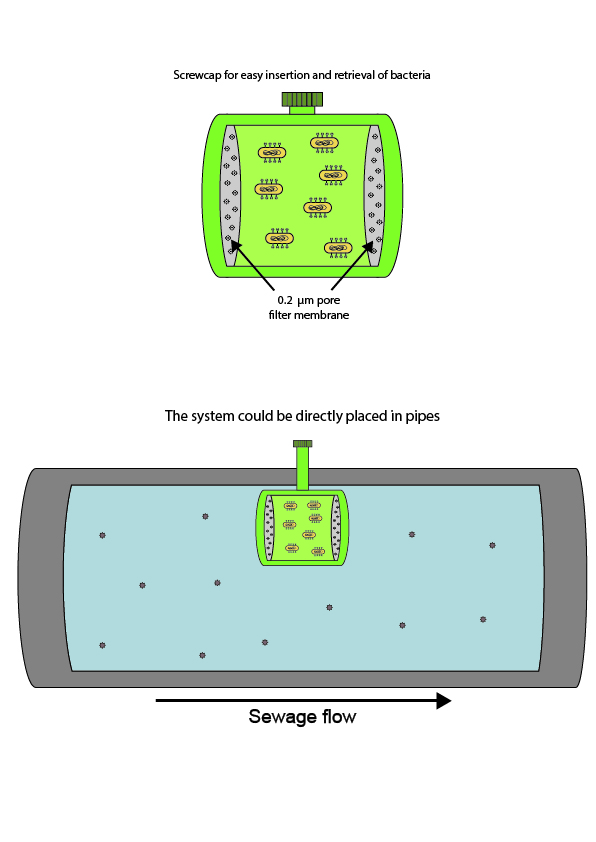
The device that we have planned to engineer would be composed by a filtrating chamber where genetic engineered bacteria with the ability to specifically attach SARS-CoV-2 would be hold.
A liquid culture of our engineered bacteria could be grown in just hours with simple and inexpensive equipment. This liquid culture is next placed into a filter chamber through a tight a screwcap. The chamber only communication with the outside environment is a membrane with a pore of 0.2 micrometer in each ending. This pore is too small for bacteria, trapping inside our engineered E. coli and isolating them from other species, however, the SARS-CoV-2, whose particles are between 50 to 200 nm, could easily flow through it. With the device tightly closed, the operator would place it inside a liquid sample of sewage or other potential virus containing fluid.
If the virus is present in the sample, the bacteria would specifically attach to it, trapping it into the chamber. Afterwards, the chamber now containing the virus would be sent to clinical labs for detection of the virus. This analysis could give very relevant information about the presence of the virus for instance in sewage water coming from public or house buildings even if the presence of the virus is very low. This information could be used by public health authorities to determine spots where the virus is present and take measures trying to identify contagious communities selectively.
We could even be more ambitious and generate a device that could be incorporated into sewage water flow and automatically concentrate the virus. Afterwards, the device would be removed and analyzed as we described with the manual way. Moreover, the chamber could be even engineered to allow retrieval of the bacteria without removal of the device for a simpler continuous use by designing a closing system in each end to stop the flow through the chamber and a pump circuit to introduce and recover the bacteria.
And how would we build it?
The new bacterial strain would be constructed by standard genetic engineering methods in our laboratory. The process would be trivial as the modular structure of the Synthetic Adhesins is designed for easy substitution of the nanobody. Candidate sequences can be obtained from current and future academic literature, but they could also be obtained by generation of immune libraries from scratch, which is also a common procedure for us. The candidate strains specific binding to SARS-Cov-2 antigens would be confirmed by different techniques such as ELISA or flow cytometry using conjugated antigens. In the case of newly generated nanobodies techniques such as Surface Plasmon Resonance could be used to further characterize the binding characteristics.
Once bacteria have been confirmed to bind the viral antigens, the next step would consist in the construction of a functional filtrating chamber prototype. With the simplicity of the device being one of the main advantages of the project, the creation of a prototype would be an easy task: 0.2 micrometer filter membranes are available commercially at low price and the main structure of the chamber could be 3D printed with the desired specifications. The complete structure would be tested to ensure that no liquid is able to penetrate the chamber unless it flows through the filters. Next, we would also test the chamber containing bacteria culture to guarantee that no bacterium is able to escape the structure, a crucial requirement in order to not lose our bacteria but also to assure the containment of this modified strain.
The final steps would require testing the device for its planned function. Initial tests would introduce the bacteria filled chamber into solutions containing different known antigen concentrations for different periods of time. Afterwards, the bacteria would be recovered and tested to check attached virus in each condition of time and concentration, allowing us to characterize the optimal operation conditions for our system. Other interesting conditions such as temperature and salinity could also be tested.
Finally, the device would be tested with real samples such as wastewater, diluted fecal samples and other liquids that may contain SARS-CoV-2. Results would be compared to traditional testing methods.
Our laboratory is placed in the Spanish National Centre for Biotechnology, where currently several research groups are already working with SARS-CoV-2. Thus, we have access to the facilities and resources required for working with a virus of this characteristics such as a P3 laboratory and the correct personal protection equipment for this biosafety level. In order to obtain samples, as well as guidance regarding the virus, the aforementioned groups can be contacted.


Log in or sign up for Devpost to join the conversation.