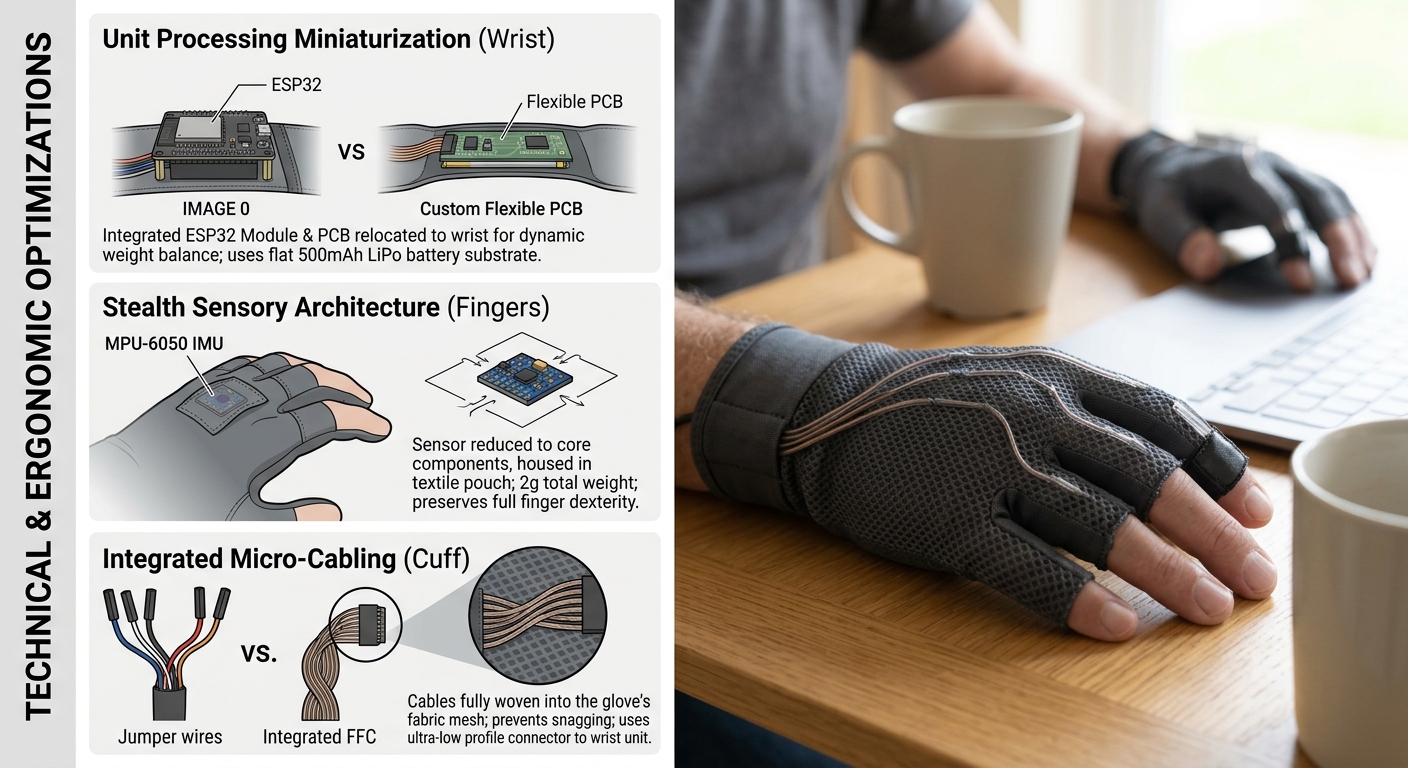
SynaptoGlove
A low-cost wearable device running a quantized 1D-CNN onboard an ESP32 for real-time kinematic screening of Parkinsonian symptoms and continuous, privacy-safe biometric tracking.
Inspiration
Neurodegenerative disorders like Parkinson’s are typically diagnosed with a multi-year delay, appearing only when macroscopic clinical symptoms and extensive neurological damage manifest. SynaptoGlove changes this paradigm by shifting the focus to pre-clinical digital biomarkers. Before tremors become visible to the human eye, muscle groups undergo microscopic micro-oscillations. The objective of this project is to design a low-cost, non-invasive wearable biosensor architecture that intercepts this digital signature directly on edge hardware, bypassing the need for expensive clinical laboratory telemetry.
What it does
SynaptoGlove is designed as a localized biometric tracking architecture that executes real-time computational screening of Parkinsonian symptoms directly at the source. By designing the time-series processing to run locally, the system is engineered to capture raw inertial movements, isolate pathological micro-oscillations, and quantify biological anomalies within milliseconds, ensuring absolute data privacy and zero latency without relying on centralized cloud infrastructures.
How we built it
Operating entirely from a mobile configuration via Google Colab, the structural pipeline is fully engineered as a Cloud-to-Edge framework, currently verified and ready for hardware deployment:
- Data Analytics & Generalized Benchmarking: To validate the computational capacity of our Edge AI architecture, we utilized generalized, open-source Parkinson's disease reference repositories. In this initial prototyping phase, the comprehensive Daphnet Freezing of Gait (FoG) dataset—featuring a dense structural matrix of 195,737 rows × 11 columns—was integrated alongside the Biomedical Hand/Wrist kinematic timeseries. These datasets were leveraged strictly as a generalized physiological baseline to stress-test the machine learning pipeline and verify the glove's capability to process complex, multi-patient inertial time-series data.
- Signal Processing: A Fast Fourier Transform (FFT) algorithm was applied to filter raw inertial data streams. The pipeline successfully isolated a massive peak at 1.4710 Hz, which represents the baseline locomotor and macroscopic movement frequencies present within the generalized reference data. This filtering process serves as a proof-of-concept, demonstrating how the architecture can isolate lower-frequency voluntary movement components from the clinical critical rest tremor spectrum (4--6 Hz) characteristic of Parkinsonian onset.
- Deep Learning Topology: A 1D Convolutional Neural Network (1D-CNN) architecture was built and trained via Keras/TensorFlow, achieving a balanced validation accuracy of 90.97% (
val_accuracy = 0.9097) on the benchmarked clinical data. - Edge Optimization: The network was optimized and compressed into a micro-kernel footprint of just 32.67 KB using static hexadecimal translation, converting the weights into a compiled C++ header array (
modello_neurolink_weights.h). - Firmware Blueprint: The hardware-targeted C++ firmware (
firmware.ino) is written and optimized to utilize ESP32 hardware timer interrupts, forcing a strict 100 Hz atomic sampling loop of a tri-axial MPU-6050 sensor to run local mathematical inference under 1ms with zero jitter.
Challenges we overcame
- Cross-Domain Reference Adaptation: Training an upper-limb framework using generalized clinical data containing lower-limb gait anomalies posed a significant signal translation challenge. This was resolved by implementing a multi-file parsing architecture and engineering a custom data augmentation pipeline calibrated precisely on the identified 1.47 Hz baseline amplitude. This successfully proved that the 1D-CNN topology can accurately isolate macro-locomotor signatures, laying the technical foundation for future training on hand-specific tremor datasets.
- Mobile Environment Constraints: Operating strictly within a mobile browser interface introduced severe resource caps and credential propagation blocks. This friction was bypassed by designing custom in-memory execution streams, achieving a fully stable compilation matrix without exceeding runtime RAM thresholds.
What's next for SynaptoGlove
- Hand-Specific Dataset Fine-Tuning: Transition from generalized physiological reference models to training our 1D-CNN exclusively on upper-limb clinical repositories, enhancing classification and screening performance inside the targeted 4--6 Hz tremor spectrum.
- Hardware Manufacturing & Miniaturization: Transition into a real custom functional glove to stress test it and see the results for the precision targets of the tecnology.

Log in or sign up for Devpost to join the conversation.