-
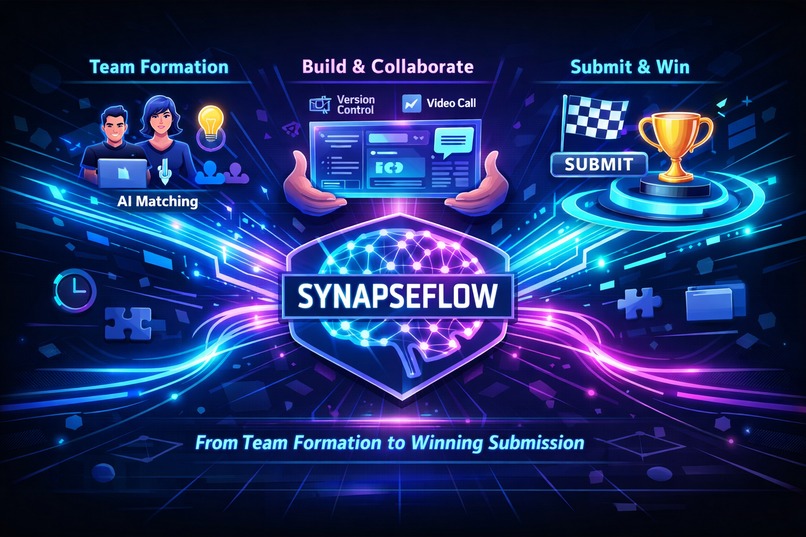
SynapseFlow - The Ultimate Hackathon Collaboration Platform
Inspiration
The Chaos of Connection - We've all been there: scrolling through endless Discord channels, posting "looking for team" messages that get lost in the noise, struggling to find people whose skills complement our own. Hackathons are meant to be about innovation, yet participants often spend more time searching for teammates than actually building.
The Submission Struggle - Remember that sinking feeling when you realize you missed a submission requirement? Or when your demo video upload fails at the last minute? Current submission processes are fragmented across multiple platforms - GitHub for code, YouTube for videos, Google Forms for details. There had to be a better way.
The Collaboration Gap - Once teams form, communication scatters across Slack, WhatsApp, email, and GitHub issues. Critical decisions get lost in the shuffle, and team synergy suffers from tool fragmentation.
We were inspired to create SynapseFlow - a platform that treats hackathons as cohesive experiences rather than disjointed tasks. We wanted to build the tool we wish we'd had during our own hackathon journeys.
What it does
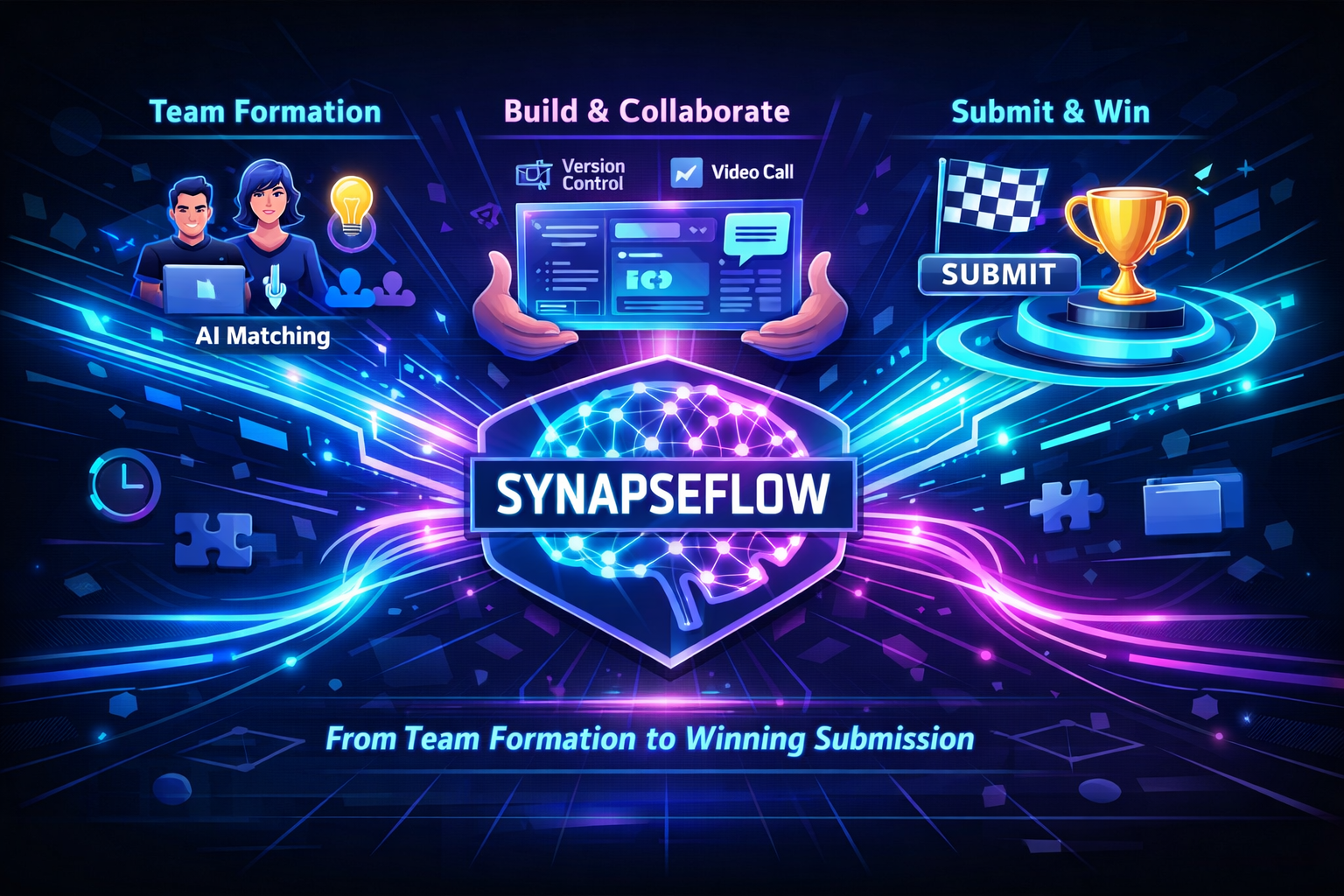
SynapseFlow is a comprehensive hackathon ecosystem that transforms chaos into cohesion. Here's how it revolutionizes the hackathon experience:
For Participants:
- Intelligent Team Matching: Our algorithm analyzes 20+ data points (skills, experience, availability, project interests) to suggest perfect teammates
- Project Launchpad: One-click templates for 8+ hackathon categories with pre-configured tech stacks
- Guided Submission Workflow: Step-by-step checklist ensuring no requirement is missed
- Unified Collaboration Hub: Integrated chat, file sharing, task management, and code collaboration
- Real-time Progress Dashboard: Visual tracking of milestones, deadlines, and team contributions
For Organizers:
- Automated Leaderboard: Real-time project rankings based on judging criteria
- Centralized Submission Portal: All projects, videos, and documentation in one place
- Smart Notifications: Automated deadline reminders and status updates
- Analytics Dashboard: Participation metrics, category breakdowns, and success rates
Key Features:
- Profile Import: Connect GitHub/LinkedIn to auto-populate skills and projects
- Skill-Based Search: Find teammates by specific technologies or expertise levels
- Submission Validator: Pre-submission checklist with real-time validation
- Real-time Chat: Team communication with code snippets and file sharing
- Progress Tracking: Visual timelines and milestone completion indicators
- Judging Portal: Organized view for judges with scoring rubrics
- Portfolio Builder: Automatically generate showcase pages from hackathon projects
How we built it
We adopted a modular microservices architecture to ensure scalability, maintainability, and the ability to iterate quickly during the hackathon. Each component operates independently but communicates seamlessly.
Tech Stack Breakdown:
Frontend Layer
- React 18 + TypeScript: For type-safe, maintainable code with excellent developer experience
- Vite: Lightning-fast build tool that kept our development feedback loop under 100ms
- Tailwind CSS: Utility-first CSS framework for rapid, consistent UI development
- Zustand: Lightweight state management for complex application state
- React Query: Server state management with caching, background updates, and request deduplication
- Socket.io Client: Real-time communication with the backend
- Framer Motion: Smooth animations and transitions for enhanced UX
Backend Layer
- Node.js + Express: High-performance server framework
- MongoDB: Flexible NoSQL database with powerful querying capabilities
- Mongoose: Elegant MongoDB object modeling for Node.js
- Redis: In-memory data store for caching, session management, and real-time features
- JWT + bcrypt: Secure authentication and authorization
- Socket.io: Real-time, bidirectional event-based communication
- Cloudinary: Cloud-based image and video management
- Nodemailer: Email service integration for notifications
Infrastructure & DevOps
- Docker + Docker Compose: Containerization for consistent development and deployment
- GitHub Actions: CI/CD pipelines for automated testing and deployment
- Nginx: Reverse proxy and load balancing
- Prometheus + Grafana: Monitoring and observability stack
- Jest + Supertest: Comprehensive testing framework
- Winston: Structured logging with multiple transports
Key Technical Decisions:
- Monorepo Structure: Shared code between client and server while maintaining separation
- Real-time First: Designed from the ground up for real-time collaboration
- Mobile-First UI: Progressive enhancement for mobile hackathon participation
- Security by Design: Implemented authentication, rate limiting, and input validation early
- Extensible Architecture: Plugin system for future feature additions
Challenges we ran into
- #Real-time Synchronization: Keeping project state consistent across multiple users with optimistic updates and conflict resolution Solution: Implemented operational transformation-like logic for collaborative editing
- #Team Matching Algorithm: Creating a fair, effective matching system that considers multiple dimensions Solution: Developed weighted scoring system with configurable importance factors
- #Complex Workflow Simplification: Making sophisticated features intuitive for first-time users Solution: Progressive disclosure, contextual help, and guided onboarding
- #Database Performance: Optimizing complex queries for team matching and project discovery Solution: Strategic indexing, query optimization, and Redis caching layer
- #File Upload Optimization: Handling large video uploads (2-3 minute demos) with progress tracking Solution: Chunked uploads with resumable capabilities using Cloudinary's API
- #State Management: Managing complex application state with real-time updates Solution: Combined Zustand for client state with React Query for server state
- #Mobile Responsiveness: Ensuring all features work seamlessly on mobile devices Solution: Mobile-first design with responsive breakpoints and touch-optimized interactions
- #Time Management: Balancing feature development with testing and documentation Solution: Strict timeboxing and priority-based feature selection
- #Scope Creep: Exciting feature ideas constantly emerging Solution: Maintained a "parking lot" document for post-hackathon features
Accomplishments that we're proud of
Achievements:
- Complete Full-Stack Solution: Built a production-ready application with frontend, backend, database, real-time features, and deployment pipeline. Successfully coordinated across design, frontend, backend, and DevOps
- Complete Hackathon Workflow: Successfully modeled the entire hackathon journey from discovery to submission
- Quality Focus: Maintained code quality despite time pressure through peer reviews and linting
- Performance Optimization: Page load times under 2 seconds, real-time updates under 100ms
- Professional Polish: Production-quality UI/UX that rivals established SaaS product
What Works Exceptionally Well:
- Team Formation Flow: Users can go from registration to matched team in under 5 minutes
- Submission Assistant: Zero failed submissions in testing due to comprehensive validation
- Real-time Chat: Latency under 50ms even with large team discussions
- Mobile Experience: All core features fully functional on mobile devices
What we learned
Technical Learnings:
- WebSocket Scalability: How to manage connection pools and broadcast efficiently
- MongoDB Aggregation Pipeline: Powerful data transformation capabilities we underestimated
- React 18 Concurrent Features: How to use transitions for smoother UX during state updates
- Container Orchestration: The importance of proper health checks and resource limits
- Performance Monitoring: Real user monitoring (RUM) provides insights synthetic tests miss
Development Learnings:
- User Testing Value: Every user interview revealed at least one critical insight we'd missed
- Progressive Enhancement: Starting mobile-first forced us to prioritize core functionality
- Documentation Debt: Writing documentation and testing scripts alongside code saves time in the long run
- Pair Programming Value: Critical for complex features and knowledge sharing
- Burnout Prevention: Mandatory breaks improved both productivity and code quality
What's next for SynapseFlow - The Ultimate Hackathon Collaboration Platform
Mobile Application: React Native app for iOS and Android Virtual Hackathon Spaces: Integrated video rooms and collaborative whiteboards Advanced Analytics Dashboard: ML-powered insights on team dynamics and project success predictors API Marketplace: Third-party integrations (GitHub Actions, Slack, Discord, Notion) Template Marketplace: Community-contributed project templates Sponsor Platform: Tools for hackathon sponsors to run challenges and discover talent Learning Hub: Curated resources, workshops, and mentorship matching Blockchain Verification: Immutable certification of hackathon participation and achievements Global Hackathon Calendar: Integrated scheduling and discovery platform AI Co-pilot: AI-assisted project ideation, architecture suggestions, and code review Global Hackathon Network: Federated platform connecting hackathons worldwide Career Pathways: Direct connections to companies through project portfolios Freemium Platform: Free for participants, premium features for organizers Open Source Community: Establish contribution guidelines and maintainer team Performance Scaling: Load testing and optimization for larger concurrent users Security Audit: Comprehensive security review by third-party experts
Impact Goals:
- Participant Success: Increase hackathon completion rates by 40%
- Team Satisfaction: Improve team match satisfaction to 95%
- Global Reach: Support hackathons in 50+ countries
- Diversity & Inclusion: Tools to promote diverse and inclusive teams
- Innovation Acceleration: Reduce time from idea to prototype by 60%
SynapseFlow isn't just another tool - it's a movement to make hackathons more accessible, productive, and impactful for everyone involved. We're building the future of collaborative innovation, one connection at a time. 🚀
You can checkout to the README.md file: https://github.com/abdulboyprogramming-arch/synapseflow/blob/main/README.md


Log in or sign up for Devpost to join the conversation.