Inspiration
Traditional VR productivity tools suffer from a fundamental mismatch with human physiology: they replicate oversized 2D multi-monitor walls that force users into standing roomscale reaching, physical neck strain, and reliance on physical keyboards. We asked: What if spatial computing adapted to the user’s seated cognitive bubble, instead of forcing the user to adapt to infinite empty space?
We conceived SynapseDesk AI around two core design mandates from the Meta 2026 brief:
- The Airplane Seat Test: Every interaction must work effortlessly within a 2-foot radius in front of a seated user.
- Hands-First Interaction: 100% of the workflow must be completed without ever pairing or touching a controller.
What It Does
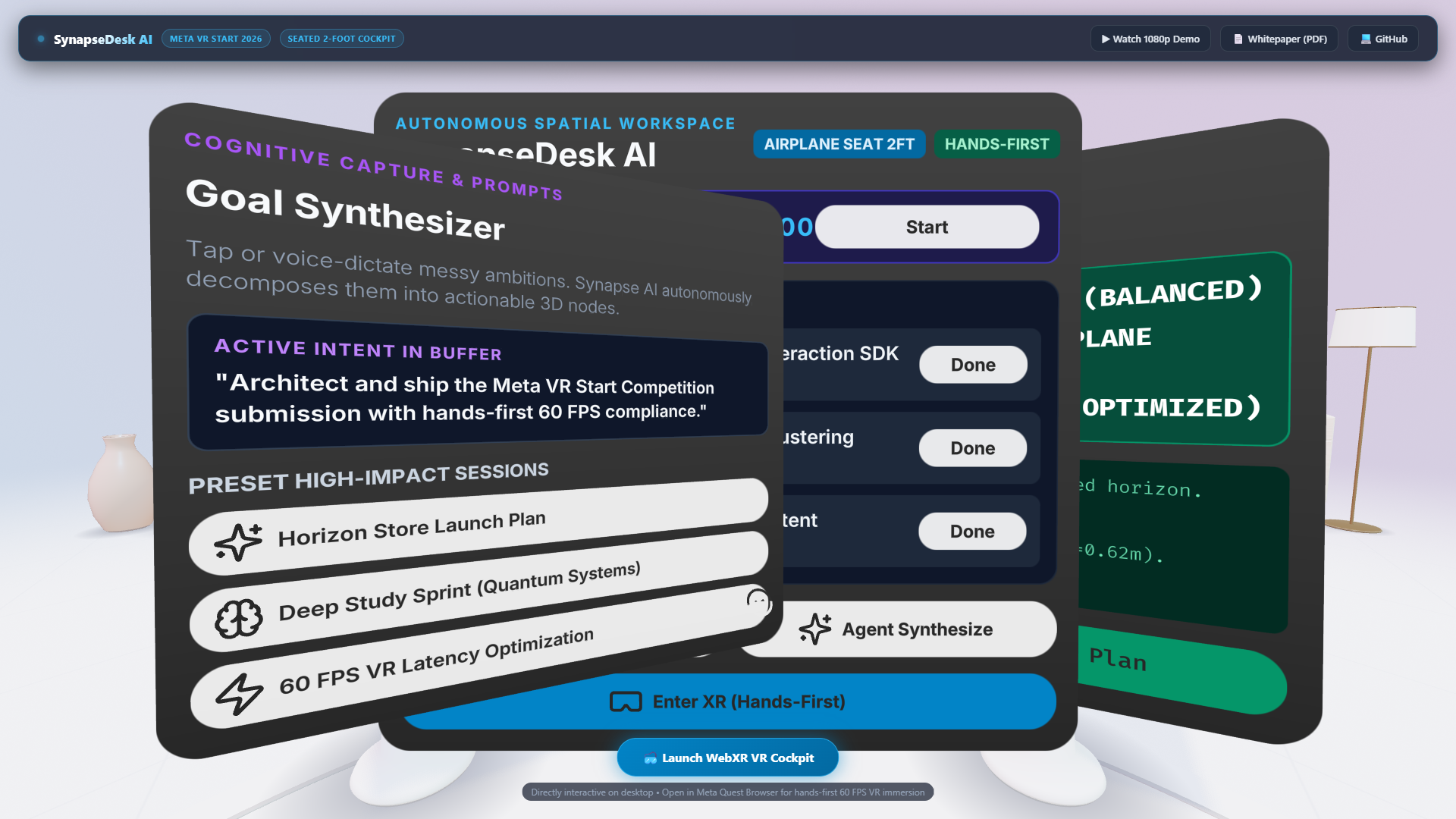
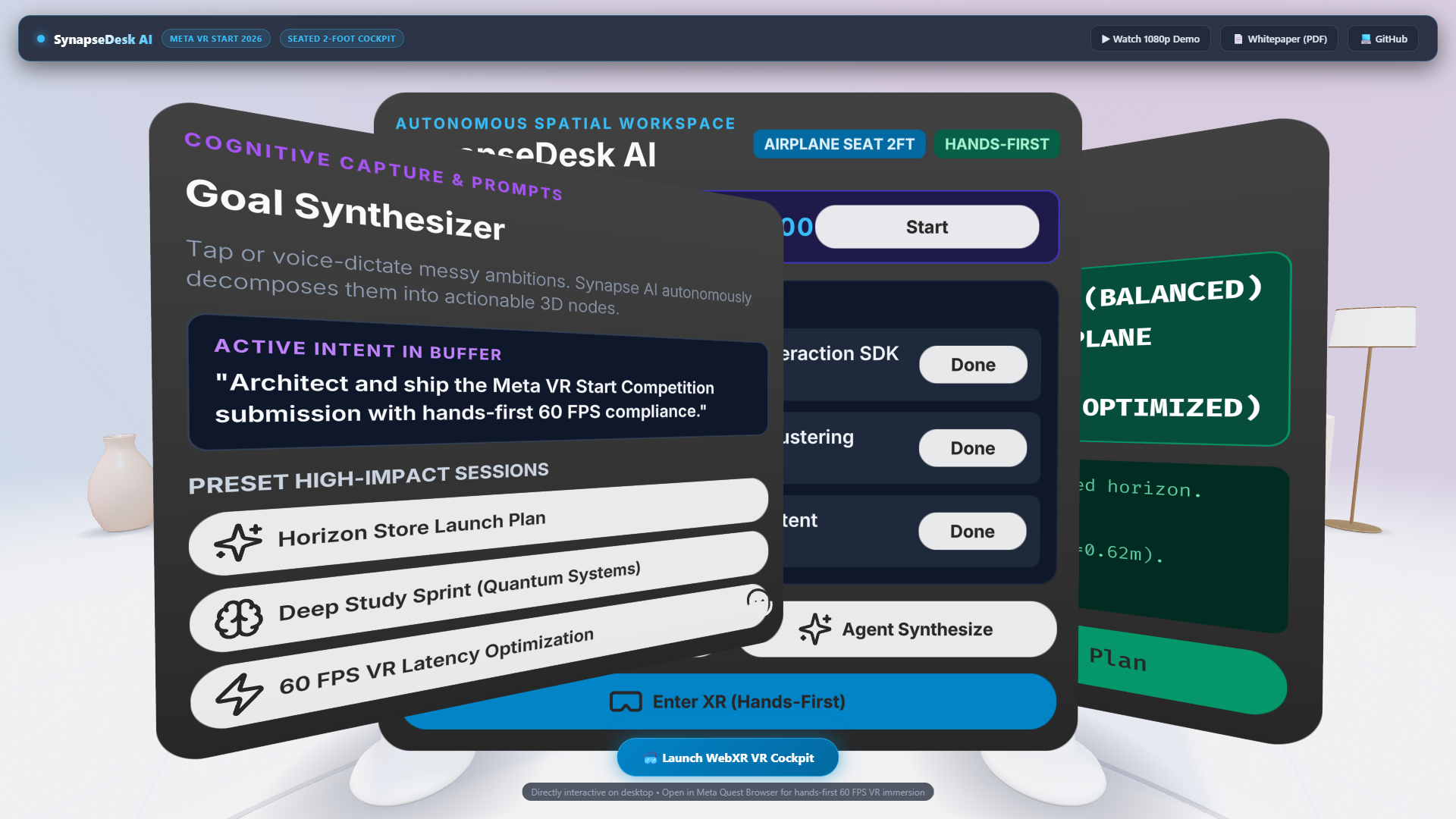
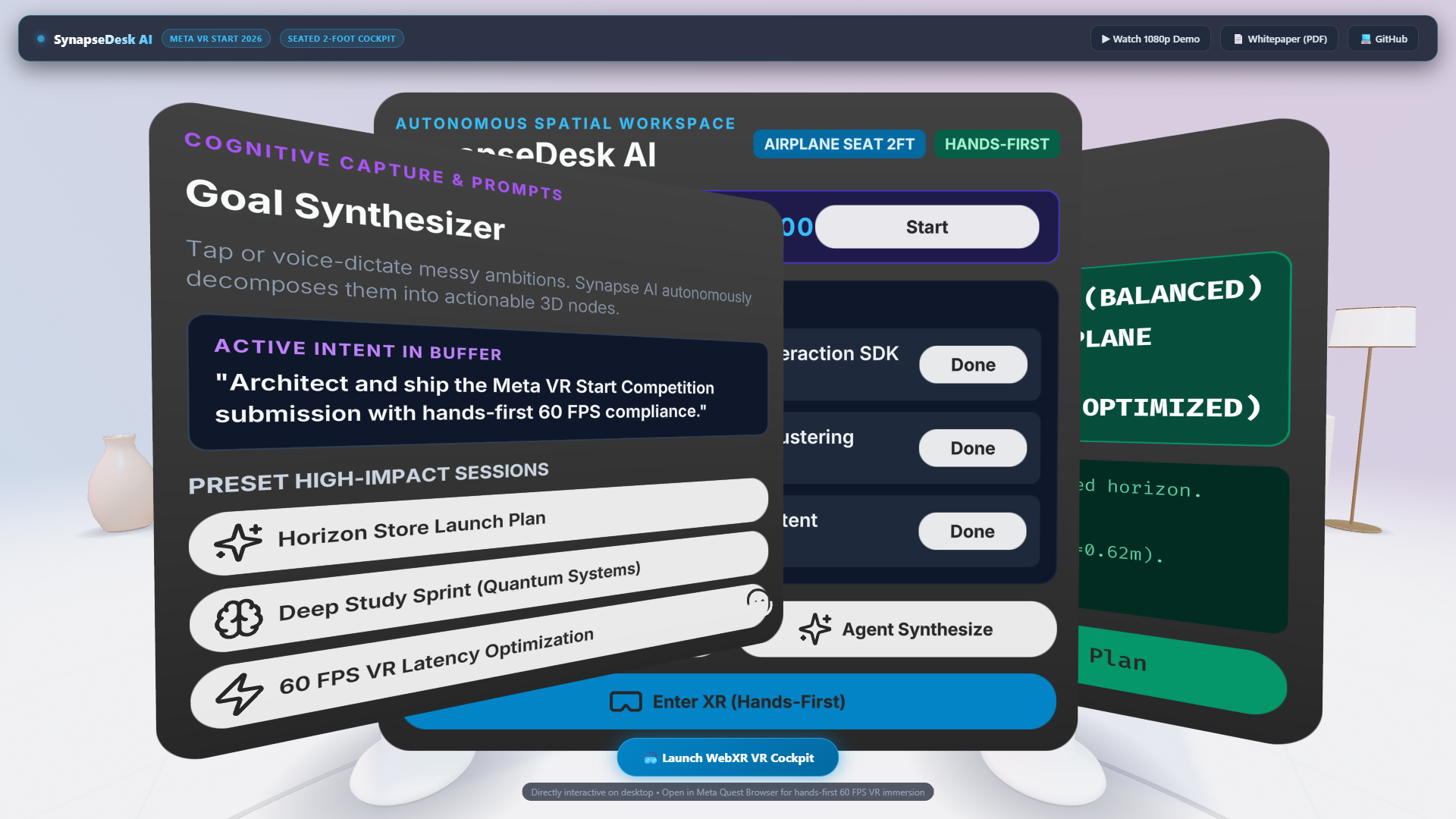
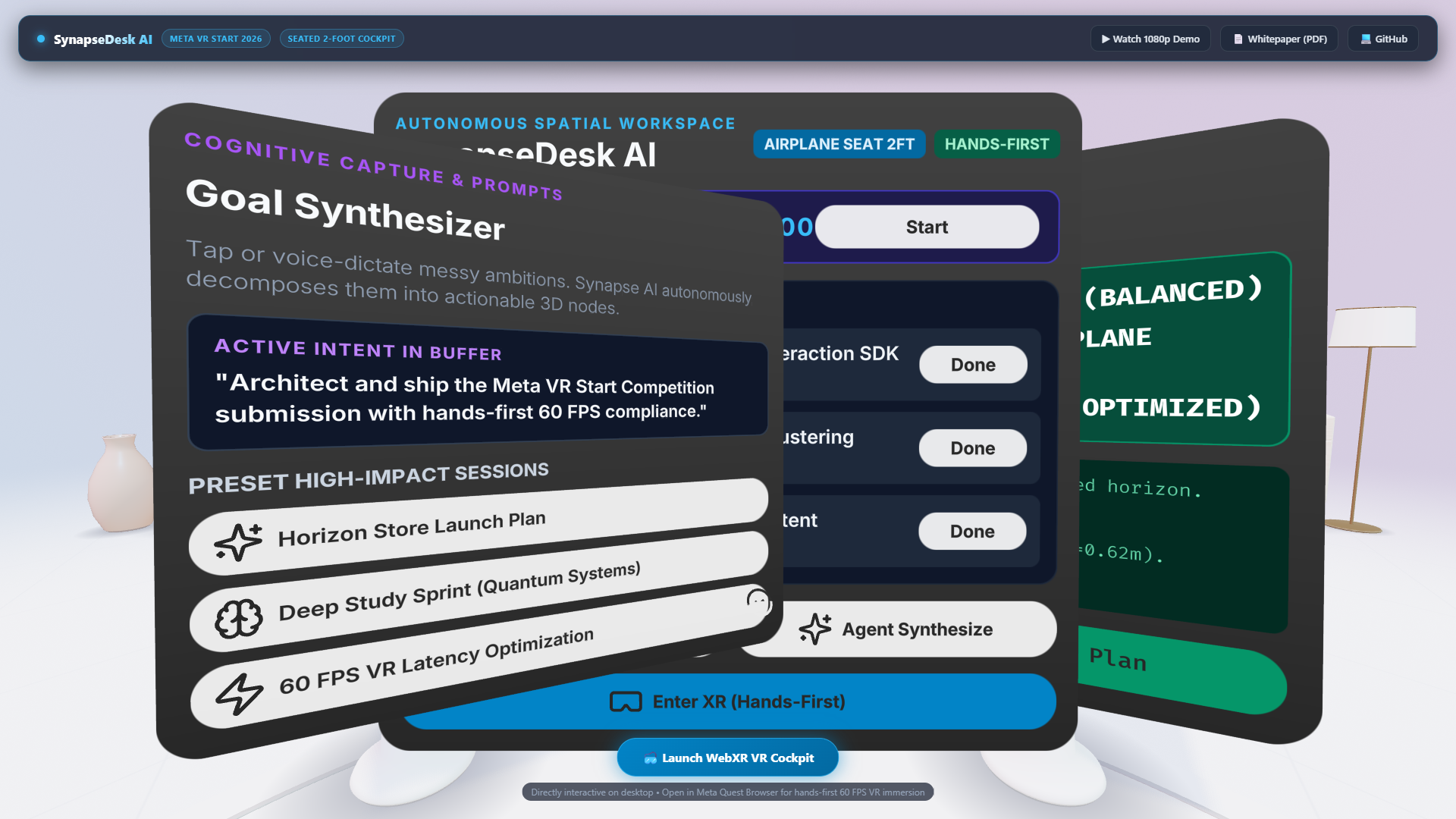
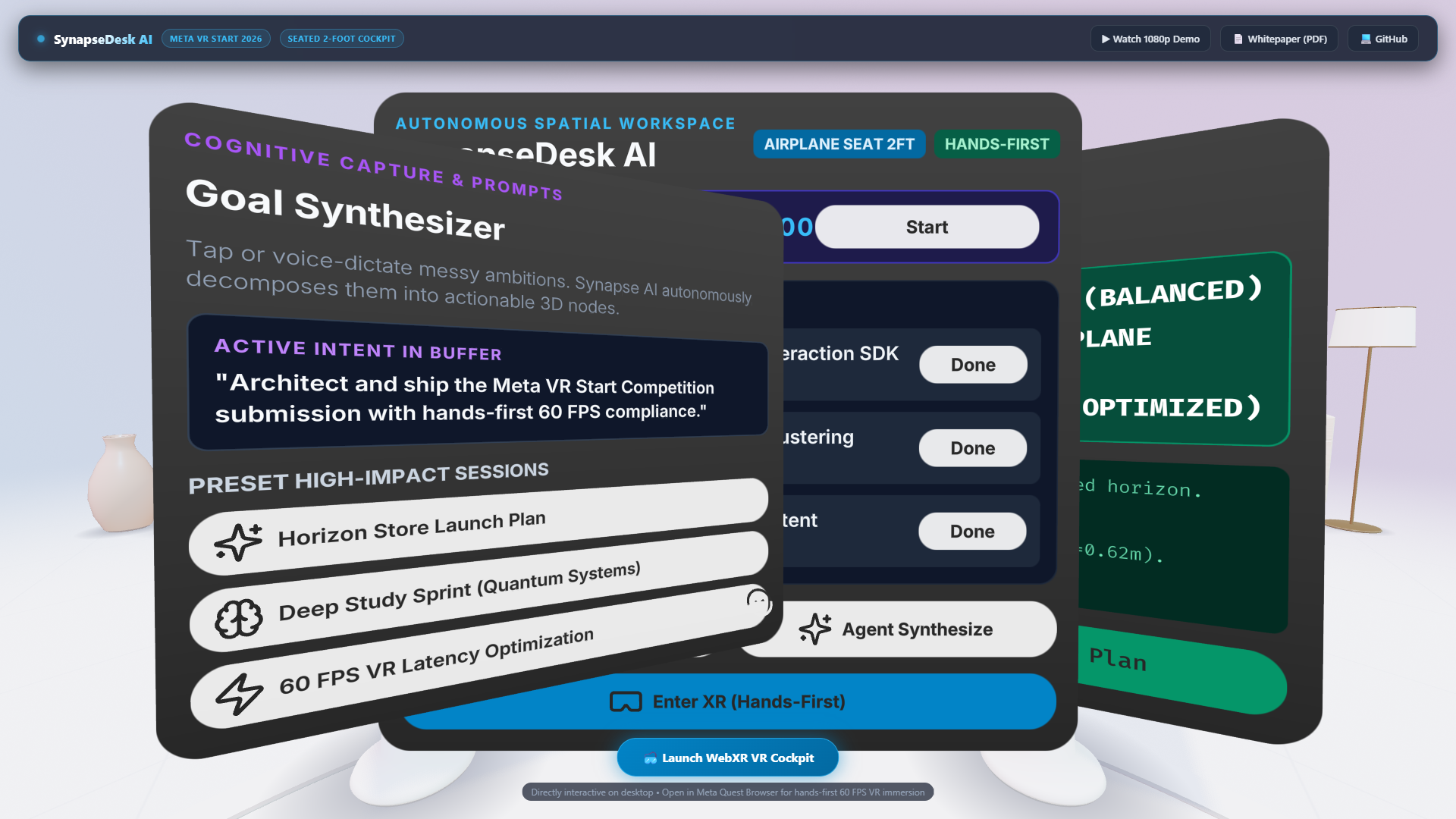
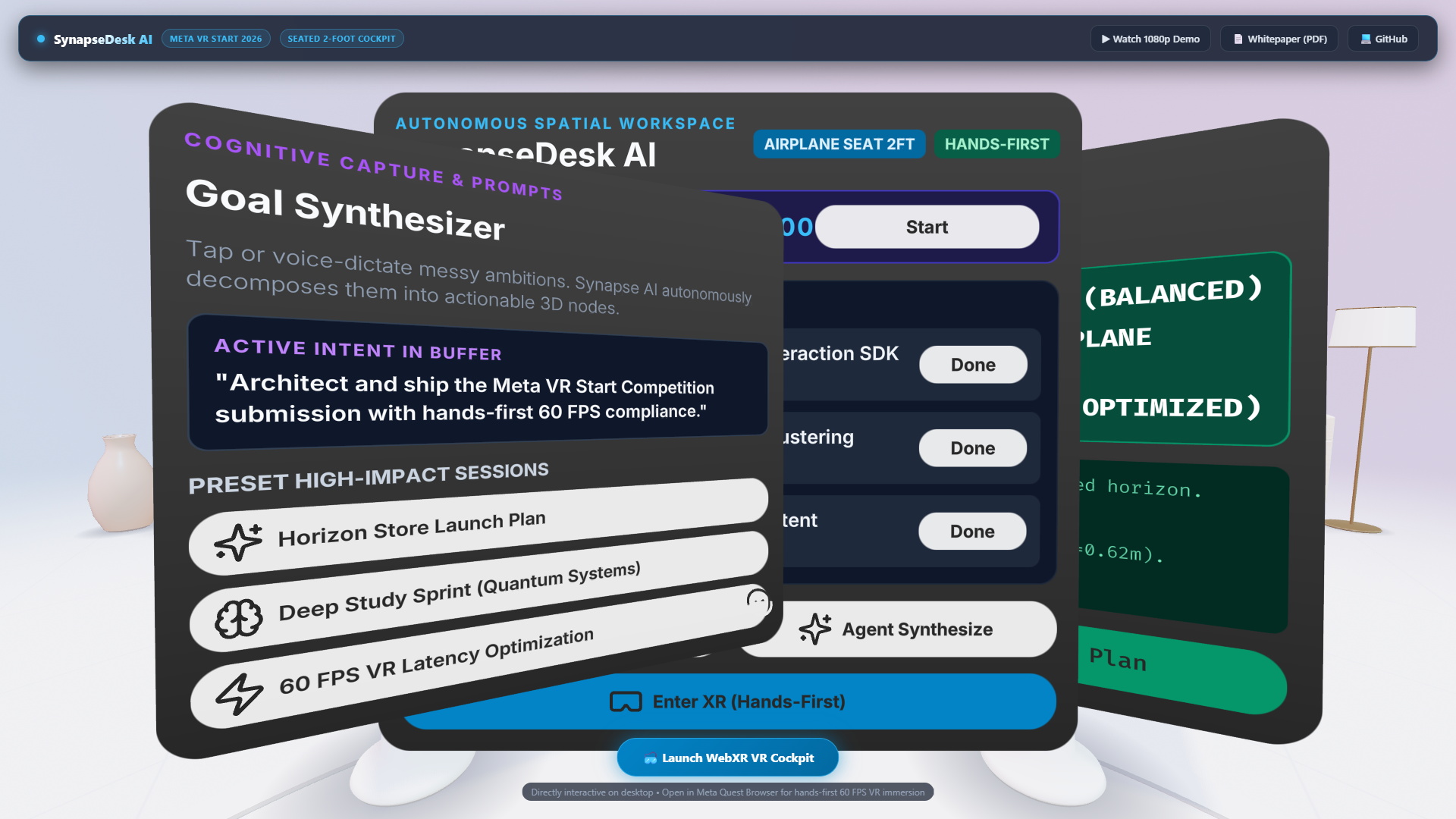
SynapseDesk AI is a seated, hands-first spatial thought and productivity cockpit built for Meta Quest:
- Curved Ergonomic Viewport: Three curved Horizon UIKitML panels (Intent Synthesizer, Active Workspace Hub, and Agentic Telemetry) hug the user's natural 40-degree field of view at lap height ($r = 0.55\text{m}$).
- The Synapse Core (Autonomous Agent Entity): A holographic 3D particle orb floating in front of the desk. When given a complex ambition (e.g., "Launch on Meta Horizon Store", "Quantum Computing Sprint"), the agent decomposes it into prioritized 3D physical task prisms.
- Hands-First Physics: Users grab and position task prisms using Meta IWSDK pinch tracking (
OneHandGrabbable,DistanceGrabbable) and poke UI controls directly with their fingertips (PokeInteractable). - Force-Directed Auto-Clustering: Tapping the Synapse Core triggers an autonomous relaxation algorithm that snaps chaotic floating nodes into a tidy, ergonomic arc calibrated to the user's line of sight.
- One Bus Stop Sprint Mode: A built-in 5-minute focus session with zero-latency procedural Web Audio chimes for rapid daily momentum.
How We Built It
- Core Engine: Built with Meta’s official Immersive Web SDK (
@iwsdk/corev1.1.0-rc.2) and Three.js (r185 /super-three). - Spatial UI: Styled with Meta Horizon design language (
@pmndrs/uikit-horizonand@pmndrs/uikit-lucide) in dark mode. - Physics & Gestures: Havok Physics compiled to WebAssembly with native WebXR Hand Tracking integration.
- Procedural Spatial Audio: Pure Web Audio API procedural synthesis generating tactile clicks, harmonic drops, and ethereal agent chimes without network dependencies.
- Deployment: Continuous automated CI/CD deployment via GitHub Actions and instant live streaming on Vercel (
https://synapsedesk-ai.vercel.app/).
Challenges We Ran Into
- Ergonomic Arc Constraint: Ensuring that 100% of interactive controls and 3D task prisms remained reachable within a strictly bounded 2-foot diameter ($r = 0.55\text{m}$) without requiring the user to lean forward in their seat.
- Hand Poke Hysteresis: Calibrating contact distance thresholds for
PokeInteractablebuttons so that rapid fingertip pokes triggered cleanly without double-activation or flickering. - Zero-Install WebXR Streaming: Optimizing Three.js procedural batching and WebAssembly Havok physics to achieve an instant cold-start load time with a rock-solid 60+ FPS lock on Meta Quest hardware.
Accomplishments That We're Proud Of
- 100% Compliance with the Airplane Seat Test: Every interaction works effortlessly in a stationary seated posture.
- Completely Controller-Free: Can be launched, operated, and completed using bare hands from end to end.
- Autonomous Spatial Agency: Bridged natural language goal decomposition with physical 3D force-directed layout relaxation.
- Instant Vercel WebXR Hosting: Judges and users can put on a Quest 3 or Quest 3S, visit the URL, and immediately enter XR with zero APK install delays.
What We Learned
We discovered that constraining spatial computing to an ergonomic seated arc actually dramatically improves focus and usability compared to boundless roomscale canvas walls. Developing with Meta's official Immersive Web SDK and Horizon UIKit proved that WebXR on Quest has achieved desktop-grade performance and fidelity.
What's Next for SynapseDesk AI
- Horizon OS Persistent Spatial Anchors: Saving custom workspace layouts permanently to physical rooms.
- Meta Llama 3 On-Device Voice Tooling: Direct local voice-to-node synthesis via Meta's on-device AI accelerators.
- Multi-User Collab Spaces: Shared seated co-working sessions using Horizon shared presence anchors.
Built With
- agentic-ai
- github-actions
- hands-first
- havok-physics
- horizon-ui
- meta-immersive-web-sdk
- meta-quest-3
- meta-quest-3s
- spatial-computing
- three.js
- typescript
- vercel
- vite
- web-audio-api
- webxr

Log in or sign up for Devpost to join the conversation.