-
-
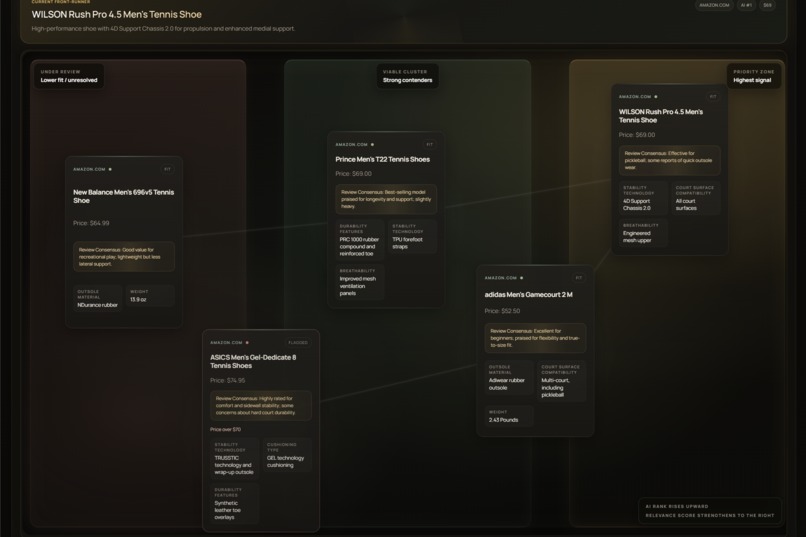
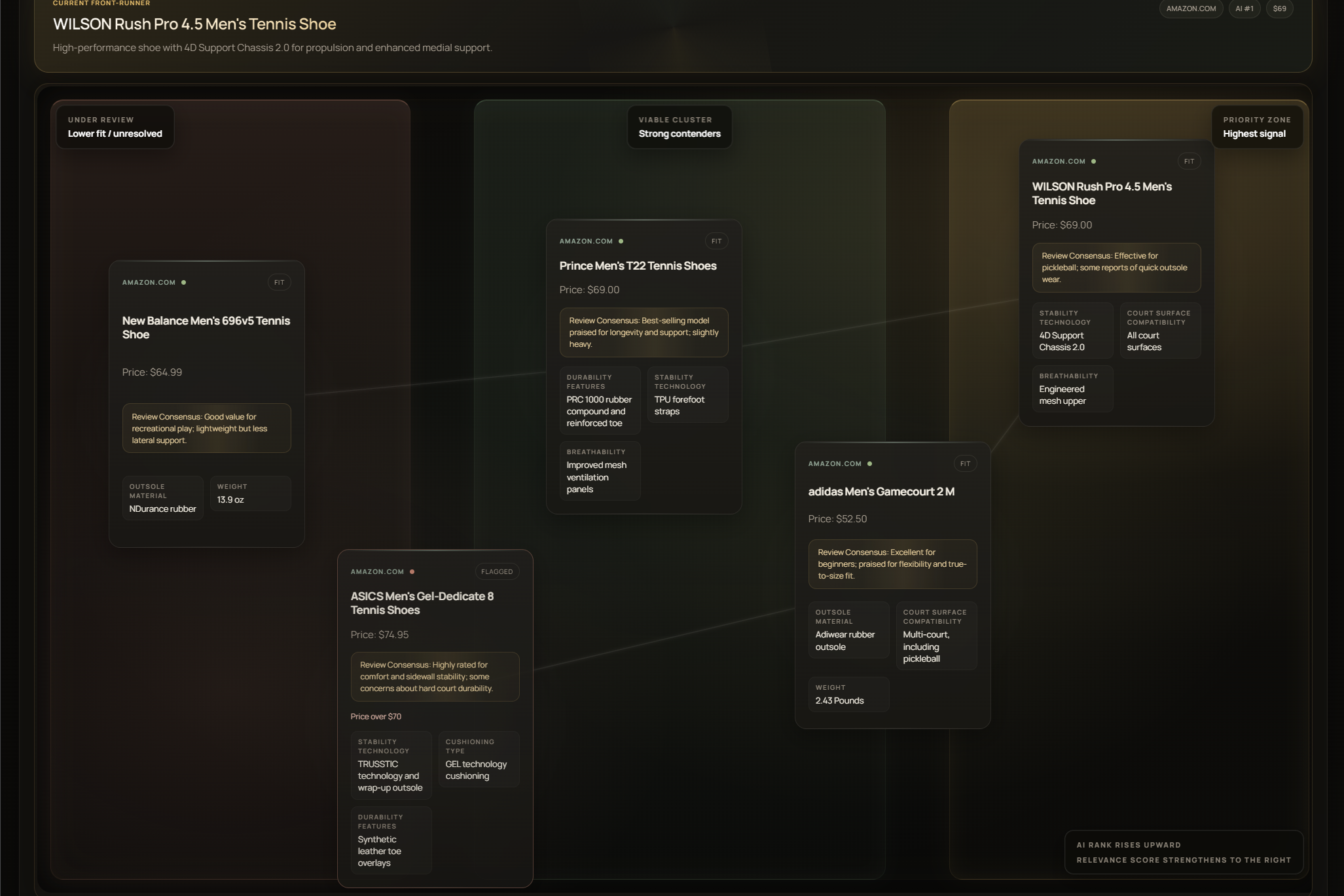
Board Graph View
-
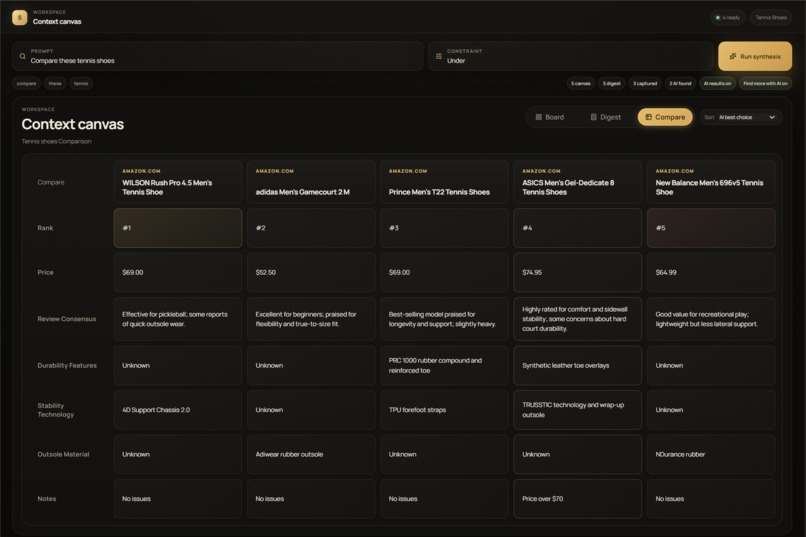
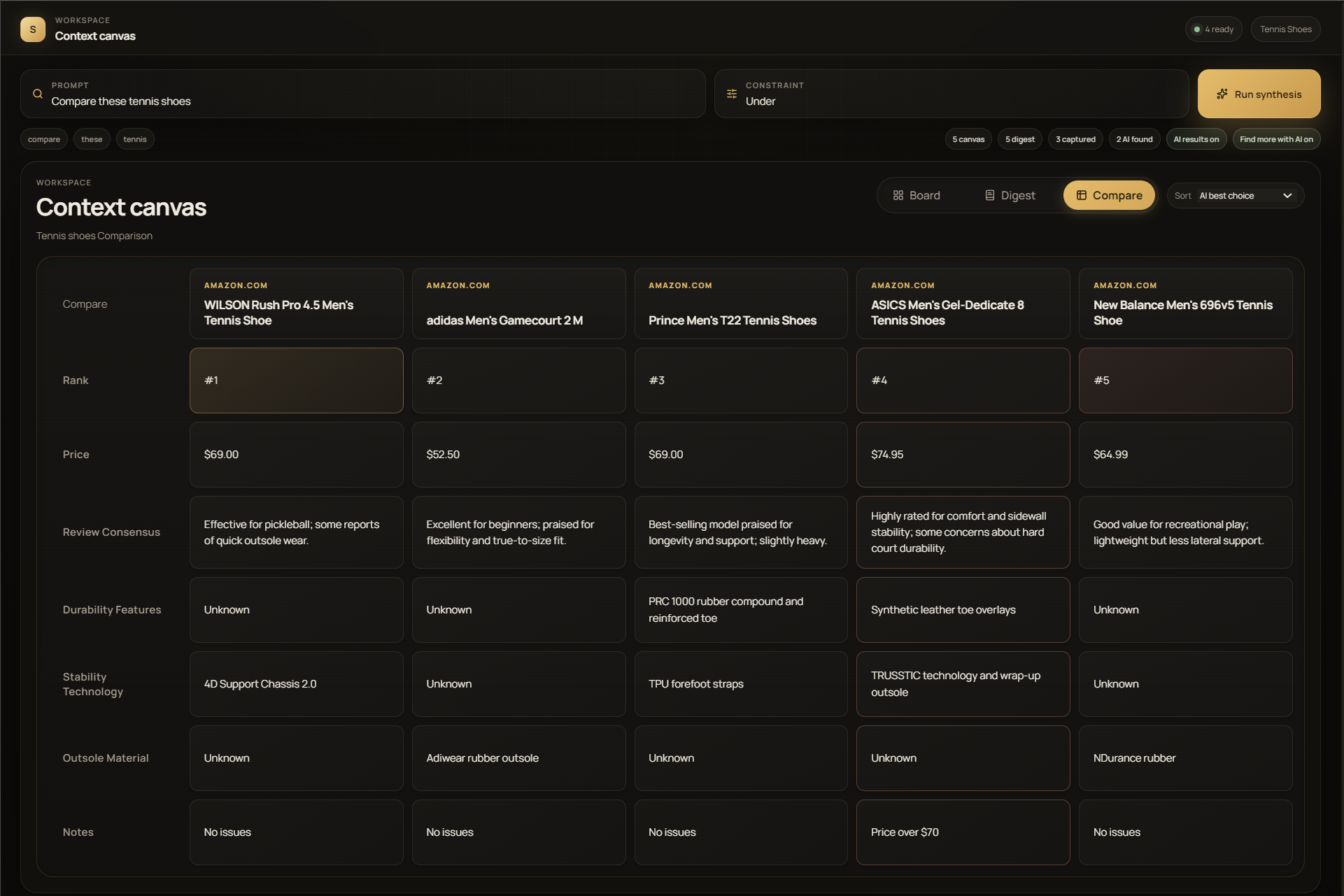
Compare Spreadsheet View
-
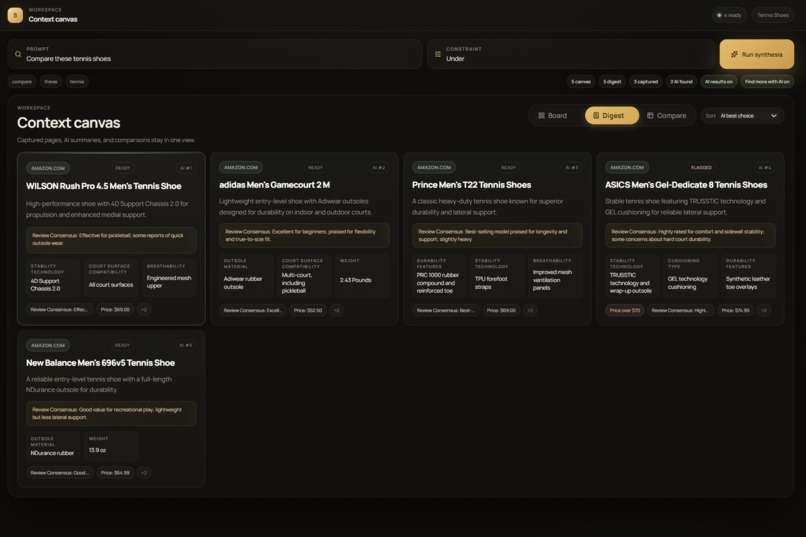
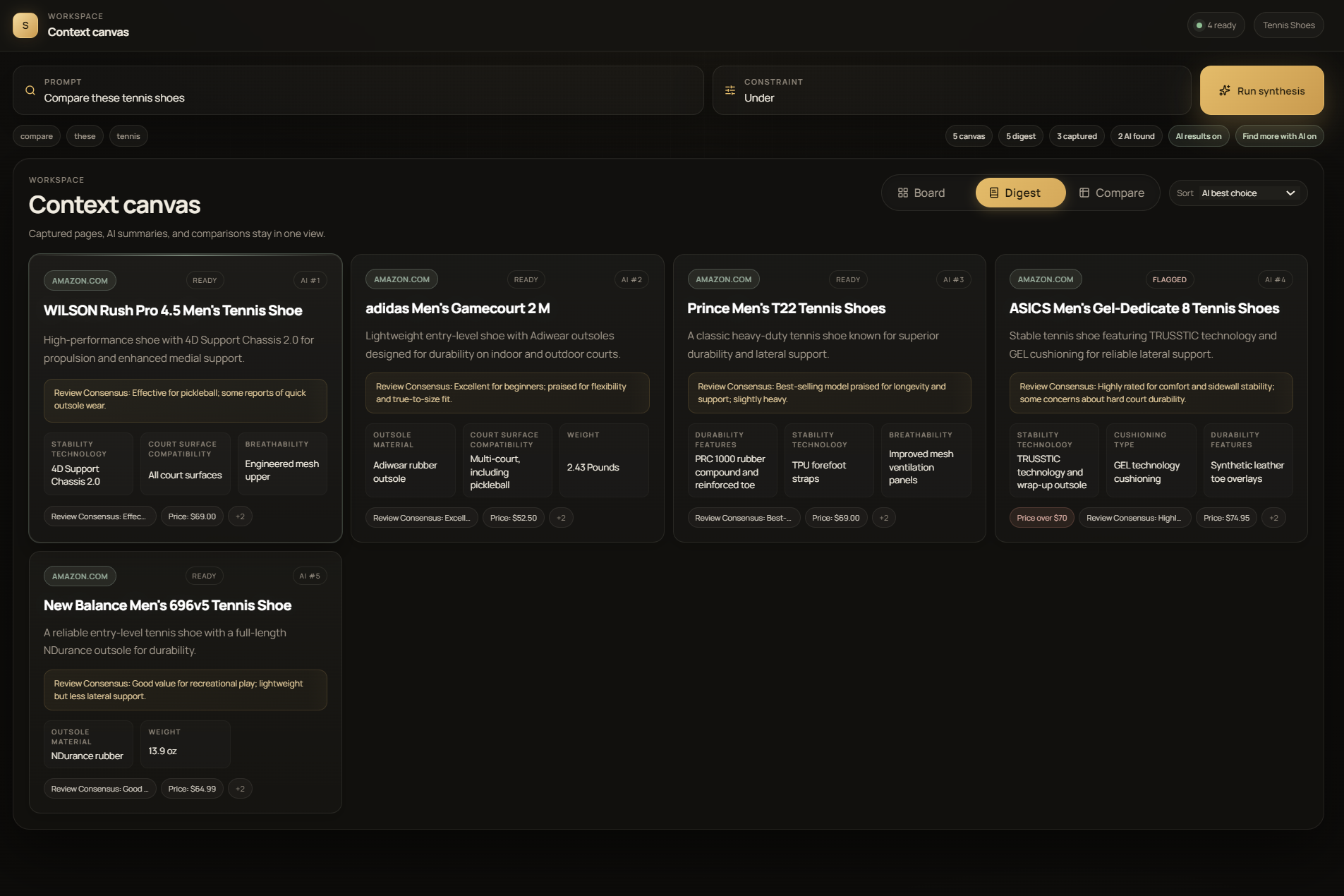
Digest View
-
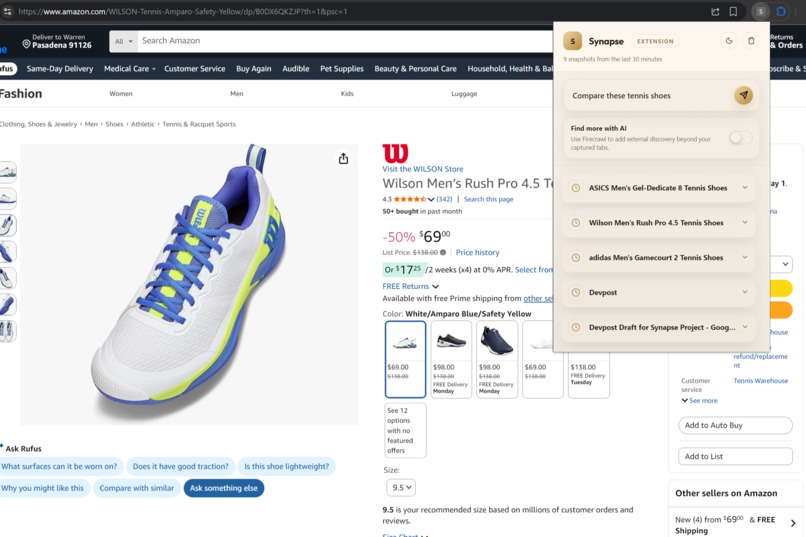
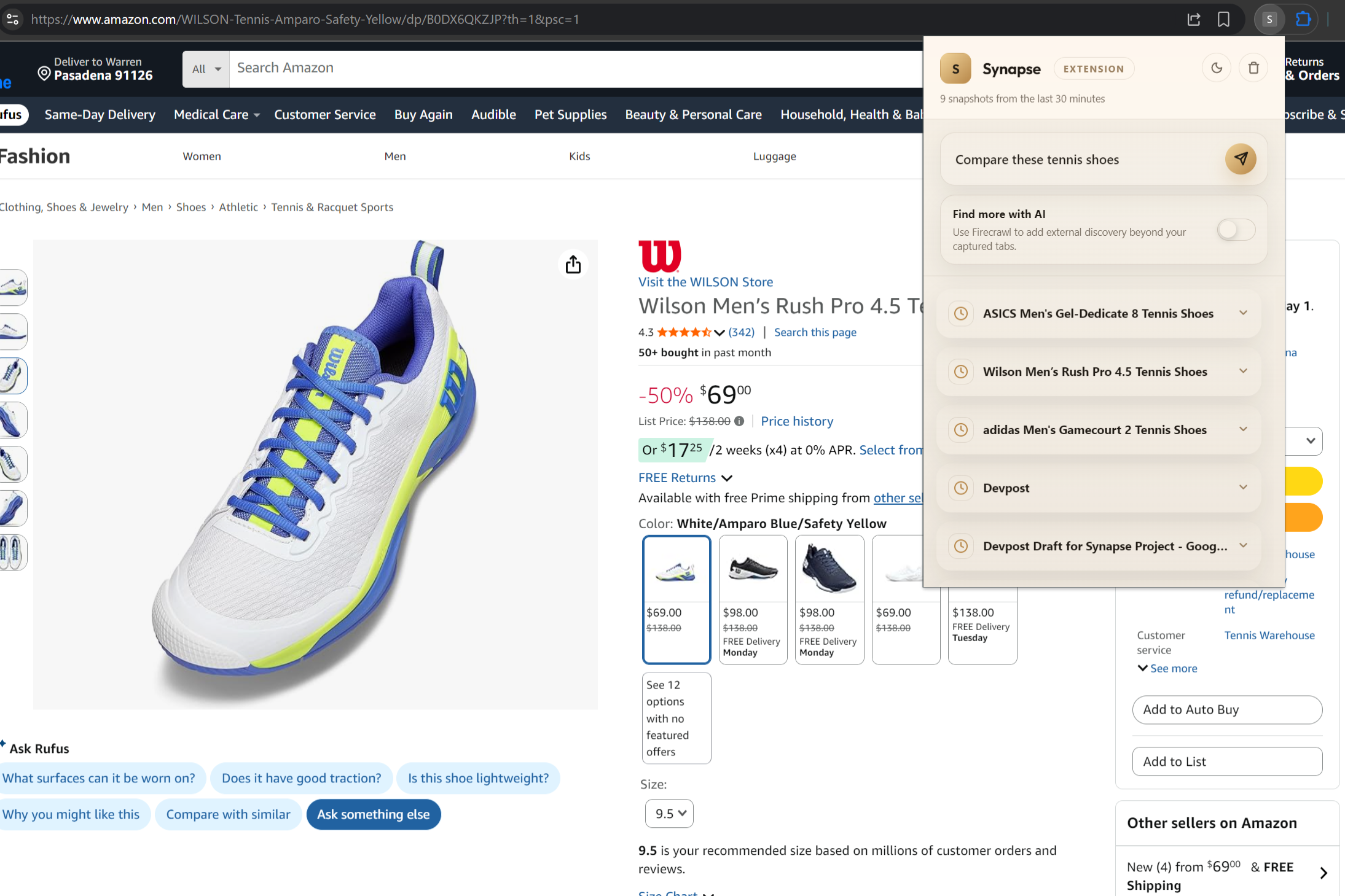
Extension View on Browser
Inspiration
We’ve all been there: you’re trying to make an informed purchase, like speccing out a new laptop, and your comparison data gets fragmented across dozens of disconnected tabs, reviews, and tech forums. Trying to balance variables like CPU performance, display quality, battery life, and RAM configurations makes it impossible to keep track of everything in your head.
Manual online research is completely broken. We end up stuck in a time-consuming cycle of manually copy-pasting specs into spreadsheets, which means the most valuable insights—like real user experiences buried deep in a Reddit thread—simply get lost and forgotten before we even make a decision. We built Synapse to automatically synthesize your scattered research into an actionable decision board.
What it does
Synapse is an intelligent browser extension and visual workspace that passively organizes your online research into actionable insights.
As you browse, Synapse silently captures research signals. When you open the extension, you can provide a prompt (e.g., "Compare these tennis shoes"), and our AI Orchestration Engine analyzes your browsing history to identify your core intent (budget, technical requirements, etc.).
Synapse then generates a structured knowledge graph presented in three distinct views:
- The Board (Graph View): A visual layout clustering your items into categories like "Current front-runner" and "Strong contenders," showing high-level details like price and stability tech, alongside a summary of the AI's top pick.
- The Digest View: Ranked, detailed summary cards that allow you to sort by price, review consensus, or the AI's best choice.
- The Compare View (Matrix): A dynamically generated spreadsheet populated entirely by AI.
Dynamic Constraints & AI Discovery: You can apply specific constraints like "Under $70, prioritize durability" while toggling on "Find more with AI." Synapse will use Firecrawl to break out of your browser history, scraping the web for new products that fit your exact needs. It then visually flags items—highlighting them in red if they fail your new constraints—and ranks the newly discovered items against your original tabs so you can feel confident in your final choice.
How we built it
Synapse operates through a robust three-layer architecture:
1. Passive Ingestion (The Chrome Extension)
Our extension (content.js and background.js) silently captures DOM snapshots and lightweight readable content from your browser in real-time. It stores the last 30 minutes of browsing history locally and pushes it to our backend without interrupting your workflow.
2. The AI Orchestration Engine (Local Python Backend) The backend acts as the brain. When triggered, it pipes your browsing history and summaries through OpenRouter (using strict Pydantic models to ensure highly structured JSON outputs). This engine identifies your core intent. If the "Find more with AI" toggle is active, it triggers the Firecrawl API to gather missing context and cross-reference matches to build a comprehensive knowledge graph.
3. The Intelligence Workspace (React Frontend) The frontend receives the unified session model from the backend and synthesizes it into our interactive UI. It maps the data perfectly to the visual Board, the Digest cards, and the structured Compare spreadsheet, handling all sorting and dynamic sidebar details.
Challenges we ran into
- LLM Hallucinations & Formatting: Forcing an LLM to consistently output complex, multi-layered JSON (nodes, edges, matrix rows, and constraint flags) without dropping data was incredibly difficult. We had to iterate heavily on our prompts and schema validation.
- DOM Noise: Building a reliable extractor that could distill a busy product page into clean, readable text—without eating up the entire LLM context window—took significant trial and error.
- Latency vs. Discovery: Balancing the time it takes to process multiple DOM snapshots, run Firecrawl web searches for external alternatives, and generate a massive JSON structure required heavy optimization and asynchronous summarization.
Accomplishments that we're proud of
- Zero-Friction UX: Users don't have to change their behavior. They just browse normally, and the tool builds the context in the background.
- The Intent Engine: Building an architecture that doesn't just summarize what you looked at, but actually understands the underlying variables (budget, specs) to proactively find better options.
- The Unified Session Model: Creating a single, unified backend contract that perfectly maps to a visual graph, a robust table, and a text digest simultaneously.
What we learned
- The Power of Structured Outputs: We learned exactly how to wrangle LLMs using strict schemas to act as reliable data parsers rather than just text generators.
- Extension Architecture: We deepened our understanding of Chrome Extension security, service workers, and cross-origin communication with local backends.
- Web Scraping at Scale: Using Firecrawl taught us how to seamlessly blend deterministic web search with generative AI summarization.
What's next for Synapse
Looking ahead, we look forward to scaling Synapse to become an even more powerful tool for product research. Our roadmap includes:
- Multimodal Synthesis: Pulling insights directly from YouTube video reviews and integrating image-based sentiment analysis, which is critical given how many products rely on video tutorials and visual community feedback.
- Collaborative Multi-Session Persistence: Moving beyond local 30-minute retention to enable persistent, collaborative team workspaces where groups can research and compare together.
- Browser Agents: Deploying browser agents for full agentic navigation of complex, nested e-commerce and review sites.
- Custom Infrastructure: Our end goal is to fine-tune our own models and host a custom web scraper, which will dramatically improve data reliability and reduce synthesis latency.

Log in or sign up for Devpost to join the conversation.