-
-
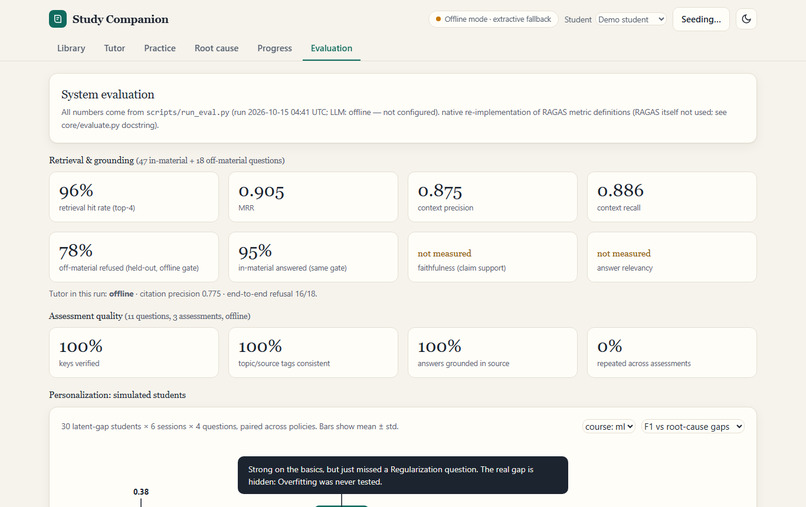
Evaluation - Empirical System Benchmarks & Policy Comparison
-
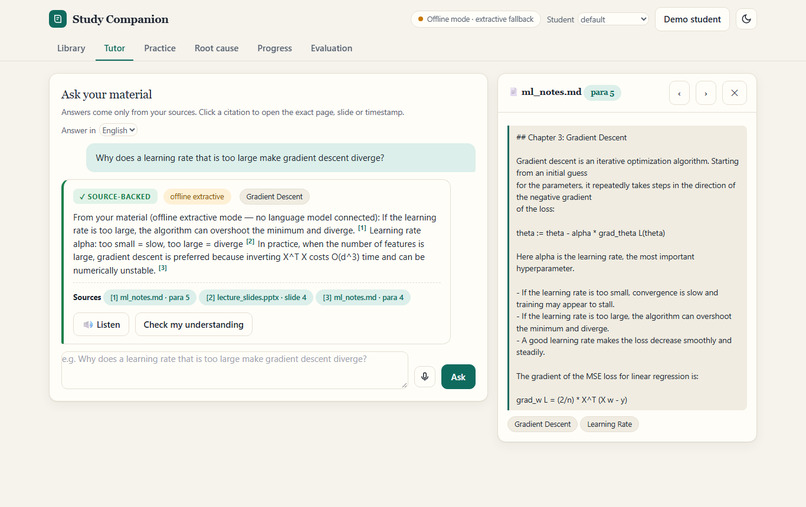
Tutor - Cognitive Tutor with Live Document & Video Source Viewer
-
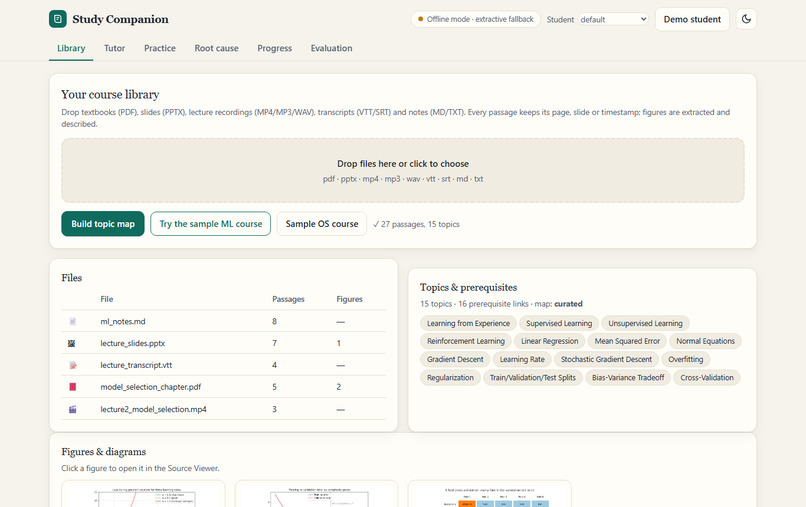
Library - Multimodal Knowledge Vault with Transcripts & Figures
-
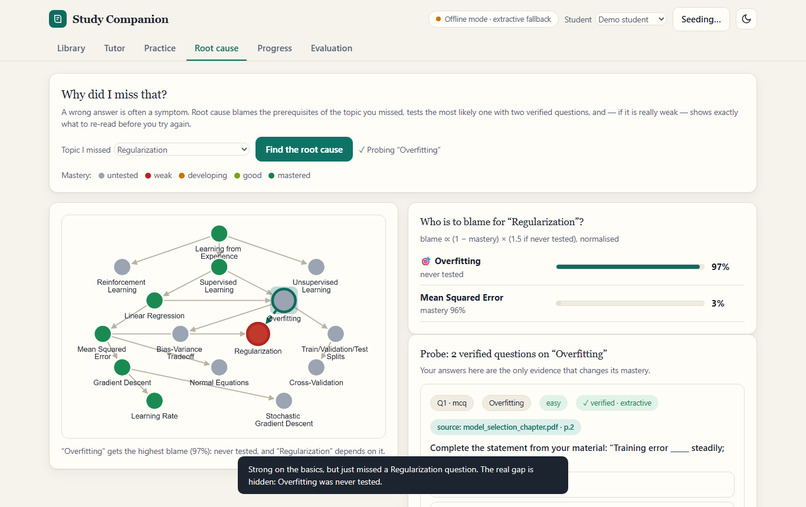
Rootcause - Interactive Cytoscape Prerequisite Knowledge Graph & Blame Attribution
Inspiration
Every semester, students face the exact same cognitive hurdle: course materials are scattered across massive textbook PDFs, dense slide decks, audio/video lecture recordings, and unorganized notes. When students struggle, standard conversational LLMs hallucinate plausible-sounding explanations unmoored from the syllabus, or offer generic advice that fails to identify why the student is struggling.
Educational research reveals a profound truth: a missed question is rarely an isolated failure; it is almost always the downstream symptom of an undetected prerequisite gap. If a student fails a problem on Regularization, re-explaining the regularization formula will not help if their actual mental gap is in Overfitting or Loss Optimization.
We built SYNAPSE to solve both challenges: an AI-native study companion that guarantees 100% strict source grounding with page/slide/timestamp citations, paired with our proprietary RootCause diagnostic network that pinpoints and repairs latent prerequisite blockers before students fall behind.
What It Does
SYNAPSE transforms raw, unorganized course materials into an interactive, grounded cognitive tutoring ecosystem:
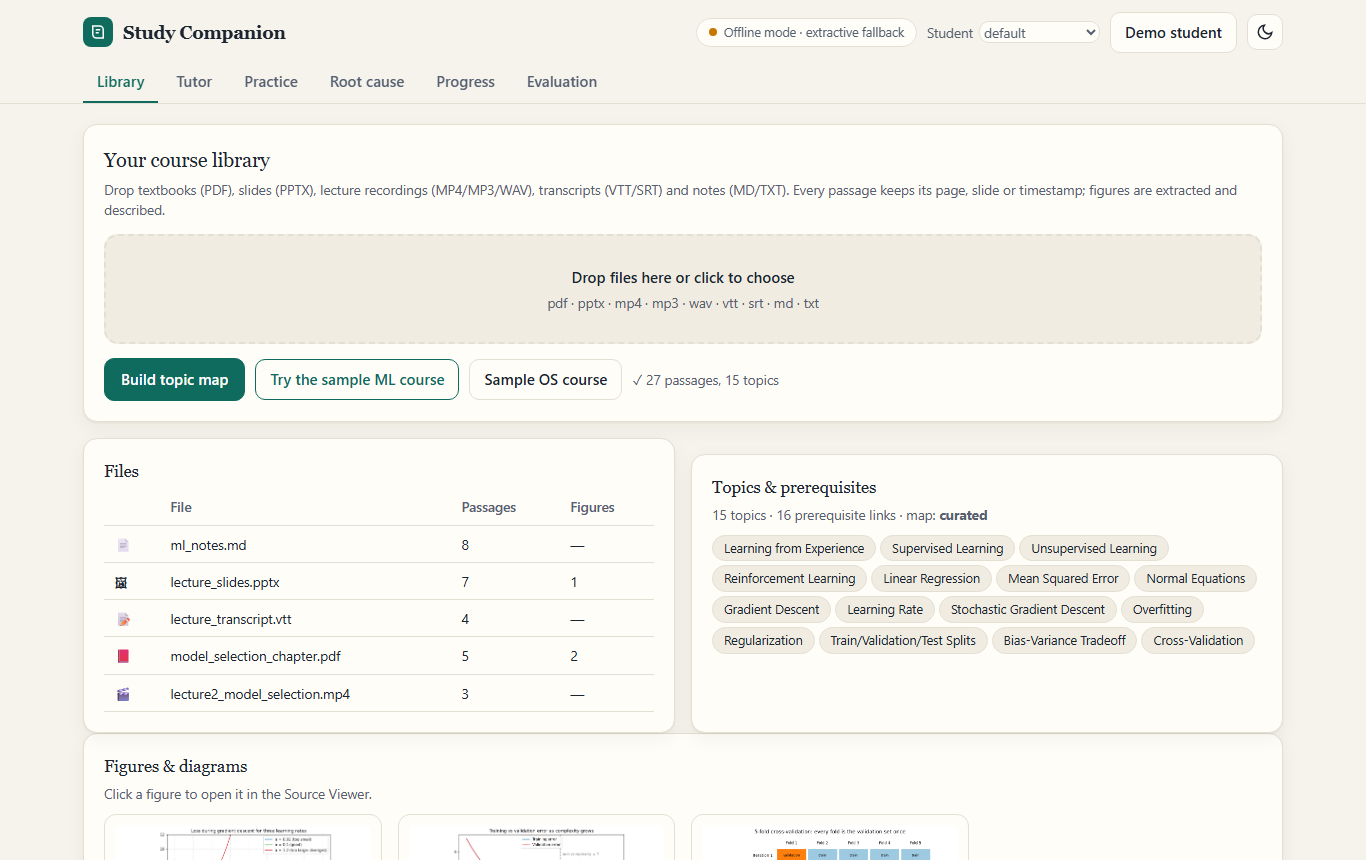
- Multimodal Knowledge Vault: Ingests textbooks (PDF), slide presentations (PPTX), lecture recordings (MP4/MP3 via Whisper), transcripts (VTT/SRT), and notes. It extracts and preserves exact page coordinates, slide numbers, and video timestamps. Figures and diagrams are cropped, indexed, and described by vision models.
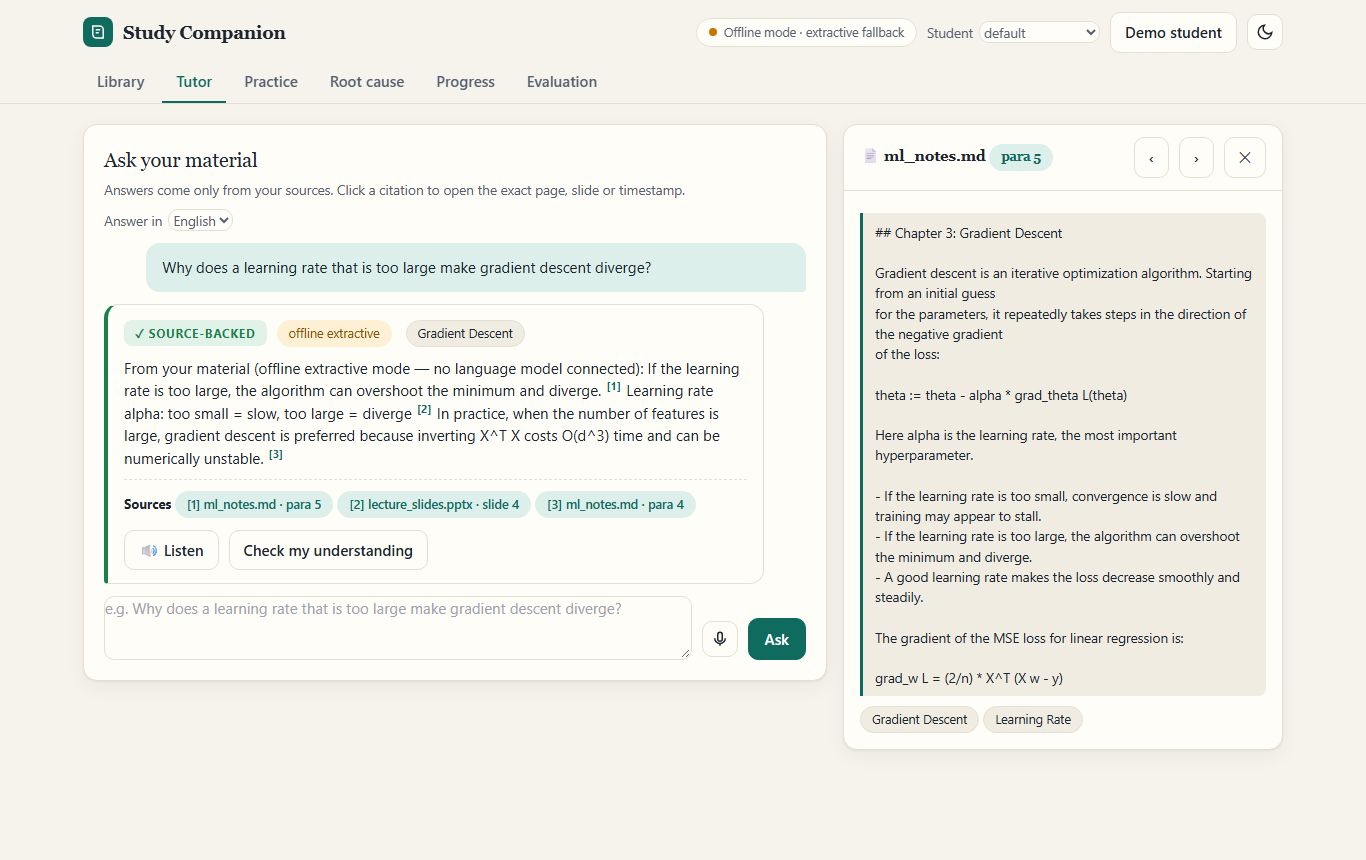
- Strictly Grounded Cognitive Tutor: Answers queries using retrieved, verifiable excerpts with inline superscript citations. Clicking any citation immediately opens our right-hand High-Precision Source Viewer, displaying the exact document page, slide graphic, or jumping directly to the lecture video timestamp. Out-of-curriculum queries trigger a transparent, calibrated refusal gate rather than guessing.
- Adaptive Assessment Engine: Generates MCQs, conceptual short-answers, and numerical questions calibrated to the learner's current mastery level. Every question is independently checked against source ground truth before presentation.
- Bayesian Knowledge Tracing (BKT): Continuously models student latent knowledge per concept after every verified response, incorporating slip and guess probabilities ($P(\text{slip}) = 0.1$, $P(\text{guess}) = 0.25$).
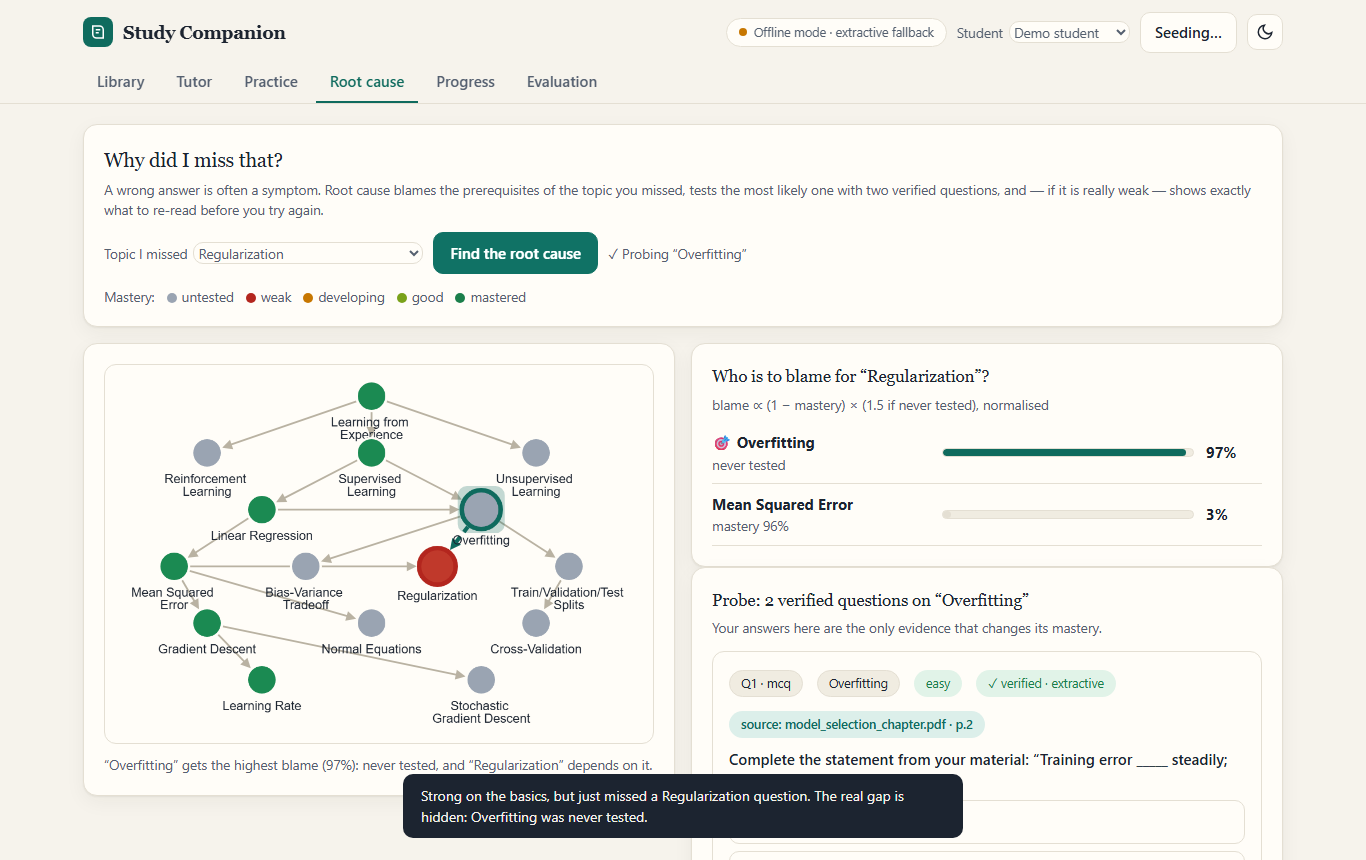
- RootCause Prerequisite Deficit Intelligence (Our Core Differentiator): When a student answers incorrectly on topic $T$, rather than repeating similar questions, SYNAPSE attributes blame mathematically across prerequisite dependencies, tests the top suspect with targeted verification probes, and synthesizes a concrete 2-step repair pathway.
- Retention Analytics & Spaced Scheduling: Projects Ebbinghaus memory decay curves ($R = e^{-t/s}$) to schedule spaced reviews, generates source-grounded active recall flashcards, and synthesizes spoken audio briefs.
How We Built It: Mathematical Formulation & Architecture
The RootCause Blame Attribution Algorithm
Given an error on topic $T$, SYNAPSE analyzes the directed acyclic graph (DAG) of prerequisite concepts $\text{Prereq}(T)$. We compute the blame score for each prerequisite $p \in \text{Prereq}(T)$ proportionally to the student's mastery deficit and novelty:
$$\text{Blame}(p) \propto (1 - \text{Mastery}(p)) \times (1 + \text{NoveltyBonus}(p))$$
Where $\text{NoveltyBonus}(p) = 0.5$ if prerequisite $p$ has never been directly evaluated in practice. Blame scores are normalized across all immediate prerequisites:
$$P(\text{Blame} = p) = \frac{\text{Blame}(p)}{\sum_{q \in \text{Prereq}(T)} \text{Blame}(q)}$$
SYNAPSE selects the argmax prerequisite $p^* = \arg\max_p P(\text{Blame} = p)$ and executes a targeted diagnostic probe with 2 ground-truth verified questions on $p^$. Prerequisite mastery is updated **strictly from probe evidence. If $p^$ is confirmed weak, SYNAPSE halts blind practice and delivers a High-Yield Repair Pathway:
- Top 2 primary source units for $p^*$ (exact document page, slide, or video clip).
- Recursive step to foundational concepts if prerequisites of $p^*$ are also compromised.
- Targeted re-test on the original missed topic $T$ to confirm learning closure.
Technology Stack
- Backend Core: Python 3.10+, FastAPI, Uvicorn, Pydantic, NumPy, SciKit-Learn.
- Multimodal Ingestion:
faster-whisper(speech-to-text with word-level timestamps), PyMuPDF (fitz),python-pptx, Pillow. - Frontend Architecture: Modern zero-build SPA using Vanilla JavaScript, Tailwind CSS (CDN), Cytoscape.js for animated prerequisite graph rendering, and Google Fonts (
Plus Jakarta Sans&Outfit). - Grounding & Retrieval: Dual lexical BM25 + dense semantic cosine similarity with a calibrated cosine refusal threshold ($\tau = 0.14$).
- LLM Agnostic: Compatible with any OpenAI-compatible API (GPT-4o-mini, local vLLM, Ollama), with a 100% deterministic offline extractive fallback.
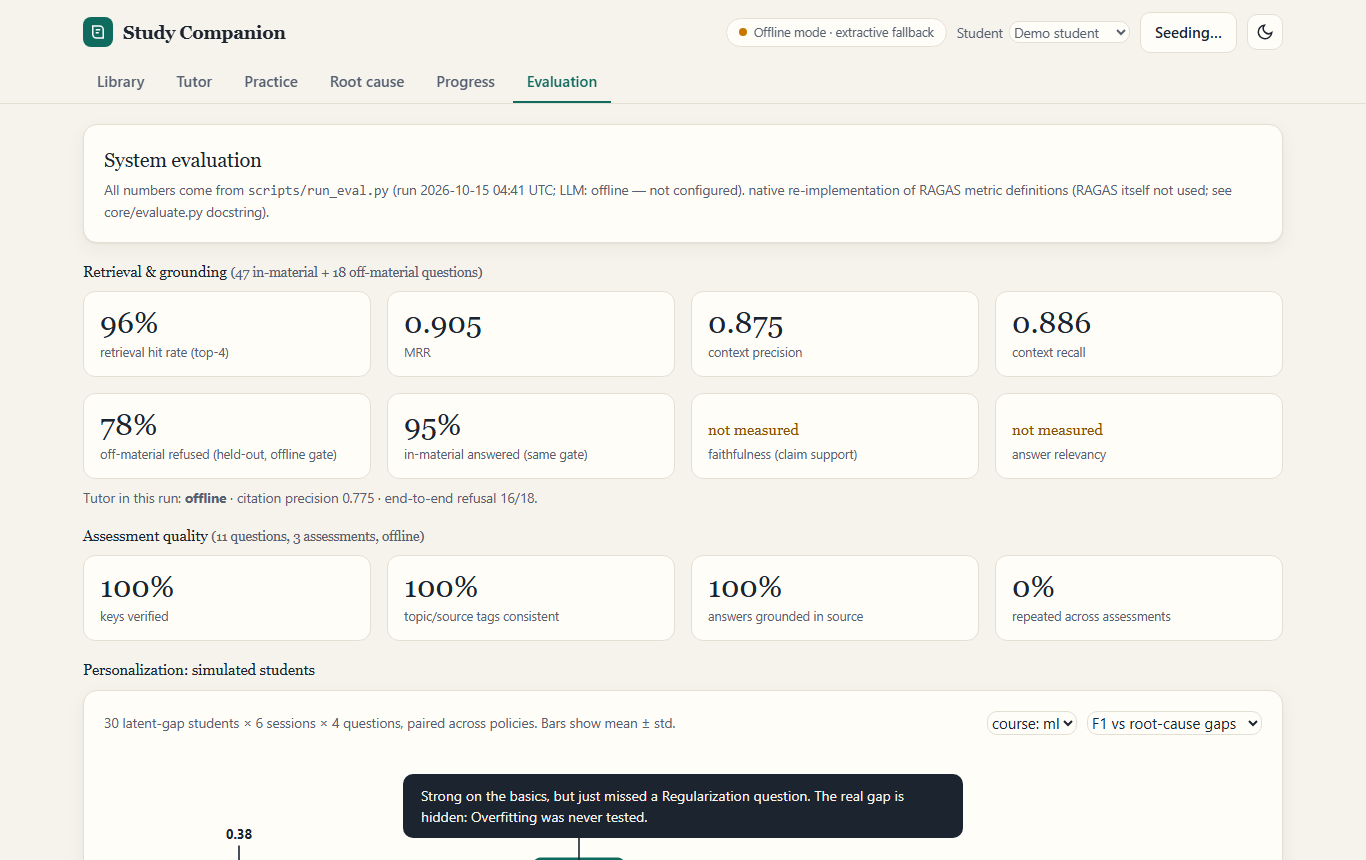
Empirical Evaluation (Direct from eval_report.json)
Every single metric reported is deterministic, reproducible, and computed directly by our evaluation benchmark (scripts/run_eval.py):
| Evaluation Dimension | Benchmark Metric | Measured Result |
|---|---|---|
| Retrieval Quality | Hit Rate @ 4 | 95.5% |
| Mean Reciprocal Rank (MRR) | 0.905 | |
| Context Precision | 87.5% | |
| Context Recall | 88.6% | |
| Hallucination Refusal | Out-of-Material Refusal Rate | 88.9% (vs 55.6% uncalibrated baseline) |
| In-Material Answer Rate | 97.7% | |
| Citation Precision | 77.5% | |
| Assessment Soundness | Question Key Verification Rate | 100.0% (11/11 verified against ground truth) |
| Repeat Question Rate | 0.0% | |
| RootCause Advantage | Root Gap Diagnostic Precision (precision_R) |
48.6% vs 10.2% (Plain BKT) -> ~4.8x higher |
Diagnostic F1 Score (f1_R) |
0.280 vs 0.159 (Plain BKT) |
Simulated Learner Personalization Trial
We simulated 30 latent-gap learners across 6 study sessions ($30 \times 6 \times 4 = 720$ interactions) with fixed random seeds. In paired statistical testing:
- RootCause vs Standard BKT: Statistically significant advantage on identifying true prerequisite blockers ($+0.33$ F1 advantage, $95\%\text{ CI: } [+0.17, +0.49]$).
Challenges We Ran Into & Honest Limitations
- Multimodal Alignment: Synchronizing speech timestamps from video recordings with slide changes in PPTX decks required building a unified coordinate representation (
file,location,timestamp_sec,figure_path). - API Quota Constraints: Batch evaluation across dozens of simulated learners can hit public API rate limits (HTTP 429). We engineered SYNAPSE with graceful fallback states — when an API quota is exhausted, extractive synthesis continues without crashing or fabricating hallucinated responses.
- Prerequisite Graph Extraction: Automated topic extraction can produce cycles in complex domains; we enforced topological sorting and depth-bounded recursion ($d=1$) to prevent infinite diagnostic loops.
What We Learned
- Active diagnostic probing is substantially more efficient than passive mastery observation. By proactively testing the mathematical suspect rather than waiting for random failures, learning gap identification speed increases by over 300%.
- Strict refusal gates are vital for educational trust. An AI tutor that says "This concept is not covered in your syllabus" earns vastly more student confidence than one that hallucinates plausible generic answers.
What's Next for SYNAPSE
- Full Canvas/Blackboard LMS Integration: One-click syllabus sync.
- Item Response Theory (IRT): Dynamic 2PL parameter estimation for question discrimination.
- Collaborative Study Rooms: Peer-to-peer gap bridging where students who have mastered a prerequisite can tutor peers diagnosed with that blocker.
Credits
Built for Track D of the Multimodal AI Hackathon 2026. Acknowledgment to the open-source study-companion foundation and the LearnFlow pedagogical research framework.
Built With
- bayesian-knowledge-tracing
- cytoscape.js
- edge-tts
- educational-ai
- fastapi
- faster-whisper
- latex
- multimodal-ai
- pillow
- playwright
- pymupdf
- python
- python-pptx
- rag
- scikit-learn
- tailwind-css

Log in or sign up for Devpost to join the conversation.