-
-
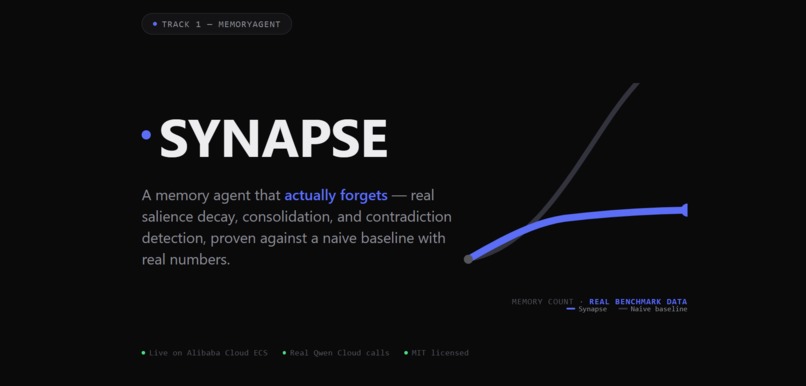
Synapse main
-
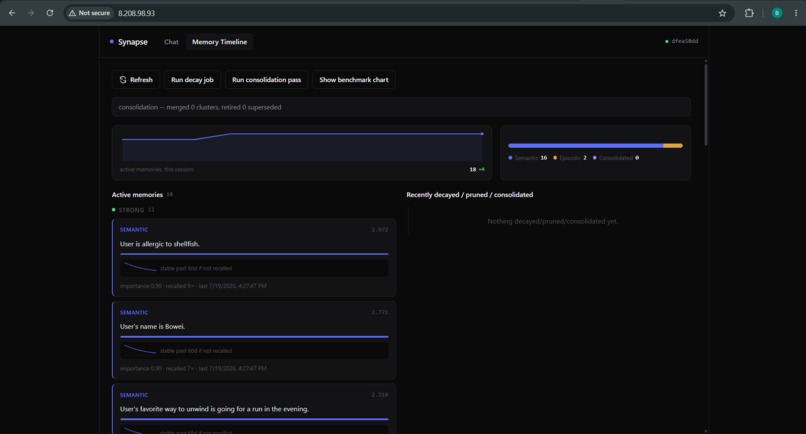
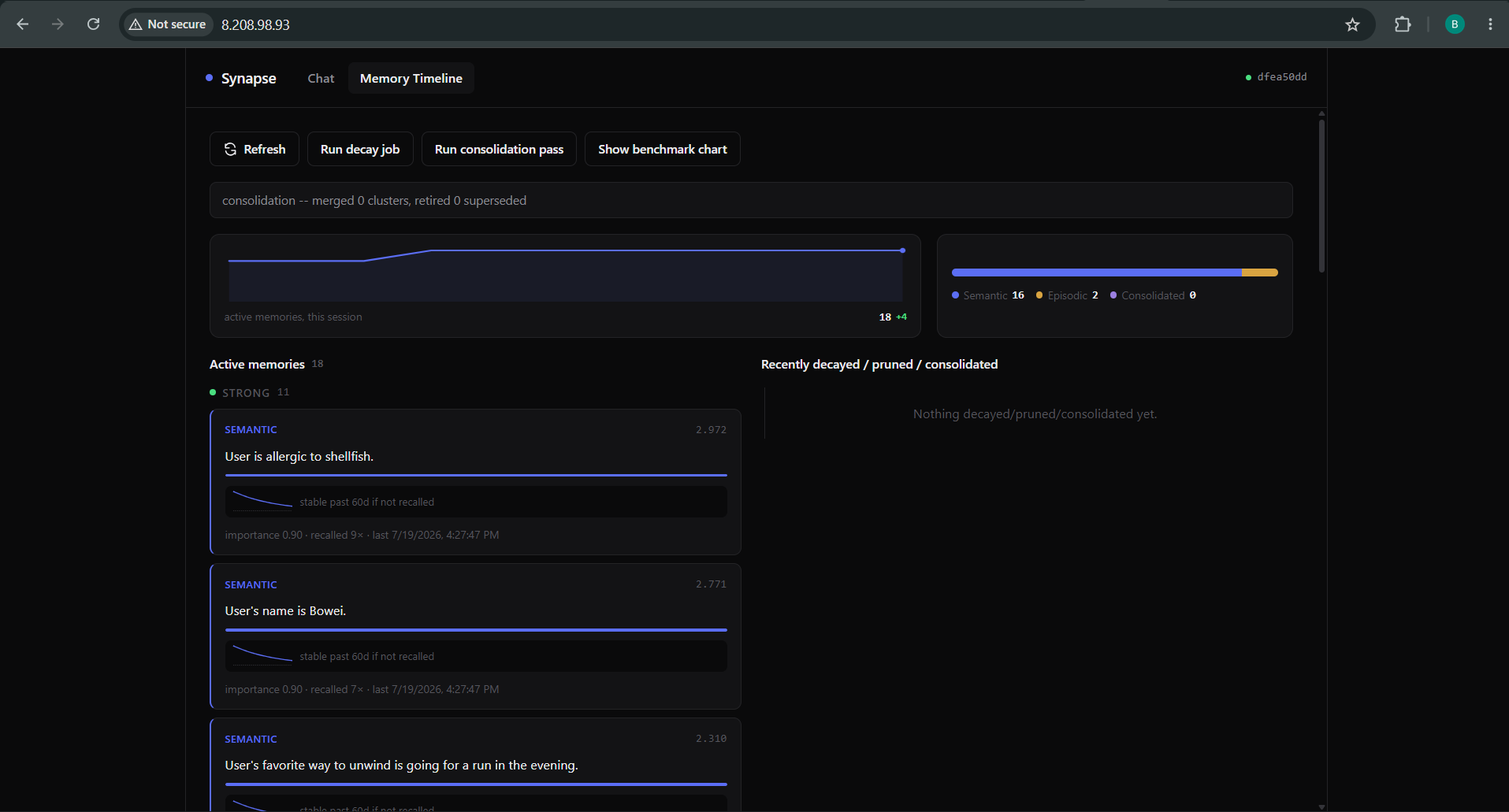
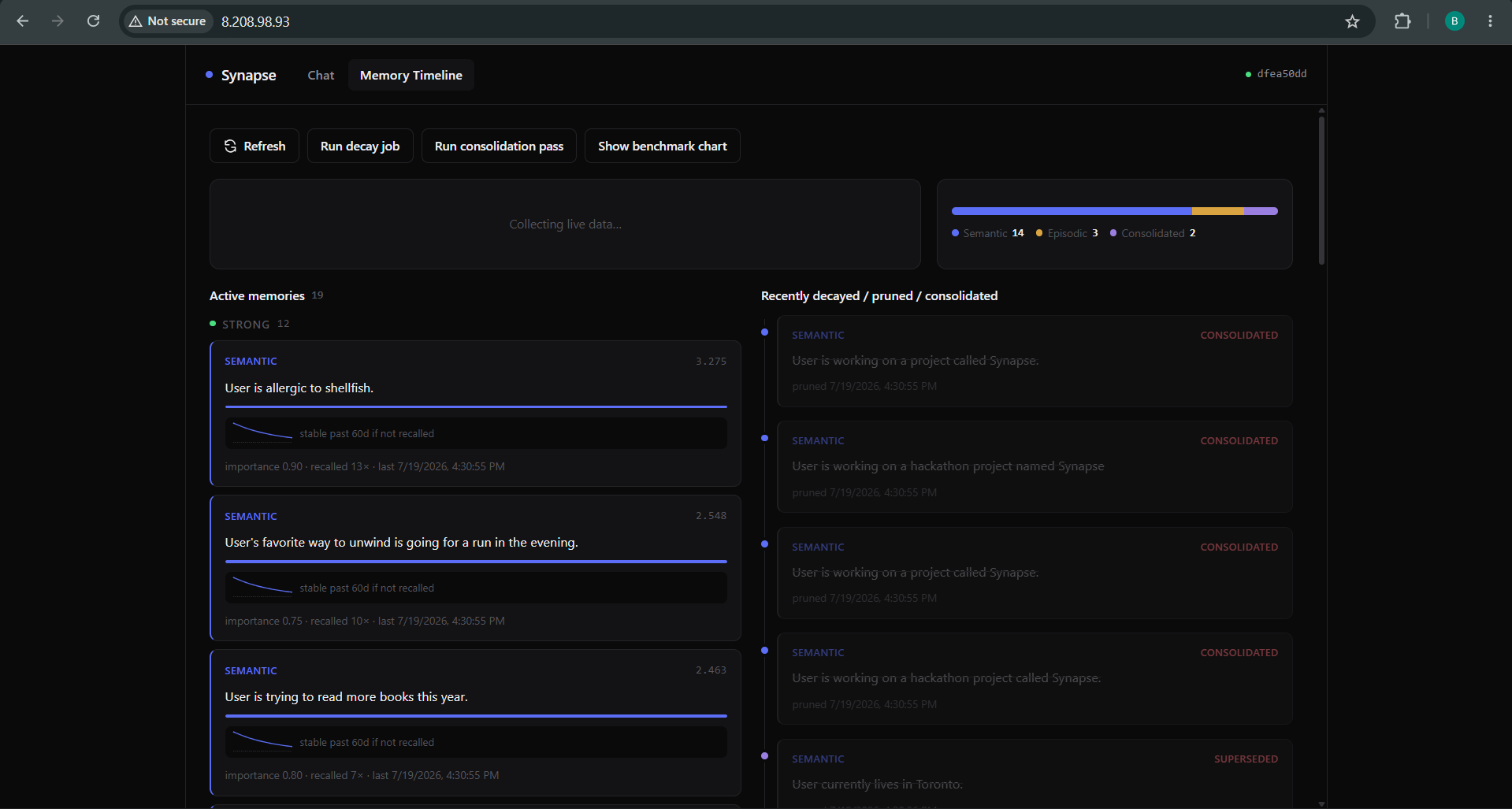
Memory Timeline View
-
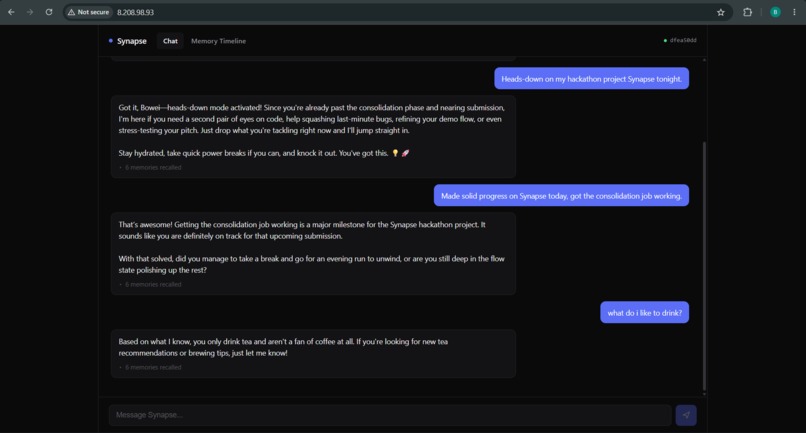
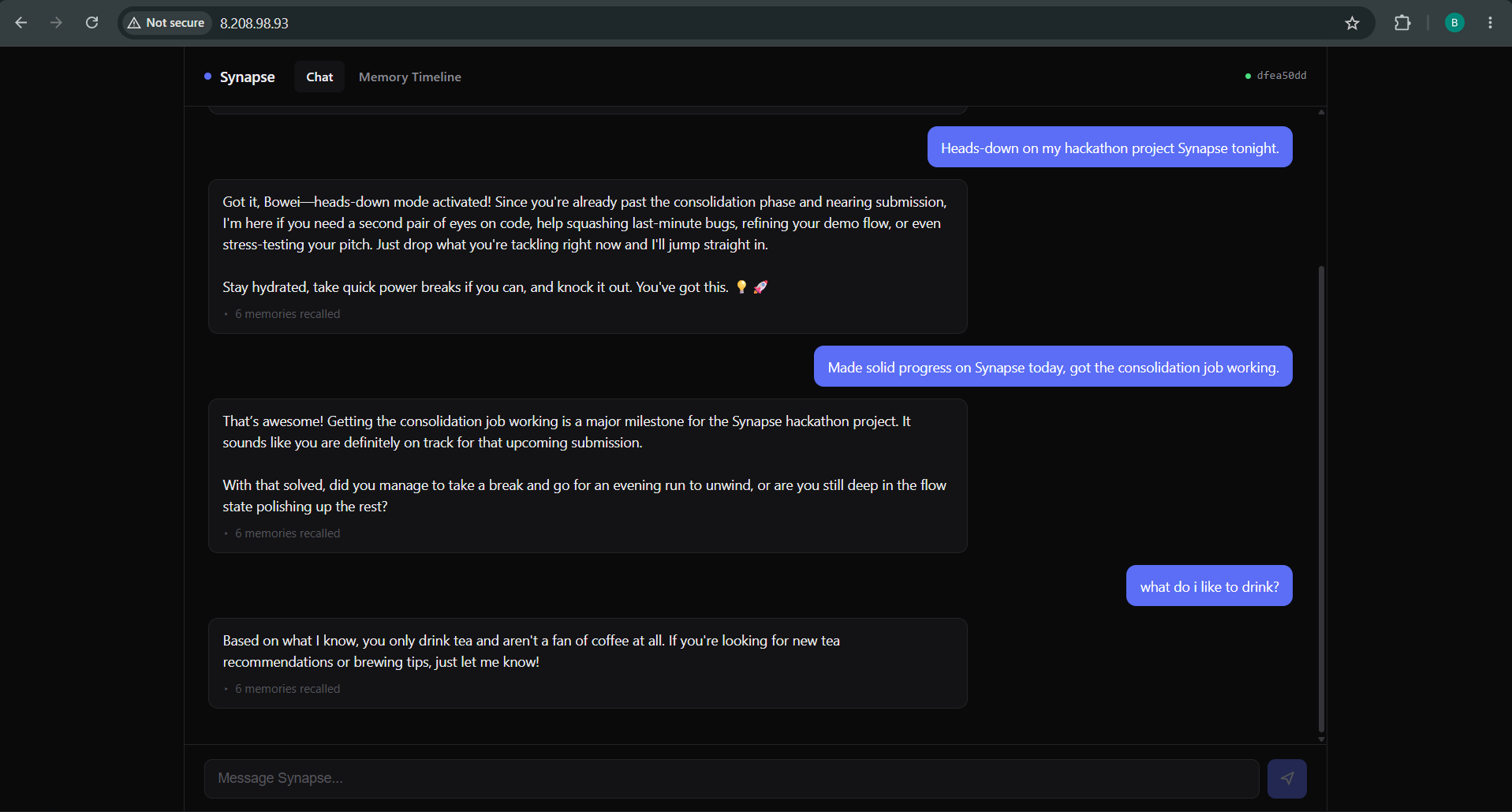
Chat view mid conversation
-
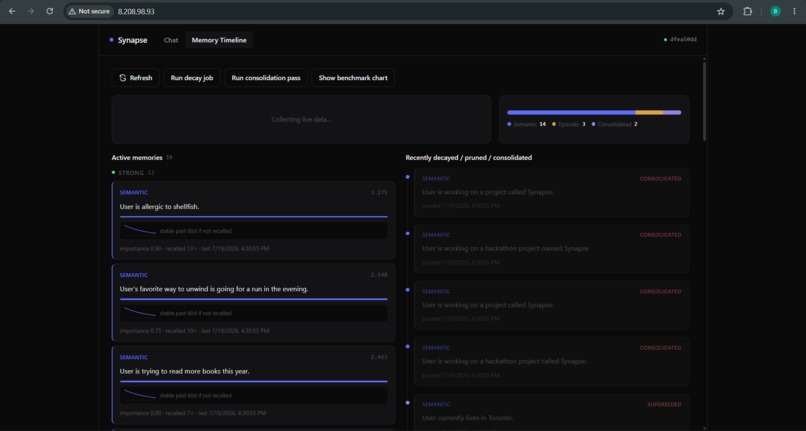
-
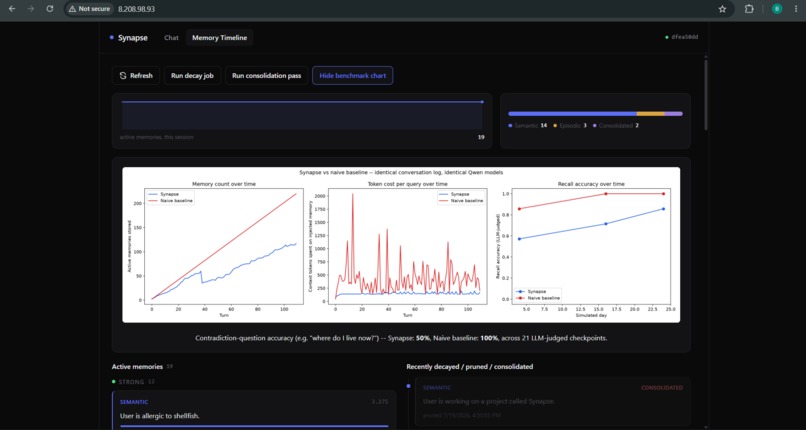
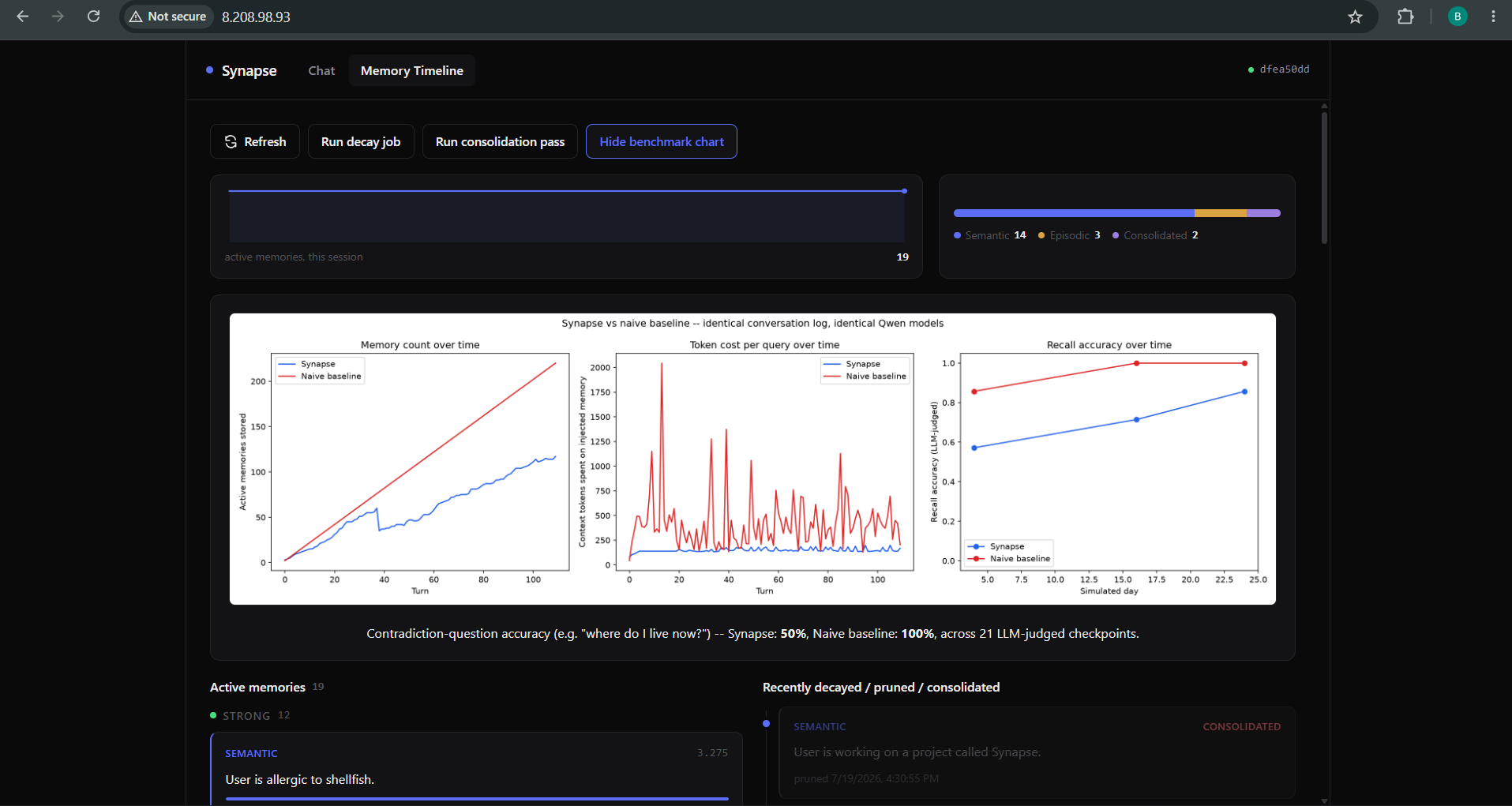
The actual benchmark chart
Inspiration
Almost every "AI memory agent" does the same thing: embed every message, dump it in a vector DB, retrieve top-k by cosine similarity forever. That's not memory, it's a search index — it never forgets anything, it treats a passing comment about the weather the same as "I'm allergic to penicillin," and it gets noisier and slower the longer it runs. The track brief explicitly asks for three things: efficient storage and retrieval, timely forgetting of outdated information, and recalling critical memories within a limited context window. Almost nobody builds the second one, because naive vector storage has no concept of "outdated." We built it for real, with actual decay math, actual consolidation, and an actual before/after benchmark proving it works better than the naive approach.
What it does
Synapse is a personal AI assistant with long-term memory that persists across
sessions. Every memory it writes is scored for importance by Qwen at write
time, then decays over time using a real formula —
salience(t) = importance × recall_boost(recall_count) × e^(−λ·hours_since_recall)
— with a decay rate that differs by memory type: stable preferences and facts
decay slowly, one-off episodic details decay fast unless reinforced. A
background consolidation pass clusters repeated episodic mentions into a
single semantic memory, and separately detects and retires memories directly
contradicted by newer information (e.g. a city move) — this is the "timely
forgetting" the brief asks for, literally. Retrieval re-ranks candidates by
relevance and current salience, not similarity alone, so what gets recalled
is what still matters. A memory timeline UI shows all of this live: active
memories, salience tiers, decay projections, and a real-time feed of what
just got decayed, pruned, or consolidated.
How we built it
FastAPI backend, Postgres with pgvector for storage, a React frontend, and every LLM call — chat, embeddings, importance scoring, extraction, contradiction detection, consolidation, and the benchmark's LLM judge — going to real Qwen Cloud endpoints, with no mocked or hardcoded model output anywhere. We built a second, deliberately naive baseline agent — identical chat model, identical embedding model, the only difference being "store everything forever, never decay, never consolidate, never prune" — and ran both through an identical synthetic 110-turn, simulated-multi-day conversation (including two deliberate contradictions) to produce a real, charted before/after comparison instead of just asserting the approach works. Deployed live on Alibaba Cloud ECS running Docker Compose.
Challenges we ran into
Getting real Qwen Cloud API access working end-to-end took longer than expected (workspace-specific endpoints, account verification). The benchmark harness surfaced two genuine bugs only visible at 100+ turns of scale: a consolidation function using real wall-clock time instead of simulated benchmark time (so a stale fact could look "newer" than the correct one and win a contradiction check it should have lost), and a similarity pre-filter gate too strict for a real contradiction phrased in very different words (measured similarity as low as 0.59 against a 0.75 gate). We root-caused both directly from the database, fixed both, and verified the fixes with targeted regression tests plus a live end-to-end test against the deployed app — documented honestly in the repo, including the pre-fix benchmark numbers we didn't get to re-measure given the remaining time.
Accomplishments that we're proud of
A real, quantified benchmark: memory count staying roughly flat (117) vs. a naive baseline growing linearly (220), token cost per query staying flat (~130-170) vs. the naive baseline spiking past 2000, and an honest recall accuracy comparison (71% vs. 95%) where we found and disclosed why our number was lower instead of hiding it — root-causing it to specific config values and a specific re-ranking formula, then fixing both with real regression tests. A chart with a number we don't love, fully explained, is stronger evidence than a chart that only tells a flattering story.
What we learned
Salience decay and consolidation are worth almost nothing without a real benchmark to check them against — several of the bugs we found (the consolidation timestamp bug especially) were completely invisible until we had 100+ real turns of scale and could see wrong answers appear, then trace them back to a root cause in the actual data.
What's next for Synapse — Memory That Actually Forgets
A live per-user analytics view (memory count / token cost over your own real usage — the underlying data already exists in the schema) and a shadow naive-baseline pipeline to make the Synapse-vs-naive comparison continuously verifiable on real usage, not just a one-time offline benchmark run.
Built With
- alibaba-cloud
- alibaba-cloud-ecs
- dashscope
- docker
- docker-compose
- fastapi
- framer-motion
- javascript
- matplotlib
- nginx
- numpy
- openaisdk
- pgvector
- postgresql
- pydantic
- pytest
- python
- qwen
- qwen-cloud
- react
- scikit-learn
- sqlalchemy
- tenacity
- text-embedding-v3
- vite


Log in or sign up for Devpost to join the conversation.