-
-
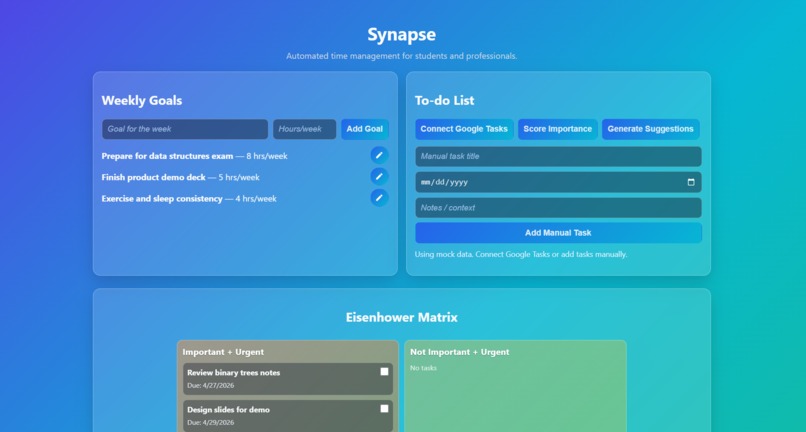
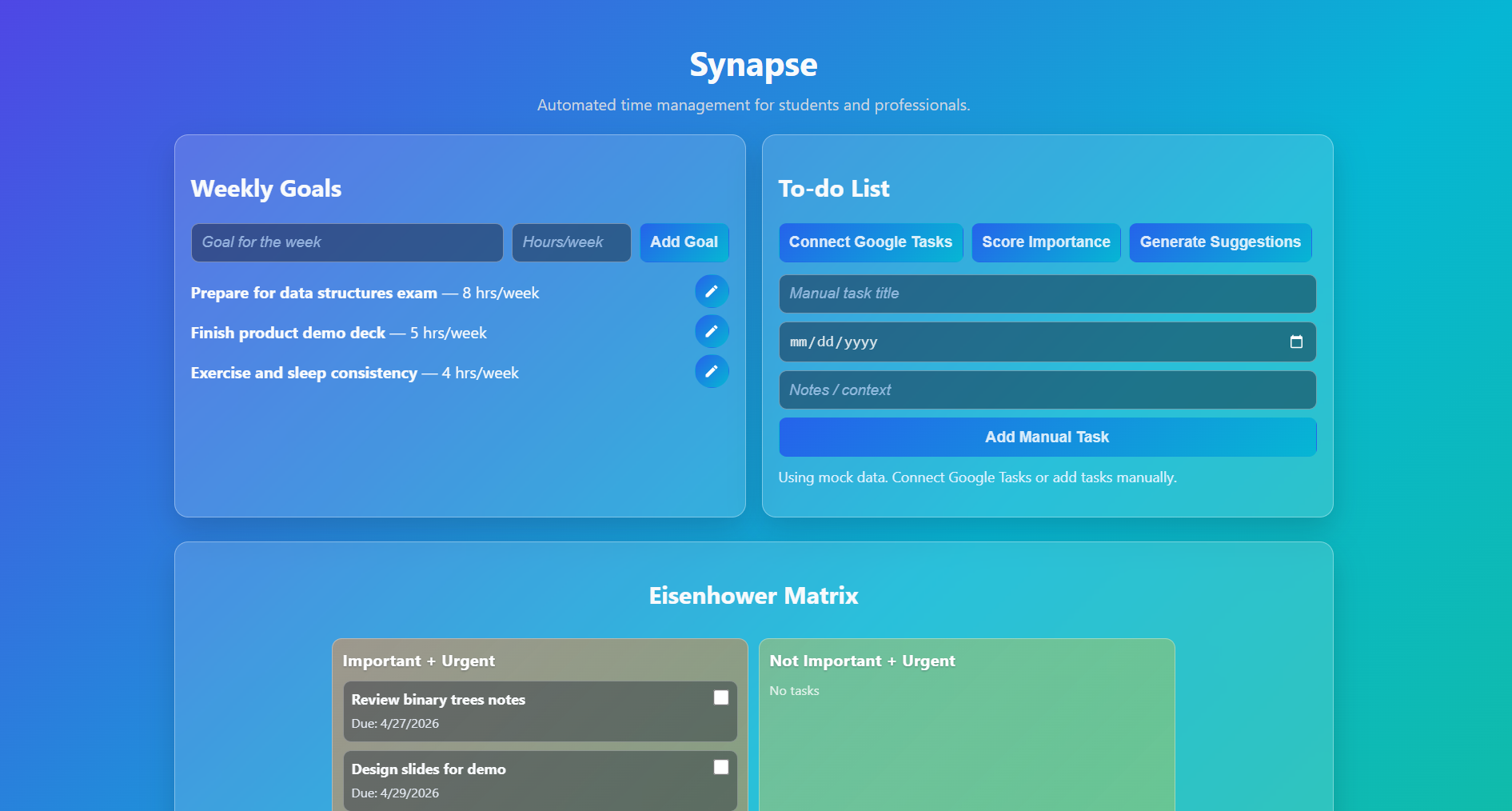
Task and Goal User Input Interface
-
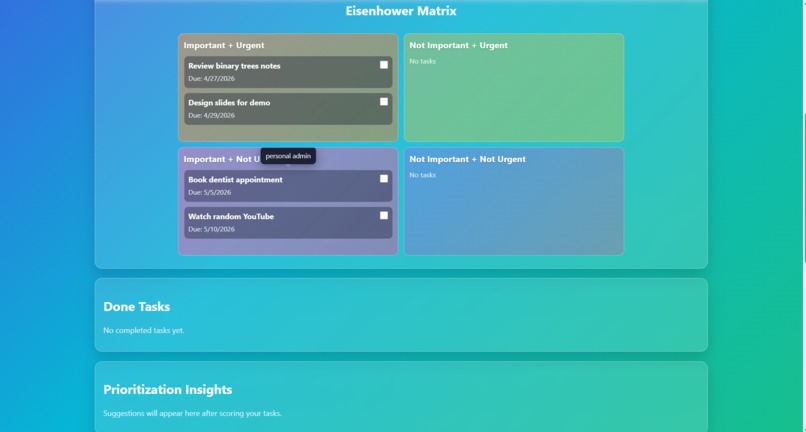
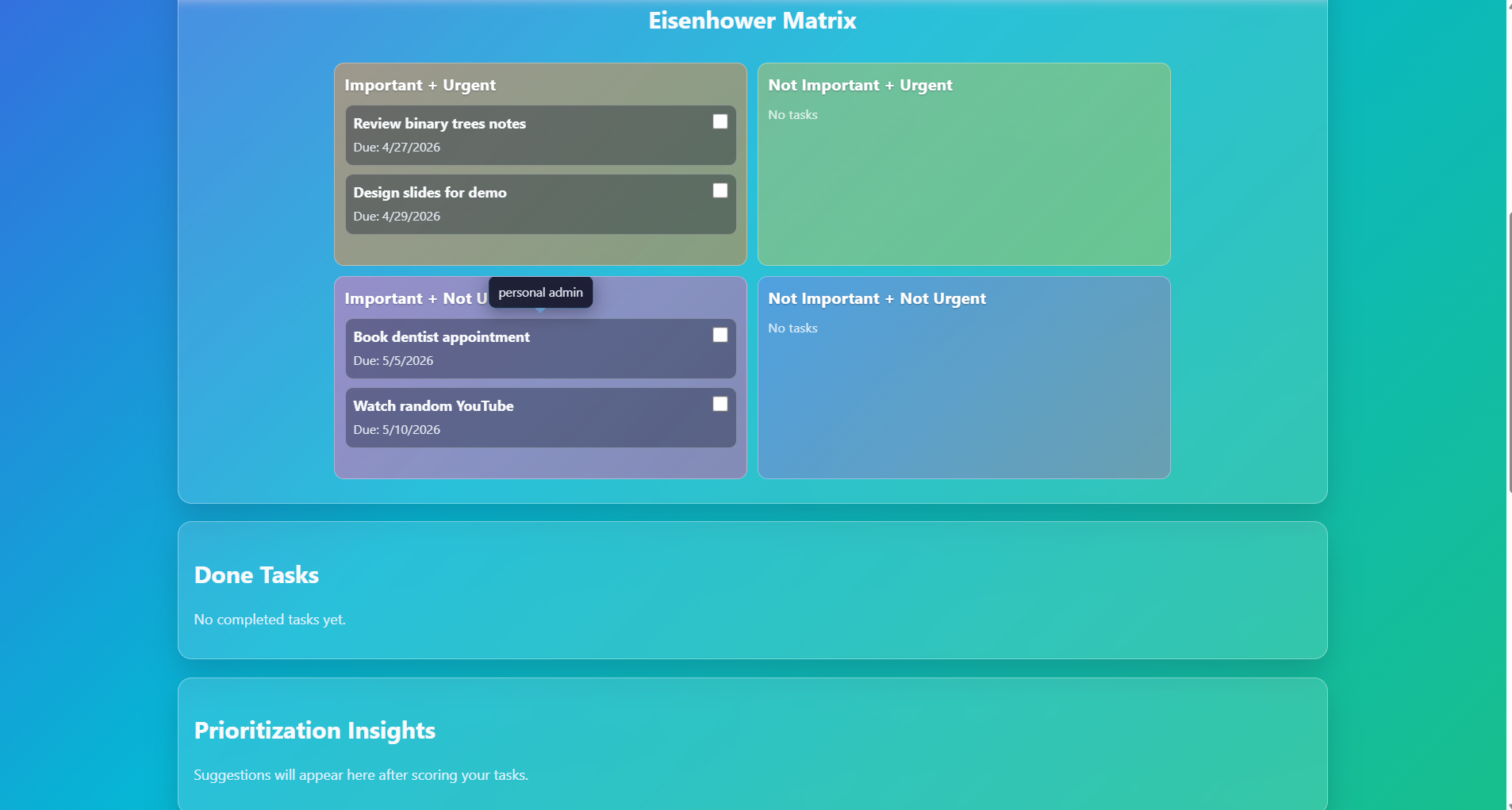
Eisenhower Matrix Before AI Prioritization
-
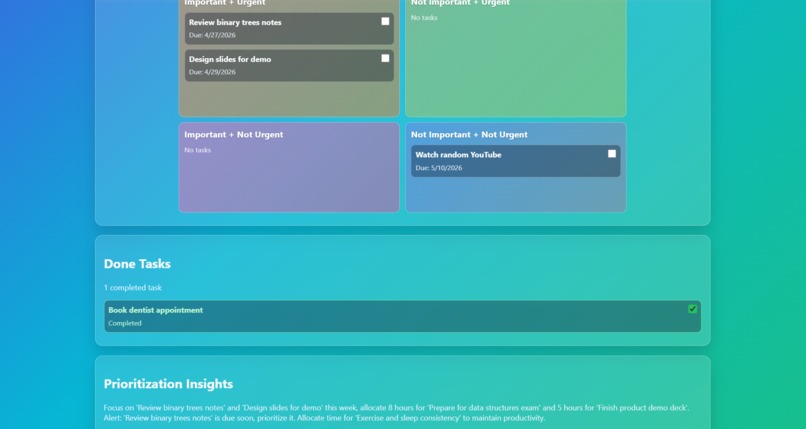
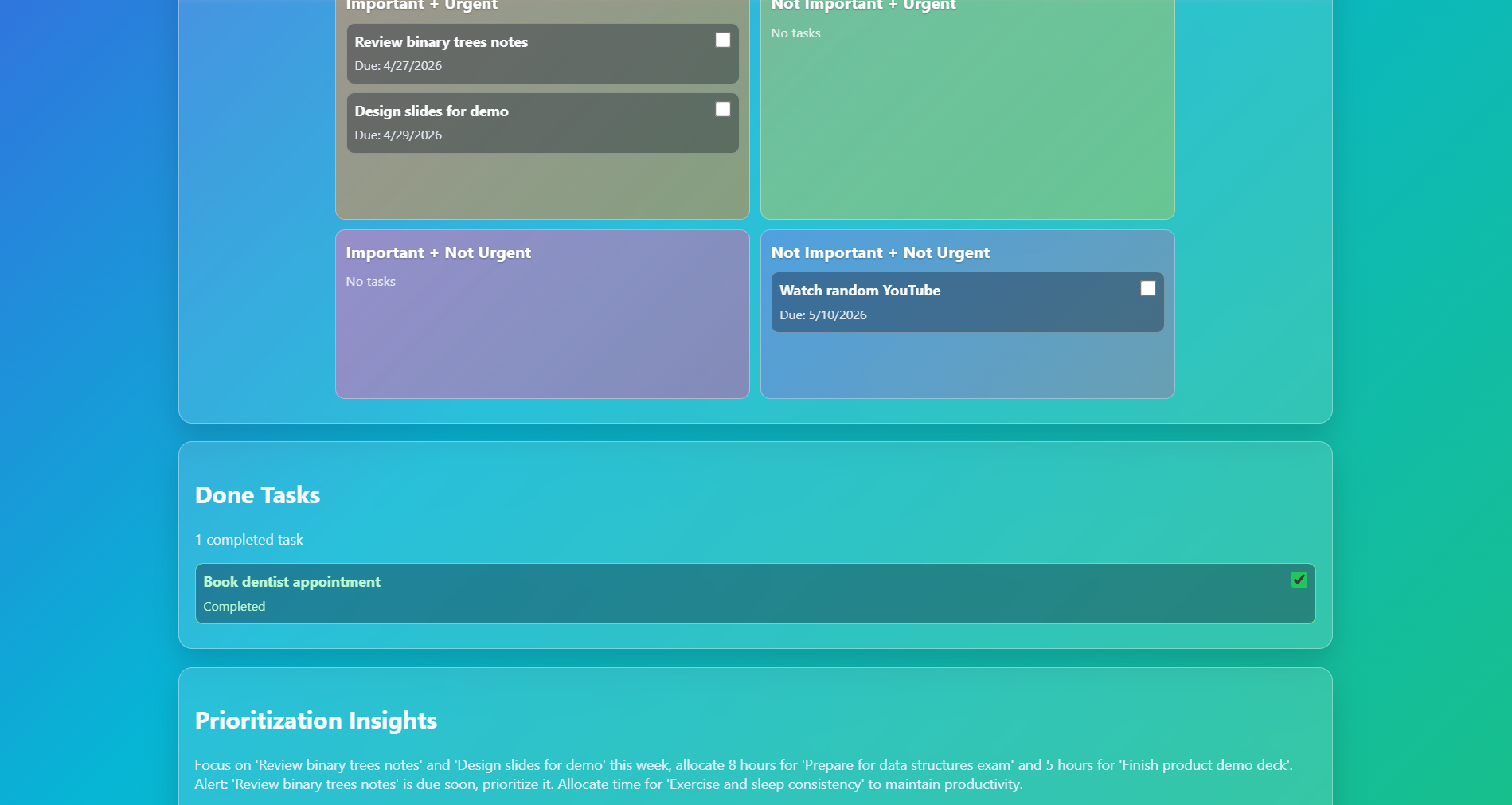
AI Prioritization Insights and Matrix
-
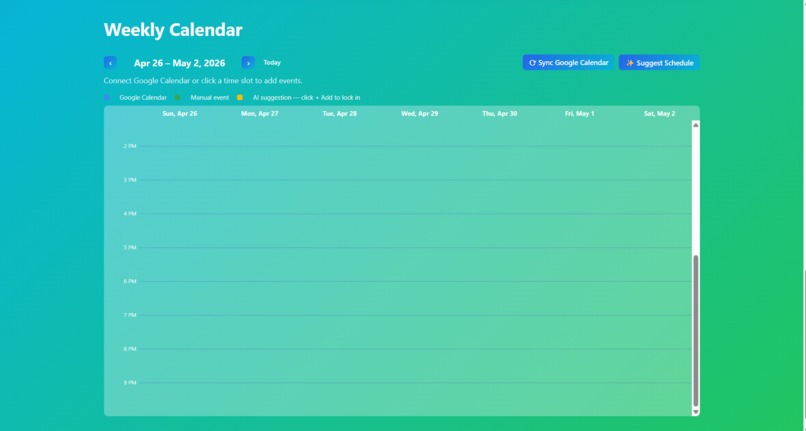
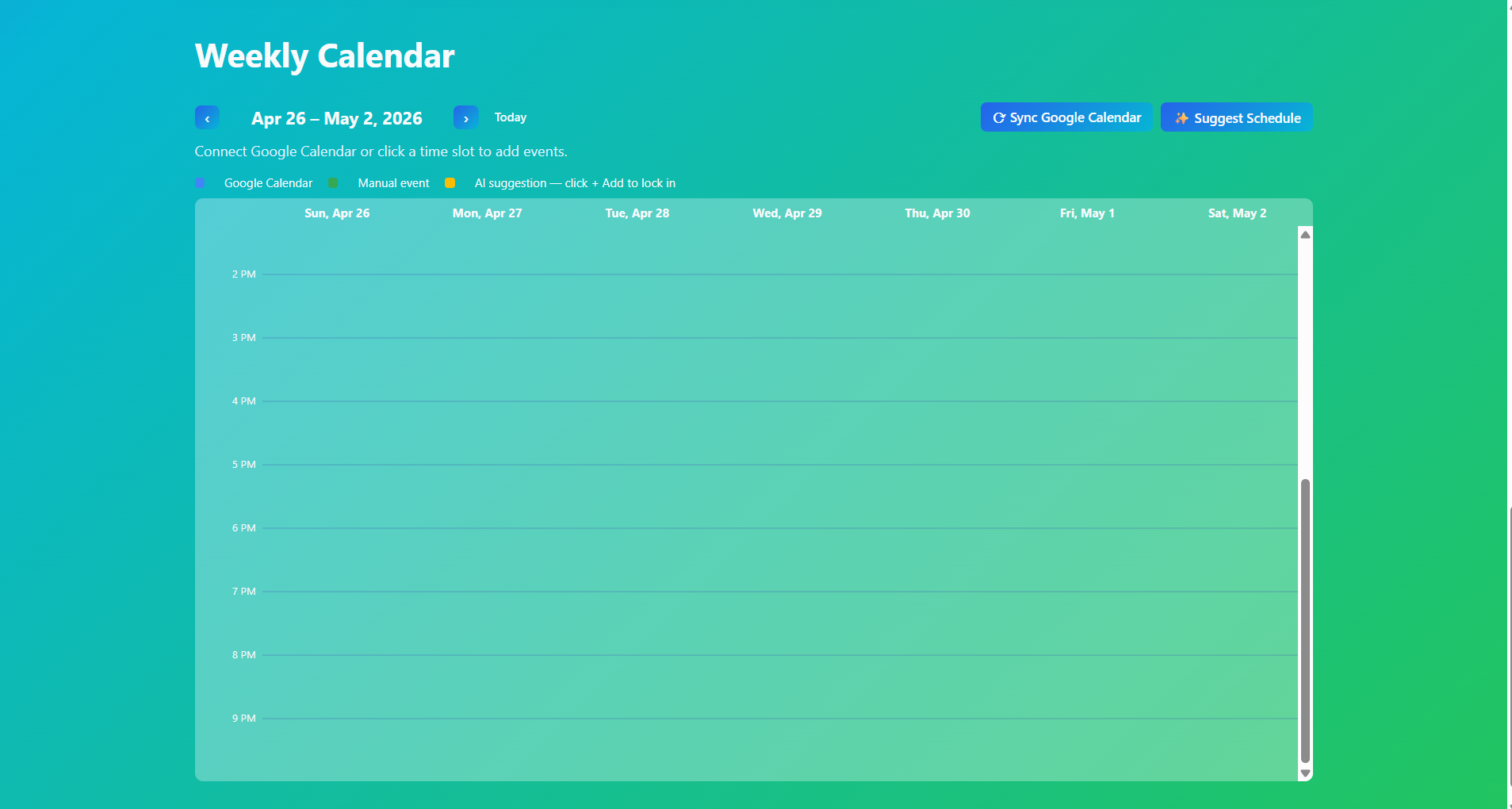
Weekly Calendar Before Task Input
-
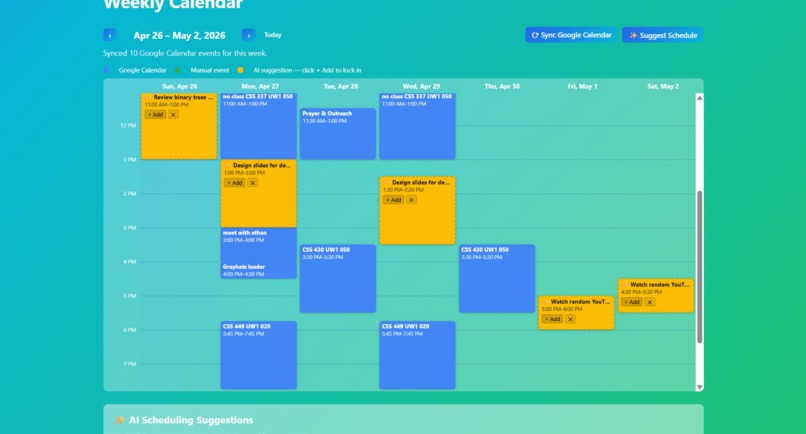
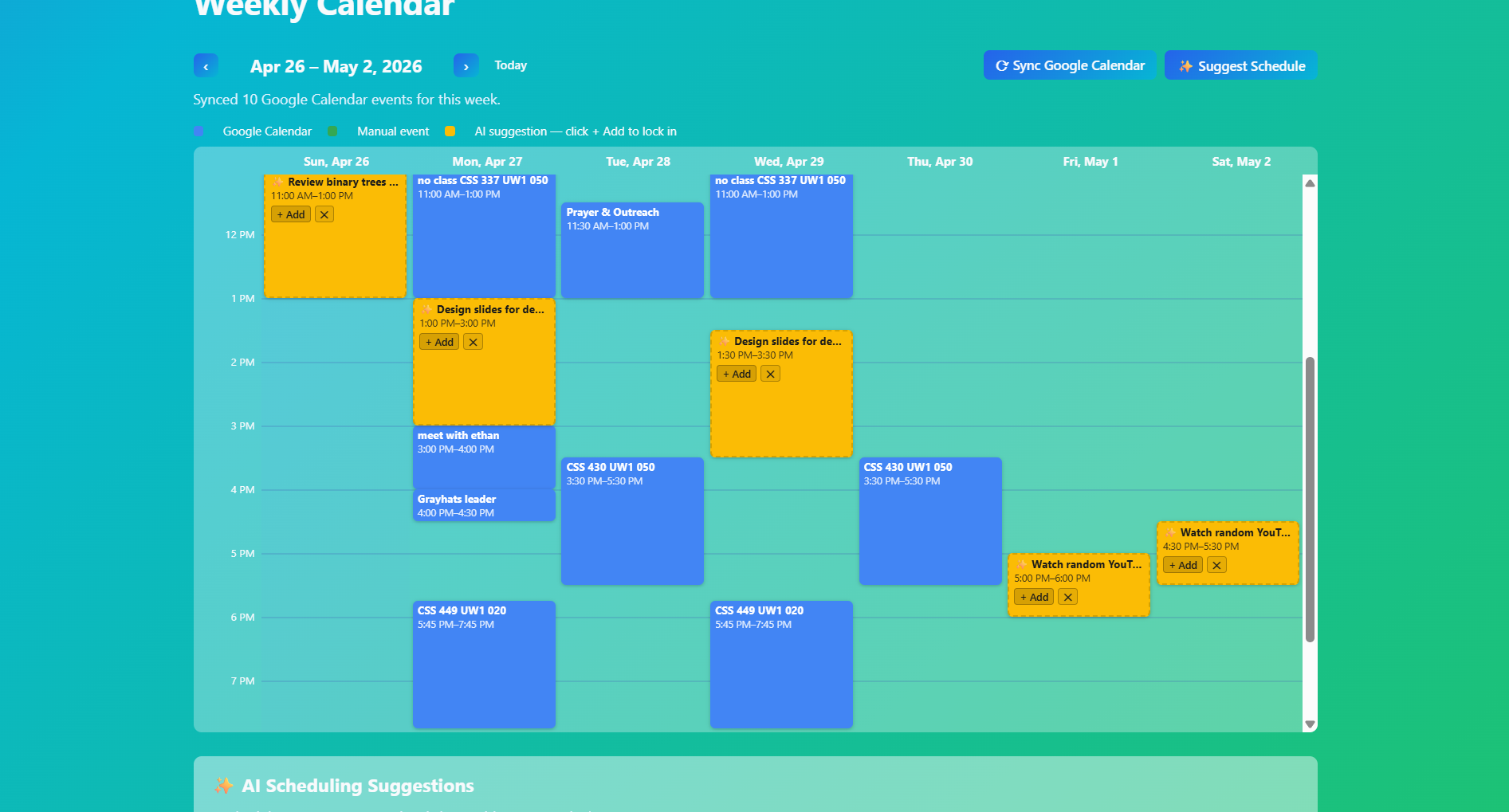
Calendar With Google Syncing and AI Suggestions
Meet Synapse
Synapse is an AI-powered task prioritization tool that bridges the intuitive gap between your daily to-do list and your long-term goals.
Users begin by entering their weekly goals along with the number of hours they want to dedicate to each. Synapse then pulls in tasks directly from Google Calendar and Google Tasks—or lets users enter them manually—and automatically scores each task across two dimensions: urgency, calculated from the task's due date, and importance, determined by an AI-powered alignment check against the user's stated goals. Each task is assigned a vector and placed into one of the four quadrants of a visual Eisenhower Matrix, naturally training users to learn an intuitive mental method for task prioritization over time. Based on a user’s goal-oriented task prioritization matrix, a Groq-powered AI coach generates personalized suggestions and alerts — flagging tasks that don't align with any of your goals, warning when your time allocations fall short of what a goal requires, and celebrating when your week is well-structured. Automated adjustments are made to calendar scheduling based on every task's relevancy to a user's goals and schedule availability. Users can review prioritization suggestions and accept, reject, or edit schedule adjustments based on intelligent feedback—placing the user in executive control while letting AI assist with clearing mental clutter and enhancing available time all while considering long term goals.
How we built it
We designed and built this application by first exploring our idea through rapid experimentation. After generating an initial concept using AI Studio, we refined our approach by breaking the project into smaller pieces and developing core features individually. This allowed us to better understand the functionality before combining everything into a unified system.
We built a dynamic React Native web application in Google’s Antigravity IDE using HTML, CSS, and JavaScript to handle user metadata for tasks, goals, and schedules. Our prioritization ranking system determines the urgency of tasks based on their due dates and relevance to user goals. We integrated Google Cloud services to log users into a personal experience which syncs with Google Calendar and Google Tasks apis. We implemented context-aware calls to Groq AI using stored goals and tasks variables to provide JSON-formatted feedback. The returned prioritization index is used to categorize tasks based on their relevancy to user goals. Version control is managed through Github. The application is hosted on Vercel so it can be accessed by anyone.
Challenges we ran into
Project Challenges From the start, we were genuinely excited about what Synapse could become — not just as a product for others, but as something meaningful for our own lives. Each of us came to the project with a different perspective on the value it could provide. Some were drawn to the bigger picture of goal-setting and how it could be structured within the platform. Others were more interested in how Synapse could integrate smoothly into the tools and routines they were already using every day. While we aligned quickly on the core concept, we each had a distinct vision of what the final product would look like, what it would do, and what problem it would ultimately solve. Rather than forcing consensus too early, we leaned into those differences. Each team member built their own mini prototype based on their individual vision, then we came together to share what we'd made — pulling the strongest ideas from each into a single, unified application. Technical Challenges Throughout the development of this project, every member of our team stepped outside their comfort zone and took on challenges they had never faced before. For some, this meant learning how to collaborate effectively within a larger team environment — navigating shared responsibilities, communicating across different skill sets, and staying aligned on a shared vision. For others, it meant diving headfirst into external API integrations and application hosting for the first time, or tackling the complexities of AI integration without prior experience to lean on. On the technical side, we encountered a number of significant hurdles along the way. Integrating with Google APIs proved more complex than anticipated, requiring careful study of documentation and repeated troubleshooting to get our implementation working correctly. Managing version control across multiple team members was another persistent challenge — merging branches, resolving conflicts, and keeping our codebase clean and stable as everyone pushed changes simultaneously. We also ran into issues with AI token permissions and usage limits, which forced us to rethink how we structured our requests and managed API calls efficiently. OAuth2 authentication added another layer of difficulty, as configuring the correct permissions and handling key management securely took considerable time and iteration to get right. Despite these obstacles, working through them gave our team invaluable hands-on experience that goes far beyond what any classroom setting could provide. Each challenge we overcame made us stronger collaborators and more capable developers.
Accomplishments that we're proud of
In just 24 hours we have brought our idea from whiteboard sketches to a fully functional web application.
Some of our key milestones include:
Seamless Integration and authorization for a tailored personal experience: We successfully configured Google OAuth 2.0 and managed authentication to sync live tasks and calendar data from Google Cloud services.
Algorithmic prioritization: We developed a logic system that translates abstract user goals and timeframes into concrete vector points for matrix placement.
AI integration and orchestration: We successfully integrated LLMs Groq to act as a "productivity coach" which learns a user’s rather than just a chatbot.
Collaborative prototyping: We consolidated 4 different branches into a single application, turning our different initial visions into a unified product by building and merging individual prototypes.
What we learned
Through this project, our team gained valuable experience both technically and collaboratively. We learned how to work effectively under pressure, build structured workflows, and ask strong, purposeful questions. While choosing the project idea was straightforward, refining the user experience required thoughtful discussion, flowcharts, and mockups to clearly define our vision. During implementation, we developed skills in using AI as a development tool, both for generating code and integrating it into our application. We improved our ability to refine prompts, evaluate AI-generated output, and balance when to rely on AI versus manual coding logic. We also worked with external integrations such as Google Tasks, Google Calendar, and AI-driven features for scoring and scheduling. This required configuring APIs and managing authentication, giving us practical experience with real-world system integration. Overall, this project pushed us to expand our technical skills and strengthened our ability to collaborate effectively as a team.
What's next for Synapse
Refined Machine Learning: Implementing an unsupervised learning algorithm to recognize patterns in user behavior over time and adjusting importance scores based on past completion habits.
Cross-Platform Expansion: Connecting the web dashboard to a native mobile app using React Native to provide push notifications via asynchronous background calls to Groq api. These notifications will alert users (via a daily summary) of goal and schedule-informed suggestions. Ex: ""Good morning DJ. You have 3 high-priority tasks due this week but only 4 hours allocated toward your monthly goal of learning bass guitar — consider blocking time tomorrow morning before your schedule fills up."
Enhanced Goal Tracking: Adding a Vision Board feature that provides long-term analytics on how much time was dedicated to individual goals over a quarter or a year. This will be calculated using the cumulative time spent on tasks mapped to their relevant goals, giving users a clear picture of where their energy has actually gone and how closely their daily scheduling habits reflect their bigger ambitions.
Backend Database: Storing a user’s specific goals, task lists, and prioritization metadata in a private relational database such as SQLAlchemy. This will allow Synapse to track how tasks evolve over time and provide the unique historical data for our AI engine to generate meaningful insights and prompts for reflection in the evolving Vision Board.
Built With
- css
- google-cloud
- google-cloud-services
- groq
- html
- javascript
- oauth
- react-native
- vercel


Log in or sign up for Devpost to join the conversation.