AI tools are extremely useful, but they often fail in a dangerous way: they sound confident even when the evidence is weak, incomplete, or unsupported.
That is a real problem for people using AI for serious work like grant proposals, policy briefs, technical comparisons, due diligence, compliance research, and startup decisions. In those settings, a fluent answer is not enough. Users need to know where each claim came from, which claims are supported, which claims are only partially supported, and what evidence is still missing.
SYNAPSE was built around one idea:
AI answers should be auditable.
What It Does
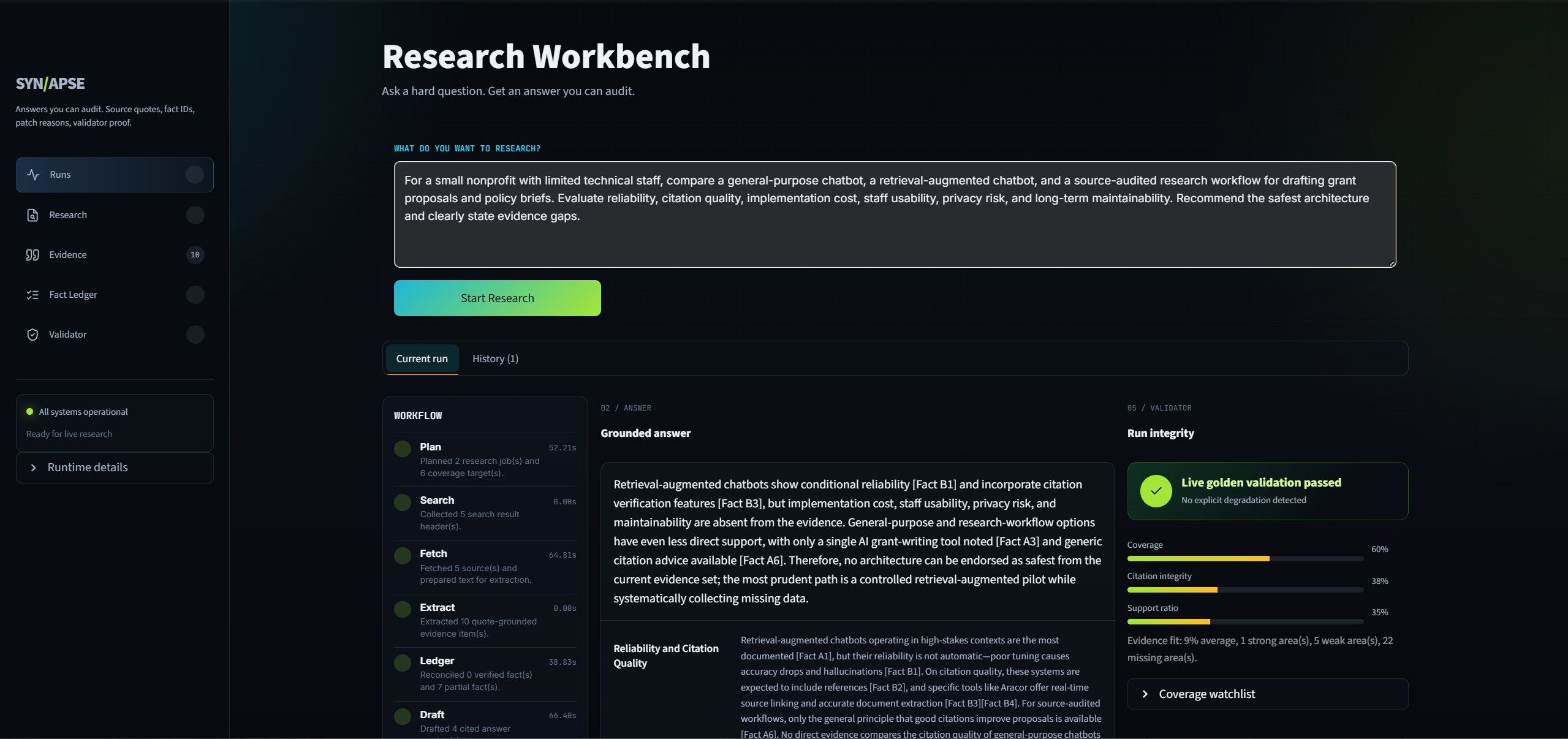
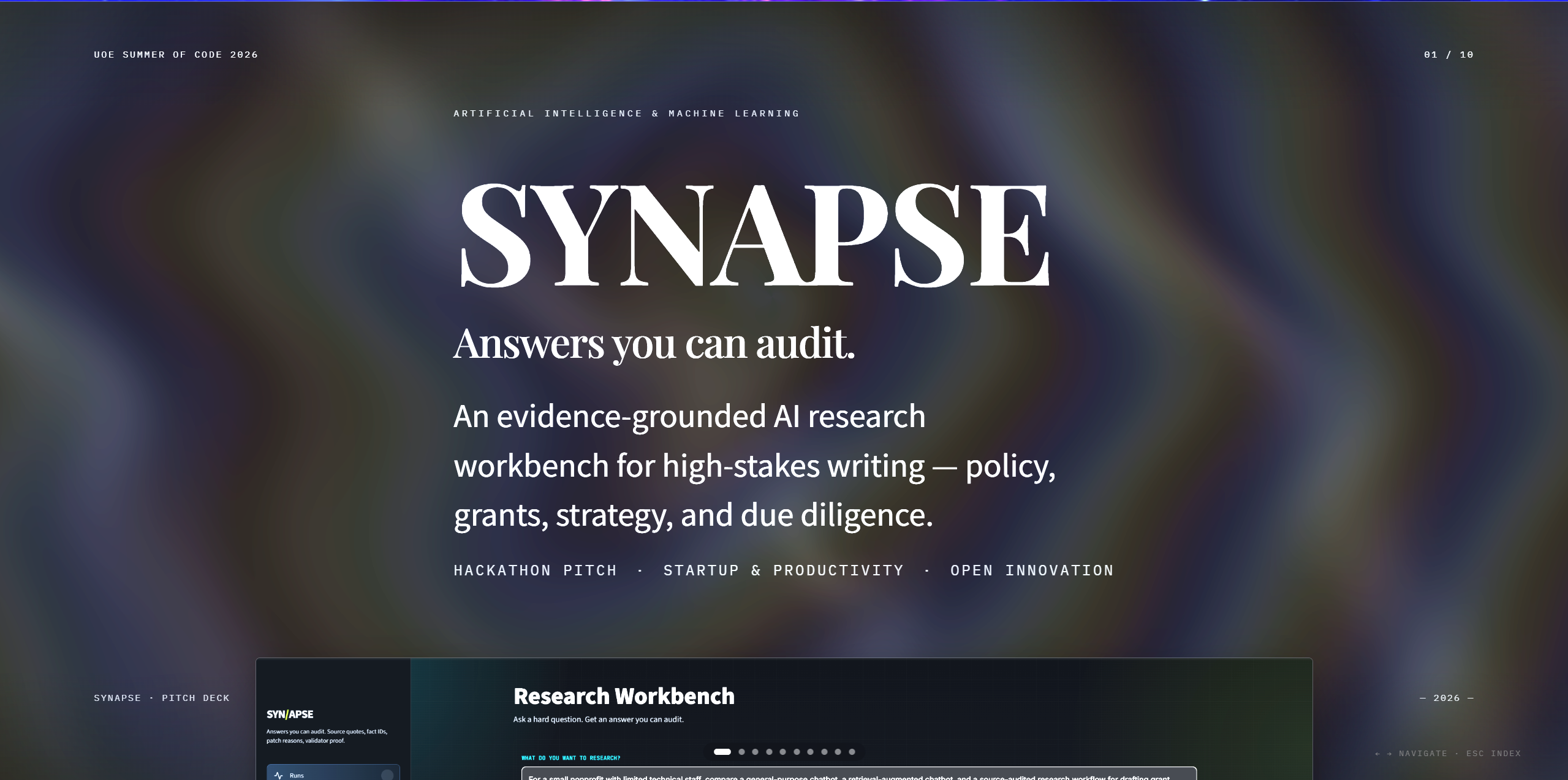
SYNAPSE is an AI research workbench that turns model answers into auditable reports.
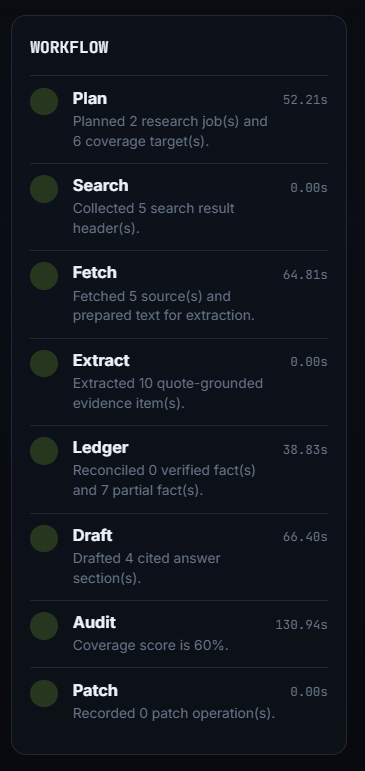
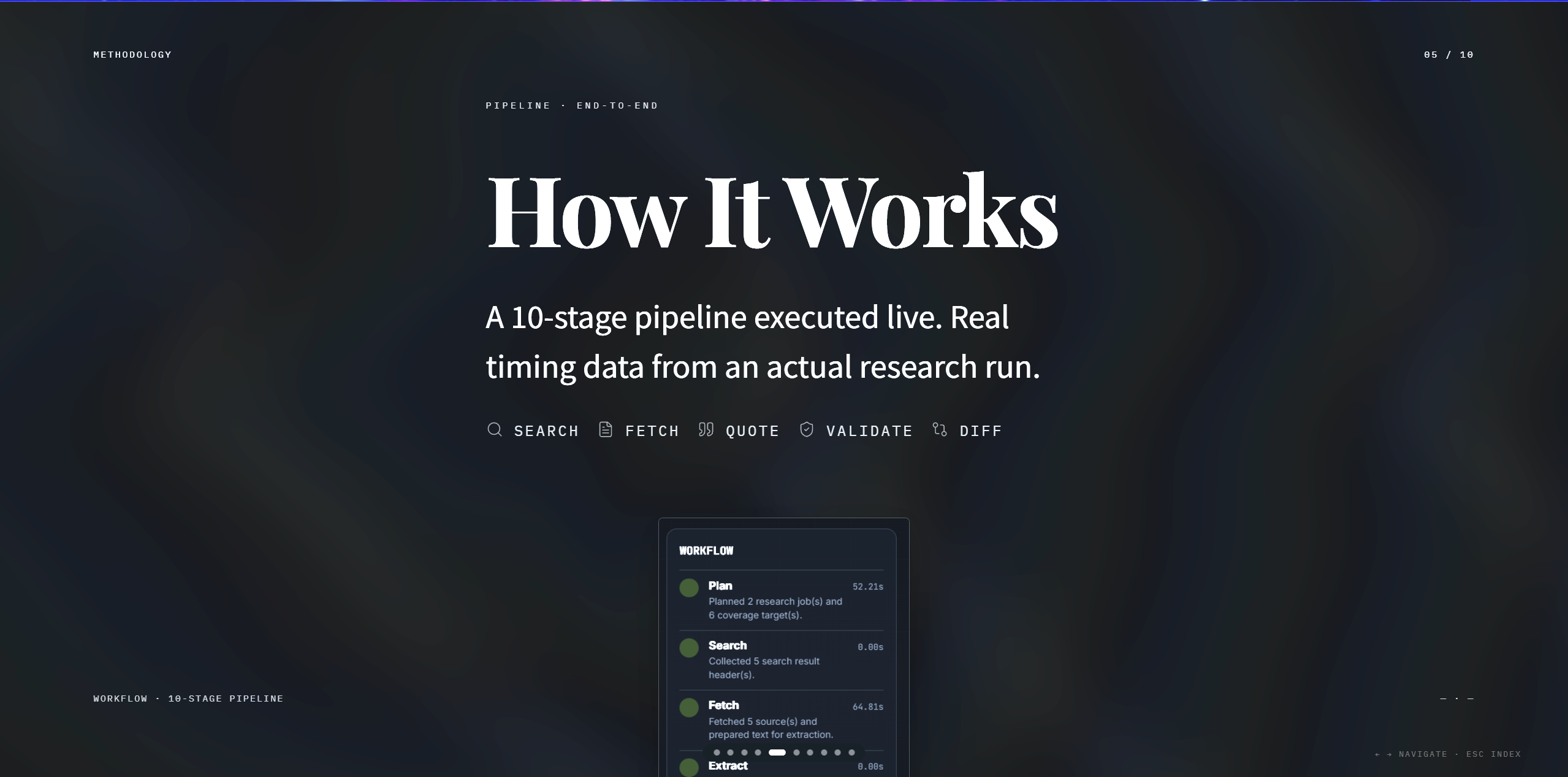
Instead of returning one black-box response, SYNAPSE runs each question through a structured research pipeline:
- Plan the research question
- Search public sources
- Fetch and clean source text
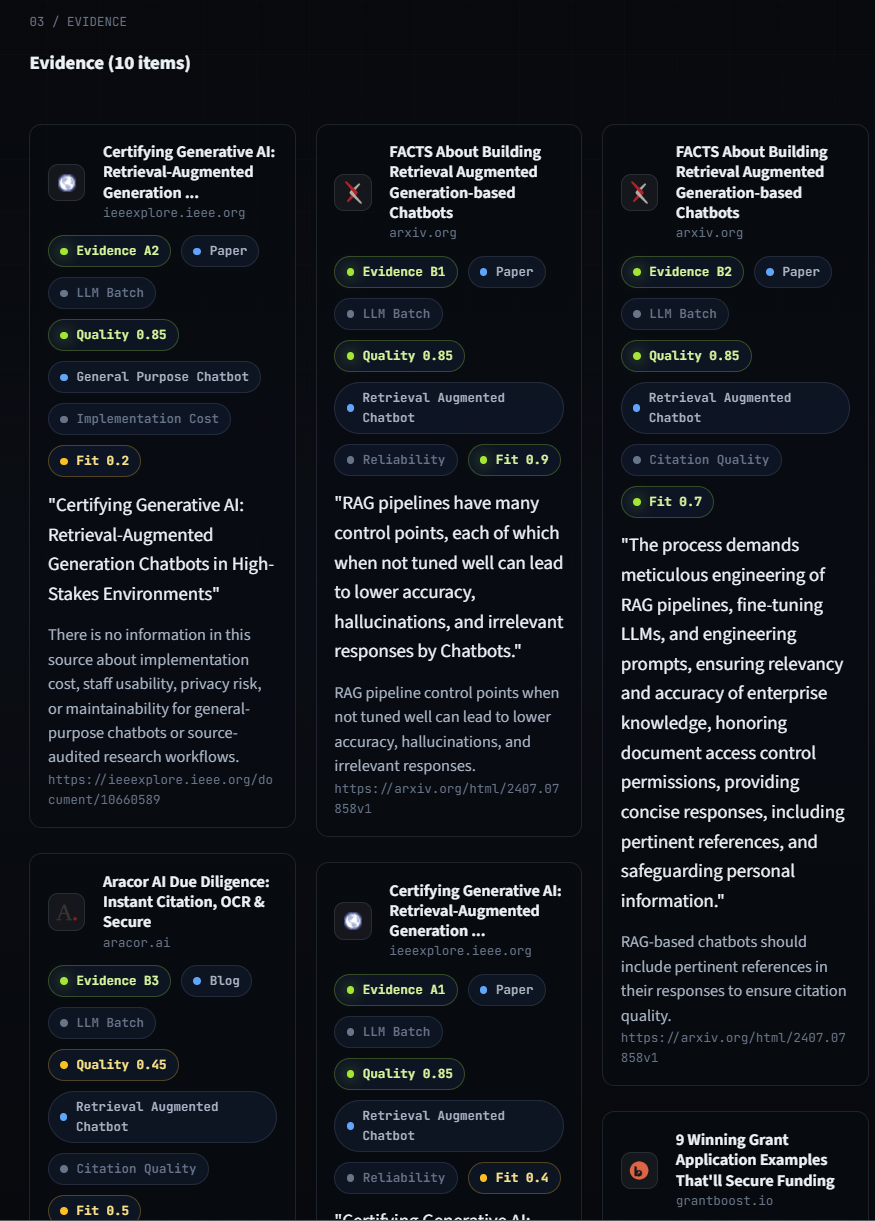
- Extract quote-grounded evidence
- Reconcile evidence into a fact ledger
- Draft a cited answer
- Audit coverage and unsupported claims
- Patch the final report with justified edits
- Validate the result
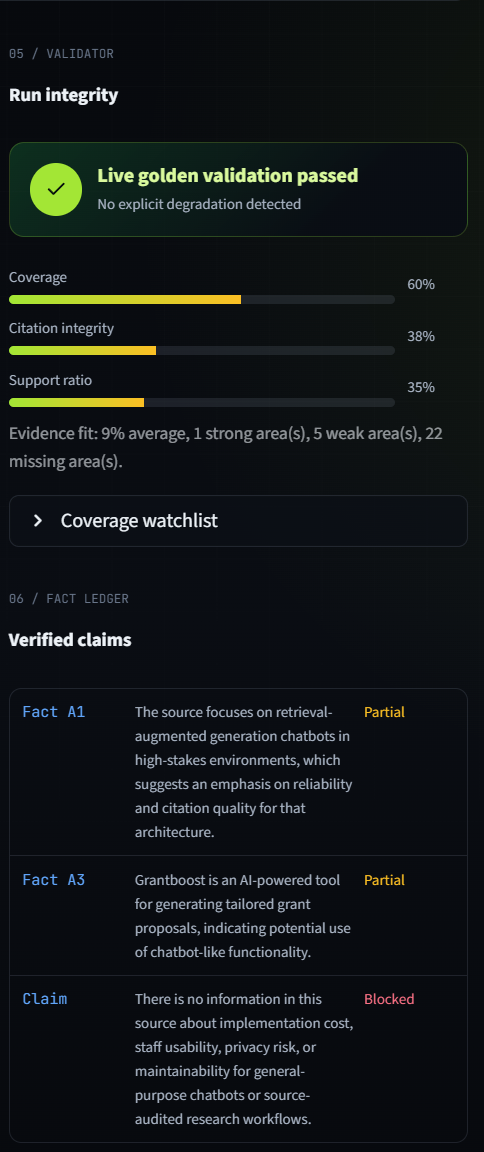
The final output includes source quotes, fact IDs, citations, evidence quality signals, coverage gaps, provider metrics, and validator proof.
How We Built It
SYNAPSE is built as a Python multi-agent research pipeline with a Streamlit workbench UI.
The backend separates each responsibility into its own agent: planner, searcher, evidence extractor, fact checker, synthesizer, coverage auditor, and patch applicator. Shared data contracts are defined with Pydantic so every stage produces structured, testable outputs.
The UI presents the pipeline as a research cockpit. Users can see the current stage, final answer, evidence cards, fetched sources, fact ledger, coverage watchlist, validator status, and provider telemetry.
We also added a SQLite prompt cache for demo reliability, so validated research runs can be replayed quickly while still showing the full pipeline experience.
Challenges We Faced
The hardest challenge was stopping the system from producing confident but weak answers.
Early versions could pass basic validation while still sounding too certain. We fixed this by adding evidence criteria, source fitness scoring, evidence fit scoring, a coverage matrix, and stricter synthesis rules. Now SYNAPSE can show when the evidence is strong, weak, or missing.
We also had to harden the LLM provider layer. Some reasoning models consumed large token budgets without returning visible content, so we added telemetry, timeout handling, provider metrics, and fallback visibility.
Another challenge was making the UI feel useful instead of just decorative. We redesigned it around the actual research workflow: evidence, facts, gaps, validation, and auditability.
What We Learned
We learned that trustworthy AI is not just about better prompts. It requires workflow design, evidence tracking, validation gates, and honest uncertainty.
The most important lesson was that a good research assistant should not always give a definitive answer. Sometimes the correct behavior is to say: the evidence is not strong enough yet.
What Makes It Different
Most AI research tools optimize for fluent answers.
SYNAPSE optimizes for inspectable answers.
It does not just generate prose. It shows the evidence chain behind the prose, blocks unsupported claims, and makes missing coverage visible before the answer is trusted.
Business and Impact Analysis
SYNAPSE targets a growing problem in AI adoption: organizations want the speed of AI, but they cannot always trust or verify the output. This is especially important for nonprofits, startups, policy teams, analysts, students, and small organizations that need credible research but may not have dedicated research staff.
The practical value is simple: SYNAPSE reduces the risk of publishing or acting on unsupported AI-generated claims. By exposing source quotes, fact IDs, evidence gaps, and validation status, it gives users a clearer basis for decision-making.
Potential use cases include:
- Grant proposal research
- Policy brief drafting
- Technical architecture comparisons
- Market and competitor research
- Compliance and due diligence workflows
- Academic and student research support
- Startup strategy and product research
Scalability and Future Roadmap
SYNAPSE is currently a functional prototype, but the architecture is designed to grow into a hosted research platform.
Near-term roadmap:
- Hosted public demo with persistent run history
- Exportable PDF, DOCX, and Markdown reports
- Better source connectors for academic, policy, legal, and business research
- Team workspaces for shared research runs
- Configurable organization-level evidence policies
- More robust live web retrieval and source ranking
- Richer coverage matrix visualizations
- Benchmarks across multiple research domains
Long-term roadmap:
- Multi-user SaaS workspaces
- Evidence policy templates for different industries
- Human review and approval workflows
- Integrations with Google Drive, Notion, Slack, and document editors
- Report versioning and audit trails
- Enterprise-grade deployment options
- Domain-specific research packs for nonprofits, policy, finance, education, and compliance
API and Extensibility
SYNAPSE is built with modular provider interfaces so the system can swap or extend model providers, search providers, source fetchers, and rerankers without rewriting the full pipeline.
The backend is organized around explicit data contracts:
SearchHeaderfor candidate search resultsFetchedSourcefor retrieved source textEvidenceItemfor quote-grounded evidenceFactLedgerfor verified, partial, contradictory, and unsupported claimsReportfor the final cited answerCoveragePatchfor audit-driven edits
This makes the system easier to test, extend, and eventually expose through an API.
Execution Quality
The project includes a working Streamlit prototype, a structured backend pipeline, provider telemetry, live validation scripts, test coverage, demo materials, screenshots, slides, and a walkthrough video.
Validation highlights:
- 172 automated tests passing
- Live golden validation passing
- Source-linked evidence required
- Fact IDs required in final report sections
- Unsupported claims blocked before final output
- Provider metrics recorded for traceability
Limitations
SYNAPSE is not meant to guarantee truth automatically. It improves research reliability by making evidence quality visible and by blocking unsupported claims, but it still depends on the quality and availability of public sources.
When evidence is weak or missing, SYNAPSE is designed to say so instead of pretending the answer is certain. This limitation is also part of the product’s core value: honest uncertainty is safer than false confidence.
Built With
- api
- apis
- arxiv
- beautiful-soup
- deepseek
- duckduckgo
- flash
- gemini-compatible
- github
- go
- httpx
- llm
- mermaid
- openai-compatible
- opencode
- provider
- pydantic
- pytest
- python
- search
- sqlite
- streamlit
- support
- v4

Log in or sign up for Devpost to join the conversation.