-
-
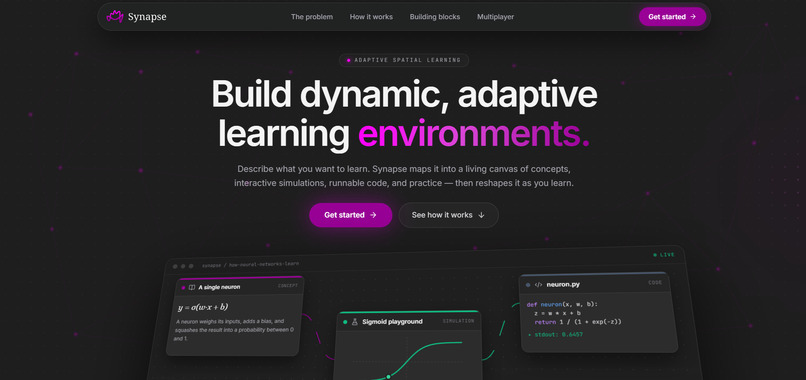
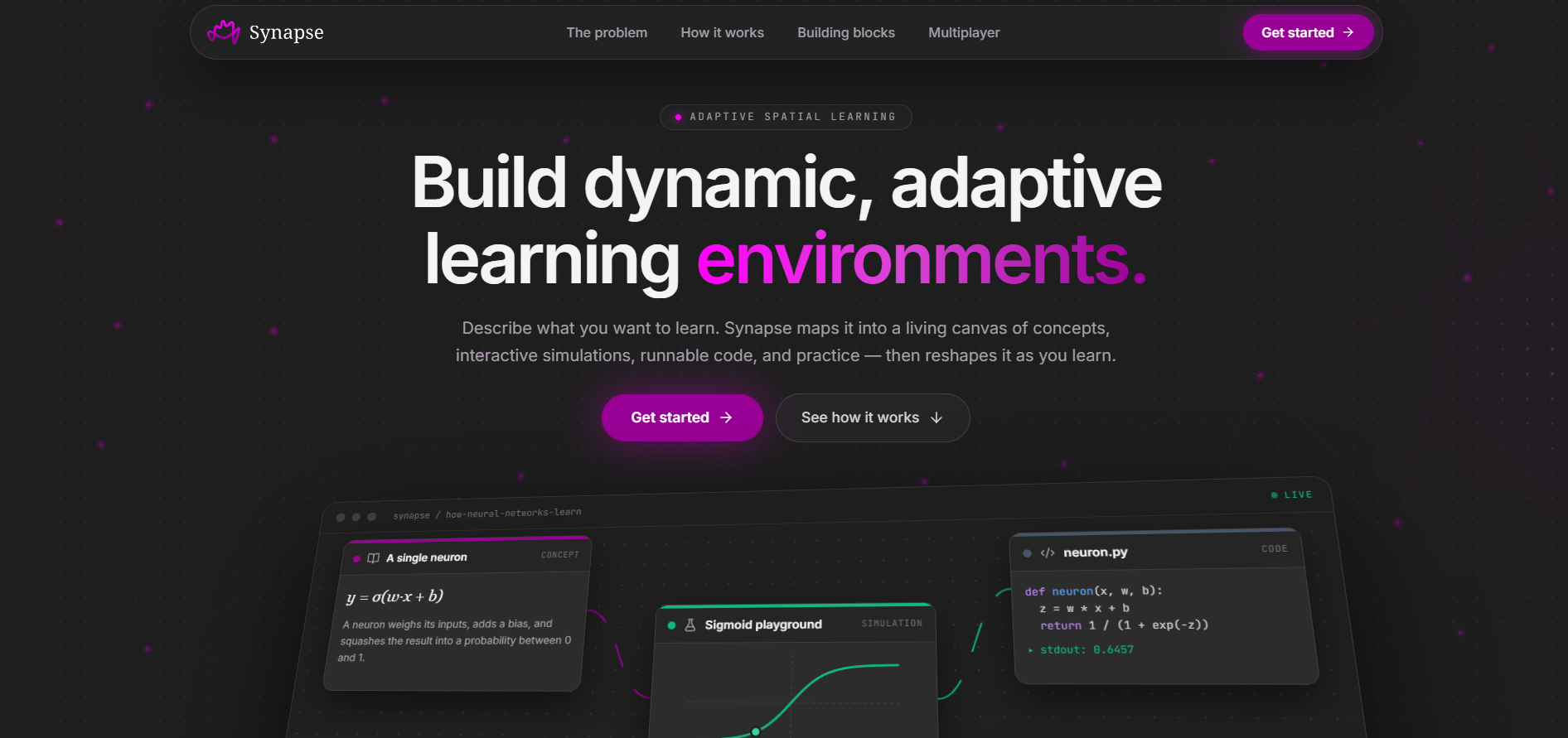
Landing Page (Hero)
-
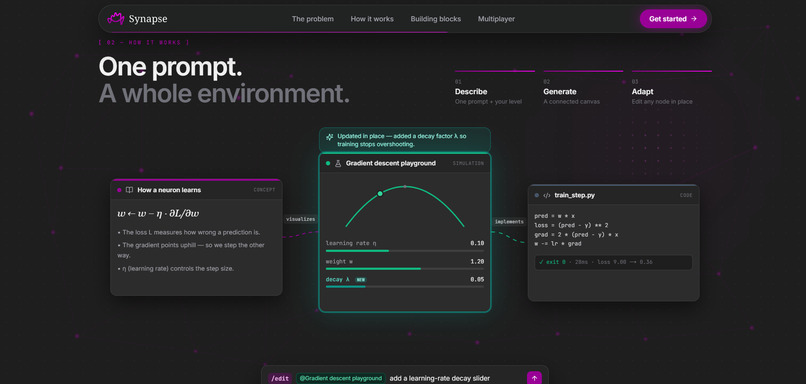
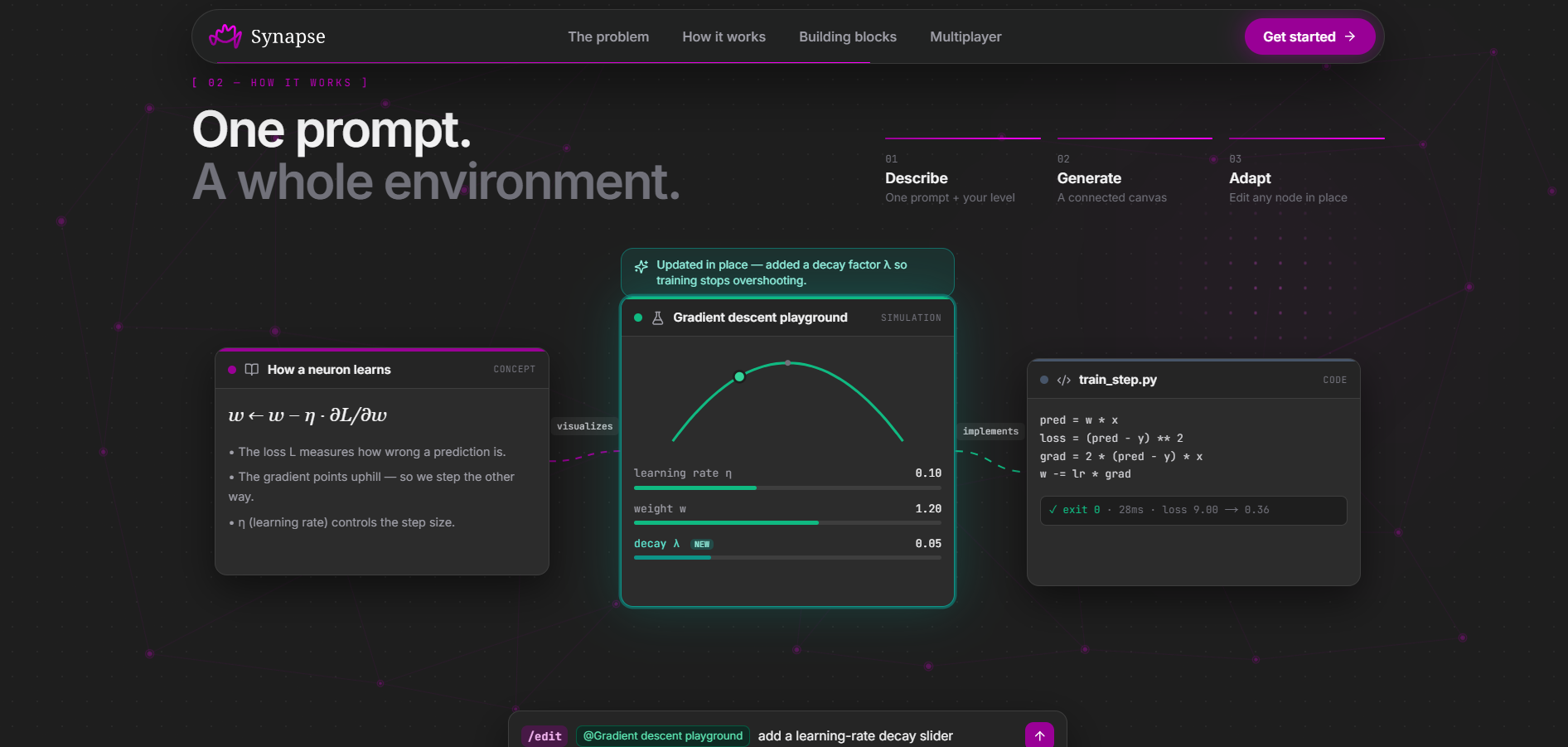
Landing Page (How it works)
-
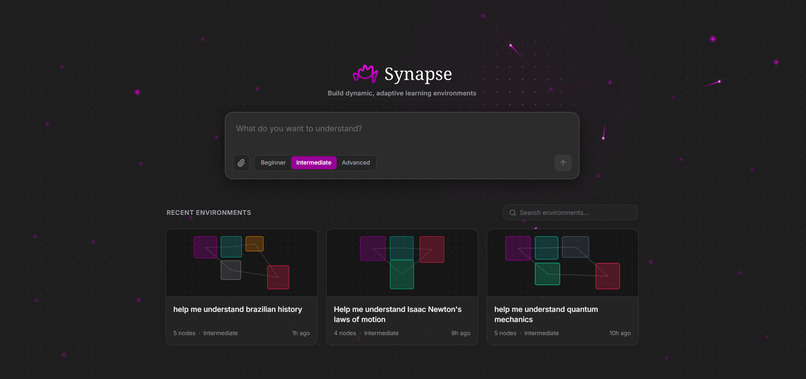
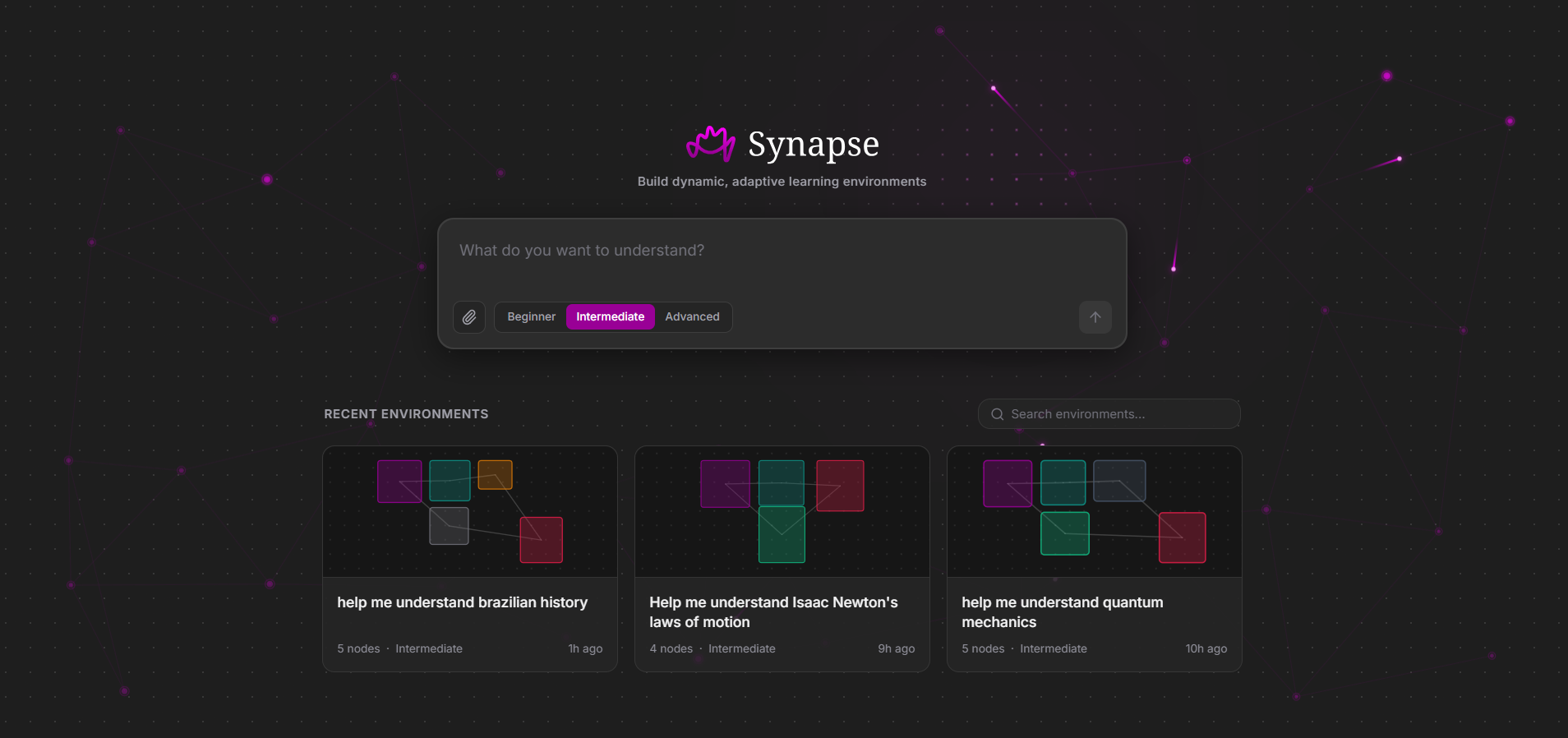
App
-
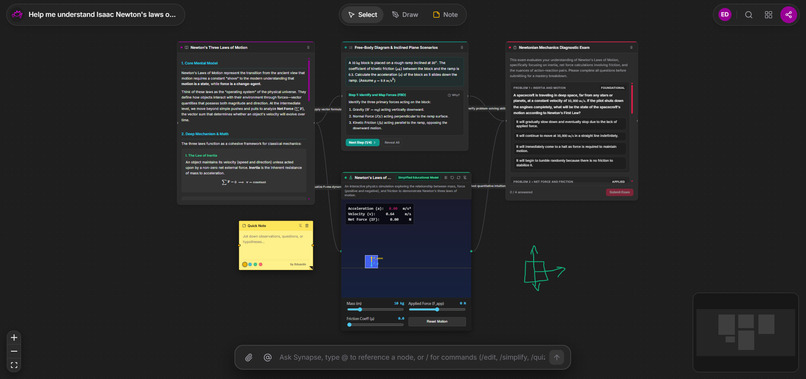
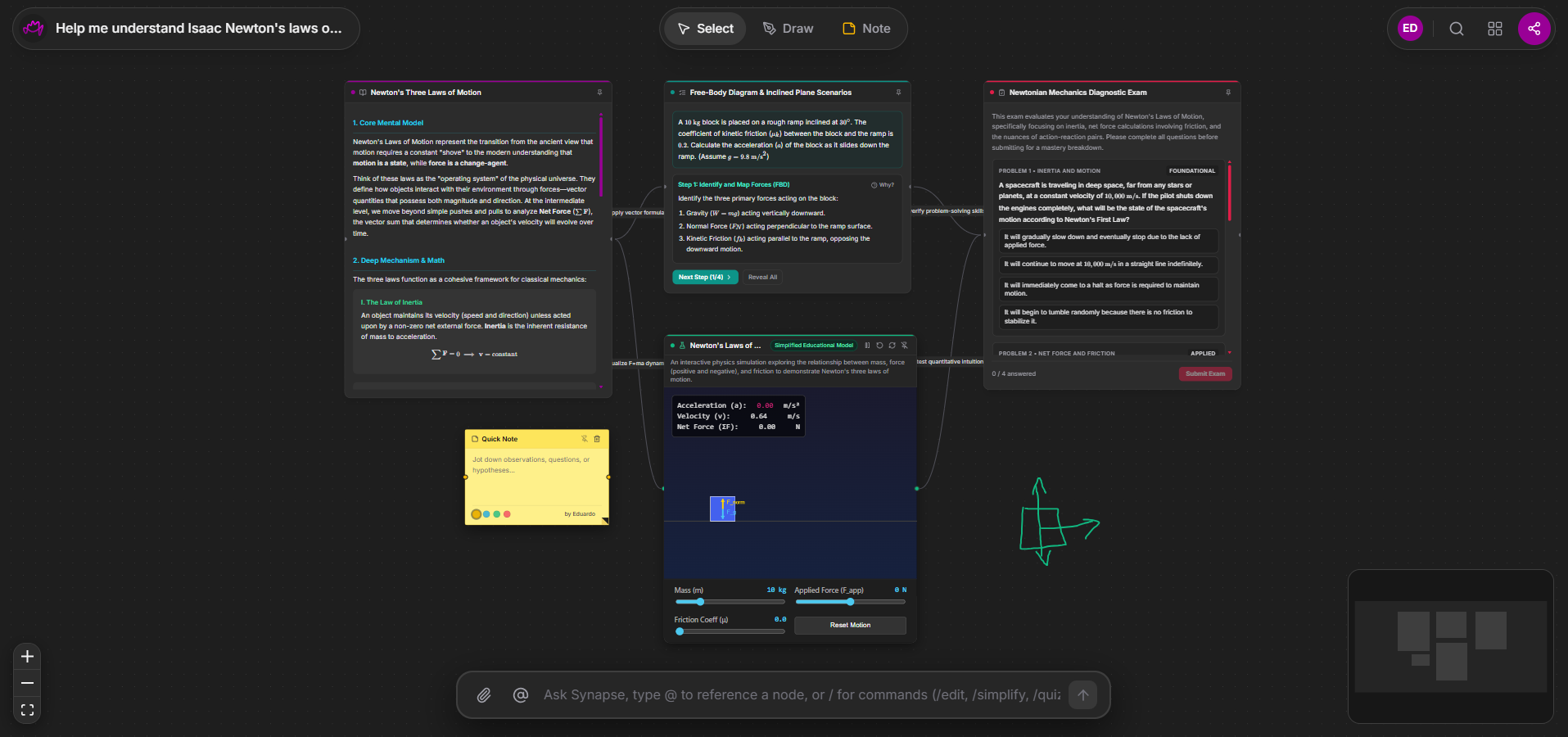
Learning Environment
Inspiration
Learning is often fragmented across different platforms, websites, tabs, and screens. From our personal experiences studying with multiple tabs open, we found it disorienting to keep track of where everything was, especially when tackling more complex and conceptual topics. Inspired by the interconnected structure of the human brain, we created Synapse: a collaborative infinite canvas where ideas form networks, concepts connect naturally, and learning becomes an interactive experience.
We envisioned Synapse as an adaptive learning environment where information is easily accessible and connections between ideas are clear and intuitive. Rather than having students feel overwhelmed as they struggle to understand complex information amid a chaotic collection of tabs and screens, our goal is to create a unified learning space where users can seamlessly navigate their learning goals and explore an interconnected network of knowledge.
What it does
Synapse transforms a learning objective into an interactive network of interconnected ideas and topics. Rather than encouraging users to simply memorize large amounts of information, we want to help them develop a deeper understanding of how concepts relate to one another.
Through a collaborative infinite canvas, users can visually explore connections between topics, interact with simulations, and experiment with executable code, bringing different forms of learning into one unified environment. The parameters within a simulation can be easily adjusted using sliders, allowing users to explore different scenarios related to the same topic.
How we built it
We built Synapse using Next.js, React, TypeScript, and Tailwind CSS to create a responsive and interactive learning platform. At the center of Synapse is our infinite canvas, developed using React Flow, which allows users to navigate interconnected topics through a neural-network-inspired structure. Each concept is represented as an interactive node, allowing users to explore relationships between ideas, interact with simulations, and experiment with executable code.
To create an adaptive learning experience, we integrated Google Gemini's generative AI API. Our AI architecture is designed to transform a user's learning objective into a structured network of concepts, generate educational content, and provide contextual assistance. We also implemented an adaptation system that can respond to learning difficulties by introducing additional explanations and connections between concepts.
For collaboration, we used Supabase, combining PostgreSQL for persistent data storage with real-time synchronization capabilities for shared workspaces. We also integrated Bright Data for external research, allowing the platform to incorporate relevant information into learning materials.
To support hands-on learning, we developed interactive simulations using sandboxed JavaScript environments and integrated the Piston API for executing code. This allows users to explore concepts beyond traditional text-based explanations.
Finally, we used GitHub to manage our project and Render as our intended deployment platform, bringing these different technologies together into one unified learning environment.
Challenges we ran into
One of our biggest challenges was integrating several complex features into one cohesive learning environment. We wanted Synapse to support an infinite canvas, AI-generated educational content, interactive simulations, executable code, and real-time collaboration without overwhelming users with a complicated interface.
Developing the infinite canvas with React Flow also introduced challenges in organizing interconnected concepts. As more nodes and relationships are generated, maintaining a clear visual structure becomes increasingly important. We addressed this by developing a node-placement system designed to minimize overlapping elements and preserve readability.
Another technical challenge involved integrating Google Gemini into our learning environment. Rather than simply generating text responses, we needed AI-generated content to follow a structured format that could be transformed into interactive nodes. To address this, we implemented structured outputs, validation, controlled parallel requests, and retry mechanisms.
We also encountered challenges with external services such as Bright Data and Piston, particularly around API availability, response times, and reliability. To prevent individual service failures from disrupting the entire experience, we implemented timeouts, error handling, and fallback mechanisms. Integrating Supabase also required us to consider how multiple users could interact with the same workspace while maintaining consistent data.
We ran into many bugs and glitches throughout the development process. Whether they involved user interface issues, errors when synchronizing with other users, or problems with Google Gemini's AI-generated responses, our team had to work through each problem carefully.
Accomplishments that we're proud of
Our biggest accomplishment is developing a learning platform that goes beyond the traditional experience of navigating endless screens, walls of text, and scattered tabs. We are particularly proud of our infinite canvas concept, which gives users a flexible environment to explore ideas, and our neural-network-inspired structure, which makes complex topics more intuitive by visualizing connections between concepts. Additionally, we are proud of integrating interactive simulations and executable code within one space while emphasizing collaboration and learning from others.
We recognize that recent developments in AI have changed how students approach learning, sometimes reducing opportunities for natural interaction between peers. With this in mind, we developed Synapse to promote human collaboration rather than replace it with AI-driven interactions. We believe that technology should strengthen human connections, allowing friends, classmates, and students to explore ideas, exchange perspectives, and learn together.
What we learned
On the technical side, we learned a lot about integrating AI into a website, working on user interfaces, and the overall development process of building a project. We learned to work through problems we encountered, address bugs and glitches with patience, and collaborate effectively while contributing to the project as a whole.
We also learned the importance of balancing functionality with simplicity. An infinite canvas offers tremendous flexibility, but making interconnected concepts intuitive and easy to navigate requires thoughtful design. While researching for development, whether through our personal experiences or those of others, we learned that educational technology should not only make information more accessible but also encourage curiosity, experimentation, and meaningful collaboration.
What's next for Synapse
Next, we want to expand Synapse into a richer, more alive ecosystem of learning primitives—introducing new 3D and spatial lab nodes, real-time dataset and experiment nodes, and spaced-repetition memory nodes that adapt over weeks instead of just minutes. Even more exciting, we want to bring live voice and interactive mascots directly onto the canvas: expressive companions that inhabit your workspace, watch what you sketch and test in real time, talk through tough ideas out loud, and nudge you with Socratic hints without spoiling the breakthrough—all across shareable, remixable environments built for solo mastery and live classrooms alike.
Built With
- brightdata
- geminiapi
- judge0
- nextjs
- react
- render
- supabase
- tailwindcss
