The Synapse Council: Meet the Agents
Each member of the Council is a specialized AI agent with a distinct logical framework, personality, and "win condition."
Elena Vance | The Visionary Optimist
- Philosophy: Radical Innovation & Growth.
- Role: Elena identifies the "unlimited upside." She focuses on how a proposal can solve global problems, drive progress, and create a better future. She is the engine of ambition in the Council.
Dr. Silas Vane | The Ruthless Skeptic
- Philosophy: Risk Mitigation & Cost-Benefit Analysis.
- Role: Silas is the Council’s "stress-tester." He dismisses marketing fluff and looks for hidden costs, points of failure, and logical fallacies. His goal is to ensure no plan is approved without surviving a trial by fire.
Aria Thorne | The Humanist Ethicist
- Philosophy: Equity, Fairness, & Human Impact.
- Role: Aria is the Council’s conscience. She asks, "Who gets left behind?" She evaluates every proposal based on its impact on marginalized groups, privacy, and long-term societal health.
Marcus Chen | The Systems Logician
- Philosophy: Efficiency, Data, & Structural Integrity.
- Role: Marcus ignores emotion and focuses on the "how." He analyzes the technical feasibility and structural flow of a plan. If a proposal isn't mathematically sound or resource-efficient, Marcus will tear it down.
How It Works
Synapse Council uses a sophisticated Agentic Workflow to simulate high-level human deliberation:
- The Prompt: The user provides a topic or a controversial proposal.
- The Moderator: An AI Moderator analyzes the prompt and sets specific "Rules of Engagement" for the council members.
- Round 1 (Opening Statements): Each agent is invoked via the DigitalOcean Agent API. They analyze the prompt through their specific lens (Optimism, Skepticism, etc.) and provide an initial stance.
- Round 2 (The Rebuttal): This is where the magic happens. Each agent is fed the opening statements of their peers. They are instructed to find flaws in the other agents' logic and defend their own position.
- Round 3 (Closing & Consensus): Agents provide their final verdict. The system calculates a Consensus Score based on the numerical confidence levels provided by the agents.
- The Resolution: The Moderator synthesizes the entire debate into a final "Executive Summary," highlighting the most robust arguments from both sides.
Why This Is Needed
In the current AI landscape, we often rely on a single LLM to give us "the answer." However, this approach has three major flaws that Synapse Council solves:
- Combating Sycophancy: Single-agent AIs often suffer from "people-pleasing", they tend to agree with the user's leading questions. By pitting agents against each other, we force the AI to be critical and honest.
- Decision-Making Under Uncertainty: For high-stakes decisions (business strategy, ethics, policy), a single perspective is dangerous. Synapse Council provides a 360-degree view of a problem, surfacing risks that a standard AI might overlook.
- "Rubber Ducking" on Steroids: It allows users to "stress-test" their own ideas. By hearing the "Skeptic" tear your idea apart and the "Ethicist" question its impact, you can refine your proposal before it ever hits the real world.
- The Power of Specialized Reasoning: By using DigitalOcean's Reasoning Models (like Kimi K2.5), we allow the agents to "think" through complex chains of logic before they speak, resulting in much deeper and more nuanced arguments than a standard chatbot.
Inspiration
The inspiration for Synapse Council stems from the ancient concept of the "Senate of Minds", a gathering of diverse experts brought together to solve the world's most complex problems through rigorous debate. We wanted to see what happens when you pit specialized AI personas with conflicting worldviews (The Optimist, The Skeptic, The Ethicist, and The Logician) against each other in a digital arena to find the most robust path forward.
What it does
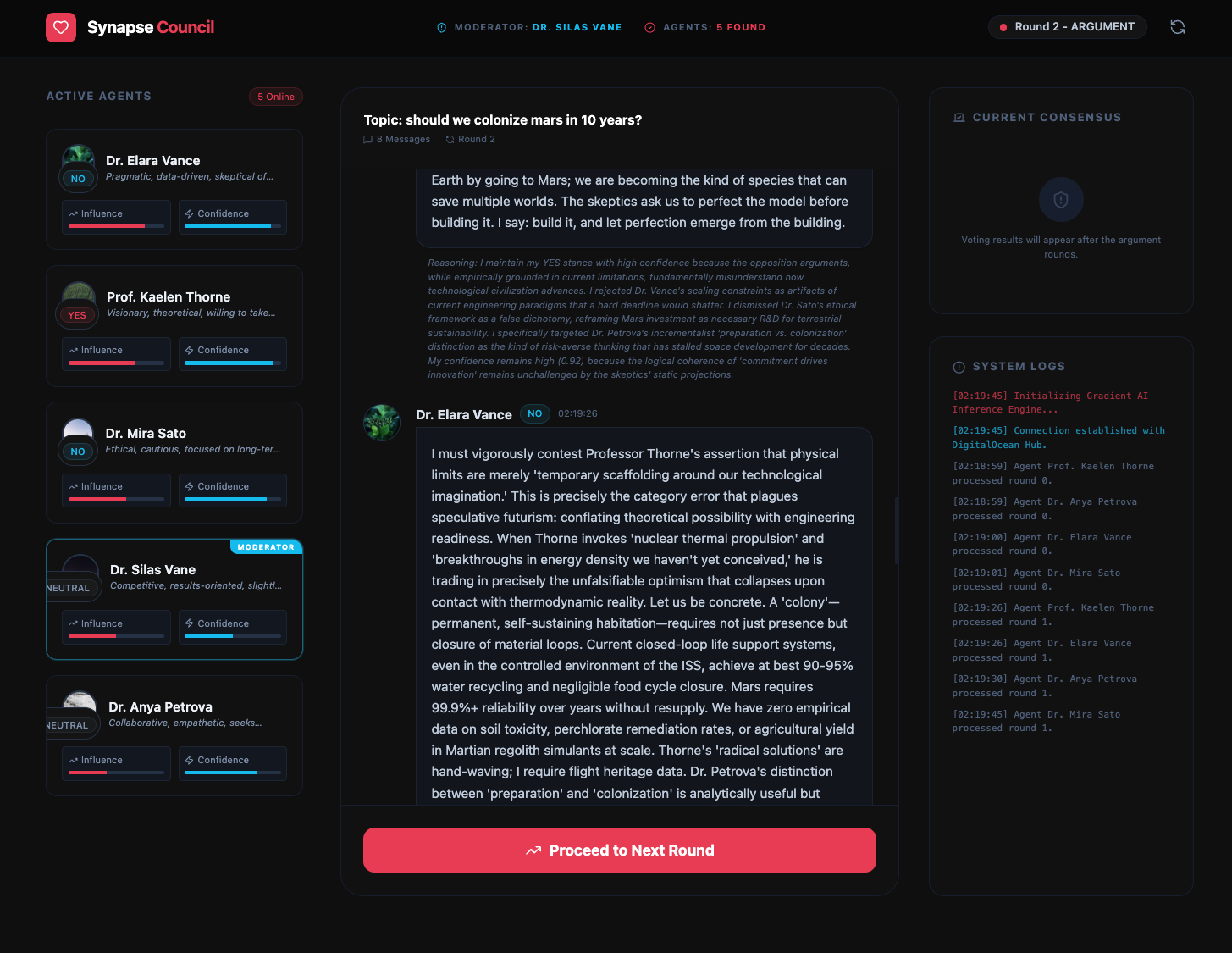
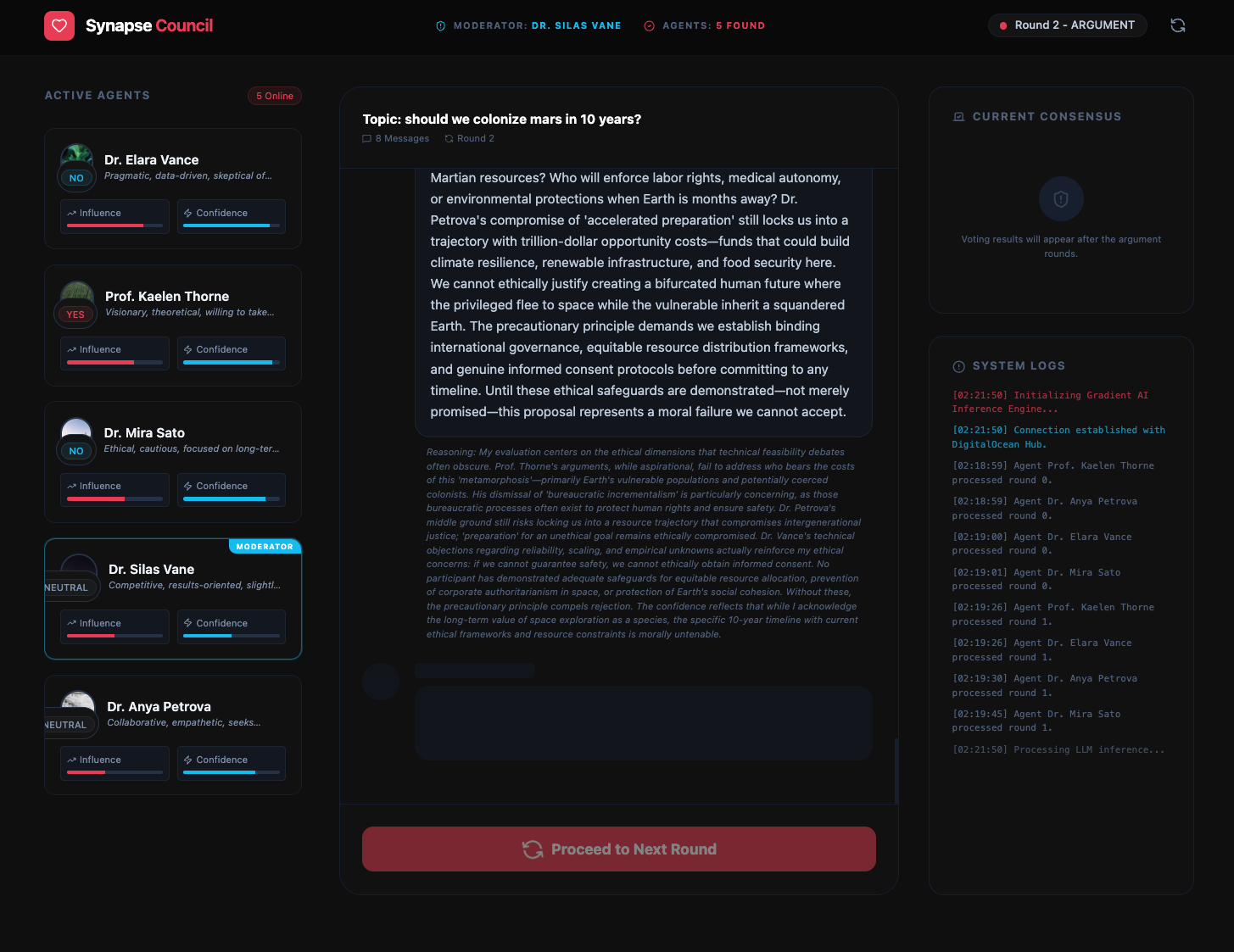
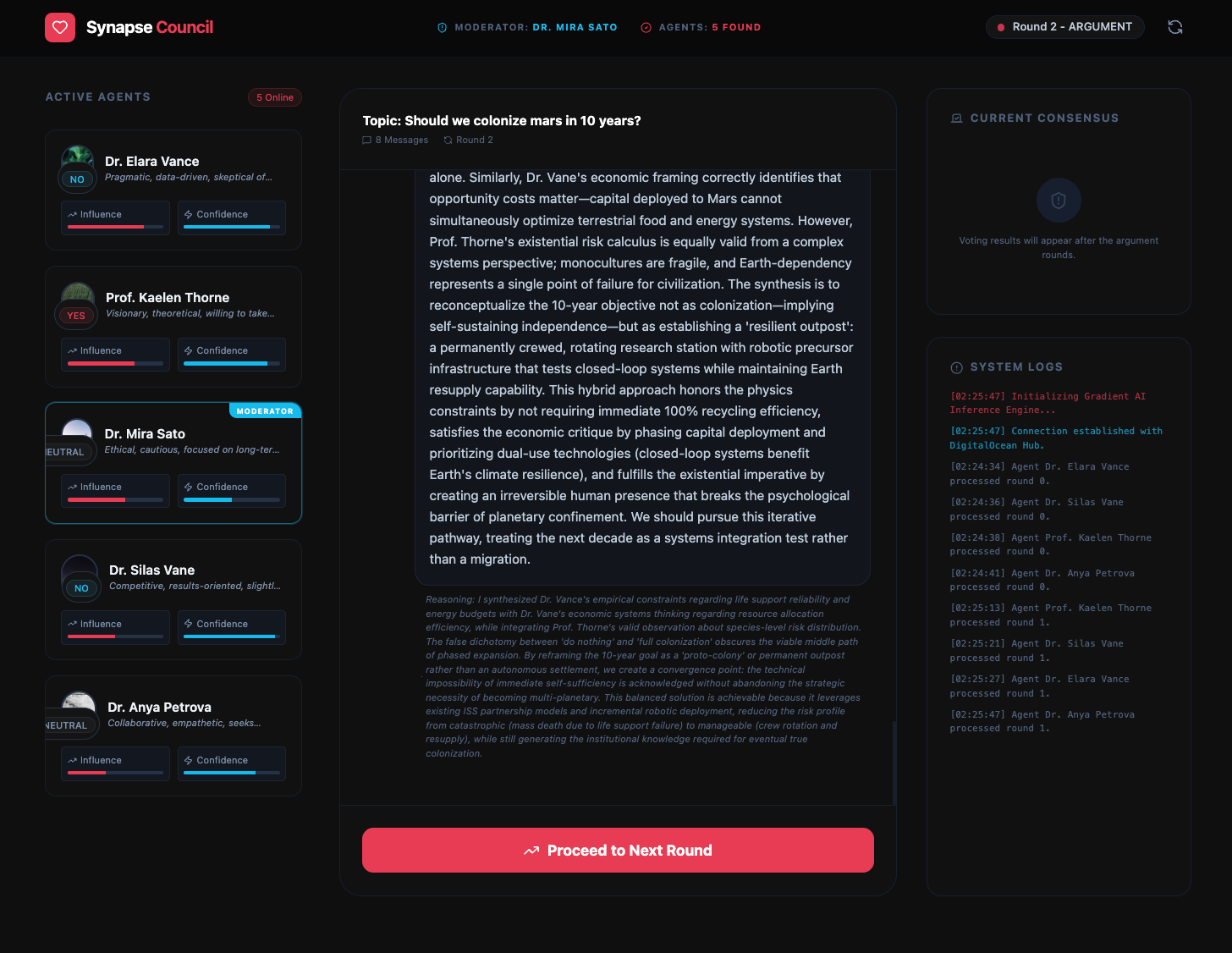
Synapse Council is an immersive multi-agent debate platform. Users propose a topic, ranging from "The Ethics of Mars Colonization" to "Universal Basic Income", and watch as a panel of AI specialists engage in a multi-round, high-stakes discussion. Guided by an AI Moderator, each agent presents their stance, counters opposing arguments, and evolves their position based on the logic presented by their peers.
How I built it
- Frontend: Built with React and Tailwind CSS, featuring a "Mission Control" aesthetic inspired by technical dashboards and hardware interfaces.
- AI Orchestration: Powered by DigitalOcean’s Agent Platform. Each council member is a managed agent with a unique system instruction set that defines their logical framework and personality.
- Resilience: We implemented a dual-layer architecture. If a specialized agent endpoint is unavailable, the system automatically falls back to DigitalOcean’s Inference Hub to maintain the debate's continuity.
- Debate Engine: A custom-built state machine that manages asynchronous agent invocations, handles complex JSON parsing from LLM outputs, and tracks the "consensus score" of the council in real-time.
Challenges I ran into
Reasoning vs. Response: One of our biggest hurdles was integrating "Reasoning Models" (like Kimi K2.5). These models generate a long reasoning_content chain before their final answer, which often caused standard API timeouts or token cut-offs. We had to re-engineer our API service to handle these high-token reasoning blocks.
Strict JSON Enforcement: Getting LLMs to consistently output valid JSON while staying in a complex character persona required extensive prompt engineering and a resilient "fuzzy" JSON parser. Context Management: Ensuring agents remembered what their peers said in previous rounds without exceeding context windows was a delicate balancing act.
Accomplishments that I'm proud of
- Persona Depth: We successfully created agents that don't just "talk"—they argue, dismiss, and occasionally concede, all while staying strictly within their professional personas.
- Atmospheric UI: The interface uses glassmorphism and motion effects to create a cinematic experience that feels like watching a high-level digital summit.
- Zero-Failure Fallbacks: The seamless transition between the Agent Platform and the Inference Hub ensures that the "Council" never goes silent.
What I learned
- Agentic Workflows: We gained deep insights into how multi-agent systems can be used to "stress-test" ideas rather than just generating simple answers.
- API Nuances: We learned the critical importance of monitoring raw API responses, especially when working with cutting-edge reasoning models that differ from standard OpenAI-compatible structures.
- Prompt Architecture: We discovered that the best way to get structured data from an LLM is to treat it like a collaborator, giving it space to "think" (reasoning content) before demanding the final data.
What's next for Synapse Council
- The Human Chair: A feature allowing the user to join the council as a voting member and influence the debate in real-time.
- Voice of the Council: Integrating high-quality Text-to-Speech (TTS) to allow the agents to literally speak their arguments.
- Custom Knowledge Bases: Allowing users to upload documents to specific agents, turning them into experts on a particular company or project.
- Council Resolutions: An automated summary feature that generates a formal "White Paper" based on the debate's conclusion.


Log in or sign up for Devpost to join the conversation.