-
-
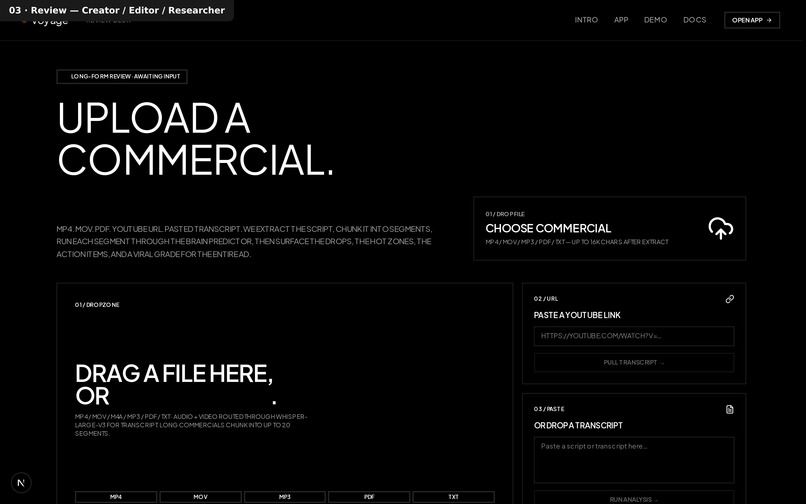
choose and upload a commercial
-
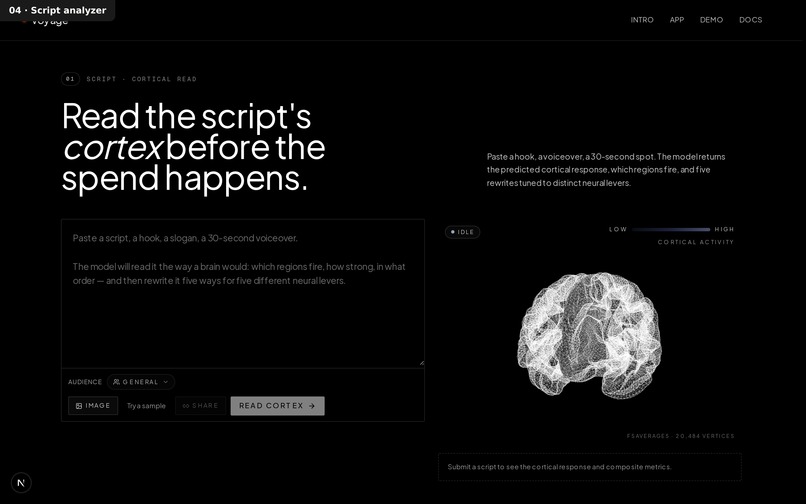
app main
-
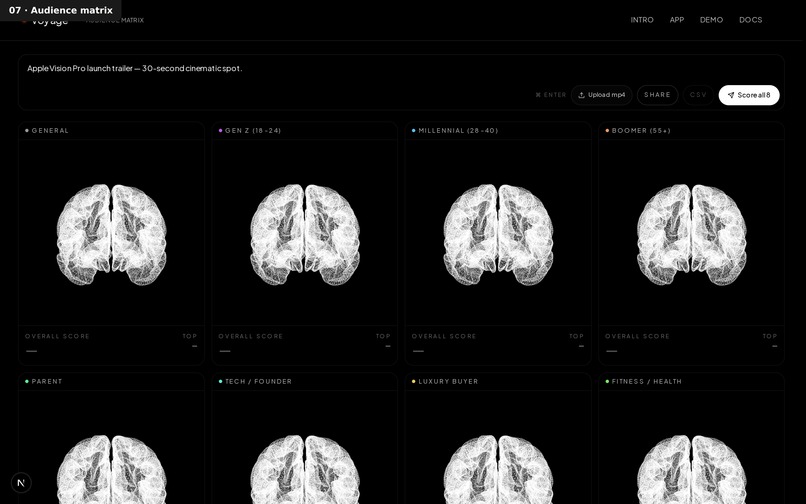
A/B testing
-

landing page
-
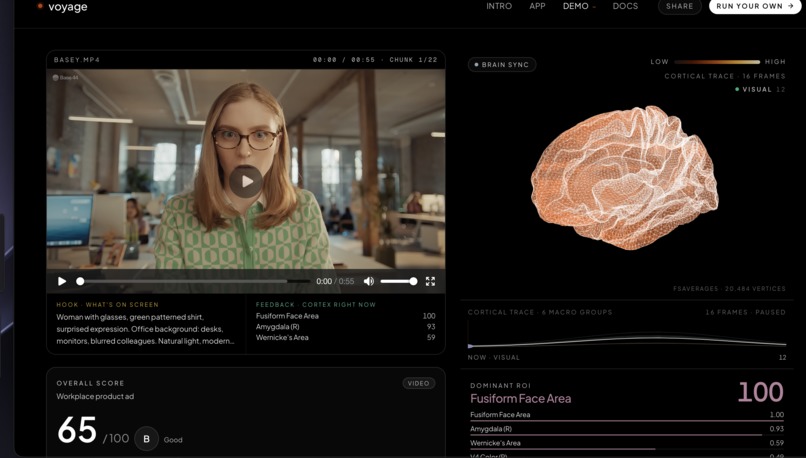
Demo
-
Feedback */demo

Inspiration
You hear constant buzz about LLMs like GPT and Claude. They're great — I use them in this app — but there's so much more to AI. I wanted to be one of the first to ship a commercial SaaS tool built on a less famous part of it. Companies spend nearly $1.16 trillion a year on marketing, but creative testing is broken: eye-tracking studios run up to $20,000 for a three-week window, and human feedback is biased or just polite — so teams act on the wrong signal. I wanted to fix that by tapping the one thing actually responsible for how we feel about anything: the brain. The science backs the bet — across three independent labs, aggregate neural response predicts real-world outcomes better than what people say: Falk et al. (2012) showed mPFC activity forecast which anti-smoking ads drove real call volume while self-reports failed; Genevsky & Knutson (2017) showed nucleus-accumbens response forecast crowdfunding markets better than behavior; Berns & Moore (2012) showed it predicted future music sales while liking ratings didn't.
What it does
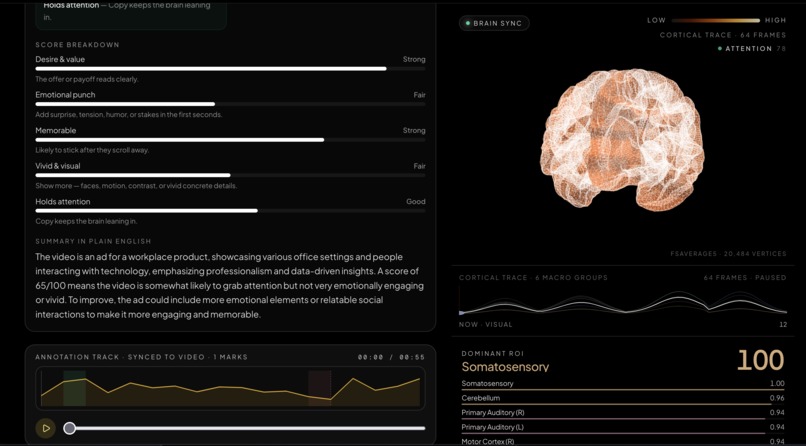
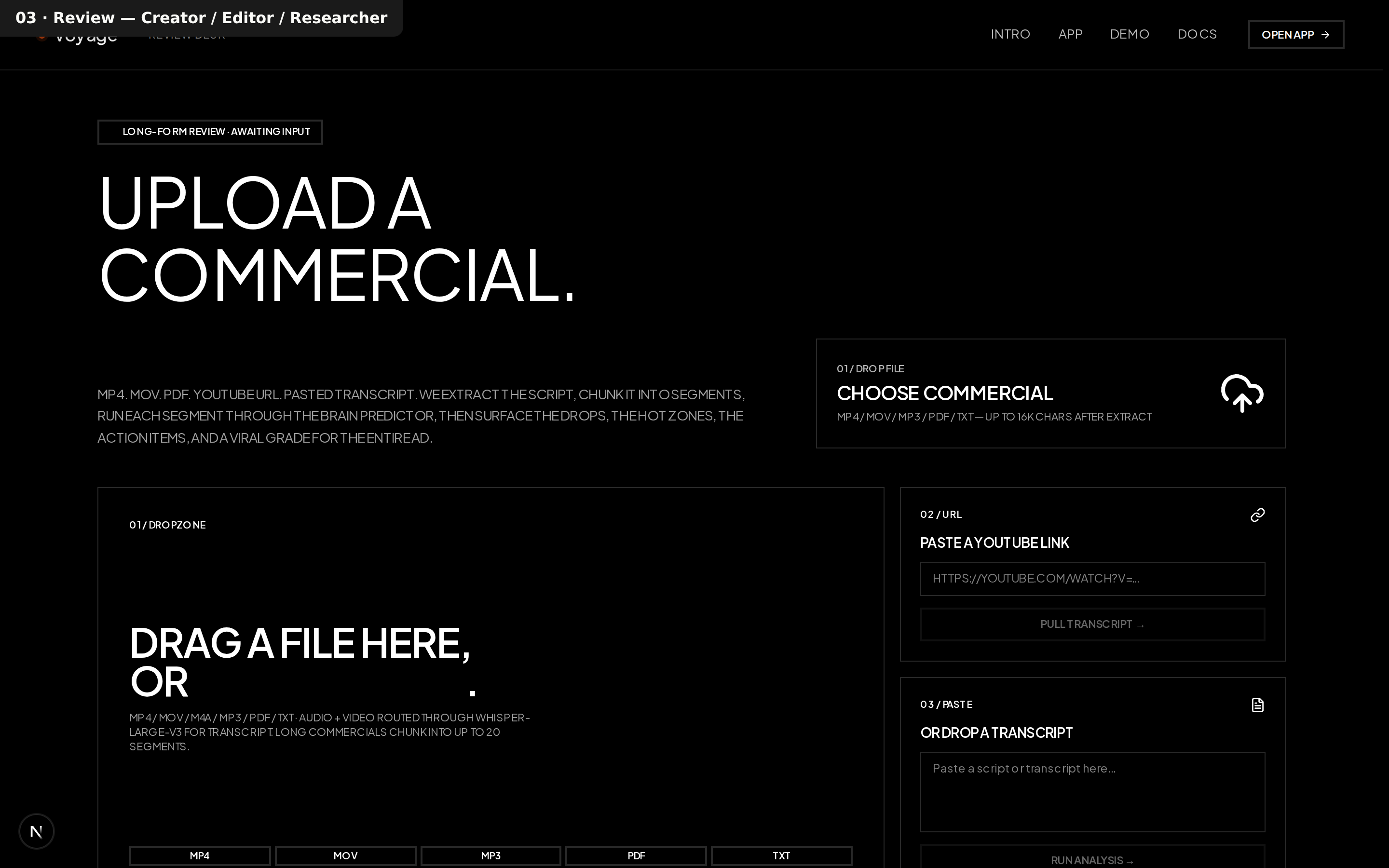
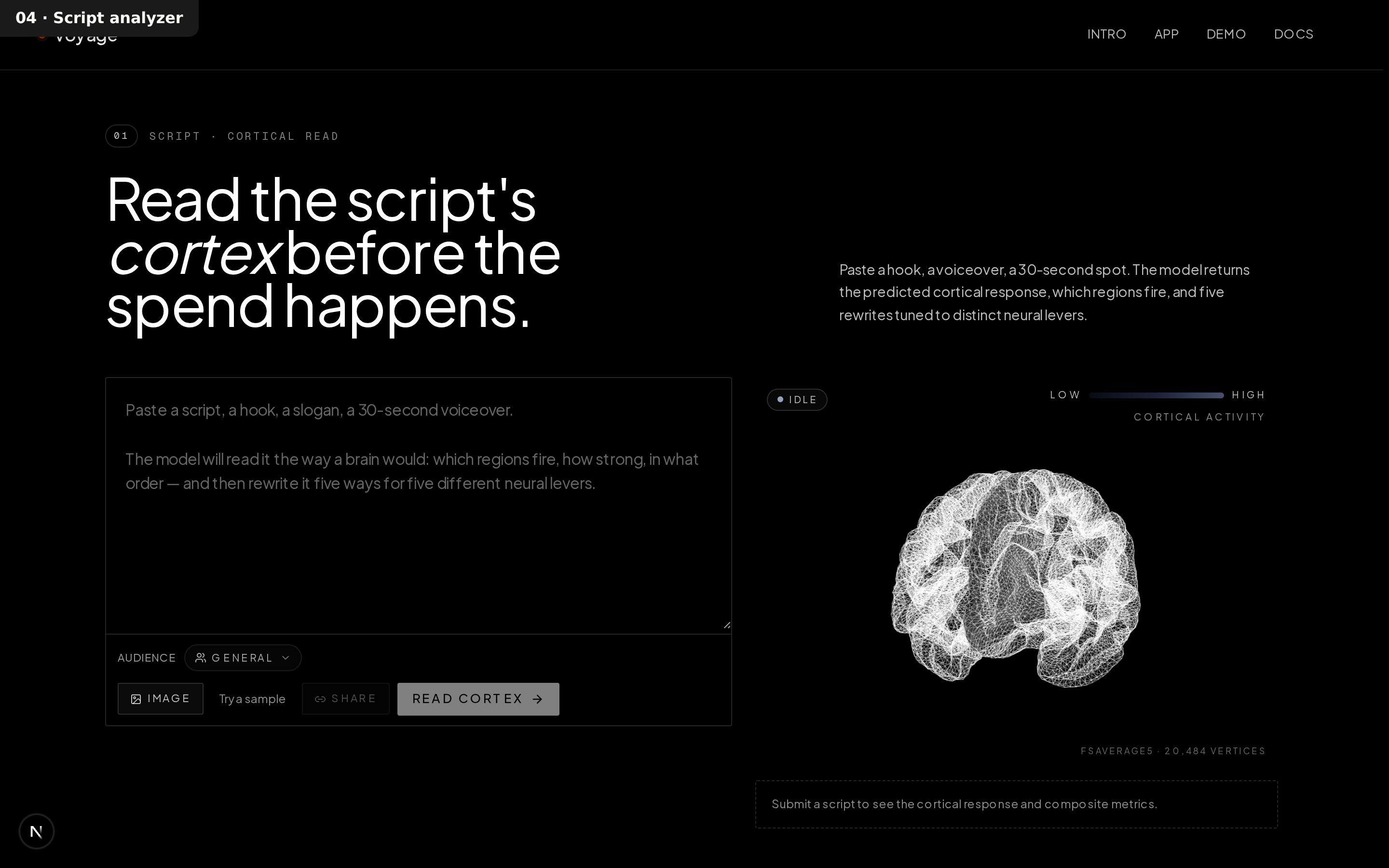
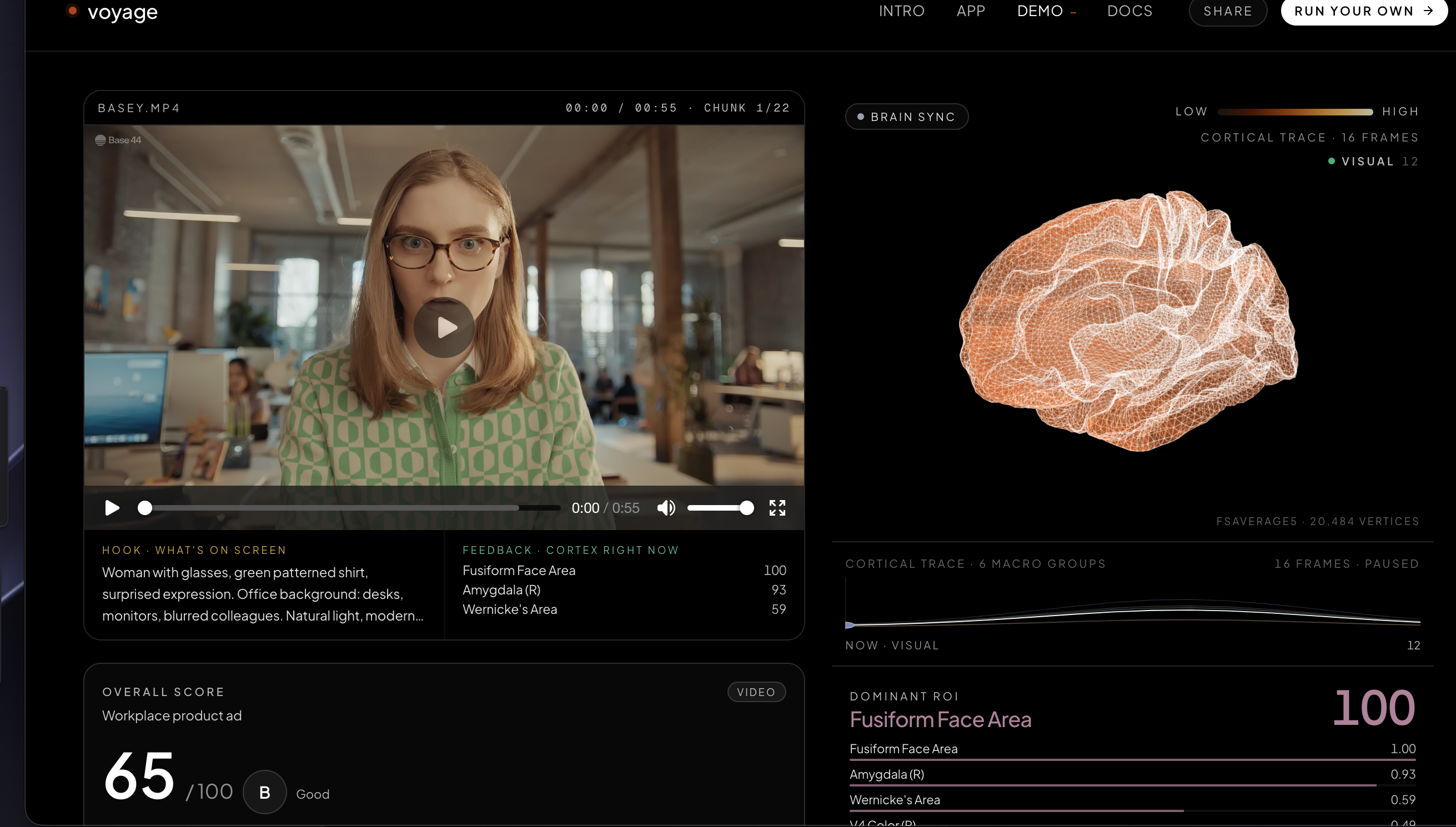
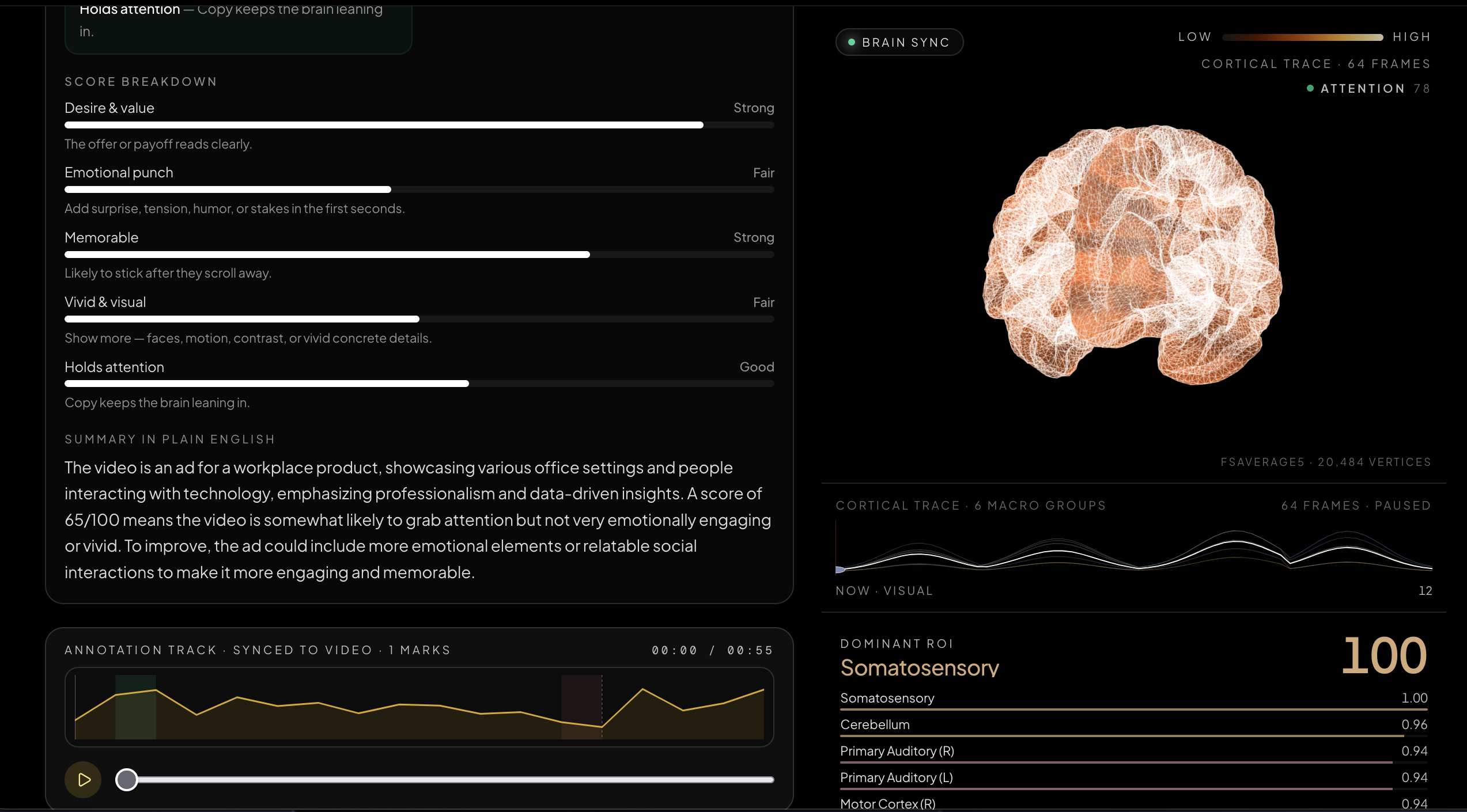
A user drops in their ad — a YouTube link, PDF, PNG, or MP4. If it's a video, a custom comprehension protocol chunks it into segments and feeds each one to GPT-4o Vision, which describes the scene and recognizes its objects. Then everything we pull from the ad — the visual description, the on-screen text via OCR, and the spoken words via Whisper — is fused into one stimulus per chunk and run through the model. It returns a predicted map of brain activity across 24 cortical regions, rolled up into a single appeal score out of 100 plus five signals anyone can read: desire, emotional punch, memorability, vividness, and attention. As the ad plays, you watch the brain react in real time — the hardest-working regions glow orange, second by second. The same read powers three views: Creator (the quick verdict — one score, what's working, the #1 fix), Editor (the cut — frame-by-frame notes tied to real timestamps and the actual on-screen words, never a vague "make the hook stronger"), and Researcher (the receipts — full per-region activation and the numbers behind every score).
How we built it
The prediction is built on Meta FAIR's TRIBE v2 — the 1-billion-parameter trimodal brain encoder that won first place at the Algonauts 2025 challenge by fusing text, audio, and video to predict moment-by-moment fMRI across the cortex. We fine-tuned and calibrated the prediction stack on real human neuroimaging from Stanford's OpenfMRI / OpenNeuro archive — CC0 BOLD recordings aligned to stimulus timing with a 6-second hemodynamic delay and averaged onto our 24 ROIs, so ground truth comes from brains that actually watched something. Front end: Next.js 16 on Vercel with a live fsaverage5 cortical mesh (20,484 vertices) rendered in real time. Pipeline glue: GPT-4o Vision, Whisper transcription, OCR, ffmpeg chunking, Supabase auth.
Challenges we ran into
Making any ad machine-readable was the core problem — a 30-second video isn't a stimulus until you've fused what's seen, what's read, and what's heard into one trimodal input the encoder can consume. Aligning noisy fMRI BOLD signal to stimulus timing (and respecting per-stimulus licensing in the public archives) took real care. And turning a 24-float activation vector into something a founder, an editor, and an analyst each find useful meant designing three genuinely different views off one prediction.
Accomplishments that we're proud of
A real, live, commercial-grade tool built on brain encoding — not sentiment analysis with a brain emoji. Predictions grounded in actual fMRI and an encoder with peer-reviewed pedigree. A read that comes back in seconds instead of three weeks and $20,000. And feedback that's specific — every Editor note is pinned to a timestamp and the words actually on screen.
What we learned
The brain forecasts the market better than the survey does — and that's not our opinion, it's a replicated result across public health, crowdfunding, and music. Also: an explainable picture of an amygdala lighting up next to a slogan changes a creative review in a way that "score: 73" never will.
What's next for Voyage
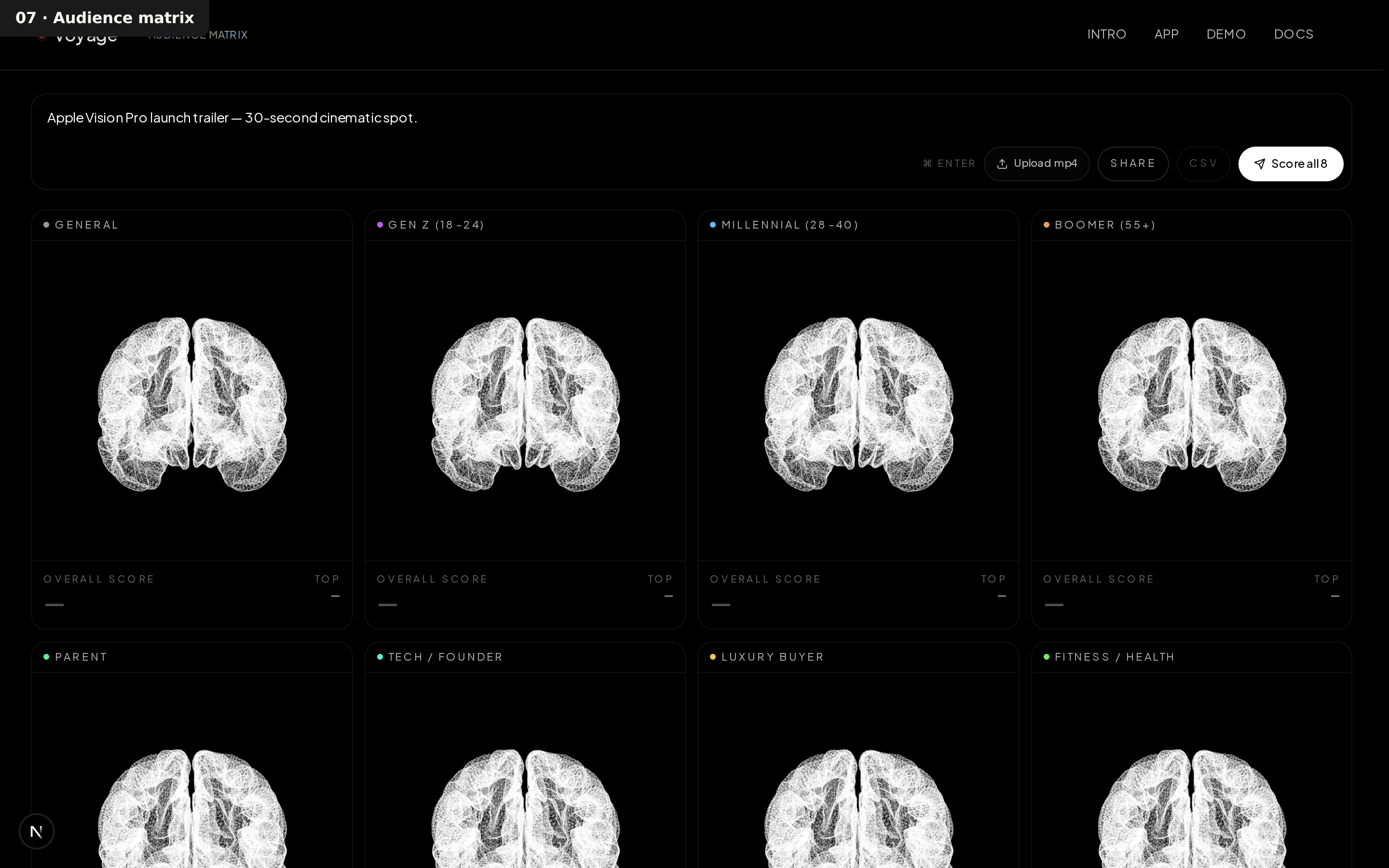
Distil the calibrated stack into a self-hosted 7B model fine-tuned on the OpenNeuro corpus for sub-second, single-GPU inference; a real-time A/B "brain-diff" view; and audience-specific cortical priors (Gen Z, B2B, luxury — already specced in the audience matrix).
Built With
- customai
- ffmpeg
- fsaverage5
- gpt-4o-vision
- meta-tribe-v2
- multimodal
- neural
- next.js
- ocr
- openai
- openfmri
- openneuro
- python
- react
- supabase
- three.js
- trimodal
- typescript
- vercel
- whisper


Log in or sign up for Devpost to join the conversation.