-
-
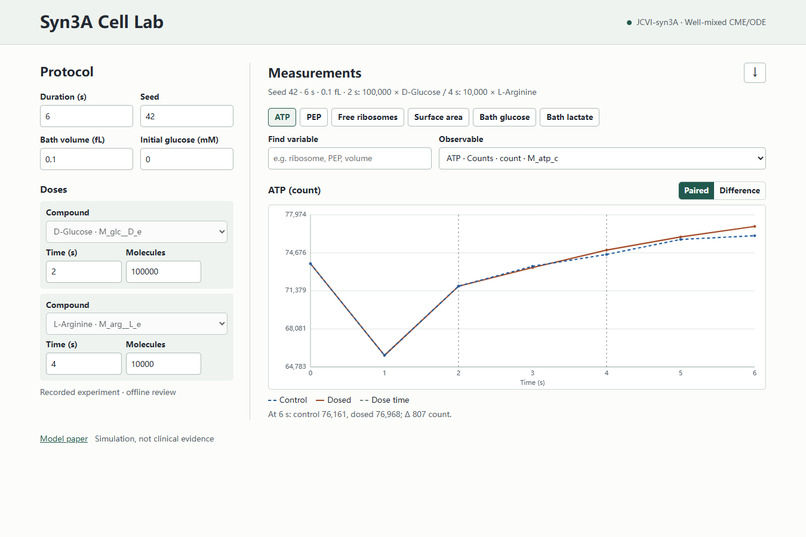
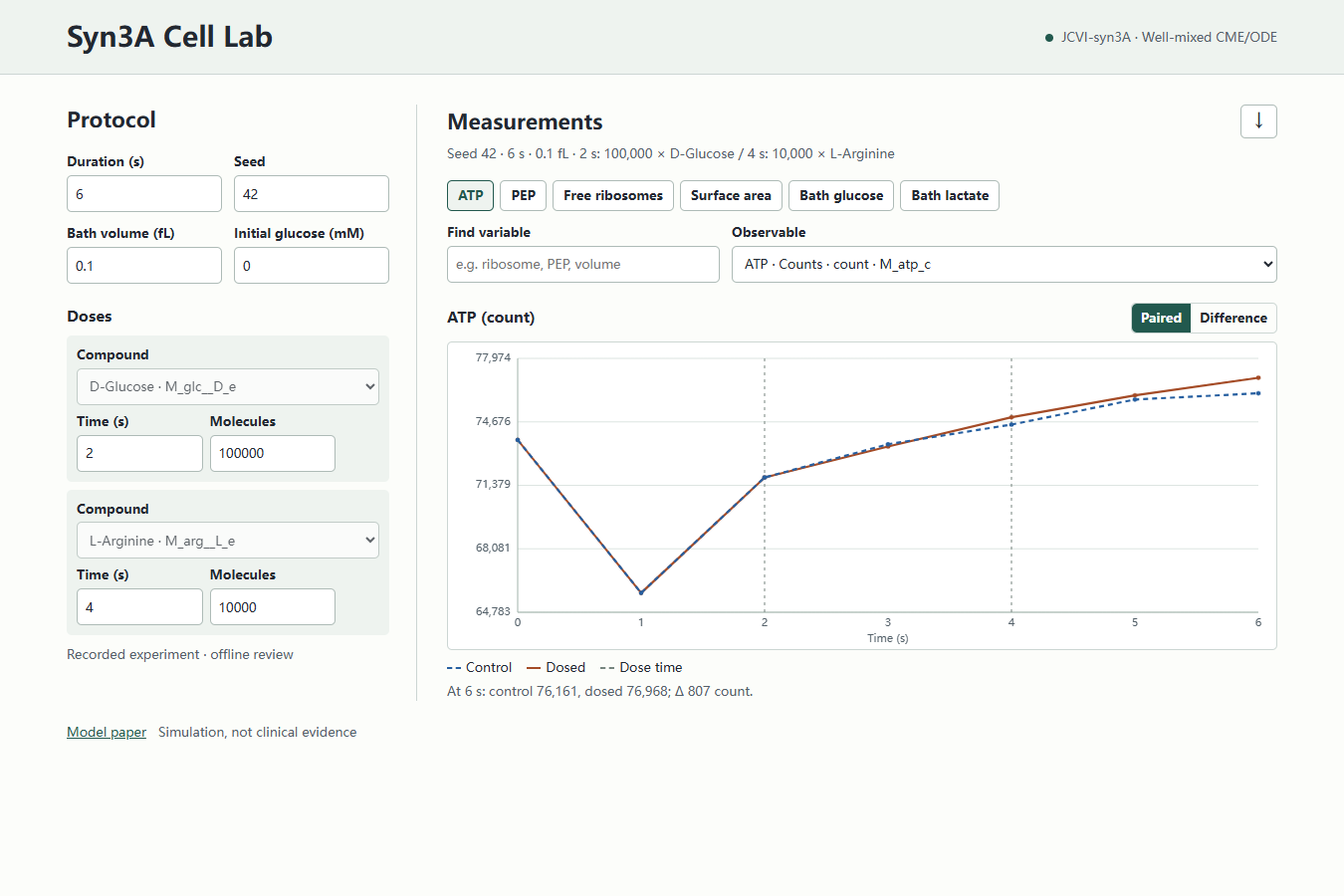
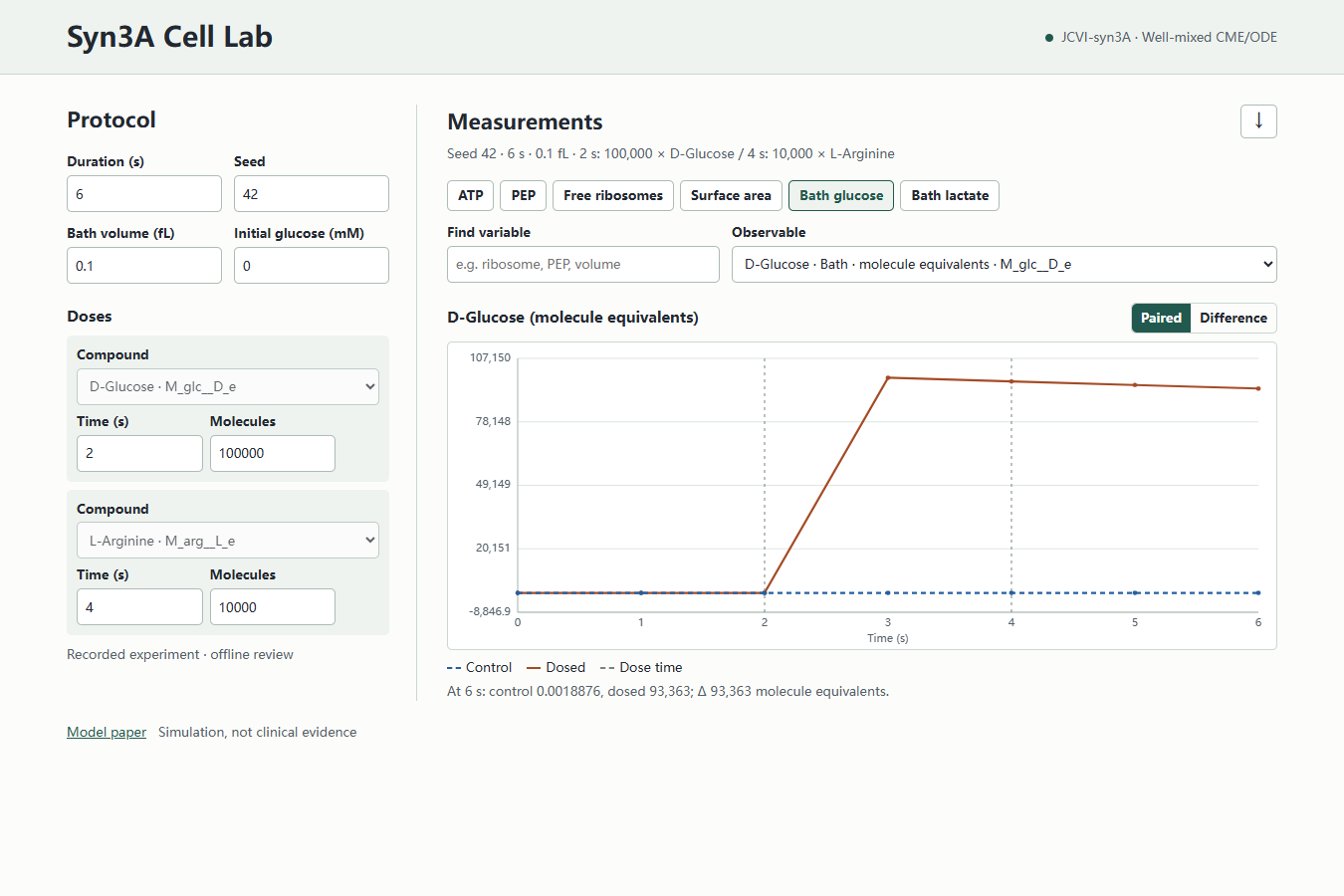
Matched-seed control and intervention from one run. ATP effects were not consistent across both tested seeds.
-
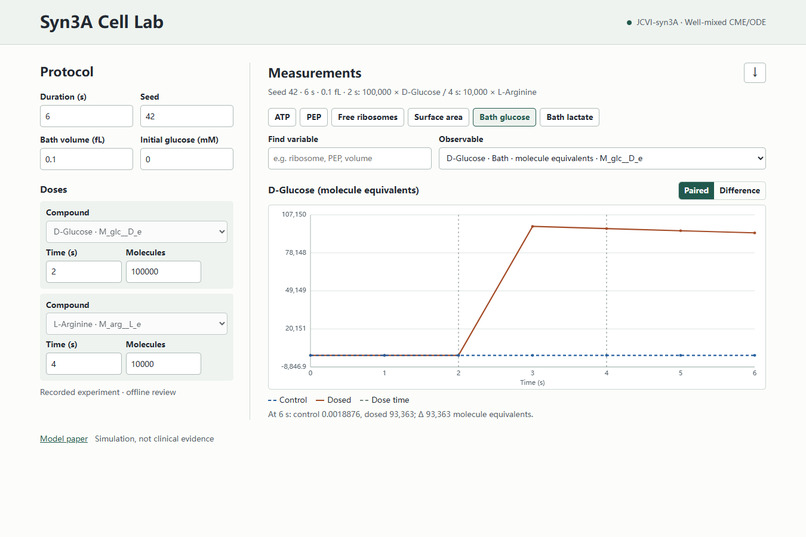
Finite bath glucose stock. The dose is applied at the start of the 2-to-3-second step and can be consumed.
-
Inspiration
If we can program an experiment, why should the simulator decide what the experiment has to be? Syn3A Cell Lab began with a virtual cell on which a learner can schedule additions and choose measurements, rather than pick a lesson with a predetermined answer.
What it does
The lab runs a published, spatially homogeneous whole-cell model of the minimal bacterium JCVI-syn3A. Choose from model-supported medium compounds, set molecule counts and dosing times, and compare against a no-addition control with the same initial conditions and random seed. Inspect intracellular counts, kinetic fluxes, cell geometry and tracked bath stocks. The finite bath can deplete or accumulate as compounds move between the model and its medium. Export both trajectories and the exact protocol as JSON.
How it was built
The upstream engine couples stochastic cellular processes with kinetic metabolism. The original contribution here is finite-bath exchange, scheduled dosing, a local browser workbench, matched-run checks, and an offline review page. The upstream model is credited to Fu et al. and pinned to a specific source revision; it is not presented as newly invented in this project.
Challenges and validation
Getting a program to produce a curve is not enough: intervention timing, finite-stock carryover, and the control must agree. A separately compiled native environment reproduced all 6,898 count series in both branches byte-for-byte. A browser test checked dosing, measurement selection and JSON export. Reproduction scripts and checks are included in the source package.
What was learned
Four arms were compared at each of two random seeds: control, glucose only, arginine only, and both. One second after glucose addition, glucose-6-phosphate rose by 1,126 and 1,129 molecules relative to matched controls. The joint intervention did not consistently increase ATP: the six-second differences were +807 and -2,703 molecules. Two seeds cannot establish a biological effect; the inconsistent ATP response is reported rather than hidden.
Research use and limits
This prototype helps students and early-stage researchers choose candidate quantities and measurement windows for follow-up bacterial experiments. It is not a human-cell model, a treatment predictor, or a replacement for wet-lab validation. The local workbench runs 2-16 simulated seconds. The public review page displays a completed solver run and supports inspecting and exporting its data; it does not rerun the native solver online.
AI disclosure
AI assisted implementation, documentation and tests. The trajectories are generated by the numerical model, not by an LLM. No patient data, private chats or mailbox material are used.
Interactive spatial workbench
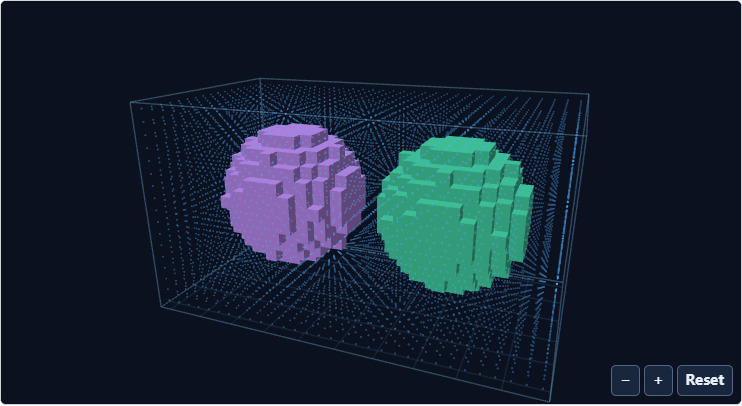
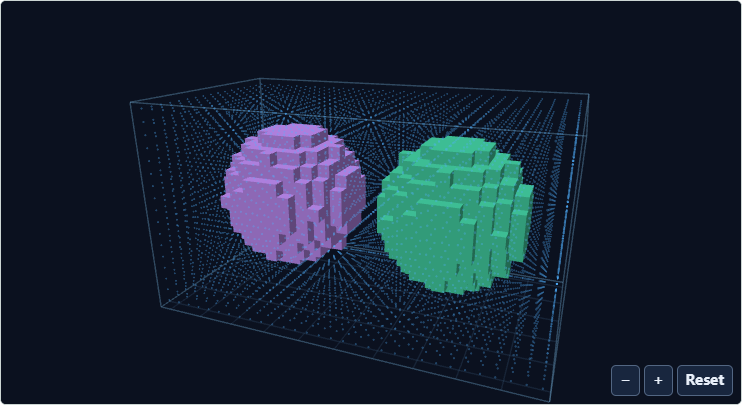
The public link opens a separate browser-based, two-cell spatial reaction-diffusion model, not the native whole-cell solver. Users can schedule and position additions, compare a no-dose control, and inspect glucose uptake and a subset of glycolysis in 3D. Other compounds currently diffuse only: their cellular responses are not modeled. Diffusion and other parameters are model assumptions, not validated predictions of real-cell interventions. The recorded native whole-cell results are available separately at https://lab.cora.zone/results/.
