-
-
The AI symptoms classifier and hospital appointment scheduler
Inspiration
Every wrong department booking triggers a chain reaction. A patient waits longer. A doctor's slot is wasted. Someone with an urgent need loses their chance. When patients self diagnose their department, the entire hospital slows down. I wanted to stop this at the source. Not with another form, but with an AI agent that thinks before it books.
What it does
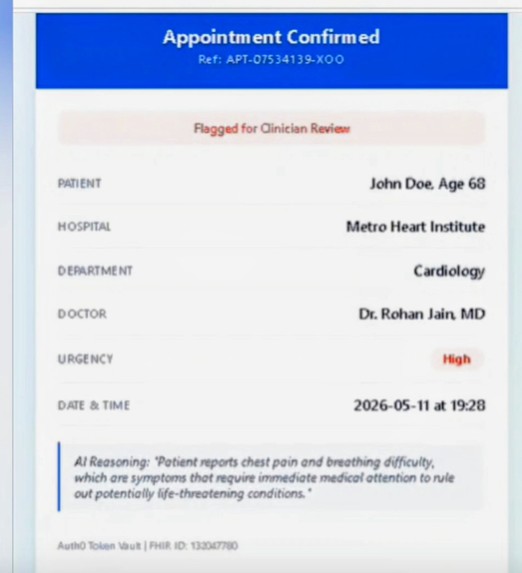
A patient describes their symptoms by voice or text. The AI classifies urgency, identifies the right department, assigns a doctor, and books the appointment. One pipeline. No handoffs. No guesswork.
The impact is direct. Right patient leads to right department leads to right urgency leads to right slot. Fewer wasted appointments. Faster care for those who need it most.
When the AI is uncertain, it escalates to a human instead of guessing. Chest pain always triggers high urgency regardless of what the LLM thinks. This hybrid safety means clinicians can trust the system and patients are protected from AI errors.
How I built it
The AI Engine uses Groq LLM (Llama 3.3 70B) to reason about symptoms and output structured classification with transparent reasoning.
The Hybrid Safety layer combines LLM intelligence with hard coded clinical rules. AI reasons. Rules protect. When confidence is low, the case escalates to a human.
The backend runs on Node.js with Express, deployed on Render.
Identity and Security are handled by Auth0 Token Vault. Every booking is identity chained. There is always a clear answer to who authorized this.
For Interoperability, every record is written to a public FHIR sandbox (HAPI FHIR). Not a silo. A system ready to plug into real hospital EHRs.
Voice Input uses the Web Speech API. Elderly patients and non technical users do not need to type.
The agent is published on Prompt Opinion marketplace with A2A and FHIR context enabled. Ready to collaborate with scheduling, pharmacy, and telemedicine agents.
Why this matters
Healthcare AI fails when it is a black box. Clinicians will not adopt what they cannot understand. Patients are at risk when AI overestimates its confidence.
This agent addresses all three. Transparent reasoning shows why every decision was made. Knowing limits means low confidence triggers escalation, not silent failure. Accountability comes from Auth0 identity plus FHIR audit trail where every action is traceable. Interoperability means it is built on standards (A2A, FHIR, MCP) so it works with existing systems, not against them.
Challenges I overcame
Designing hybrid safety that balances AI flexibility with clinical protection. Learning Auth0 Token Vault and identity chained authorization during the hackathon. Implementing FHIR from zero knowledge and writing Appointment and Patient resources to a live sandbox. Navigating the Prompt Opinion platform and publishing an A2A compatible agent. Building end to end in under 24 hours without cutting corners on safety.
What I learned
Agentic AI is not automation with a chatbot wrapper. It is reasoning under uncertainty with safety nets. Healthcare AI must explain itself because a confidence score without reasoning is useless to a doctor. Standards like FHIR and A2A are not optional. They are what separates a demo from something deployable. Time constraints force clarity. Every feature had to earn its place.
What's next
Location based doctor matching to show real available doctors near the patient, not simulated names. Camera based distress detection to capture non verbal cues that text and voice miss. Multi language voice support to serve rural and non English speaking patients. Edge deployment so clinics with poor internet are not left behind. Live EHR integration to move beyond the FHIR sandbox to real hospital systems.
Built With
- auth0
- express.js
- fhir
- github
- groq-sdk
- html
- javascript
- node.js
- prompt-opinion
- render
- web-speech-api

Log in or sign up for Devpost to join the conversation.