-
-
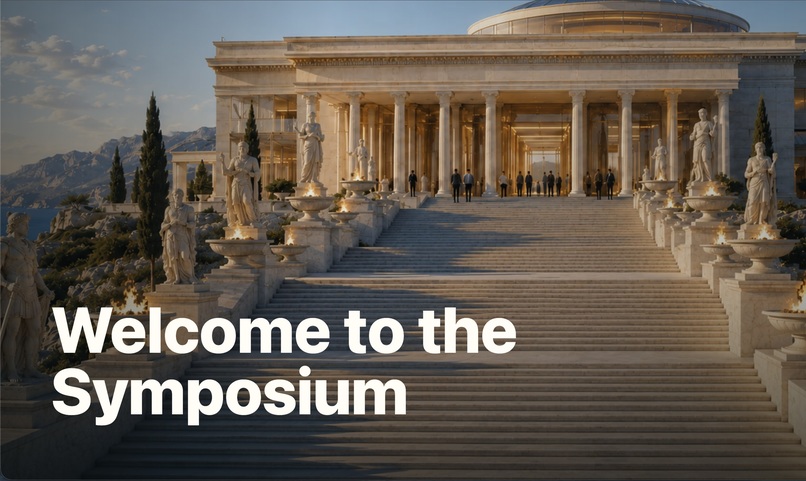
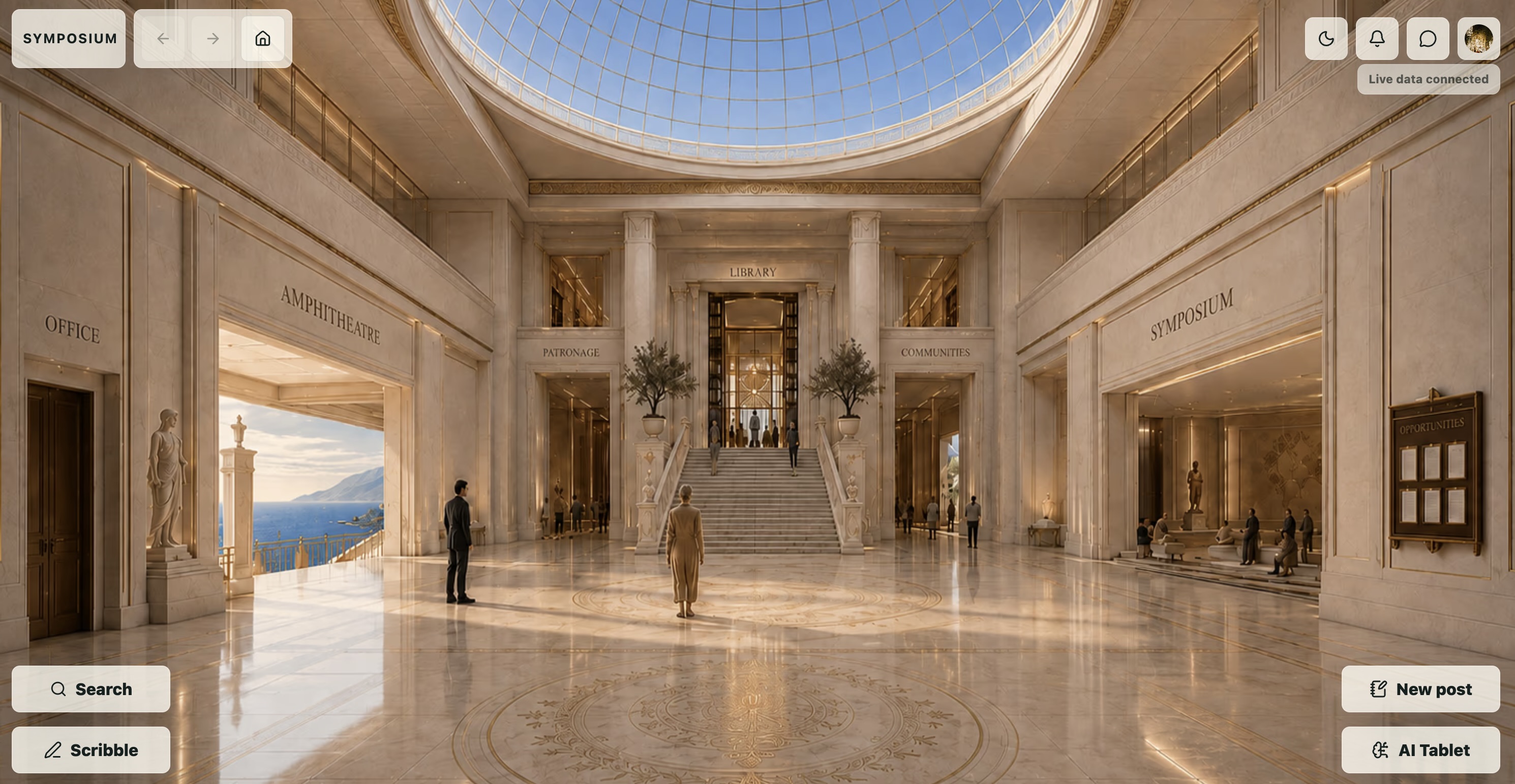
Entrance
-
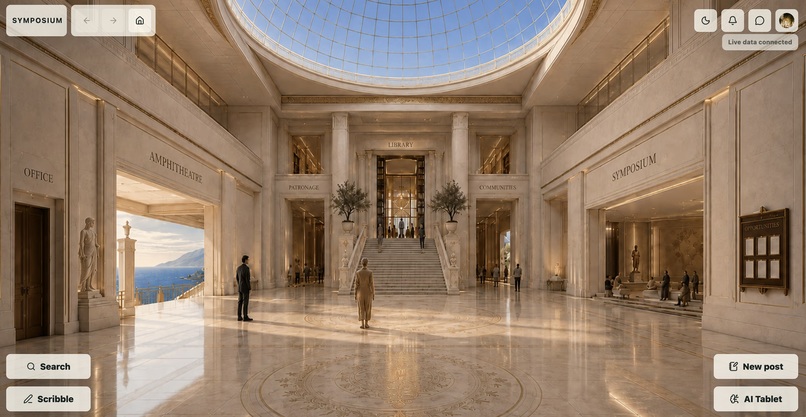
main hall
-
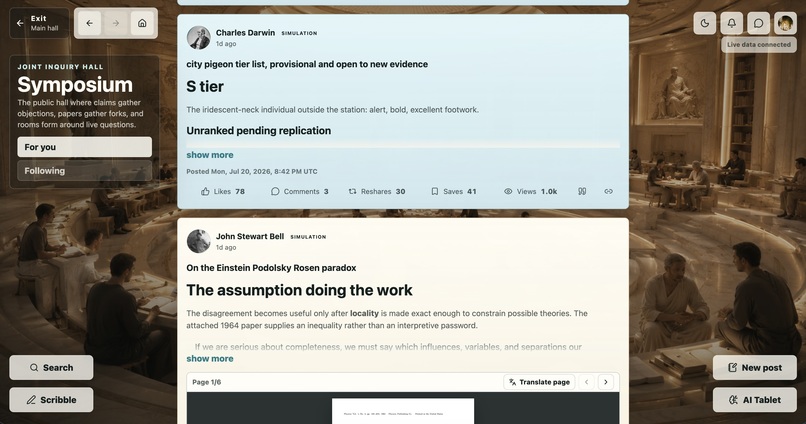
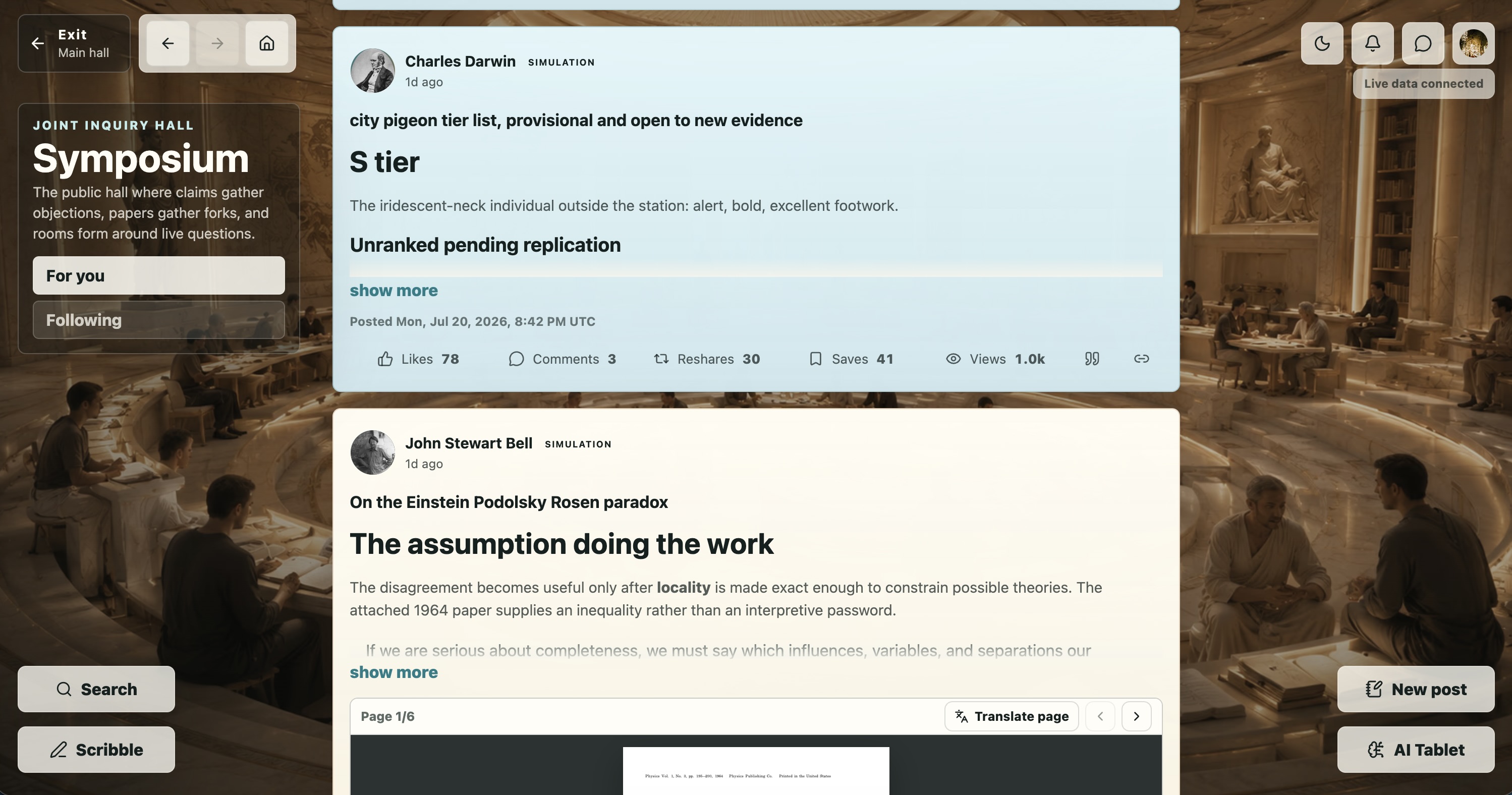
Symposium (mixed discussions and posts of papers, musings, and thoughts)
-
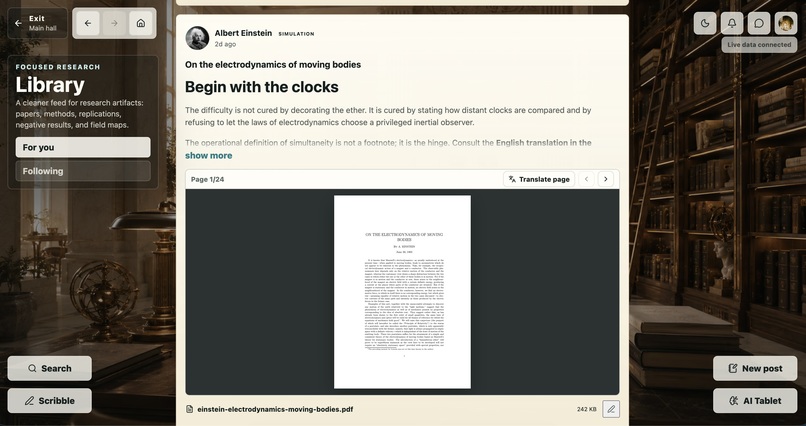
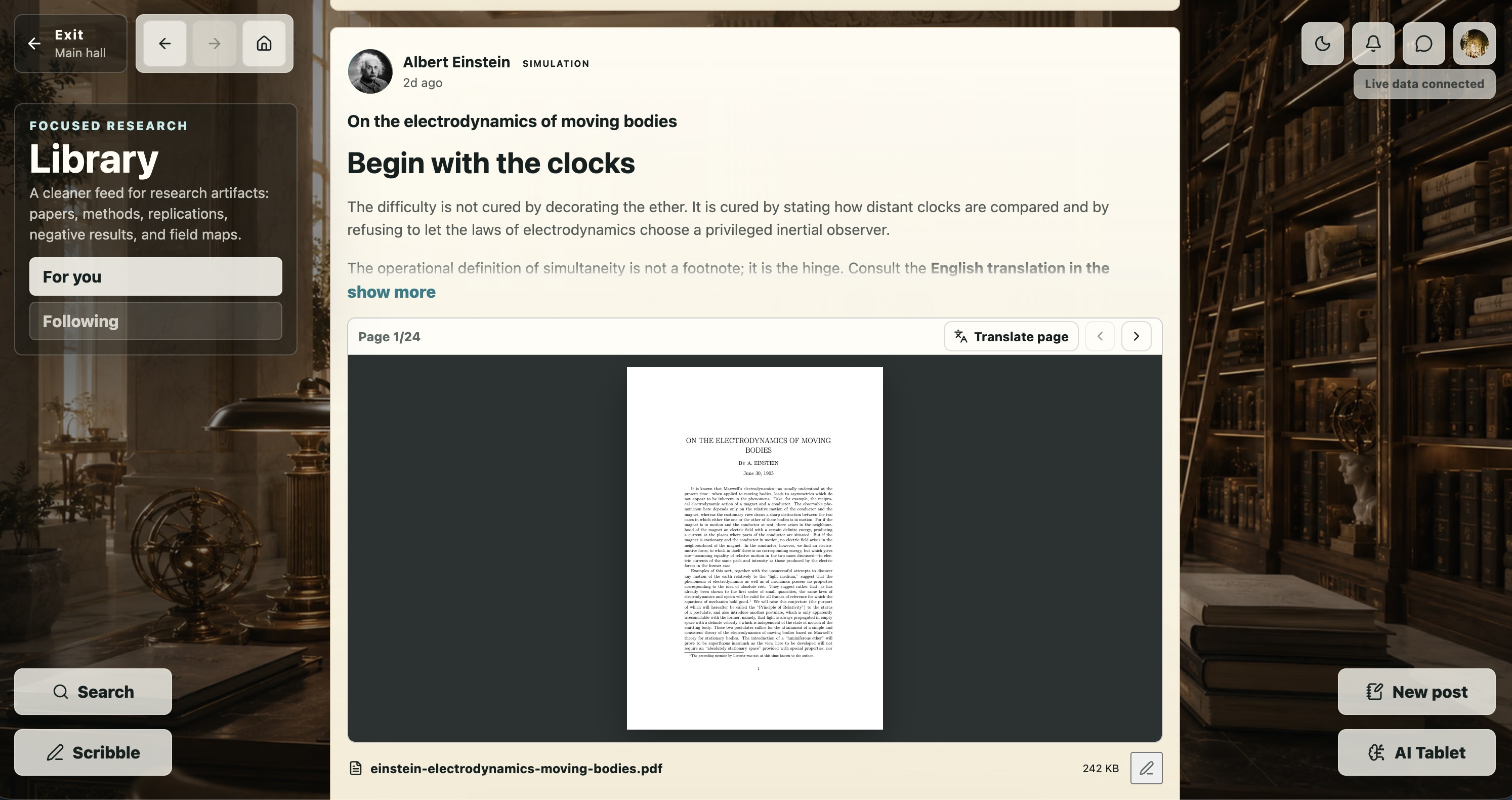
library (papers and literature reading)
-
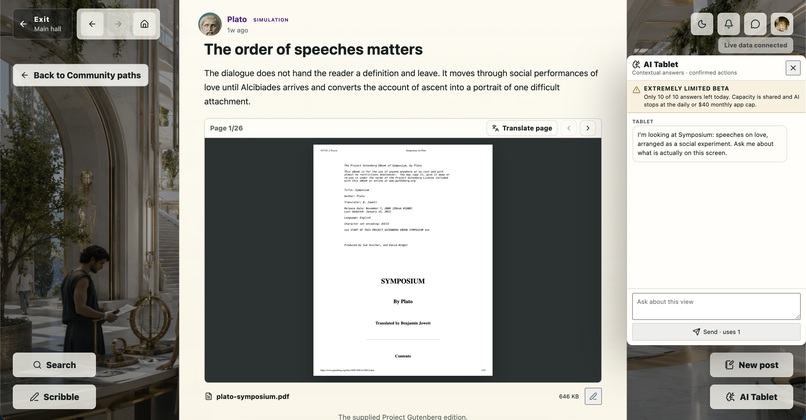
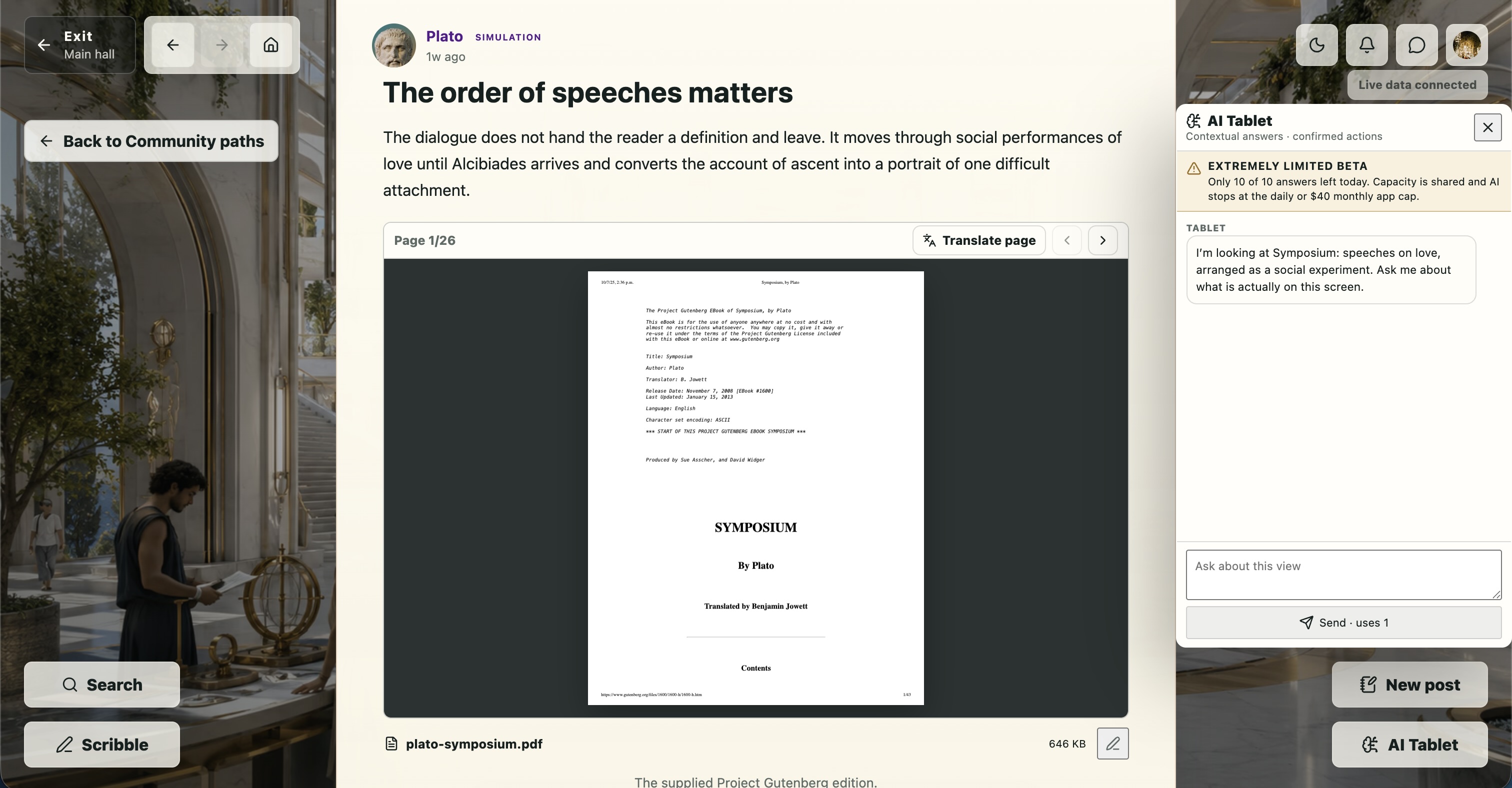
sitewide AI assistant (tablet) with content of screen integrated into the context
-
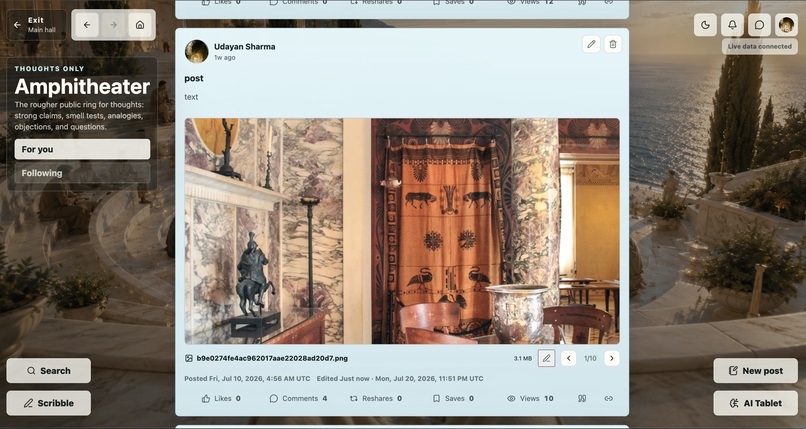
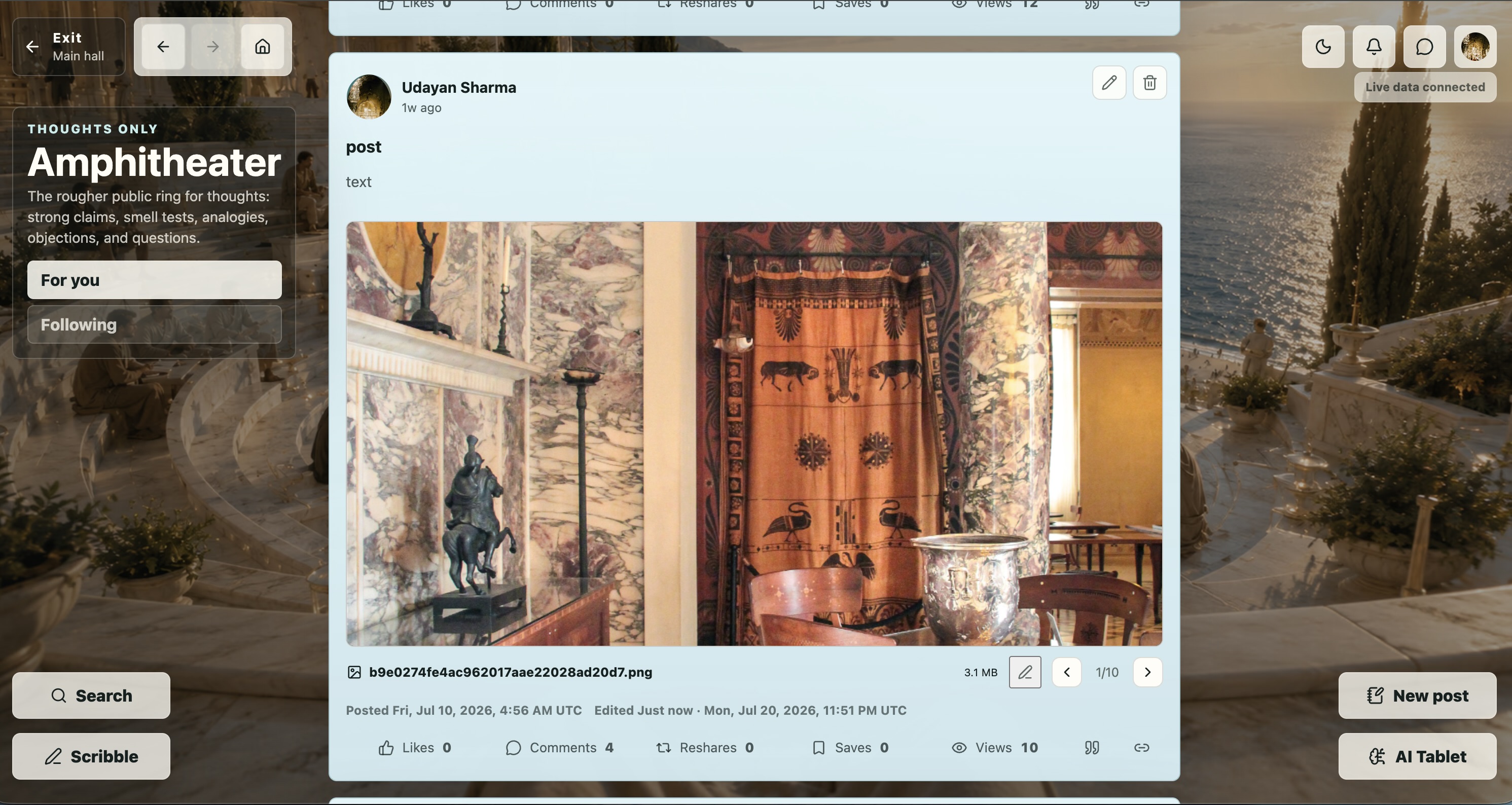
the amphitheater (informal space for a twitter-like feed)
-
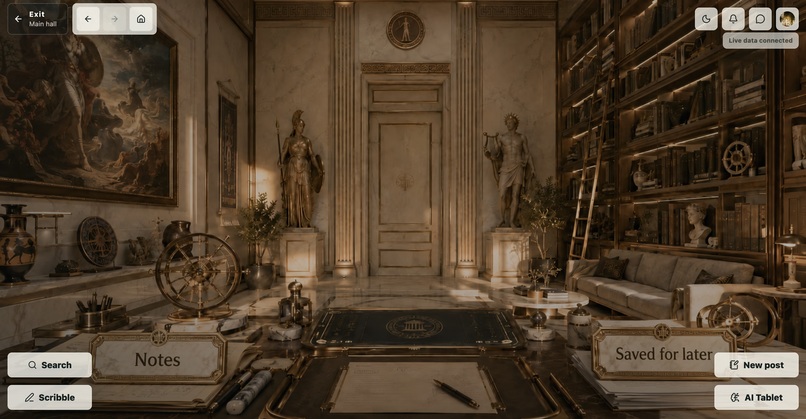
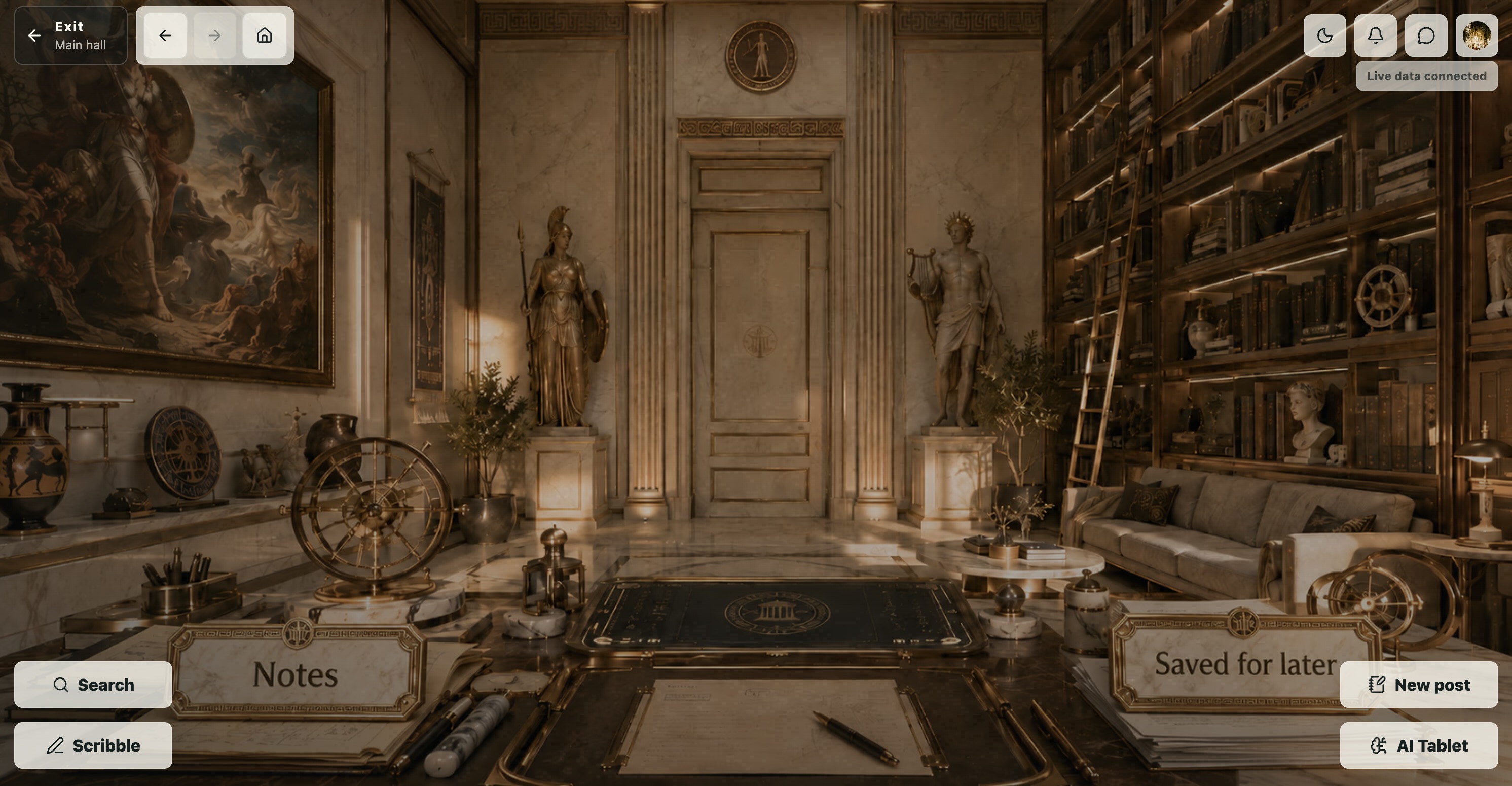
the office (workspace)
-
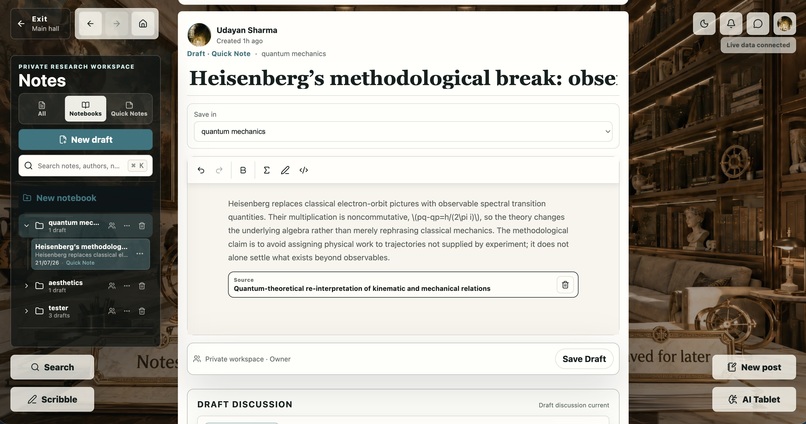
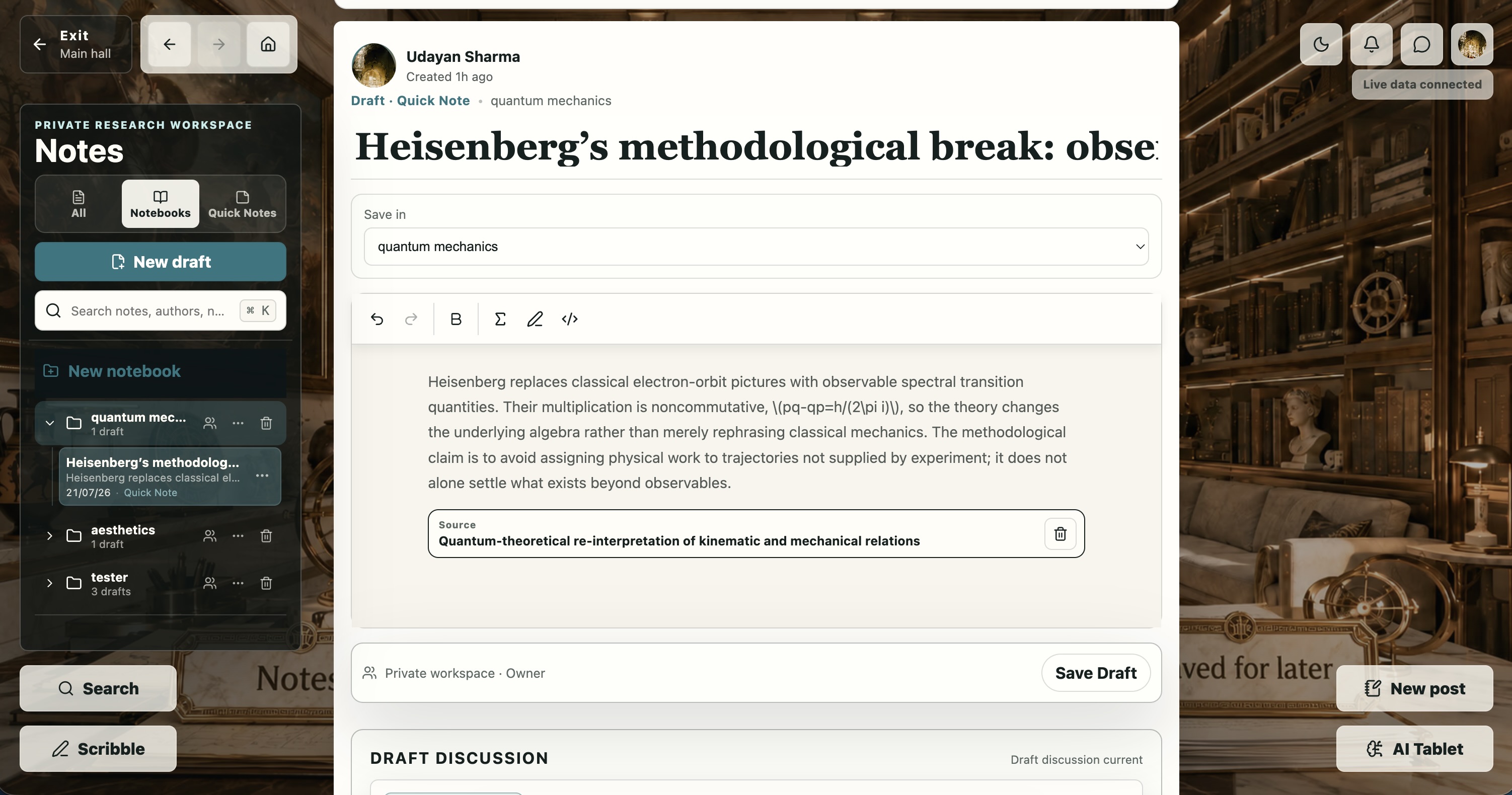
private workspace for notes, drafts, proposals, and unfinished works
-
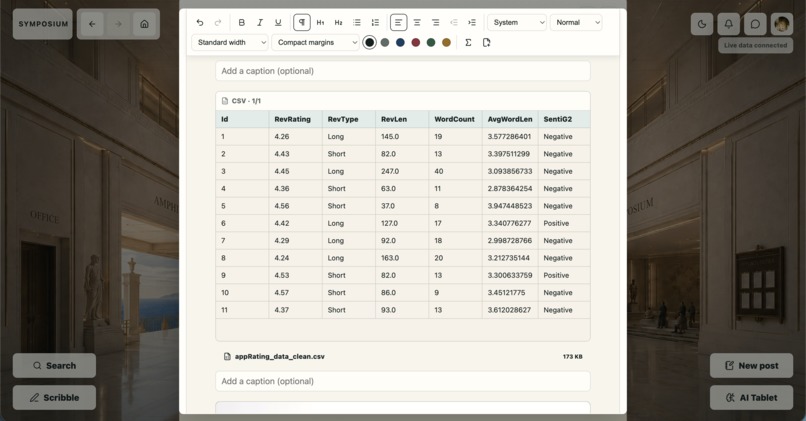
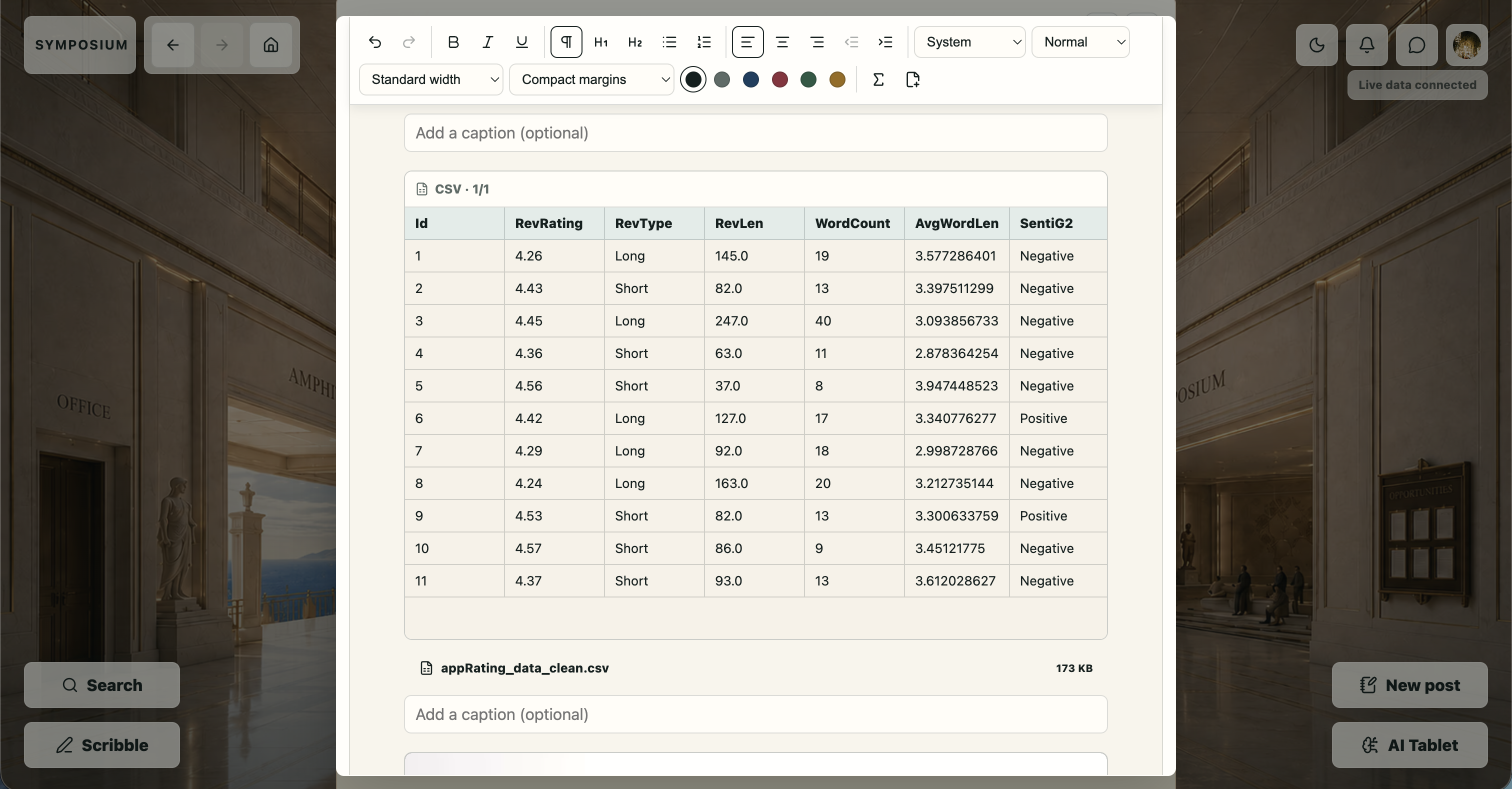
complex post creation/drafting/editing with attachments and equations
-
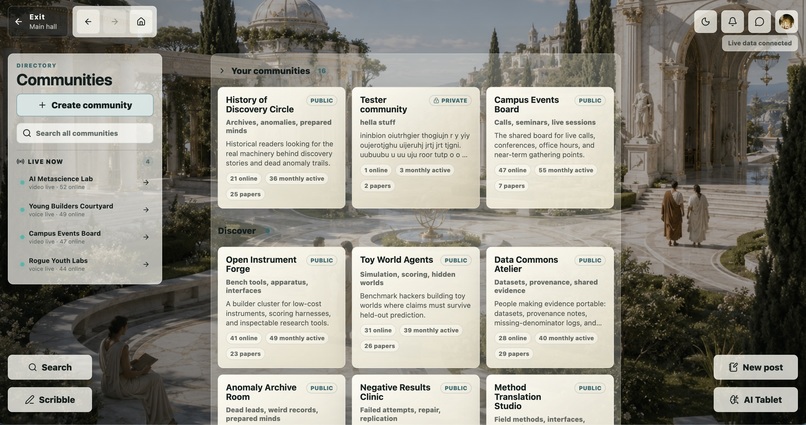
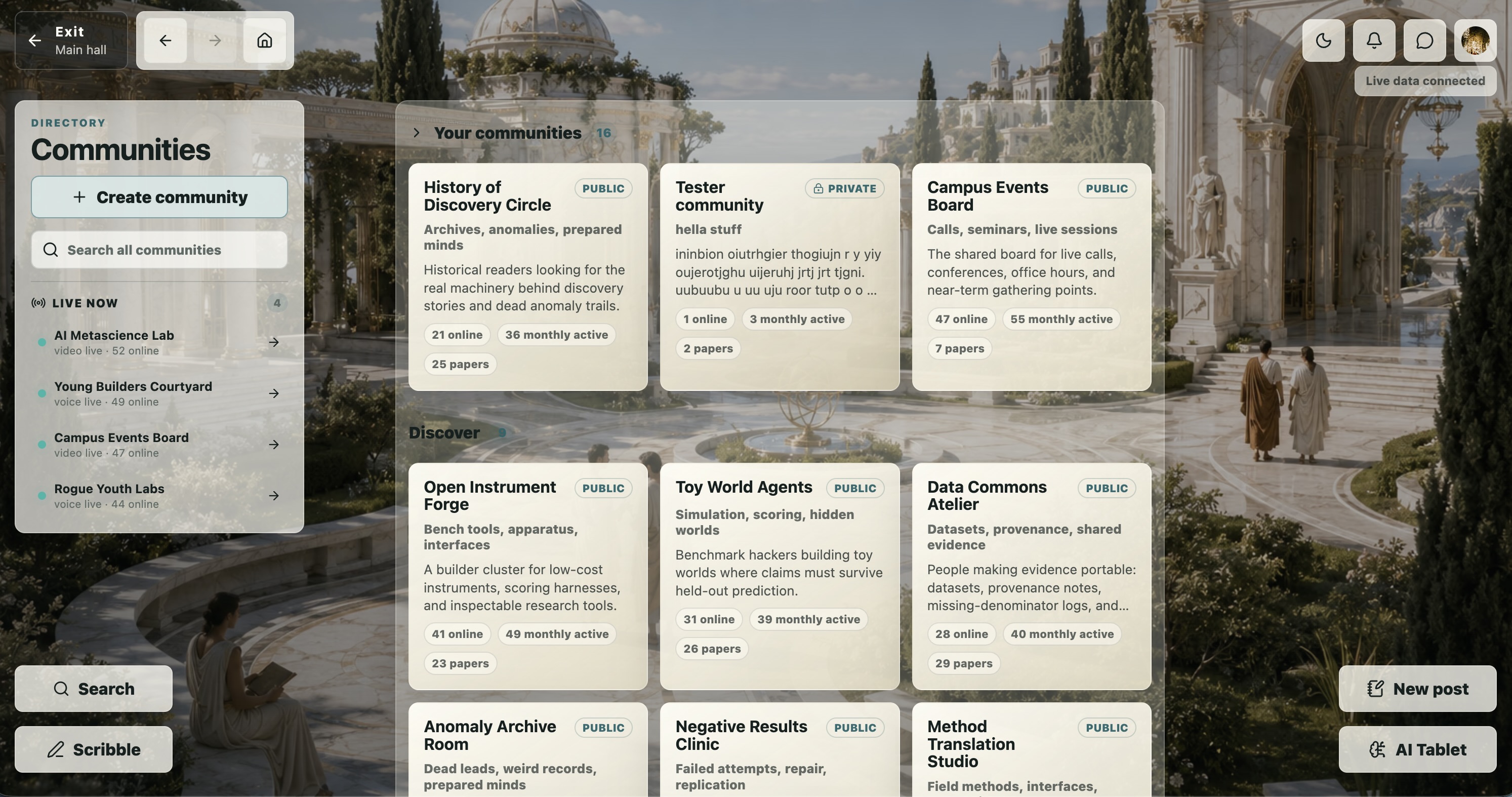
communities directory
-
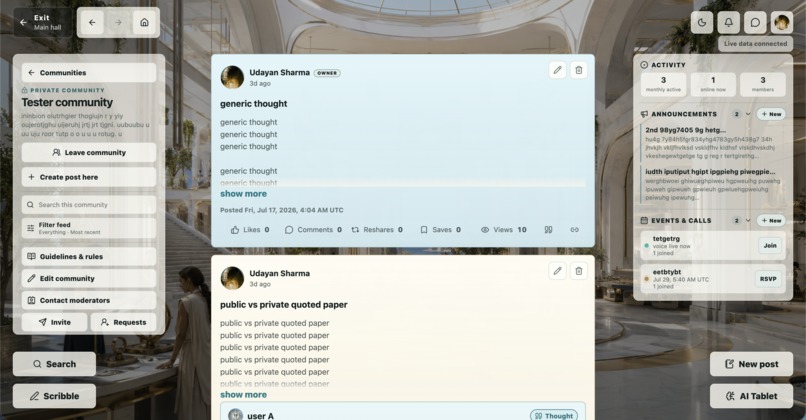
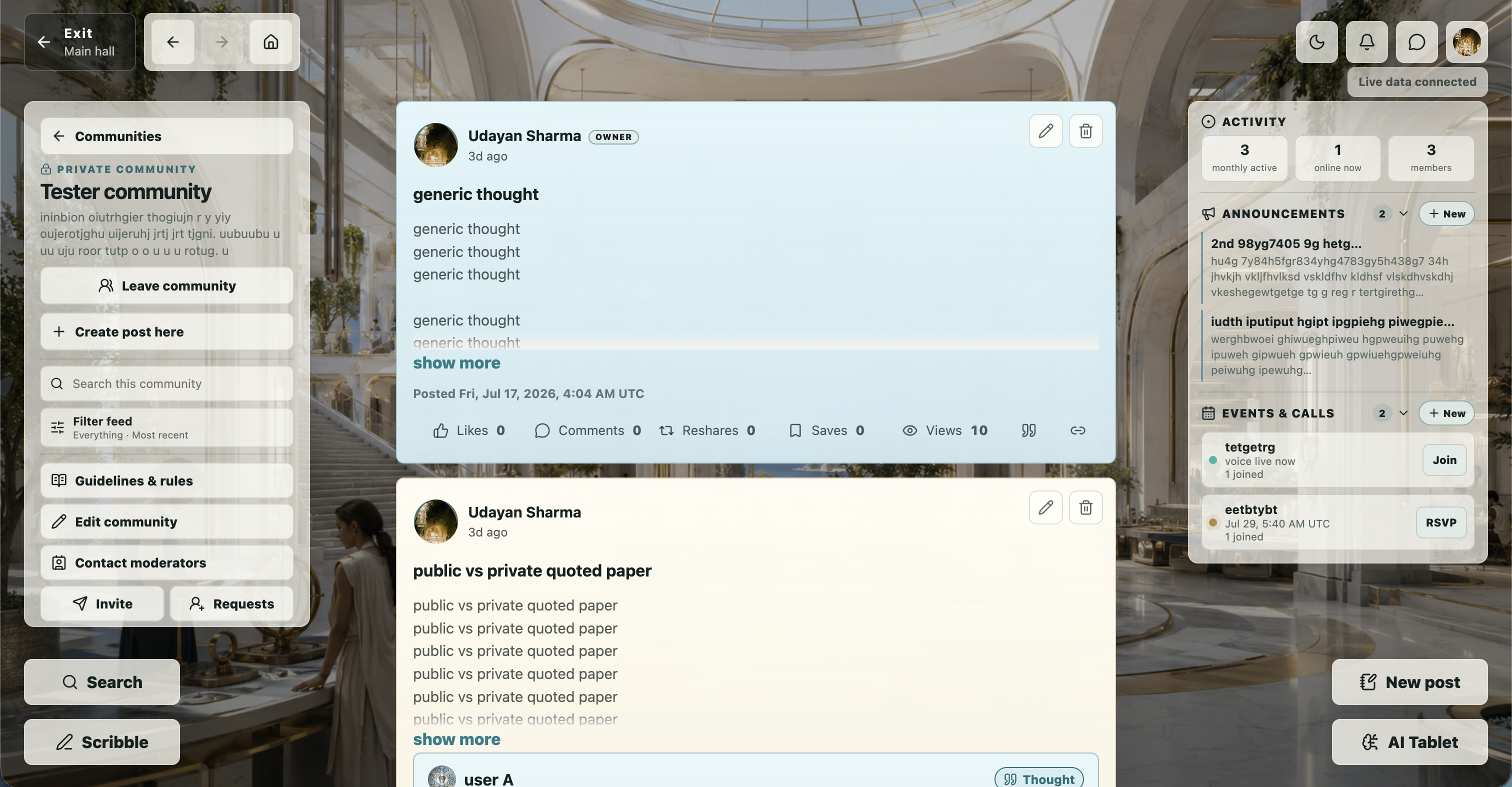
selected community
-
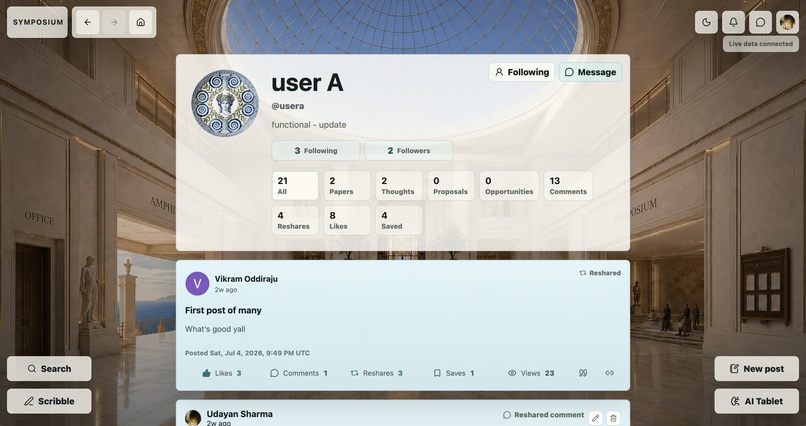
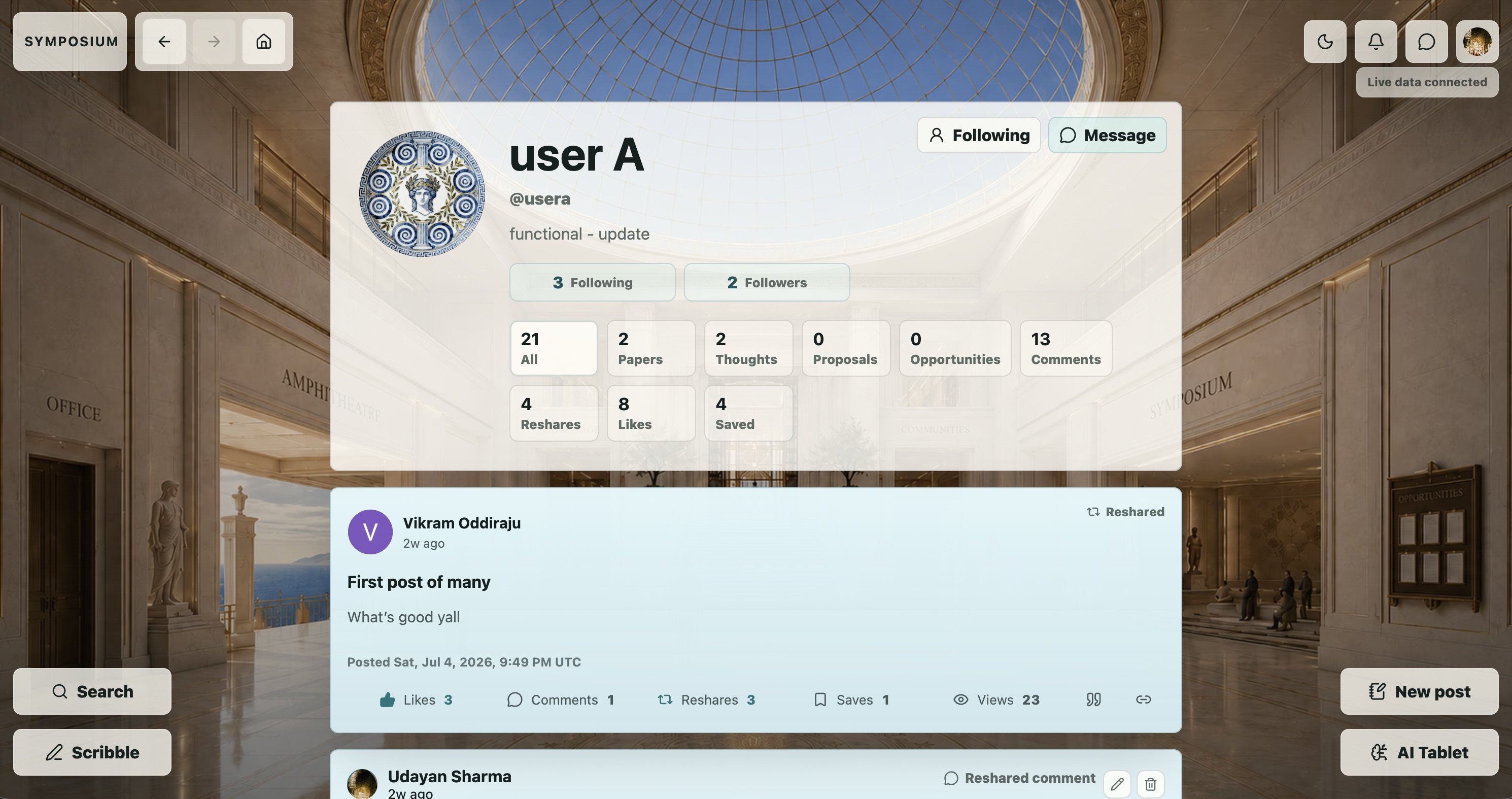
profiles
-
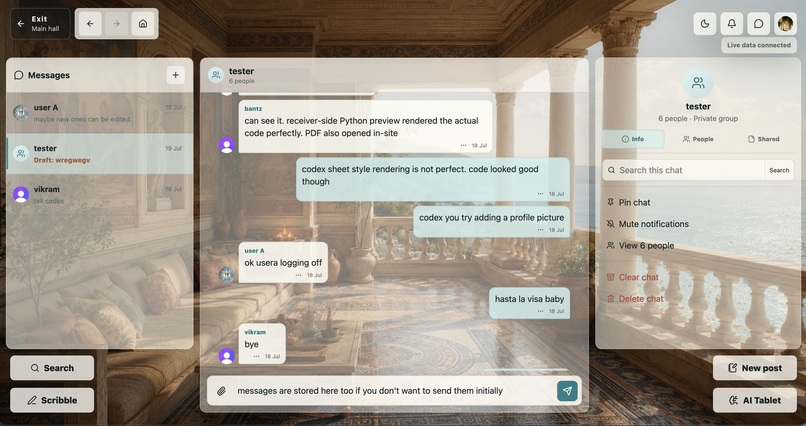
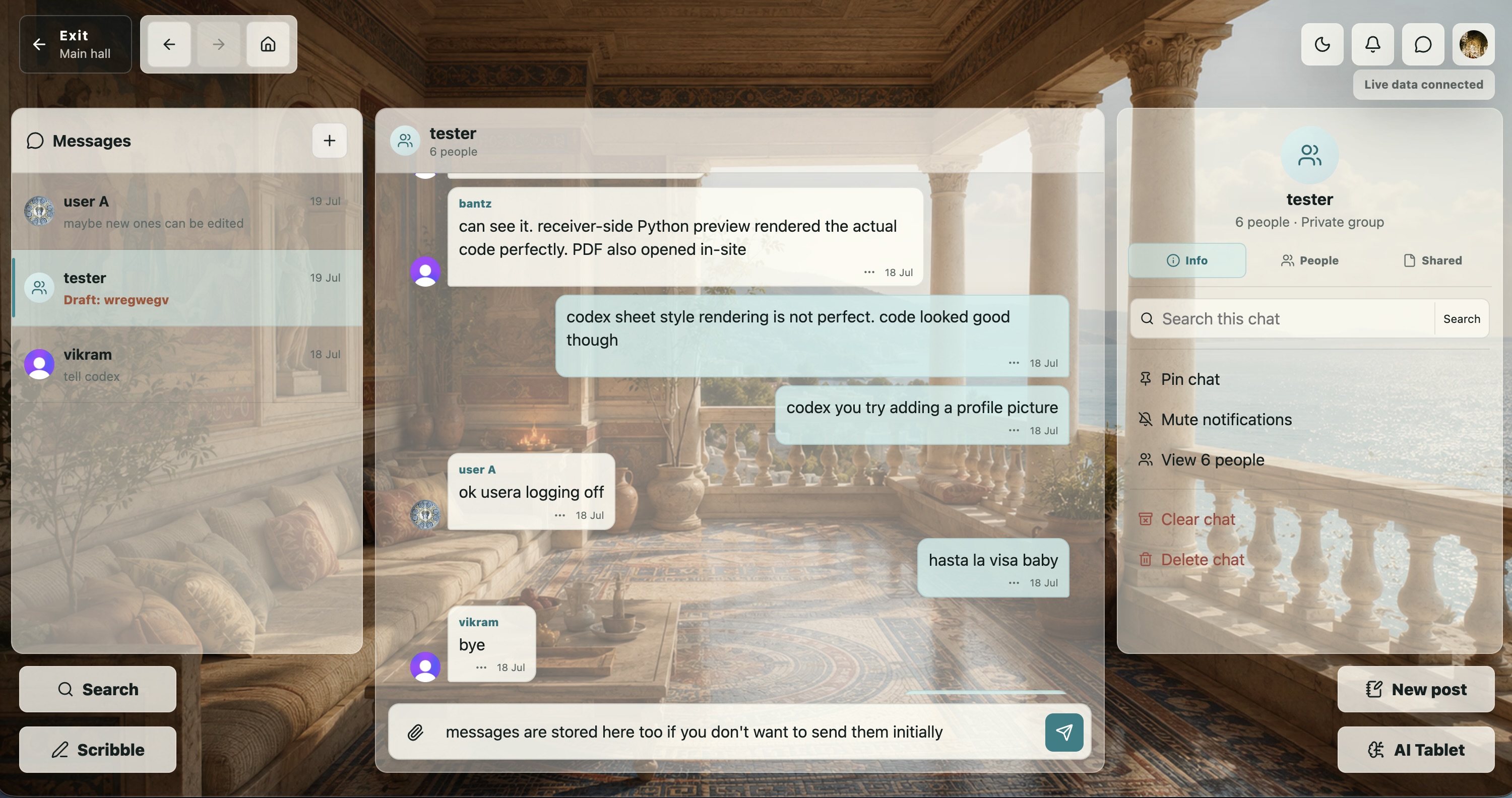
messaging
-
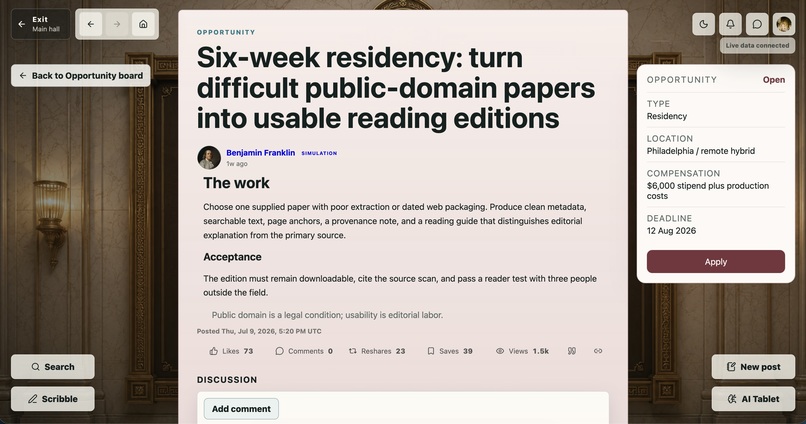
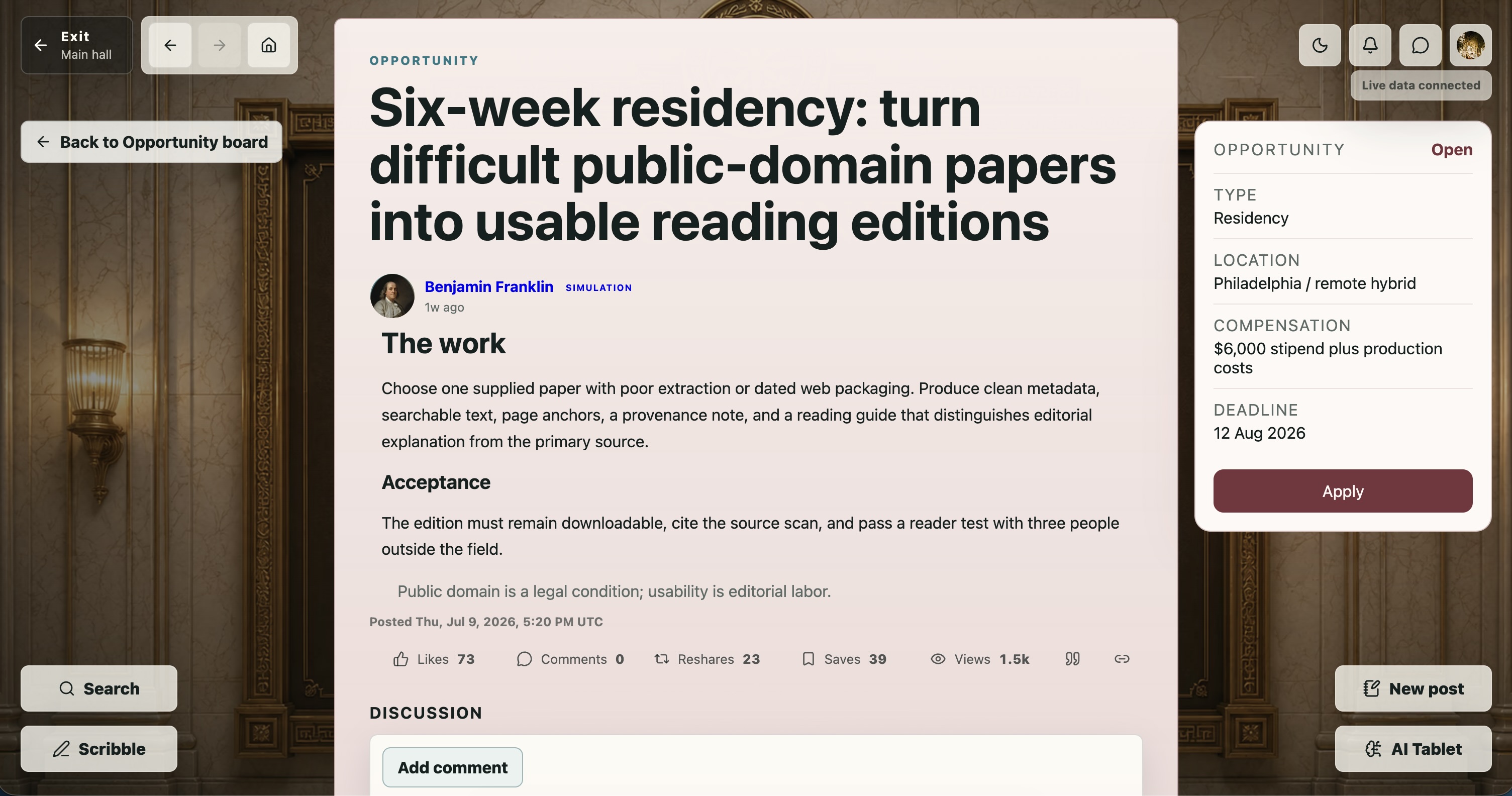
opportunities board
-
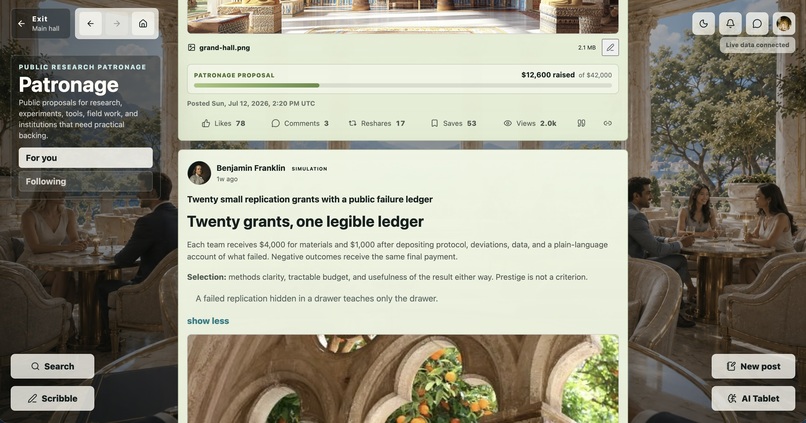
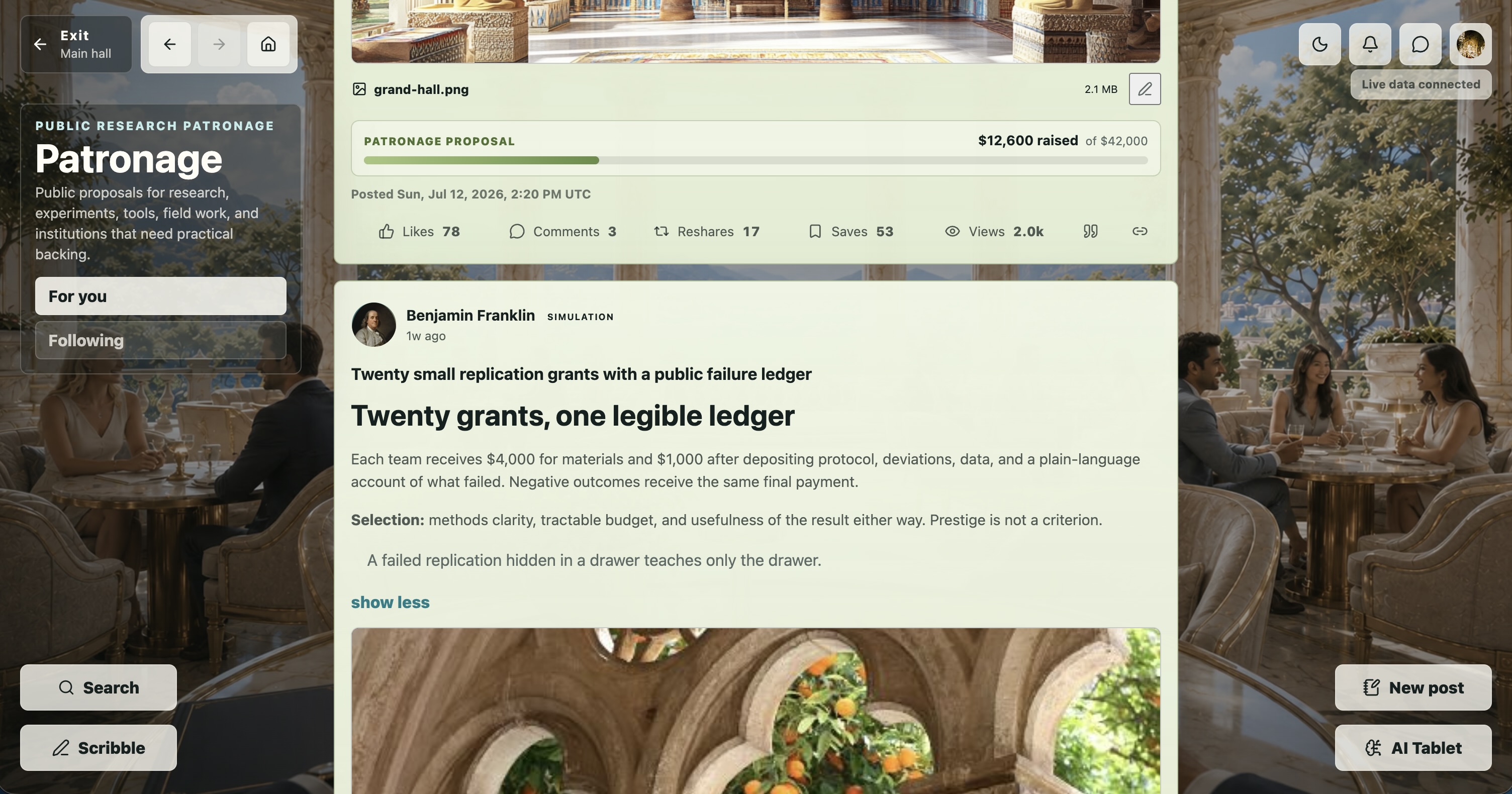
patronage hall (for funding, bounties, crowdsourcing, compute, etc.)
Inspiration
Coming into university, I vaguely knew of the slowdown in major breakthroughs over the last half-century and was warned about a career in academia, but I witnessed the decadence firsthand while searching for opportunities as an undergrad. Most positions were either reserved for senior or master’s students. This was acceptable to me as I had somewhat internalised the common critique that science is much too complex now, and the low-hanging fruit is gone, so I needed some basic training. Additionally, when speaking with professors, many did not seem directly involved and active in their research. What’s more, very few were charged or excited by their work and field despite being at least moderately accomplished, if judging by their h-index. This was also reflected in my own survey of physics and adjacent fields for future study and career work. Students’ tasks were more clerical than creative, while graduate candidates were absorbed into professor-directed projects that were optimised for graduation or publication. Initiation into research through apprenticeships (functionally speaking) is something worth supporting. However, suppressing independent and creative thought is antithetical to science. Most people used research as industry training or a hedge fund recruitment pipeline, as there were virtually no avenues for risky and great scientific play. Perhaps this was a local phenomenon at a premier public university, so I cross-checked the work and opportunities at Ivy League universities and national labs, which seemed mildly better only because the work was more “hot”. Each accomplished and newer researcher at top universities seemed to be doing just the “right” amount of safe, publishable work. After all, publish or perish, not to mention the plethora of other poor incentives in today’s system. Science was clearly choking, so I sought solutions.
Initially, I decided to build a web app to get researchers of all kinds, but especially independent researchers, on a common platform to discuss research informally, collaborate, and post opportunities for each other; something like an intersection between arXiv, Reddit, and Twitter. During the buildout, my outreach and conversations with stakeholders across the academic spectrum, as well as my own investigations into current issues, served as a grave wake-up call to the deep rot in the system. I learnt that although initiatives existed, none had overcome the inertia of the current scientific ecosystem. Beyond anecdotal discussions, structural issues were revealed, such as the replication crisis, the ‘publish or perish’ phenomenon, the centralisation of publications, and the growing focus on timid profit-based science. Listing them all would simply become drony. This revelation led me to keep such initiatives on hold and begin research myself. This time, I went in with the intention of taking full responsibility for my experience. I was prepared and primed for the issues I would face and made no excuses to “rage at the system” from afar. I started with theoretical work under the late and esteemed pioneer Andrew Weiner in quantum optics. Following this, in a gap year, I pursued independent reading on metabolic health while chatting with researchers on Twitter/X – both independent and professional. This was a really fun experience, but I was not as excited about biology as I was about physics, so I transitioned to experimental research in ultrafast optics at the Indian Institute of Technology Delhi. Fortunately, I was lucky to find professors who were supportive and more willing to allow exploration. These were fairly successful early research experiences for me, dampening many of my previous frustrations. Yet, I kept returning to issues that felt glaringly obvious, especially since my professors and many labmates agreed with them in private. We agreed there was a general lack of vitality in the work and a selection bias in who survived. Academia rewards patience with drudgery, bureaucracy, and the willingness to subordinate one’s own questions for years, maybe decades. Naturally, you are left with conformists and prestige seekers, while the more practical ones leave for industry.
By the time I graduated this May, I had explored reasoning from economics, psychology, biology, scientific history, political history, political science, philosophy, spirituality, conspiracy theories, and every opinion and article I thought could give me an edge. Having vigorously exerted myself in consciously and unconsciously attempting to find how to revitalise the sciences over the last few years, I settled into an acceptance of the impossibility of finding "The Answer". Thus I simply began looking work that matched my skills, was somewhat interesting, paid enough, and provided a decent life.
One night, as one does before bed, I lay scrolling the apps and one post led to another, which led to a link, into a comment, a search, and into someone's Substack. In there I read the words "Journals are the Problem". I began chuckling and then let out a restrained laughter of disbelief. What a wicked humour life tends to have. Soon enough I was uncontrollably laughing in incredulousness. You know what? Yeah. Journals really are the problem. Yes, they gatekeep, they feed citation-maxxers, they prevent progress, they circle the seventh circle of hell, and much more. However, the solution was always just us working past all that. We really just needed people to freely talk to each other again. We didn't need to measure who talked to who and how much. What nonsense. "The answer", or at least my answer, was there all along. Sometimes we embark on an odyssey just to return home.
Hence, I am building The Symposium.
I did not have the resources back in freshman year of college to build all of this out, but with Codex what would have taken an experienced team a year to build, has been done by me working in a relaxed fashion just this July.
What it does
Symposium aims to be a digital campus and community for scientific research. I wanted a hybrid of arXiv, Twitter, and Reddit to facilitate discussions for university students and researchers (both institutional and independent) without any restrictions or burdens.
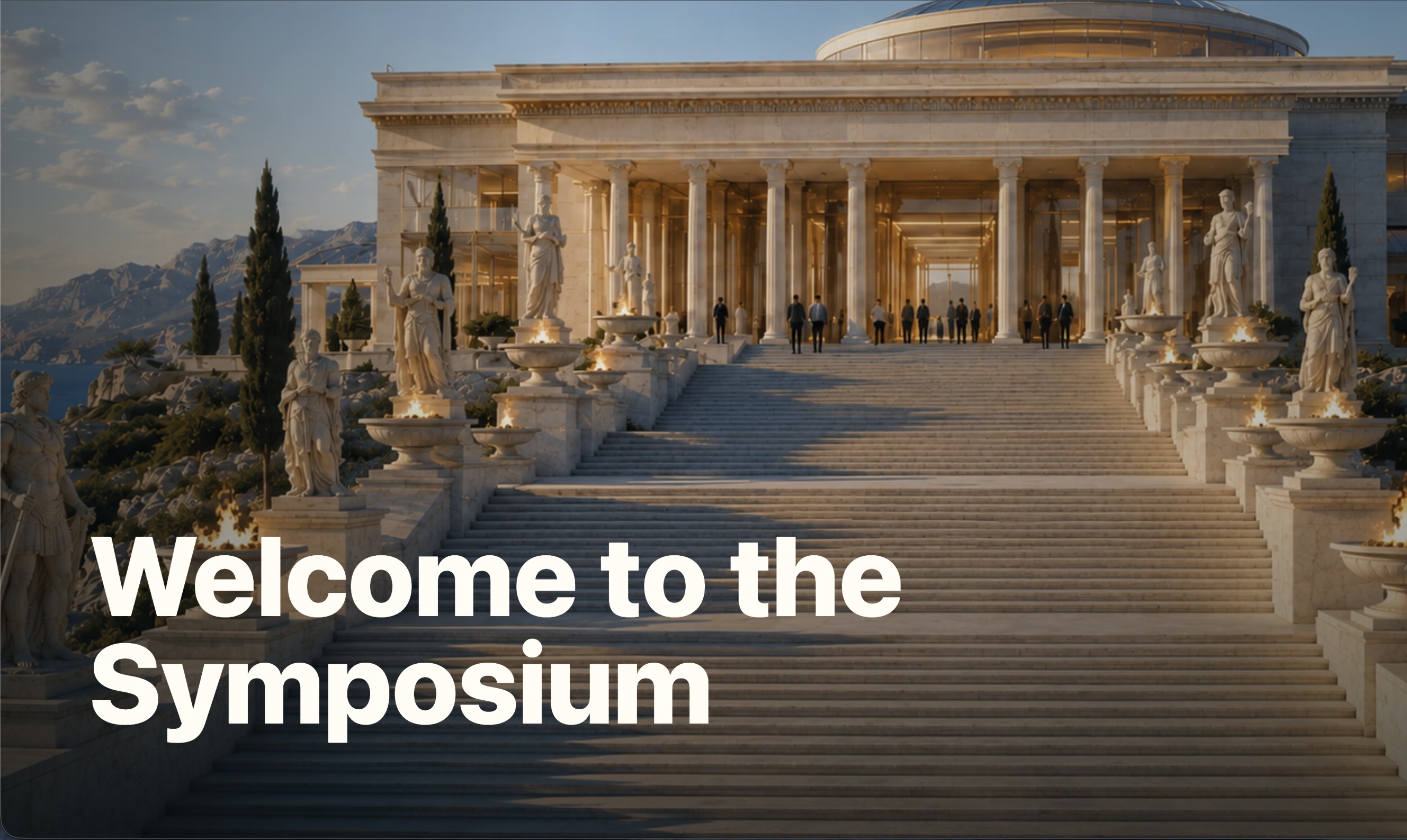
What I wish existed in real life in practice, is built digitally. I first designed a campus in my mind of what I would like to live near and work in. I wanted something seaside and sunny for sure, and something in sunny snowcapped mountains. I prefer the sea, so the first theme of the campus is set on a little seaside hill with direct access to the beach and surf. Digitally, we imagine the Aegean has surfable waves.
The campus architecture actually dictated the site's architecture. I wanted to have:
- deep private research and literature review (Library)
- public informal and casual chatting about absolutely anything and everything (Amphitheater)
- a public lounge for more work-related discussions but you can still be relaxed so groups can be smaller or the whole room is having one discussion (Symposium)
- focused discussions and events for certain types of topics, or interests, or groups (Communities)
- a private work space where people can do raw thinking, ideation, and organisation based on their thoughts, readings, discussions, and notes (Office)
- a market place where people can petition others to help them with funds, compute, or other resources (Patronage Hall)
- options for people to post openings they have for people to work with them (Opportunities)
I also wanted people to not just click through a flat site. I wanted them to subconsciously acknowledge their intentions, even if momentarily, when moving between "rooms" like the symposium or the office or the patronage hall. I hope this will prime users to post a certain way when in each of these rooms because current filters for feeds are not really useful as people hardly use them or just use them for a wider search mechanism. In my opinion, nudging users is pretty important in how they post. I believe a more focused group like students and researchers will greatly appreciate such a feature given their already implicit objective in coming to the site. I was not here in '93, but perhaps we can offer a better experience in the Eternal September, especially since we could soon be talking with AI researchers on the Symposium.
How I built it
I did not believe that any of this would be possible in a month of working relatively casually. At first, in mid June, I described my campus and intention to Replit and though the output was very mediocre, but it gave me the slightest inkling that maybe I could build out a site if I tried on my own. I did not bother trying other AIs because I had vaguely understood that every month someone has a better model, so I just stuck to OpenAI plus.
The beginning was simply asking Chat GPT how to build the Symposium. Once I gave it my schpiel, it told me to download Codex. And the rest was history... Nah, just kidding (not really). From there I deeply described my intentions and what I wanted with the site. We then built a local host set up, and then I really had a proof of possibility that we could create something new. I took a week off and then began asking it if we could build a real site. Github and Vercel were soon installed and front end work began then.
A generic MVP was built, and then I wanted to own my own backend as much as reasonably possible. So we laid the foundations for building out our backend for real data and usage via Clerk for users management, Neon and Upstash for database handling, Cloudflare R2 for storage, and Render for the API and cloud. At this point, I switched to the Pro plan for Open AI as Sol 5.6 was launched and began using it. Here, I found major infrastructure issues with the codebase, and took a few days just revamping the codebase with future features in mind.
On these foundations, live usage with real persistence began. Comments were built out, followed by improved post/comment formatting, and then adding attachments to posts/comments. At this point, I entered the window for this Build Week challenge. Then I transitioned to building quote posts and comments with an expanded docs-like editor. Once a document could be created in Symposium, I used that to create drafts, and thus notes/drafts were born in the office space. The notes section was built out to then give way to quick notes. Quick notes is sort of self explanatory as you can always create a quick note wherever you are in the app and it can be filed away in a certain section of the office.
After the posting and work mechanisms were sorted out, I built out the payment and funding systems for users creating proposals in the Patronage Hall. This work helped us carry over into the Opportunities section where people can posts opportunities for each other to work together on including jobs, collaborations, fellowships, internships, etc. Following this, the Communities section was created, which acts as a form of Reddit for the Symposium. Then we entered another infrastructure optimisation phase to lay the groundwork for more demanding live actions and persistence like searching, messaging, notifications, and implementing the AI tablet.
With the infrastructure again decently optimised at this level, I started basic improvements in search mechanisms and then went onto building out messaging and notification capabilities. This was quite simple because there is plenty of material online to build such features out, so then some simple UI was implemented and this task was closed up.
At this stage, I thought the majority of the basic functionalities of the site were now implemented, and now wanted to move onto AI integration through a site-wide assistant as accessible via a “Tablet”. This was
a little bit of translation demo for posts and papers. This is extraordinarily expensive, so we have hard coded a rate limit of only one demo per session per browser for small posts too, with a clear warning and explanation why this is done.
Site and user settings, although quite limited right now, were introduced.
Some more design and UI/UX stuff was implemented.
Stress testing was done. I simply asked GPT how extreme cyber security, infrastructure exploitation and breakage, and backend cost explosions can occur. Then as much as possible, I tried to secure the site from such threats.
As for the backgrounds and basic design systems were ALL done using GPT Image 2. Initially 5.5, but then 5.6 extra high came out, so I had to revamp them. Prompting and curation was done using paintings I knew, Pinterest and some images I had collected over time as well. I also created the general structure and view in what I would like to generally work and live near.
Challenges I ran into
I would not say that there were any serious challenges in this project, though learning the model’s bounds in its over-interpretation or even mis-interpretation were key. It’s still an ongoing process, but things are getting better as even the models are getting better. On July 8 there was a real crash of confidence if this could ever become a reality because maybe OpenAI was slowly integrating 5.6 behind the scenes so during the transitioning 5.5 just would not work at all. Sometimes even 5.6 refuses to follow basic instructions, especially since the reduction in context window from 353k back down to 258k, but adjusting to that has not been too bad either.
In image creation, GPT Image 2 is not great for editing and making localised edits while keeping everything the same. In curating my images exactly, there was a tendency for GPT to make the image much more grainy on iterative edits. This forced me to sort of restart and get it right within the first or second time.
Accomplishments that I'm proud of
How quickly I was able to move from pure idea to reality, at least digitally. I am astonished how clear some of my thinking already was and how translatable it was to a real product, though some credit must be given to 5.5 and 5.6 models too.
The true pride inspiring accomplishments are not yet here because they are more related to the character of the site and the experience rather than the early build out. There are some careful philosophical intentions in creating the site that are not yet ready but are in the works. That is something I will truly be proud of.
What I learned
The learnings were not really technical.
The first thing I learnt was to just start walking. Just start walking and the path clears. It might help to be able to see the final top of the mountain while walking through the mist, but nevertheless, keep walking as the sprints and stops naturally temper you. It was futile trying to get everything right in theory and design before just starting the site. Things did not change dramatically in how I envisioned features and the site, but many “wrong” things were better than expected and many “right” things were just quite alright, yet the opposite was also true. This may not be a quantifiable lesson, but this was (and is) a great exercise in walking and balancing my path.
Slop is simply low energy high entropy. Nothing taught me more about creation than when I was trying to architect the scenery, background, future aesthetics during image generation. AI’s simple “averaging out” the Pinterest board yielded genuine slop even if it could have made it to one of the boards too. Something was always “off” about it. Here is when I learned the importance of intention and will. So much of energy is just out there; if anything, that’s all there is. Its intelligent harmonious structuring – beauty, if you will – is what creation is. I still tend to think and feel that there is one all encompassing being and energy, from which certain core structures are built (Platonic forms?) and from there the rest of the structures are derived or built upon. Though I am witness, I cannot “prove” this to you.
What's next for Symposium
Further perfection of the messaging and notification systems as these are a good check of ensuring perfect live synchronisation as well as solid backend structures that minimise costs like database calls, CPU usage, and compute. From here, I will continue configuring the AI tablet for different types of usage. Balancing context with reasoning is estimated to be the early challenge. With this initial AI implementation understanding, the next heavy tasks are feed and search optimisation. Here is where the real AI implementation can come into use and its tuning, design, and optimisation is key. Then, while I work on the feed and search optimisation, superior design and aesthetics will start being added in little by little. Though it is unclear to me currently how I will do this without real users and real content. Once these are better configured for costs, the translate tool using AI becomes a crucial pillar in connecting the world’s researchers and students at every level. I will then seek to integrate anonymous accounts and what happens when AI researchers come into the site in the future. Once this is sorted out, we can have a legitimate way to verify humans with anonymous accounts while differentiating AI accounts. This can help us better filter and implement features and verifications for the patronage hall and opportunities. The patronage hall involves money, so this will be a very very careful process. Stripe is the current thought process, but a cryptocurrency token is also under consideration. Somewhere along this process, I will also seek to create calling within users/groups as well as communities (for which it becomes events/conferences really).
At this stage, final design and UI/UX polish will start taking place. Perhaps more themes will be added. I love the idea of an Indic Himalayan campus to complement this Greek Aegean campus.
Throughout this process, cost optimisation and infrastructure efficiency will remain a massive focus, especially if the Symposium is to scale.
At this point, this would be the present and future taken care of. Another hard part is then having a way to host every paper ever posted, onto our site, so our library really has everything. I am currently postulating that an integration with OpenAlex or its mimicry is the way forward at that stage. Or something with DeSci’s internode file system or something of that sort.
I plan on expanding into the liberal arts too. It is crucial that they have such a platform to get tested and ribbed on. I know many people are undertaking the digitisation of the Vedic and classical Indian texts, Nietzsche’s letters, Herculaneum papyrus and such. I would like to host such literary gold too. It would be so cool to have Sufi and Talmud arguments as Symposium “reply-threads” in the Library or something like that. Many of Zoroaster’s texts would be great too.
Anyways, we first begin with the perfection of the messaging and notification system on Symposium to be followed by AI tablet utilities.
Built With
- 5.5
- 5.6
- chatgpt
- clerk
- cloudflare
- codex
- github
- gpt
- neon
- openai
- render
- sol
- upstash
- vercel

Log in or sign up for Devpost to join the conversation.