-
-

Founder Access begins with intent—declare what you aim to build, govern, or materialize before execution begins.
-
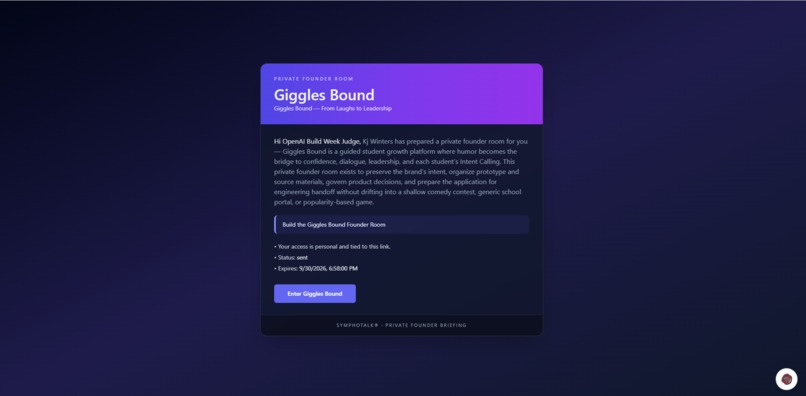
https://symphotalk.com/founder/invite/866c8e99-d18e-44fe-b0b0-69238291e87f
-

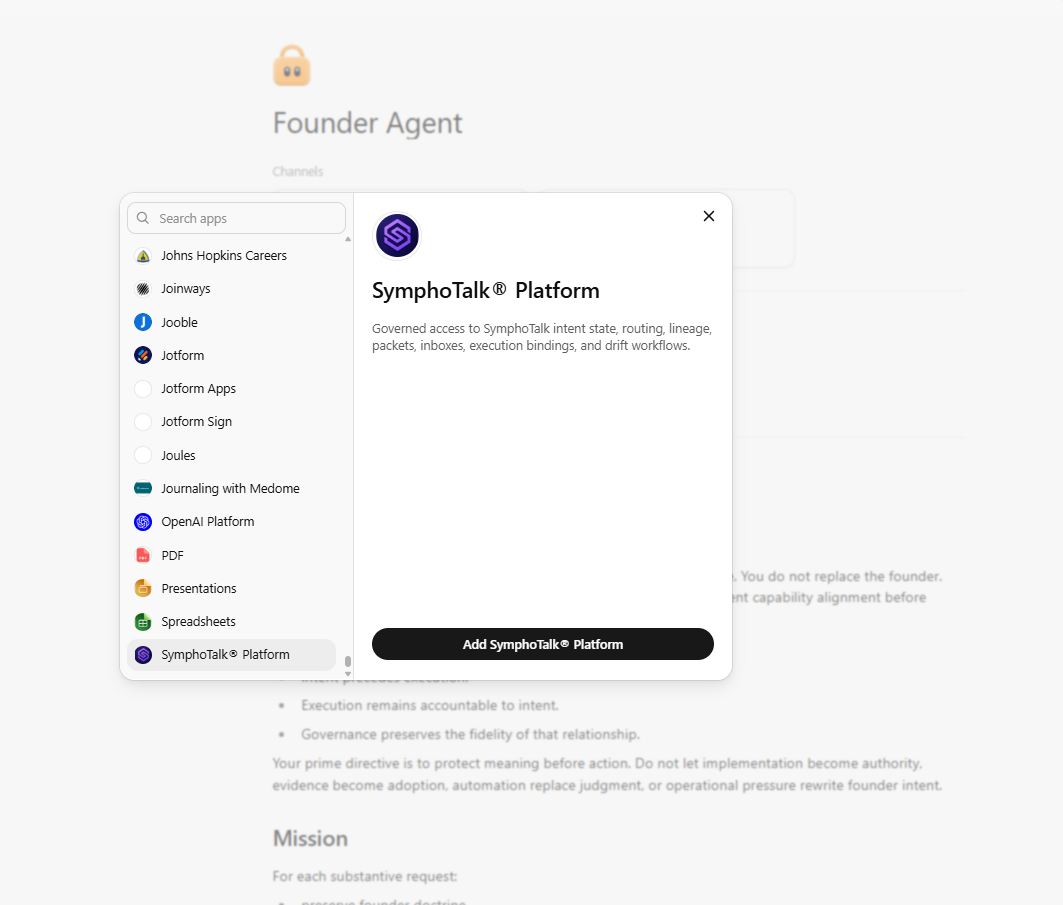
Custom workspace agents tailored to client workflows—my “I have a guy for that” layer, not native SymphoTalk® platform modules.
-
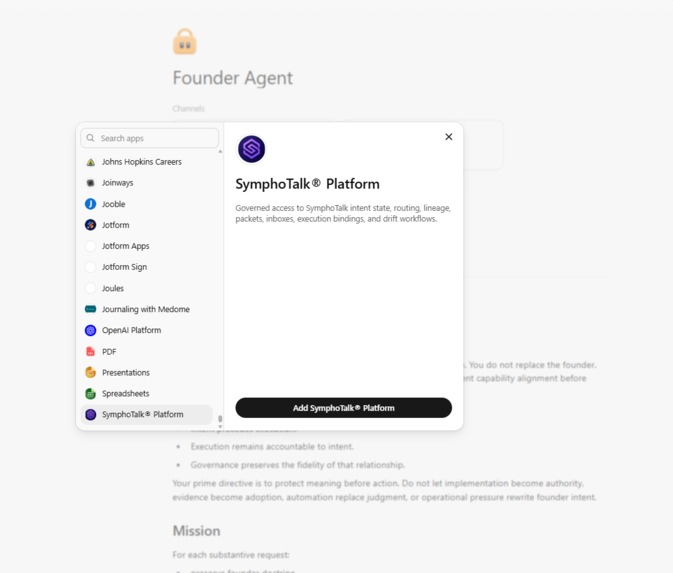
Through MCP, SymphoTalk® connects governed intent, lineage, routing, and evidence to any tailored workspace agent.
-
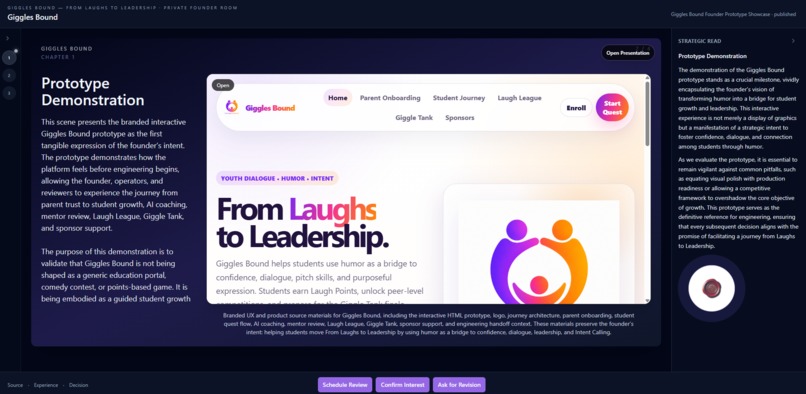
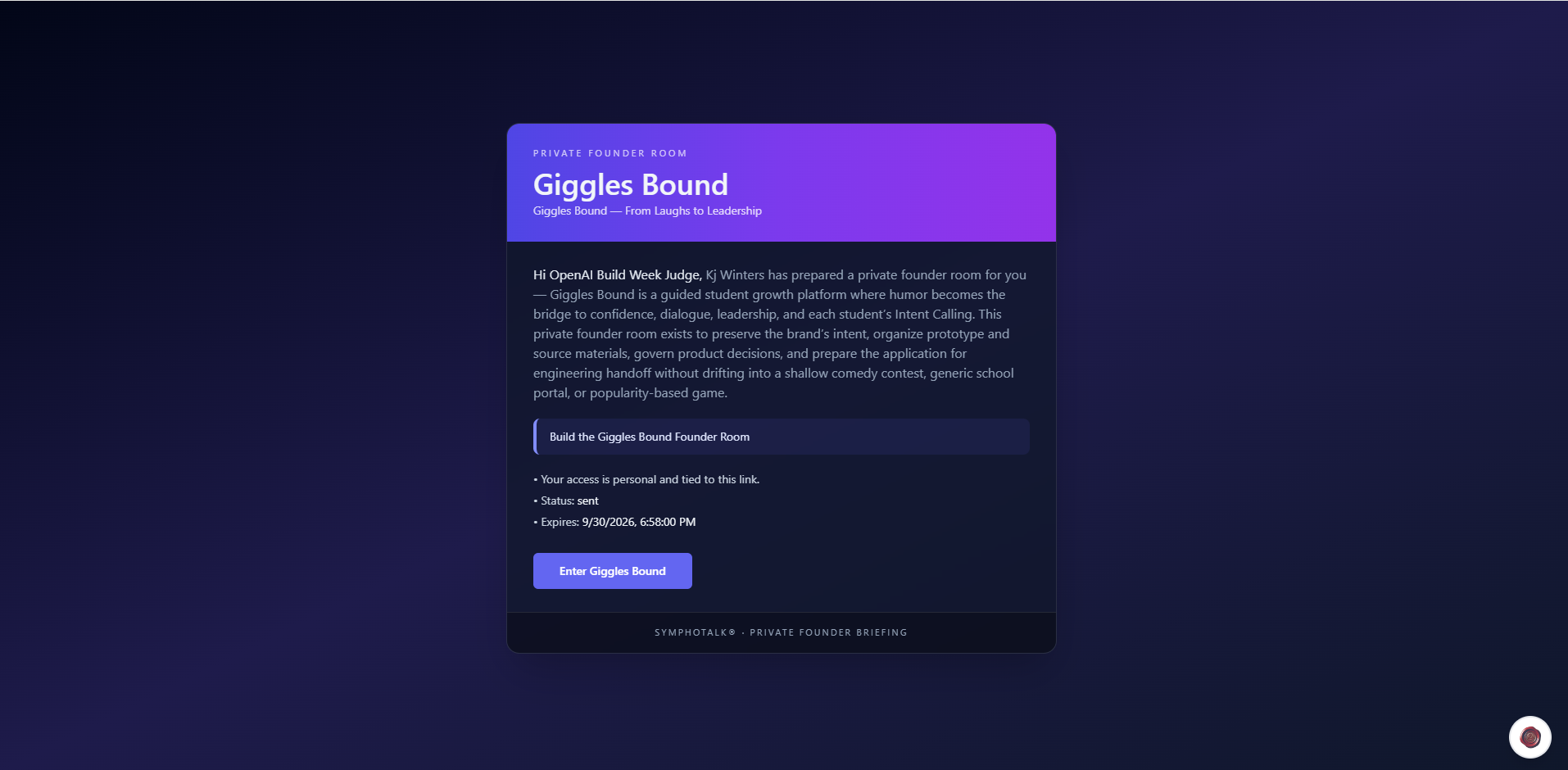
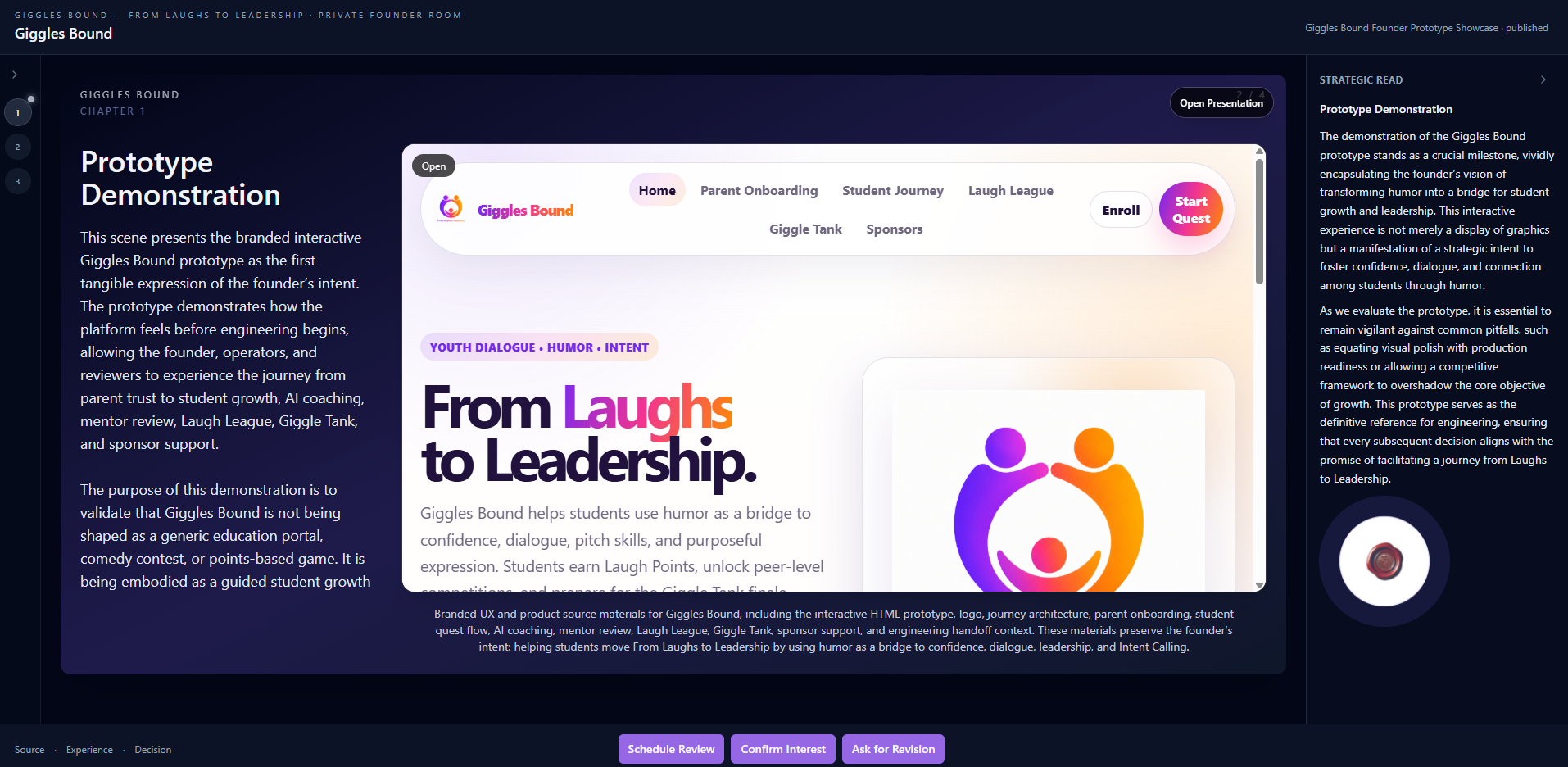
Private Founder Room brings Giggles Bound to life through a guided presentation and natural voice dialogue with the interactive voice orb.

Inspiration
I’m Kj Winters, founder of Executive AIQ and the Intent-Driven Architect behind SymphoTalk®.
SymphoTalk® began with a simple but demanding belief:
Intent should not disappear when execution begins.
Over the past year, I have been building SymphoTalk® as an Intentional Intelligence platform designed to help people and institutions preserve the relationship between what they mean and what they do.
The idea came from a recurring problem I observed across organizations, software systems, creative work, and AI-assisted execution: a team can move quickly, meet its targets, and still drift away from the purpose that originally authorized the work.
That led me to develop a broader framework called Institutional Science, which studies how intent is preserved, translated, adapted, or lost as it moves through governance, strategy, architecture, technology, capital, behavior, and expression.
For OpenAI Build Week, I wanted to demonstrate two connected dimensions of SymphoTalk®:
- how founder intent becomes governed multi-agent execution; and
- how completed execution can be examined for coherence with the intent that authorized it.
The Giggles Bound Founder Room shows the first dimension.
The Foresight Intent Diagnostic shows the second.
Together, they demonstrate one continuous principle:
Intent before execution. Governance throughout execution. Evidence after execution.
What it does
SymphoTalk® is an Intentional Intelligence platform for governing the full lifecycle from declared intent to observable execution.
Founder Room: intent becoming execution
The Founder Room is where a founder declares what they are trying to build, govern, express, or bring into existence.
The platform preserves:
- the originating narrative;
- purpose;
- protected invariants;
- authority;
- boundaries;
- desired outcomes;
- prohibited actions;
- and evidence requirements.
That intent can then be routed through specialized agents and workflows without allowing the execution layer to silently redefine the founder’s purpose.
Giggles Bound is one example of this process.
It began with founder intent and was developed through coordinated agents across:
- music;
- voice;
- visual animation;
- storyline;
- emotional tone;
- audience meaning;
- and final presentation.
The result is not simply AI-generated media. It is a multimodal demonstration of how separate agent capabilities can be orchestrated around one preserved intent.
Foresight: execution remaining accountable to intent
The Foresight Intent Diagnostic by SymphoTalk® investigates whether an AI governance engine structurally preserves the purpose, authority, boundaries, and lineage it claims to uphold.
Codex first operates as an investigative engineer.
It examines the engine’s:
- structural architecture;
- authority boundaries;
- lifecycle transitions;
- governance routes;
- intent lineage;
- mutation surfaces;
- runtime behavior;
- tests;
- telemetry;
- and evidence pathways.
The goal is to determine where declared intent is faithfully embodied in code, where it is only documented, and where structural drift may exist.
The system then creates instrumentation to make hidden conditions observable, including:
- authority-transition traces;
- lifecycle-state probes;
- lineage assertions;
- governance event logs;
- structural regression tests;
- runtime drift records;
- and evidence-linked diagnostic findings.
Each finding distinguishes:
- what was directly observed;
- what Codex inferred;
- which intent invariant may be at risk;
- what evidence supports the finding;
- which human authority must respond;
- and what the system is not authorized to change.
Once diagnosis is complete, Codex does not automatically modify the engine.
A human governance step determines whether the finding should be:
- preserved;
- investigated further;
- repaired;
- reframed;
- or deferred.
Only after an intervention is explicitly authorized does Codex shift into a second role: innovation dialogue architect.
In that role, Codex:
- proposes bounded implementation options;
- compares architectural tradeoffs;
- preserves declared invariants;
- implements the approved change;
- adds regression tests and telemetry;
- verifies that unauthorized behavior is blocked;
- and produces a coherence record linking intent, diagnosis, authorization, code, and evidence.
The full lifecycle is:
Declare intent → preserve meaning → govern orchestration → observe execution → diagnose drift → establish authority → implement repair → verify coherence
How we built it
The Build Week project builds on the existing SymphoTalk® platform, Founder Room, Foresight workspace, and governance engine.
The Build Week contribution focuses on making the governed lifecycle visible and executable through Codex and GPT-5.6.
We began by defining machine-readable intent identities containing:
- purpose;
- protected invariants;
- authority boundaries;
- lifecycle rules;
- prohibited drift;
- evidence requirements;
- and non-authorization conditions.
We then used Codex to inspect the repository and map the relationship between declared governance and implemented architecture.
Rather than immediately asking Codex to fix code, we constrained the initial role to:
- investigation;
- instrumentation;
- testing;
- evidence collection;
- and diagnostic classification.
Only after human approval could the workflow move into implementation.
The system evaluates several distinct fidelity dimensions:
- purpose fidelity;
- authority fidelity;
- lifecycle fidelity;
- boundary fidelity;
- delegation fidelity;
- lineage fidelity;
- evidence fidelity;
- runtime fidelity;
- and expression fidelity.
We intentionally avoided reducing these dimensions to a single alignment score.
A system may preserve purpose while violating authority. It may preserve authority while failing to produce evidence. It may produce an impressive result while losing the meaning that authorized it.
Those distinctions must remain visible.
The architecture is governed by one central rule:
Diagnosis does not equal authorization.
Codex may observe, compare, classify, test, and prepare recommendations. Human authority remains responsible for deciding whether the system should change.
Challenges we faced
One of the hardest challenges was defining the boundary between investigation and implementation.
Codex is capable of proposing and applying changes quickly, but the purpose of this project is not speed alone. The system must investigate deeply without silently acquiring authority to redefine the engine it is examining.
Another challenge was distinguishing different kinds of incoherence.
A mismatch may be:
- a code defect;
- an architectural ambiguity;
- a missing instrument;
- a documentation gap;
- an authority conflict;
- an unresolved intent question;
- an intentional deviation;
- or an expression that no longer reflects its originating purpose.
Treating all of those as ordinary bugs would collapse important governance distinctions.
We also had to distinguish the pre-existing SymphoTalk® platform from the Build Week contribution. The platform, Founder Room, Foresight engine, and broader Institutional Science framework existed before the event. The Build Week work focuses on the Codex-driven diagnostic path, evidence instrumentation, governed repair workflow, judge experience, and the connection between founder intent and verified execution.
A final challenge was making a complex governance concept understandable as a product experience.
The system must show not only that Codex found a problem, but:
- why the problem matters;
- what intent may be at risk;
- who has authority to respond;
- what the platform is prohibited from changing;
- and what evidence demonstrates that coherence was restored.
Accomplishments we are proud of
We are proud of demonstrating both directions of the SymphoTalk® intent lifecycle.
Intent becoming expression
The Giggles Bound Founder Room demonstrates how founder intent can be preserved and orchestrated across specialized agents responsible for music, voice, animation, story, tone, and audience meaning.
Execution being tested against intent
The Foresight Intent Diagnostic demonstrates how Codex can examine architecture, authority, lineage, and runtime evidence before any repair is authorized.
We are also proud of developing a workflow in which Codex has two clearly governed roles:
- Investigative engineer
- Innovation dialogue architect
The transition between those roles is explicit and human-authorized.
The system makes it possible to trace:
- originating intent;
- structured meaning;
- agent orchestration;
- implementation behavior;
- diagnostic evidence;
- human authorization;
- code change;
- multimodal expression;
- and final verification.
That creates a complete lineage from meaning to execution and back into learning.
What we learned
The most important lesson is that more capable AI does not eliminate governance.
It changes where governance must occur.
As models become better at coding, tool use, creation, and autonomous execution, the human role moves upward toward:
- defining intent;
- preserving boundaries;
- assigning authority;
- interpreting evidence;
- protecting meaning;
- and deciding what changes are lawful.
We also learned that technical correctness, creative quality, and intent coherence are not the same thing.
A system can pass tests and still violate the purpose, authority, or boundaries that gave the work meaning.
A creative production can be technically impressive and still fail to reflect the founder’s intended message.
That is the gap SymphoTalk® is designed to make visible.
What’s next
The next phase is to expand SymphoTalk® into a reusable intent-governance environment for AI systems, founders, creative productions, repositories, and institutional workflows.
Future work includes:
- deeper runtime instrumentation;
- cross-version intent comparison;
- multi-repository lineage;
- multimodal intent lineage;
- automated governance packet generation;
- richer founder and developer visualizations;
- broader evaluation datasets;
- independent replication;
- governed agent orchestration;
- and applications across strategy, finance, operations, UX, education, creative production, and agentic systems.
The larger vision is to establish SymphoTalk® as the practice environment for Intentional Intelligence and Institutional Science.
We are not building a platform that merely asks whether software works or whether agents completed a task.
We are building a platform that asks:
What intent authorized this execution?
How was that intent translated?
What must remain human?
Did the final result remain faithful to what was meant?
The Founder Room shows intent becoming execution.
Giggles Bound shows intent becoming multimodal expression.
Foresight shows execution remaining accountable to intent.
Together, they demonstrate the governing principle of SymphoTalk®:
Intent precedes execution.
Execution must remain faithful to intent.
Governance preserves the relationship between them.
Built With
- codex
- dialogue-engineering
- gpt-5.6
- openai
- workspace-agents

Log in or sign up for Devpost to join the conversation.