-
-
Setting
-
Workspace
-
Workspace dashboard
Project Story
About the project — SymbioSense
SymbioSense is a speculative wellness tool that helps people notice when they’re nearing cognitive overload in AI-saturated work. As Large Language Models (LLMs) and AI agents become everyday collaborators, the risk isn’t only “too much information,” but losing the feeling of control while inputs are summarized, recommended, and acted on automatically. SymbioSense makes that invisible drift perceivable.
The system has two layers:
- Wearable Bio-Patch (sensory layer): a skin-like patch that visualizes “cognitive load trends” through a living bacterial colony pattern (calm → rising → recovering).
- Work Console (control layer): a quiet interface that explains why an intervention triggers, what it will do, and lets users edit or undo actions.
What inspired us
We kept coming back to a simple moment: you’re writing something important, you’re “being productive,” yet your attention is quietly collapsing under pings, feeds, and agent outputs. You don’t always notice the threshold until you’re already exhausted.
We wanted a tool that feels less like another dashboard and more like an extra sense: an always-on cue that stays quiet until it matters—then becomes transparent, editable, and reversible.
What we learned
- A good “new sense” must be legible without numbers. We reduced our metrics to two: Load and Agency, because more metrics can become more noise.
- Automation needs a transparency layer. If Auto Mode acts without explanation, it reads as “system takeover.” We designed Frame 4 to explicitly answer:
1) Why did it trigger? (Status + Cause)
2) What will it do? (Planned actions)
3) Can I change/undo it? (Editable + reversible) - Progressive disclosure prevents overload. We used trigger chips (e.g., “Notifications (8 in 5 min)”) so users see credible causes at a glance, with details only if they choose.
How we built it
We designed a short “detect → manipulate → outcome” loop using one primary scenario (deep work overload):
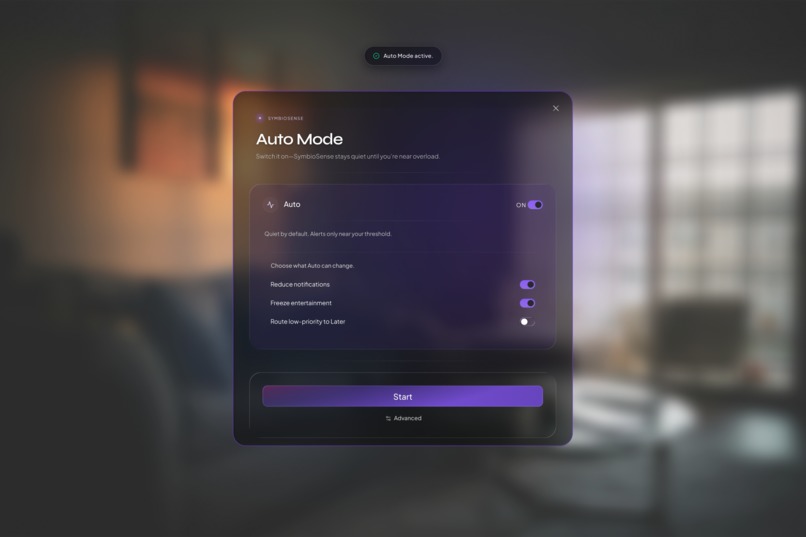
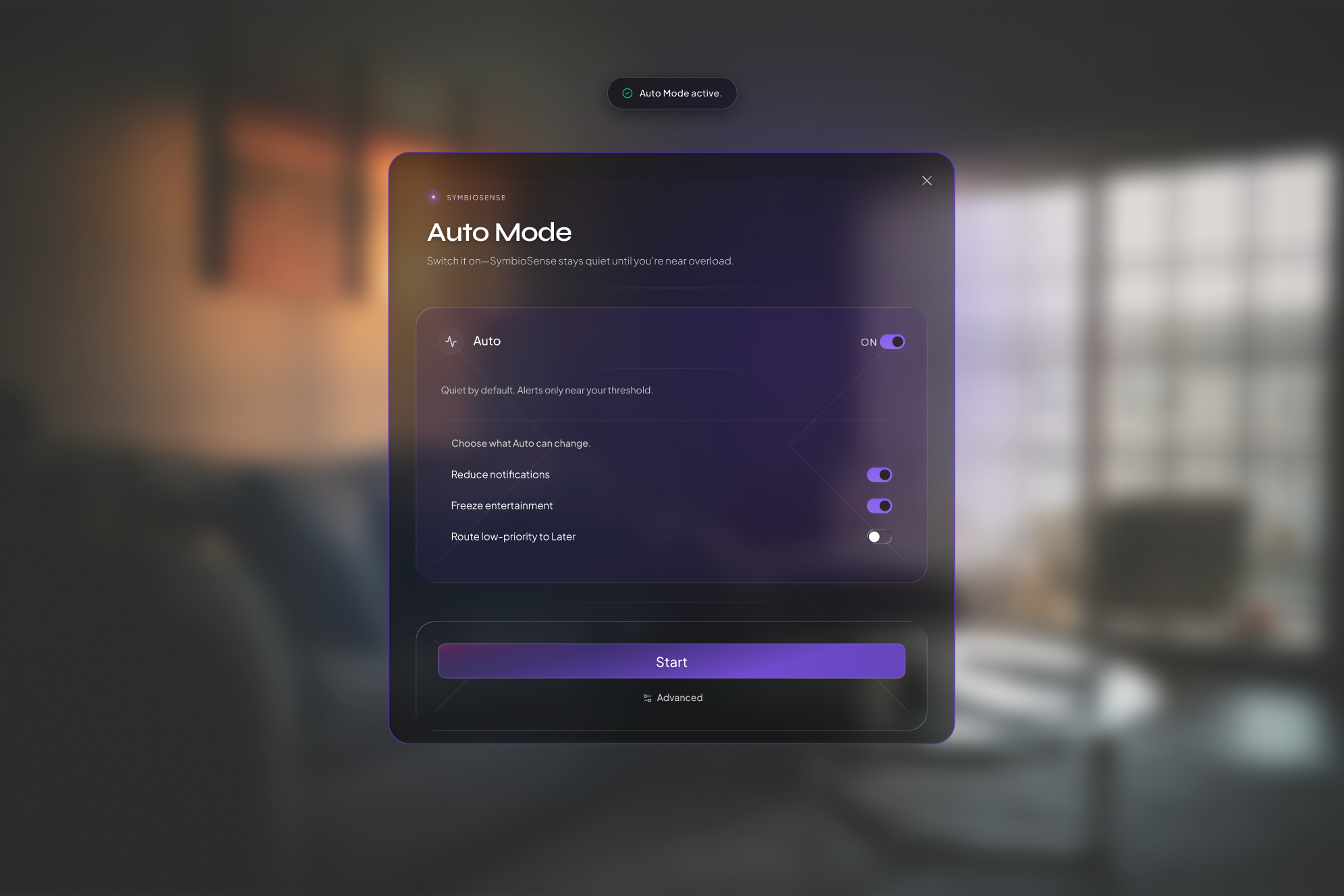
Frame 1 — Auto Mode Setup
Users turn Auto on and choose what it can change (notifications, entertainment, routing to Later).Frame 3 — Threshold Approaching
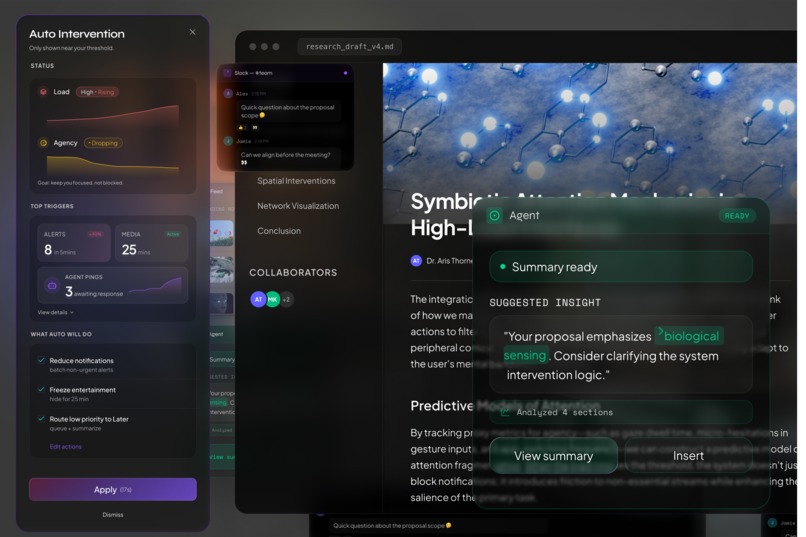
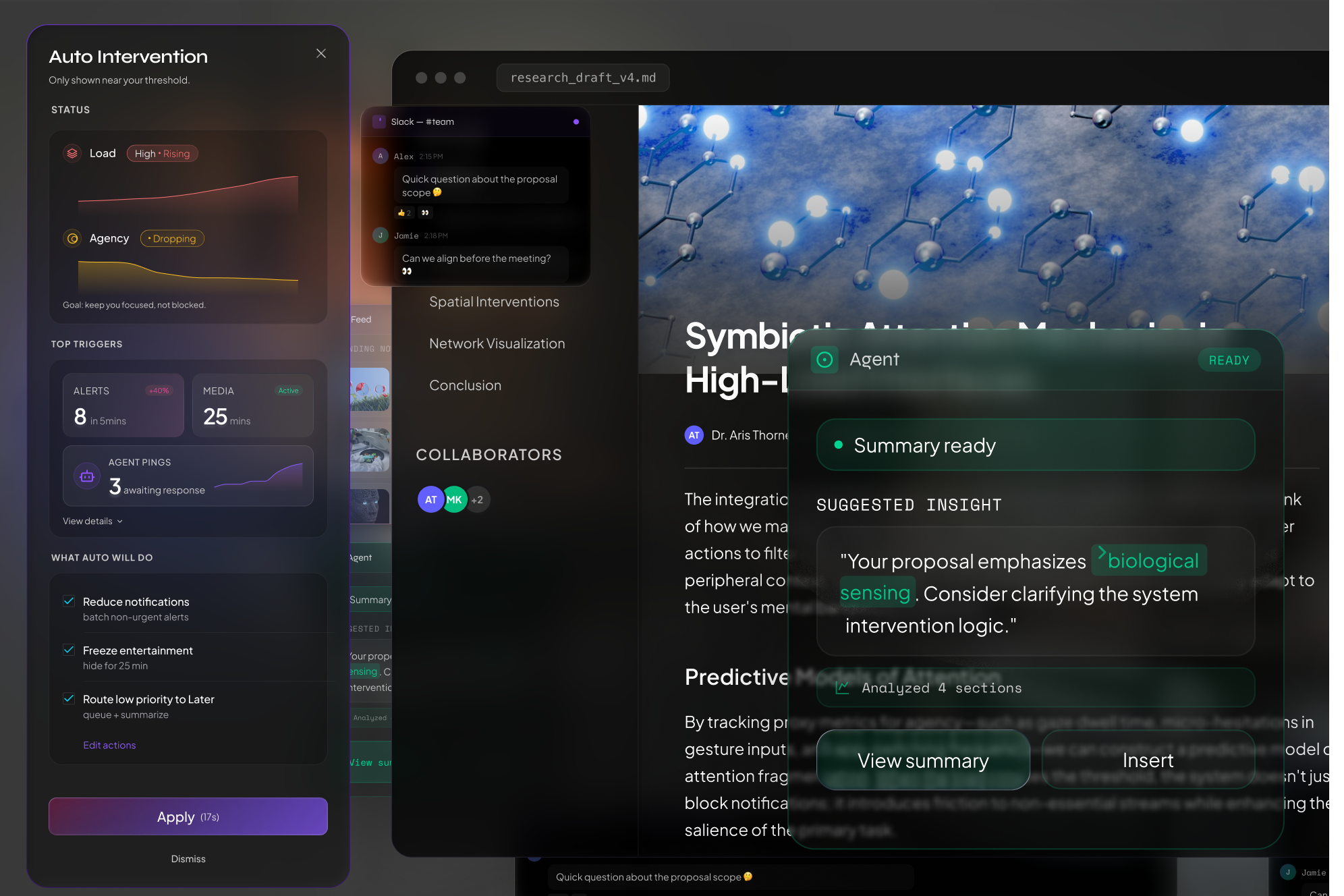
The Bio-Patch shifts into a Rising pattern, while the work UI shows a quiet alert: Load ↑, Agency ↓.Frame 4 — Auto Intervention (Transparency Layer)
A glass drawer explains:- Status: Load high/rising, Agency dropping
- Cause: top triggers (chips with counts/time window)
- Planned actions: reduce notifications, freeze entertainment (25 min), route to Later
Users can edit actions and undo anytime.
- Status: Load high/rising, Agency dropping
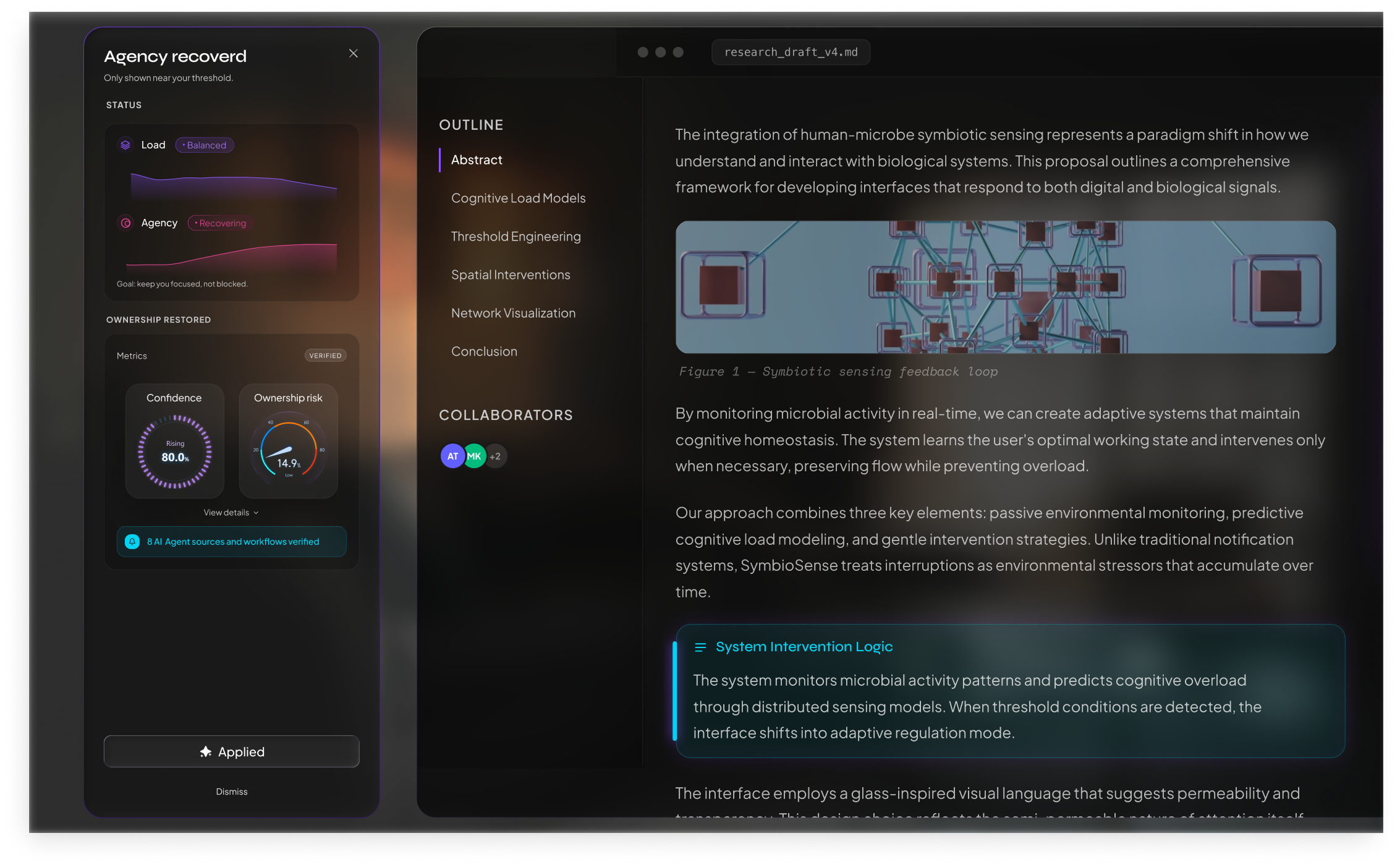
Frame 5 — Focus Restored (After + Outcome)
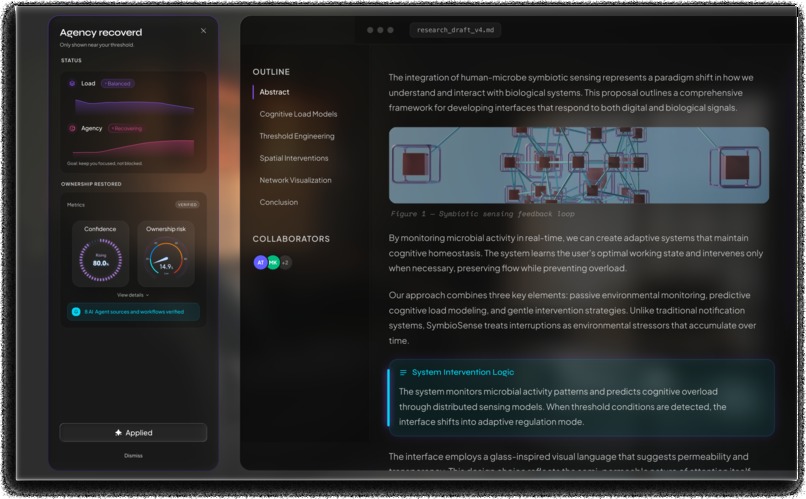
The workspace becomes visibly cleaner, a Later queue appears (not lost information), the wearable shows Recovering, and outcomes appear (e.g., interruptions blocked, focus time regained).
We kept the UI consistent with a Vision Pro / spatial aesthetic: layered frosted glass panels, strong contrast on dark backgrounds, and calm blue–purple ambient lighting.
Challenges we faced
- Avoiding “too sci-fi” while staying novel. We made the Bio-Patch expressive but restrained, and relied on the console to keep the system interpretable.
- Designing automation without removing autonomy. We avoided “blocked” language and used reversible phrasing like Paused · Resume.
- Making trust feel earned, not asserted. Cause chips with time windows (e.g., “8 in 5 min”) made the intervention feel grounded rather than arbitrary.
- Keeping the story tight in 3 days. We scoped to one strong loop and treated every screen as proof of the same promise: quiet by default, clear when it matters.
A simple model behind the concept (optional)
We treated cognitive balance as a two-signal state (not a diagnosis):
$$ S(t) = w_1 \cdot Load(t) - w_2 \cdot Agency(t) $$
Auto Mode only intervenes when $S(t)$ approaches a user’s threshold, and it stays quiet otherwise.
What’s next
If we expanded the project, we’d explore:
- richer Bio-Patch states (stable / rising / overload / recovering),
- user-calibrated thresholds,
- and stronger safeguards for privacy and consent in “work stack” sensing.
SymbioSense is our attempt to design a future-forward tool that doesn’t just quantify productivity—it protects mental steadiness and human agency in a world where AI is always present.
Built With
- class-variance-authority
- css
- html
- ionicons
- javascript
- motion
- netlify
- node.js
- react
- tailwind
- typescript
- vite


Log in or sign up for Devpost to join the conversation.