Inspiration
As a student, I often struggled to access course syllabi easily and found myself wishing for a central platform to preview, compare, and download them. This frustration led me to create Syllabus Seeker - a community-driven platform designed to empower students with the tools to make informed academic decisions.
The idea came to me after noticing the biases in websites like Rate My Professor. While those platforms offer some insight, I realized that they often lack comprehensive, unbiased information about how professors approach their courses. I believe having access to detailed syllabi is critical, as professors often cover different material and have unique teaching styles. A syllabus gives you a real sense of the expectations, workload, and environment of a class, which is crucial for ensuring you’re in a space where you can succeed.
I wanted to create a tool that offers students as much information as possible to make such important decisions - whether it's understanding course content, evaluating teaching styles, or comparing professors. With Syllabus Seeker, I aim to foster academic transparency and give everyone the opportunity to thrive in the right learning environment.
What it does
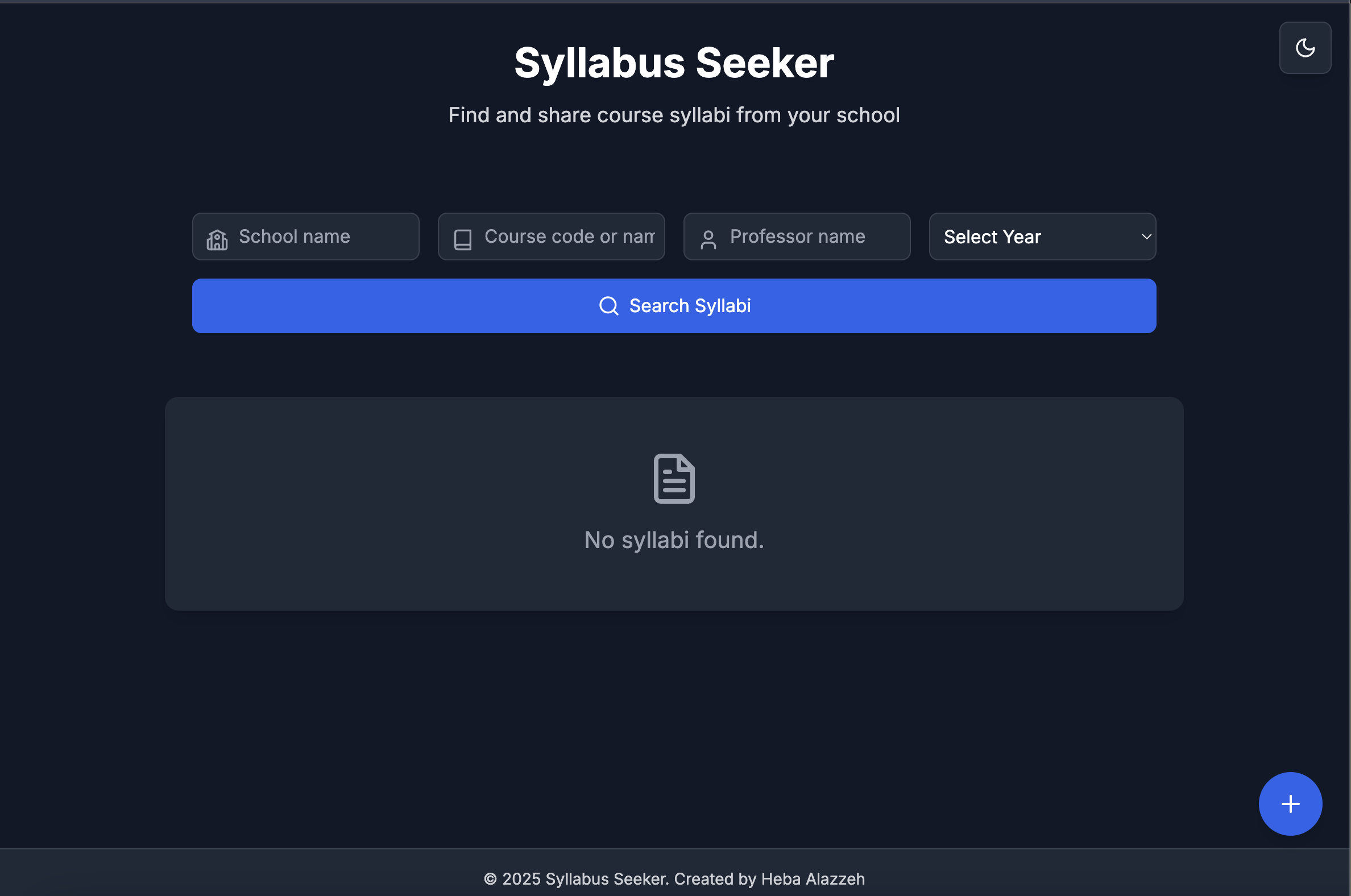
Syllabus Seeker is a powerful and intuitive web app that revolutionizes how students access course syllabi. It allows users to:
🔍 Search
- Find syllabi by school, course name, or professor with ease.
- Filter results by year to pinpoint relevant documents.
- Utilize fuzzy search for smarter query matching, even with incomplete or misspelled terms.
📂 Syllabus Management
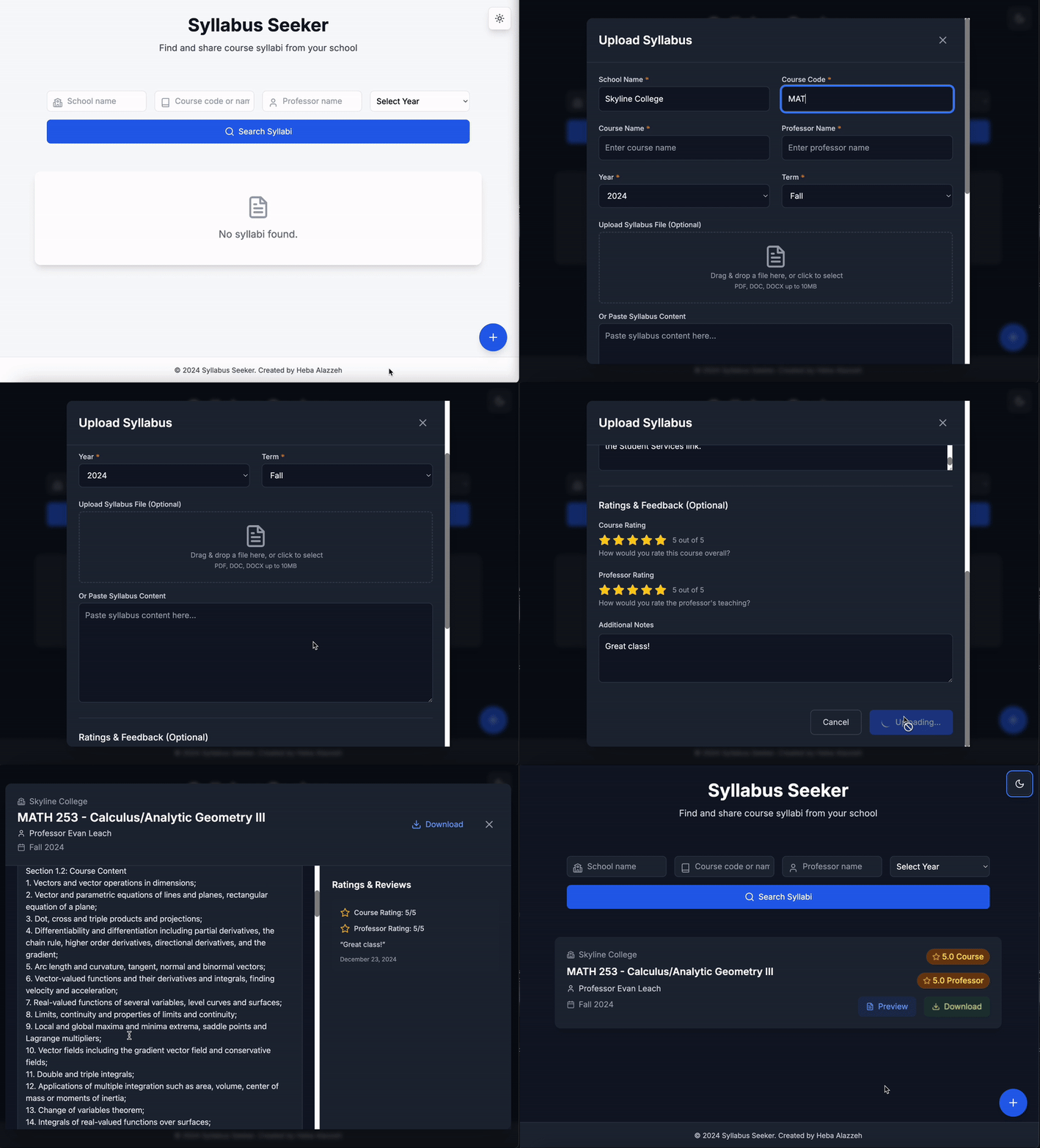
- Upload syllabi in various formats, including PDF, DOC, and DOCX, or as text-based submissions.
- Preview syllabi directly on the platform with a sleek, responsive design.
- Download syllabi quickly for offline access.
🌟 User Experience
- Navigate through a clean, modern interface designed for simplicity and efficiency.
- Toggle between dark and light modes for comfortable browsing.
- Enjoy a fully responsive layout optimized for desktops, tablets, and smartphones.
📈 How It Works
Syllabus Seeker operates as a dynamic, community-driven database that grows with contributions from students and professors. By fostering collaboration, it ensures a continually expanding resource for academic success.
How I built it
I built Syllabus Seeker using Next.js for its powerful React-based frontend capabilities, paired with TypeScript for enhanced type safety. TailwindCSS was used for styling to ensure a clean, responsive user interface. For file uploads, I integrated React Dropzone, allowing users to upload syllabi in various formats. The backend is powered by Prisma ORM and PostgreSQL, hosted on Neon for efficient database management. The app was deployed on Vercel for seamless performance and scalability. Additionally, I implemented fuzzy search functionality to improve query matching and created a dark/light mode toggle for better accessibility.
Challenges I ran into
Developing Syllabus Seeker came with several challenges:
- Designing an intuitive and scalable search feature that accommodates varying formats and data inconsistencies.
- Creating a user-friendly upload system while maintaining file compatibility and security.
- Balancing design simplicity with functionality to ensure a responsive and visually appealing interface.
- Managing database structures to handle diverse data inputs efficiently.
These challenges pushed me to think critically and find innovative solutions, ensuring the platform remained user-centric.
Accomplishments that I am proud of
- Successfully launching a platform that addresses a real problem faced by students.
- Implementing fuzzy search for more intuitive and accurate query matching.
- Designing a sleek, responsive interface that works seamlessly across all devices.
- Receiving positive feedback from peers and potential users about the app’s usability and design.
- Building a fully functional, community-driven platform from scratch within a limited timeframe.
What I learned
Through this project, I deepened my understanding of:
- Frontend and Backend Integration: Effectively combining React-based frontend with a robust backend system.
- Database Management: Structuring and optimizing a database for scalability.
- User Experience Design: Prioritizing accessibility and simplicity to create an enjoyable user experience.
- Problem Solving: Tackling real-world challenges like fuzzy search implementation and diverse file handling.
This experience reinforced the importance of balancing functionality and design to create impactful applications.
What's next for Syllabus Seeker
I plan to enhance Syllabus Seeker with:
- Advanced Search Filters: Search by department, term, or course level.
- User Authentication: Allow users to create profiles and save their searches.
- Community Interaction: Add features like comments, discussions, and professor/course ratings.
- Bulk Uploads: Enable users to contribute multiple syllabi at once.
- Analytics Dashboard: Track usage statistics and gather insights for continuous improvement.
- Mobile App: Develop a dedicated mobile app for on-the-go access.
By expanding its features, I aim to make Syllabus Seeker an indispensable tool for students worldwide.
Built With
- api
- lucide
- lucide-icons-**backend**:-prisma-orm
- neon
- neon-for-database-hosting-**tools**:-fuzzy-search-logic
- next.js
- next.js-api-routes-**infrastructure**:-vercel-for-deployment
- postgresql-(via-neon)
- prisma-orm
- react-dropzone
- vercel-deployment


Log in or sign up for Devpost to join the conversation.