-
-
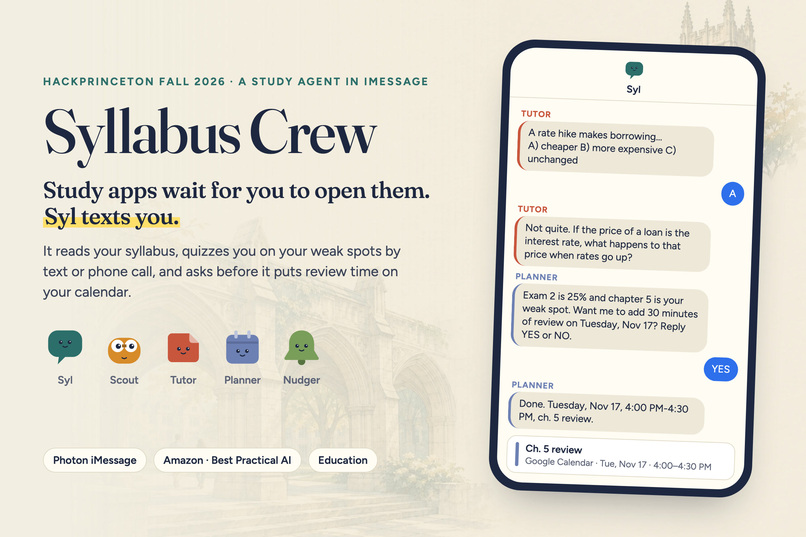
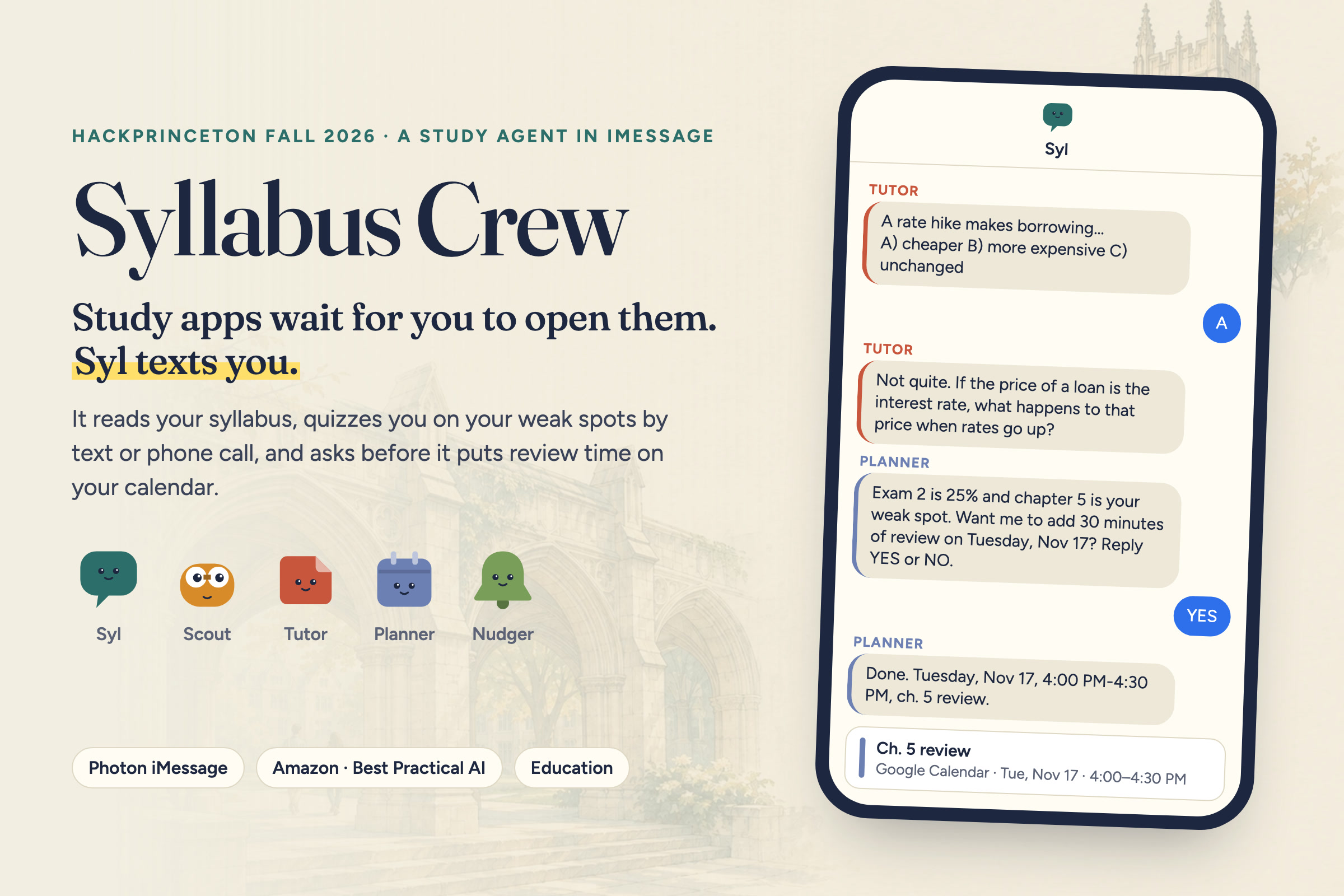
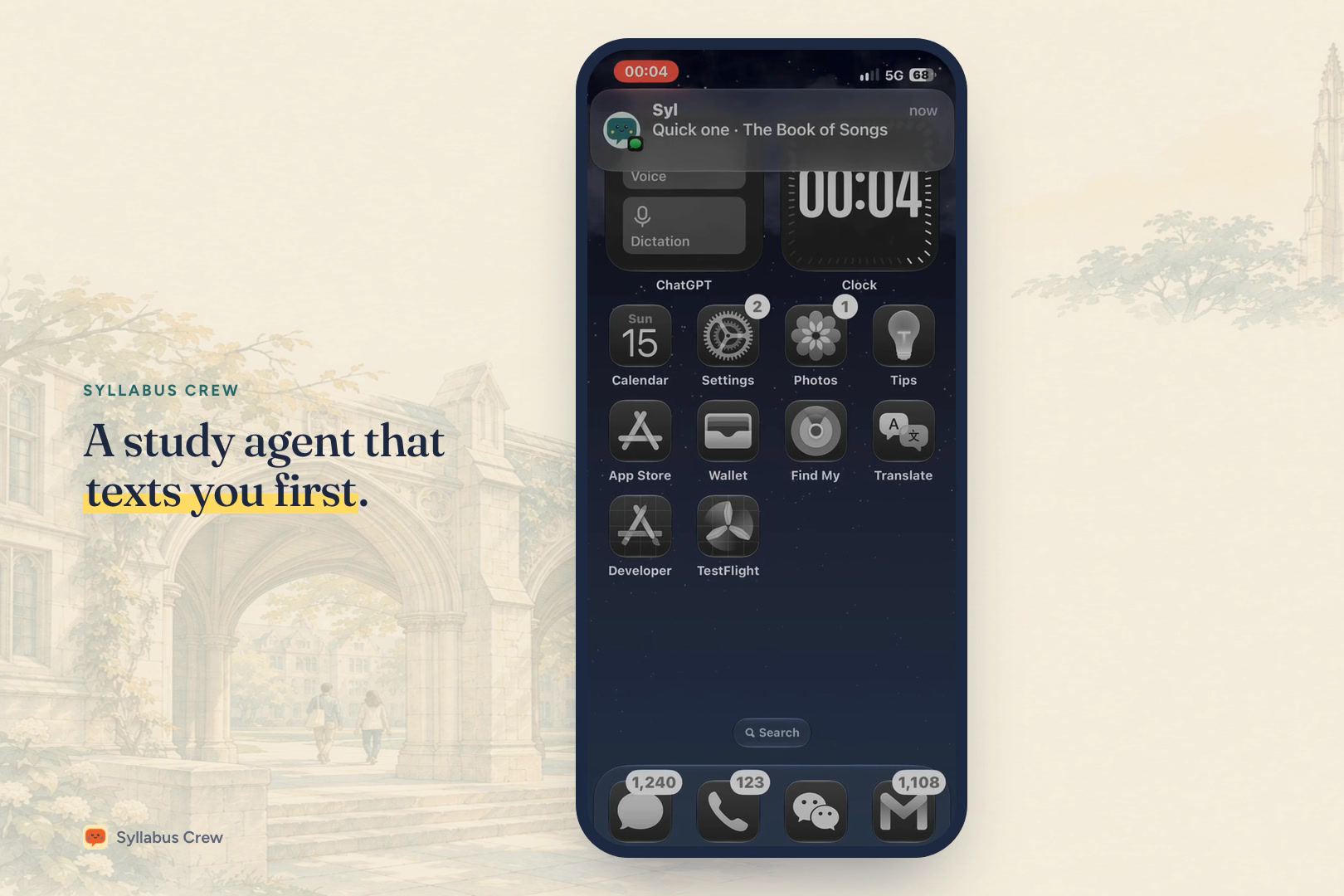
Syllabus Crew: a study agent that lives in iMessage. Study apps wait for you to open them. Syl texts you.
-
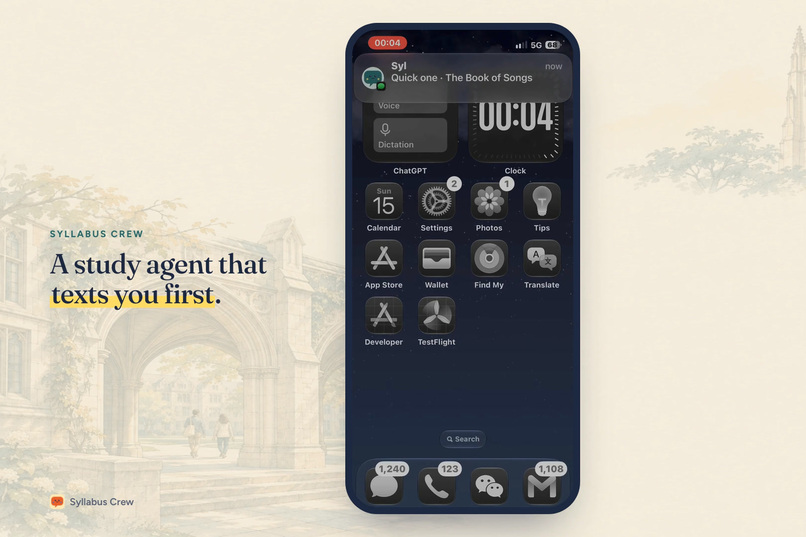
It texts first, inside rules: a quiz lands as a notification. No app to open.
-
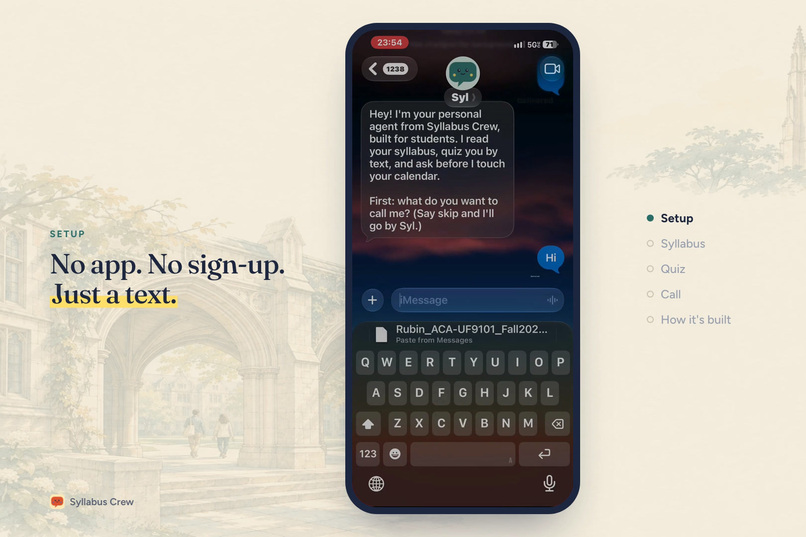
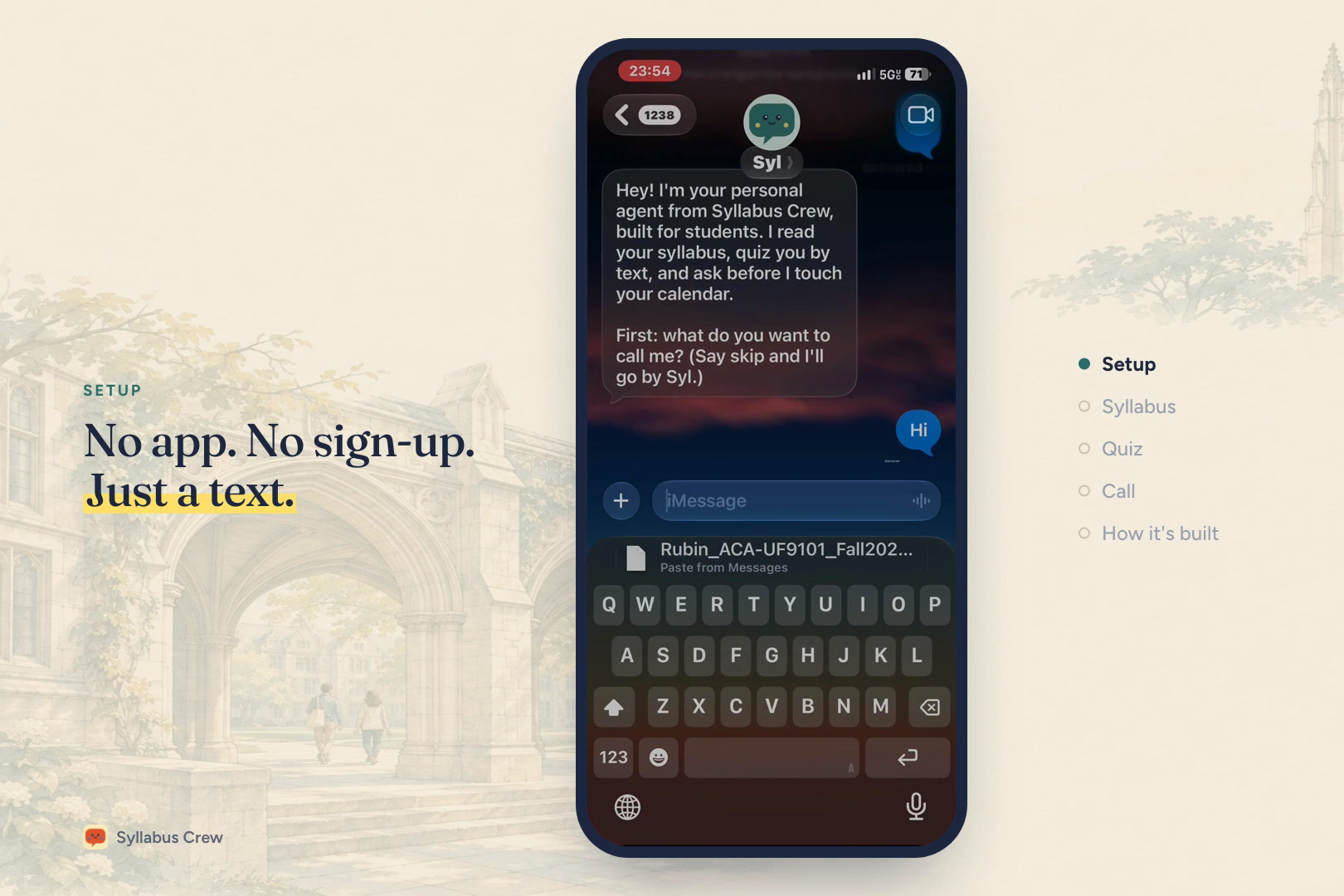
No app, no sign-up. Text the line and Syl introduces itself, then asks what you want to call it.
-
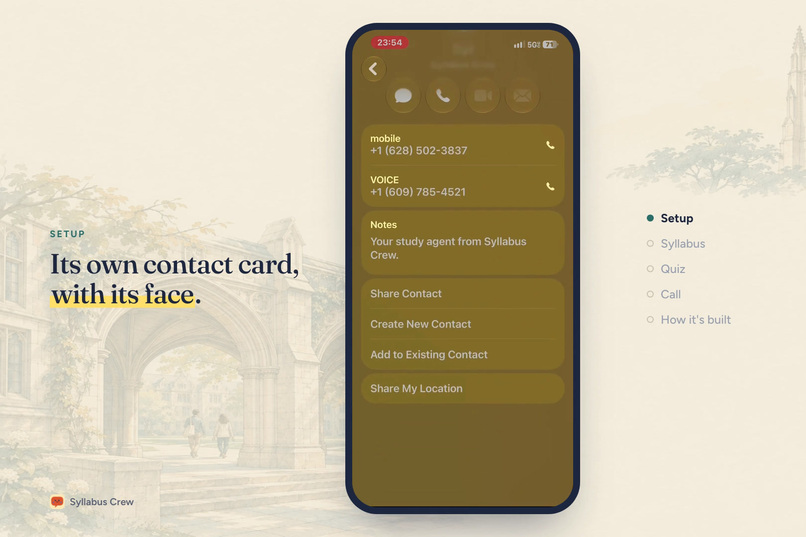
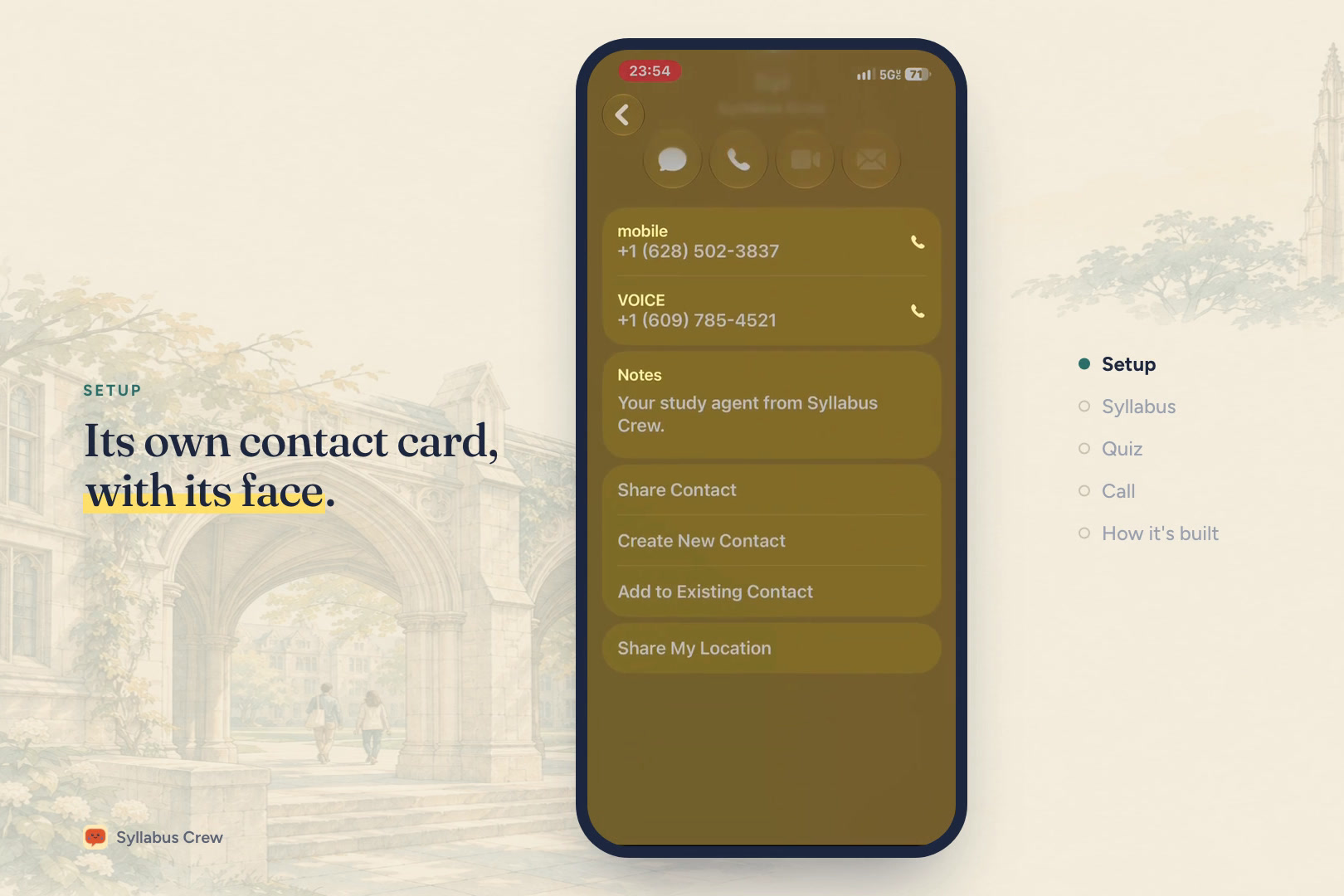
Syl sends its own contact card, so its texts show up with a name and a face.
-
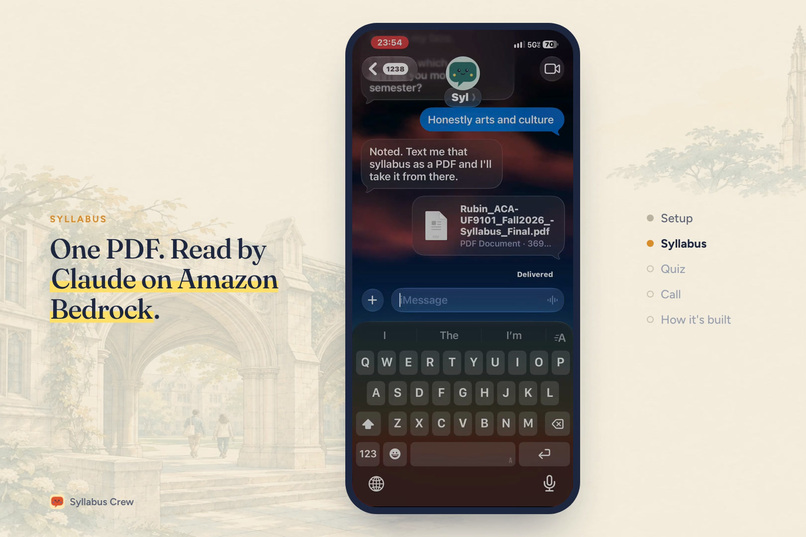
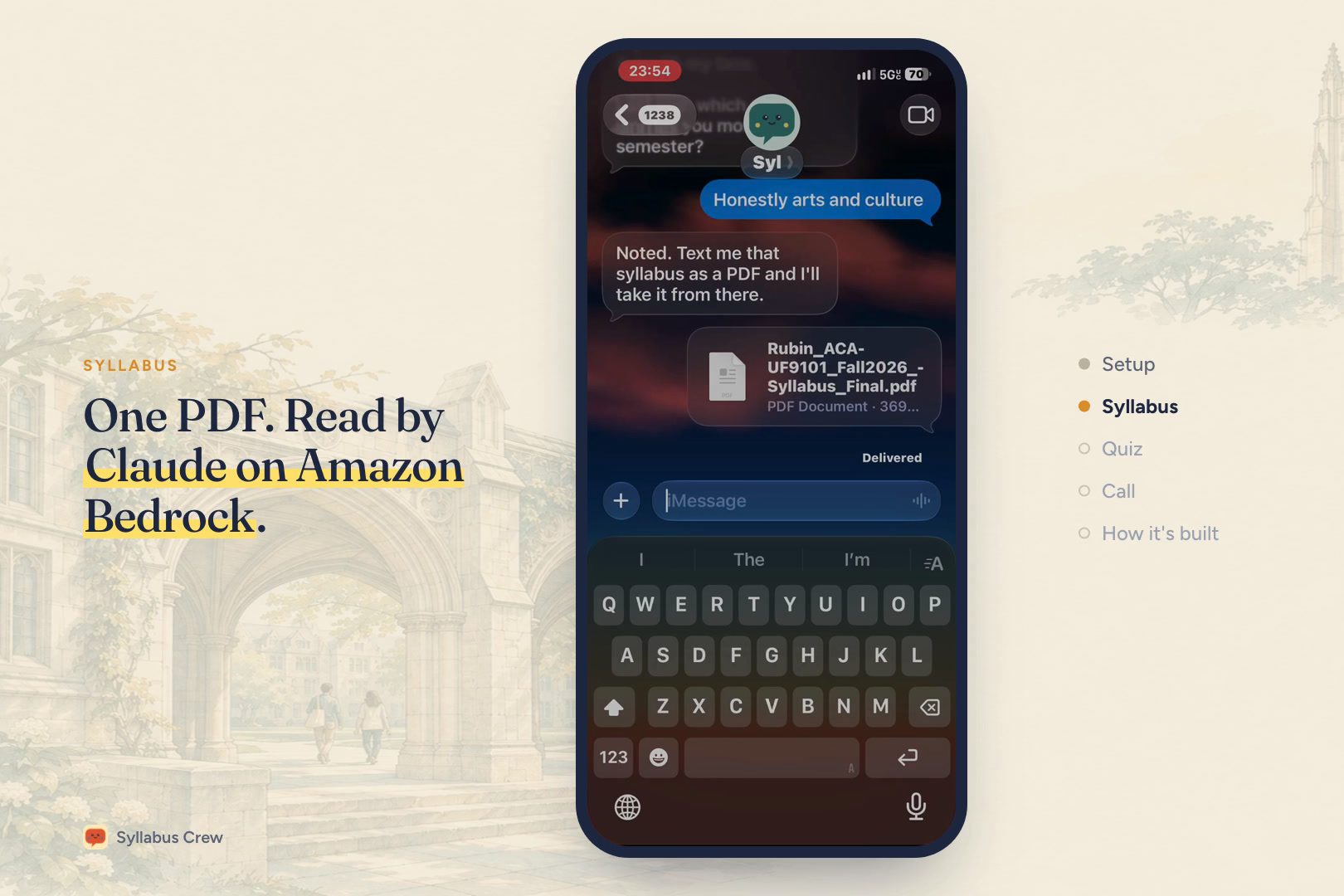
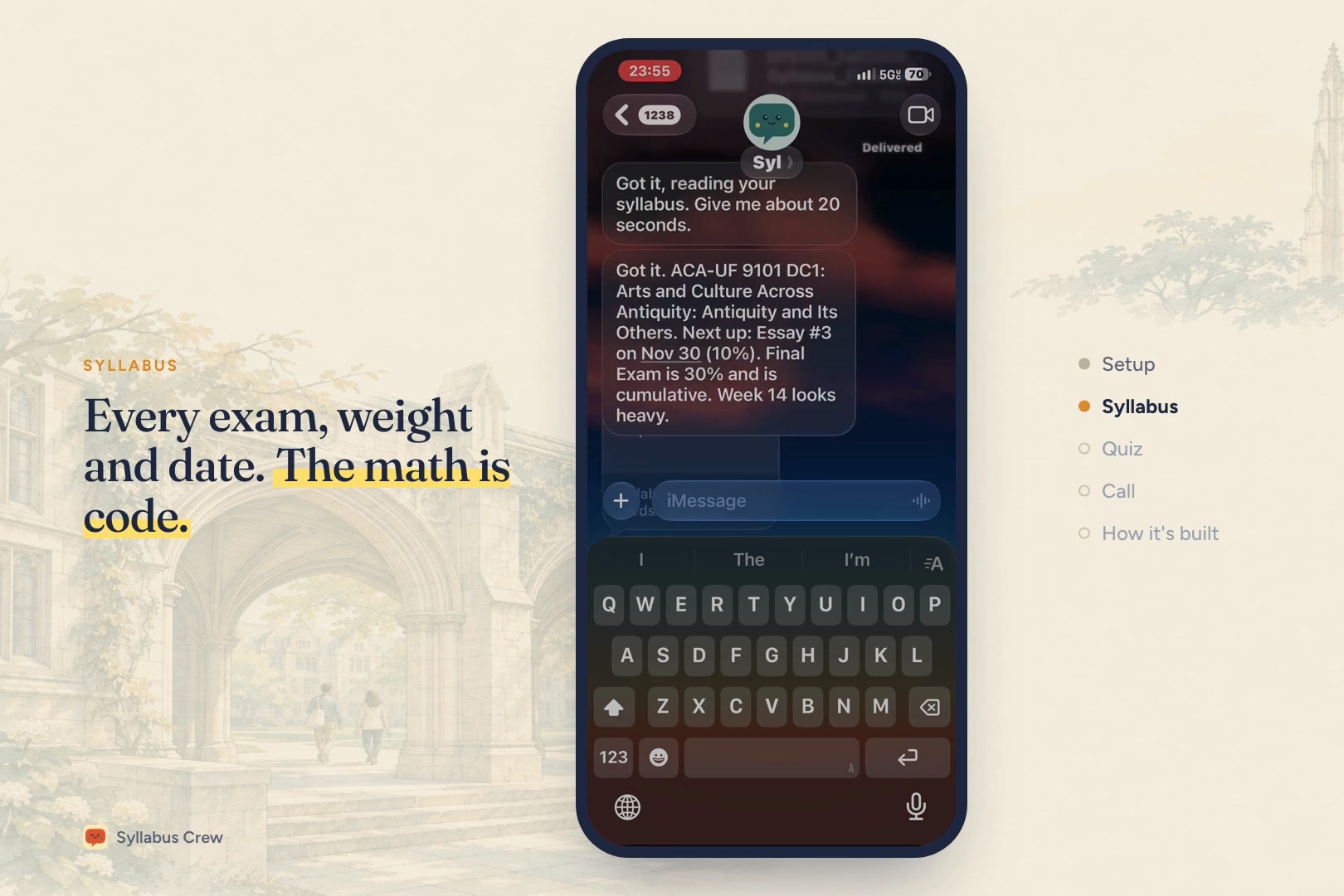
Send your syllabus as a PDF. Claude Sonnet 4.6 on Amazon Bedrock reads it in seconds.
-
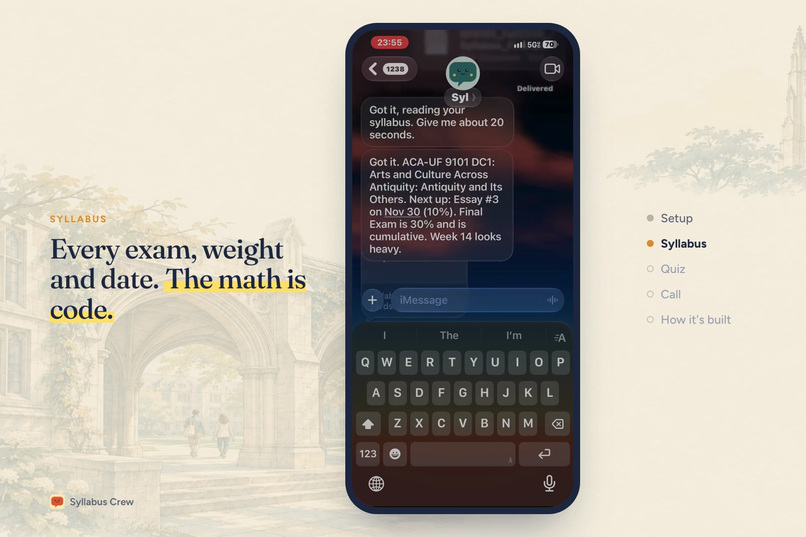
Every exam, weight and date. The model reads the syllabus; code checks it and does the math.
-
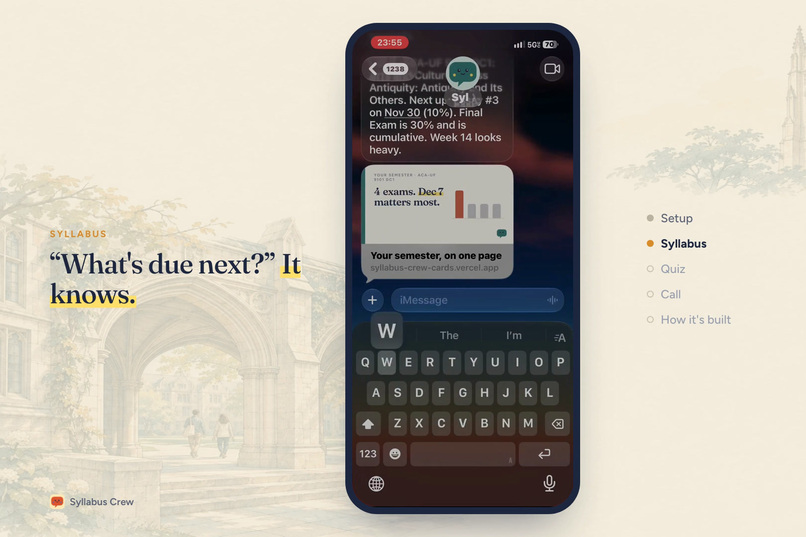
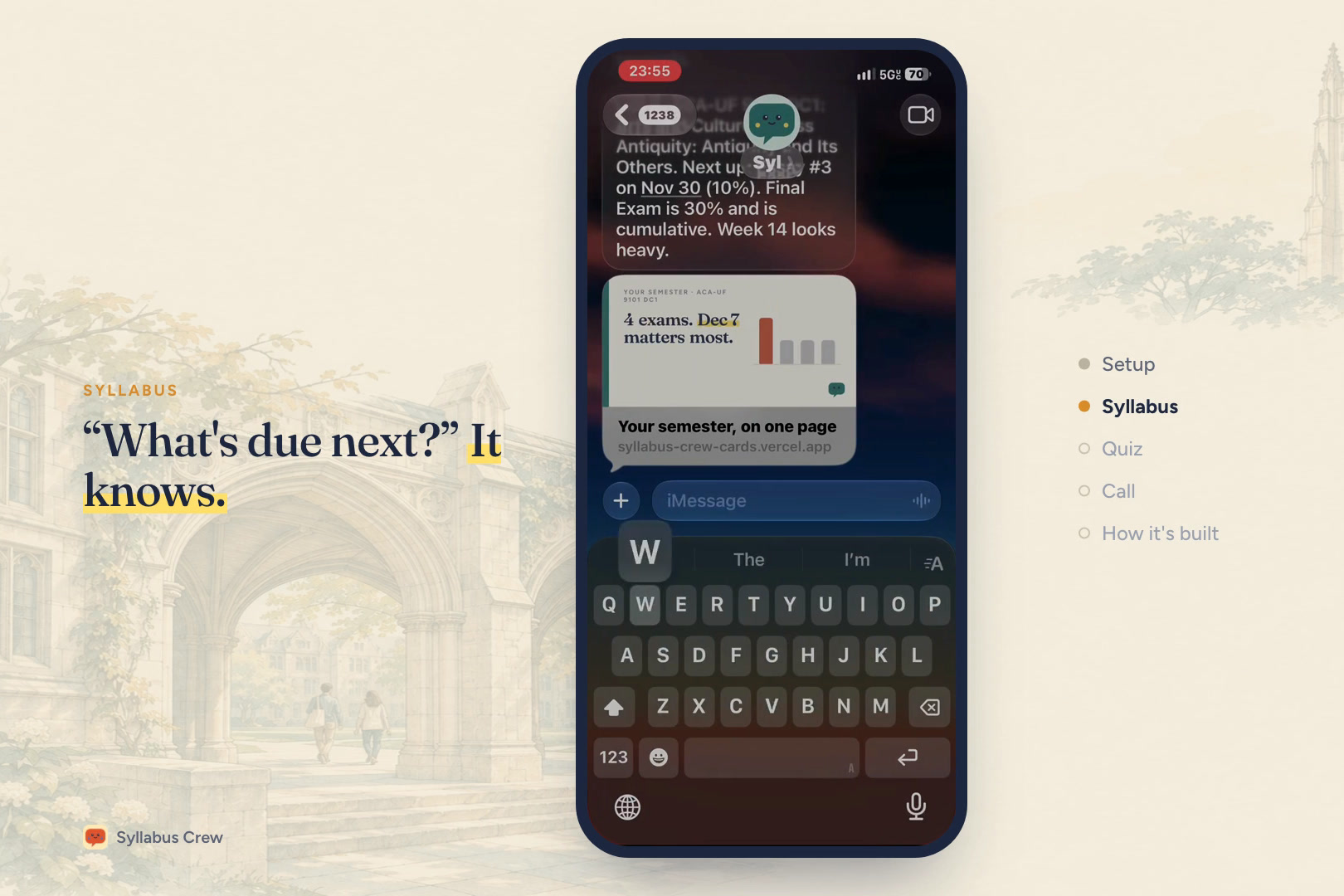
"What's due next?" Answered from your syllabus, with a tap-to-open card of your whole semester.
-
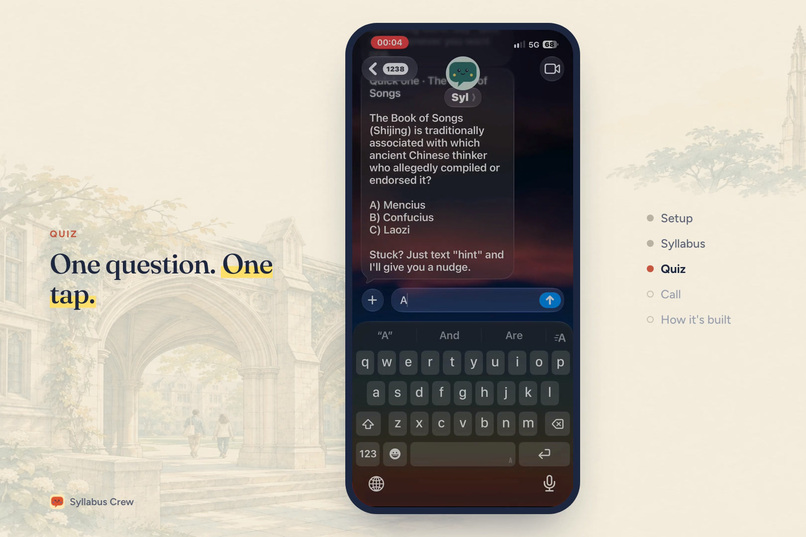
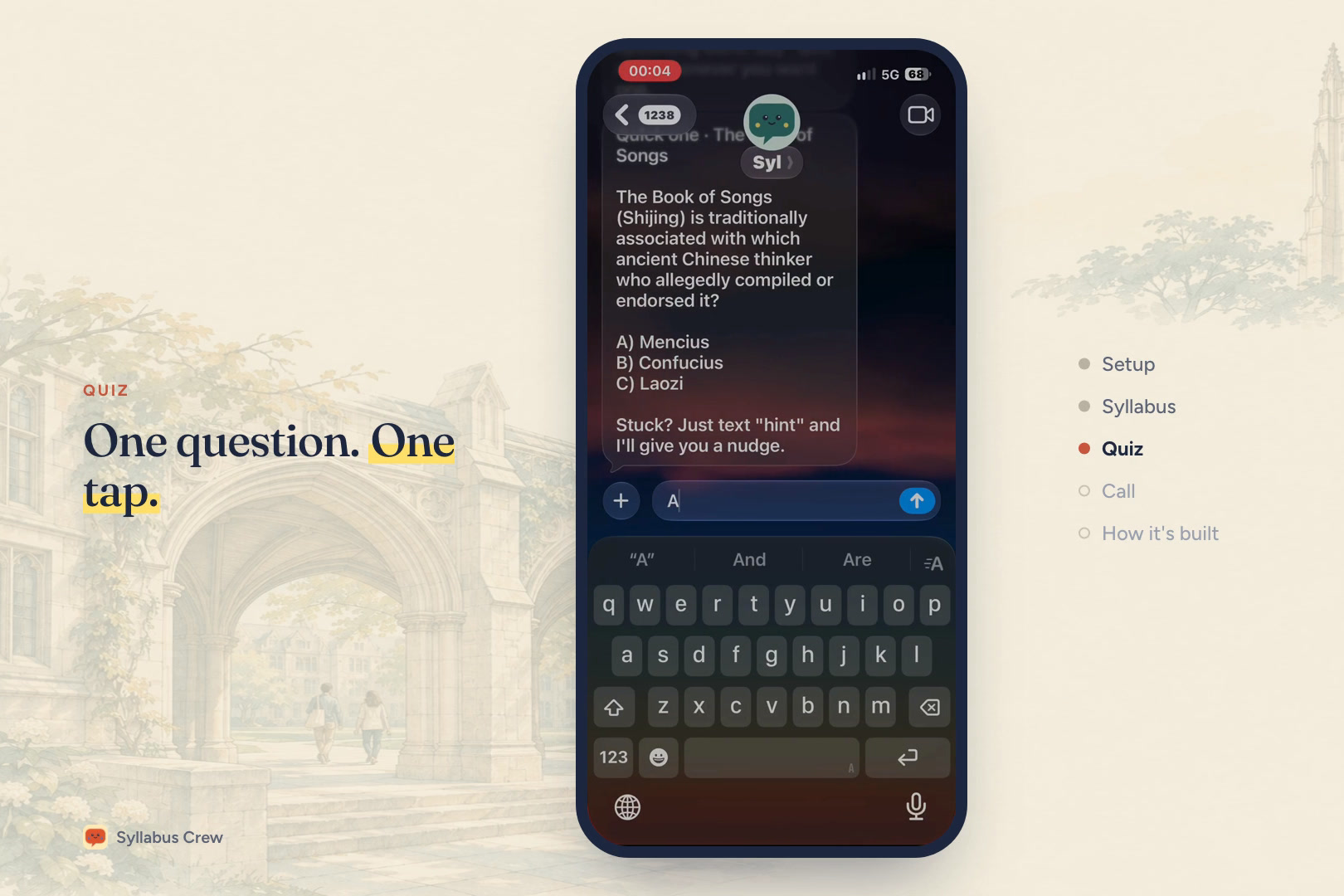
One question, one tap: A, B or C, graded in code against the stored answer.
-
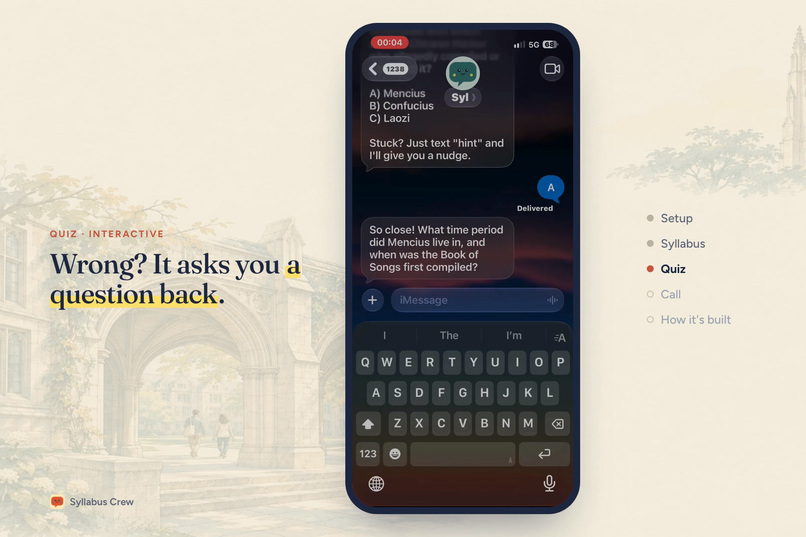
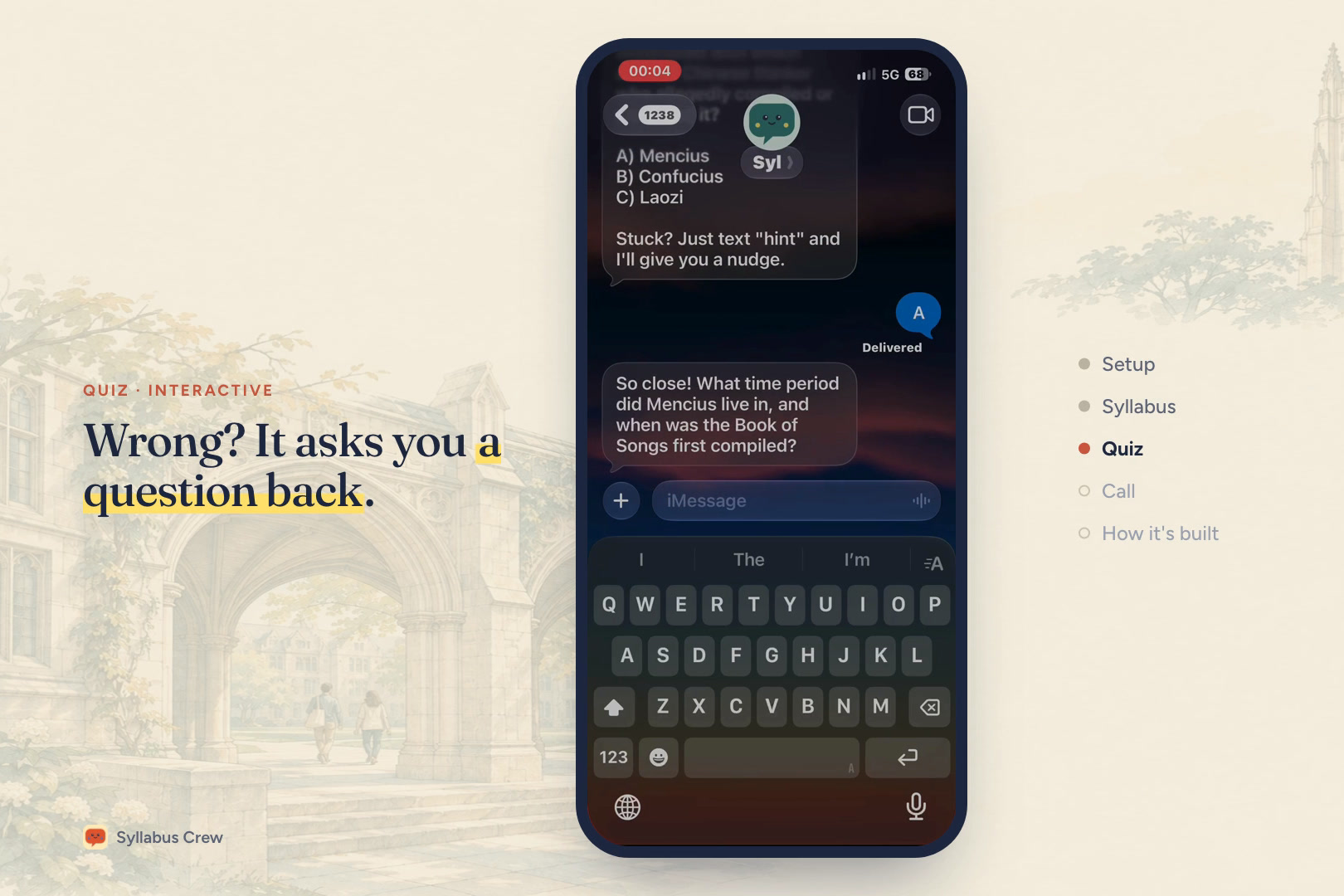
Miss it and you get a question back, not the answer, like a good TA.
-
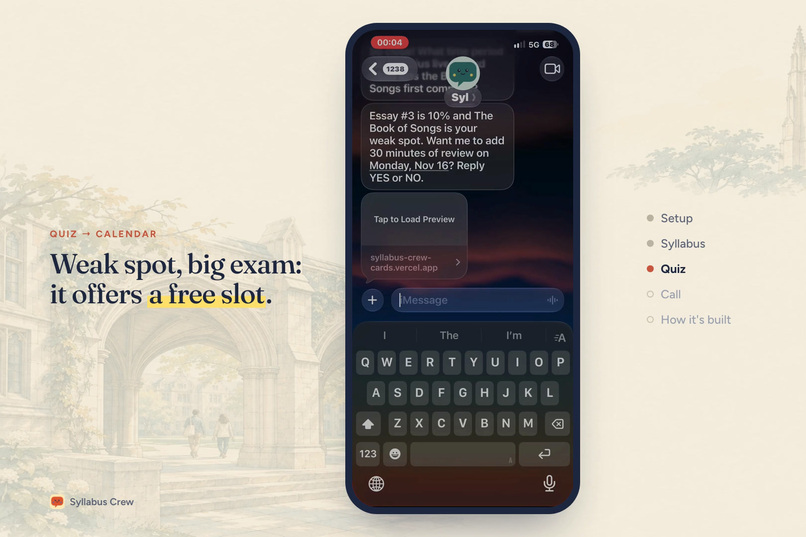
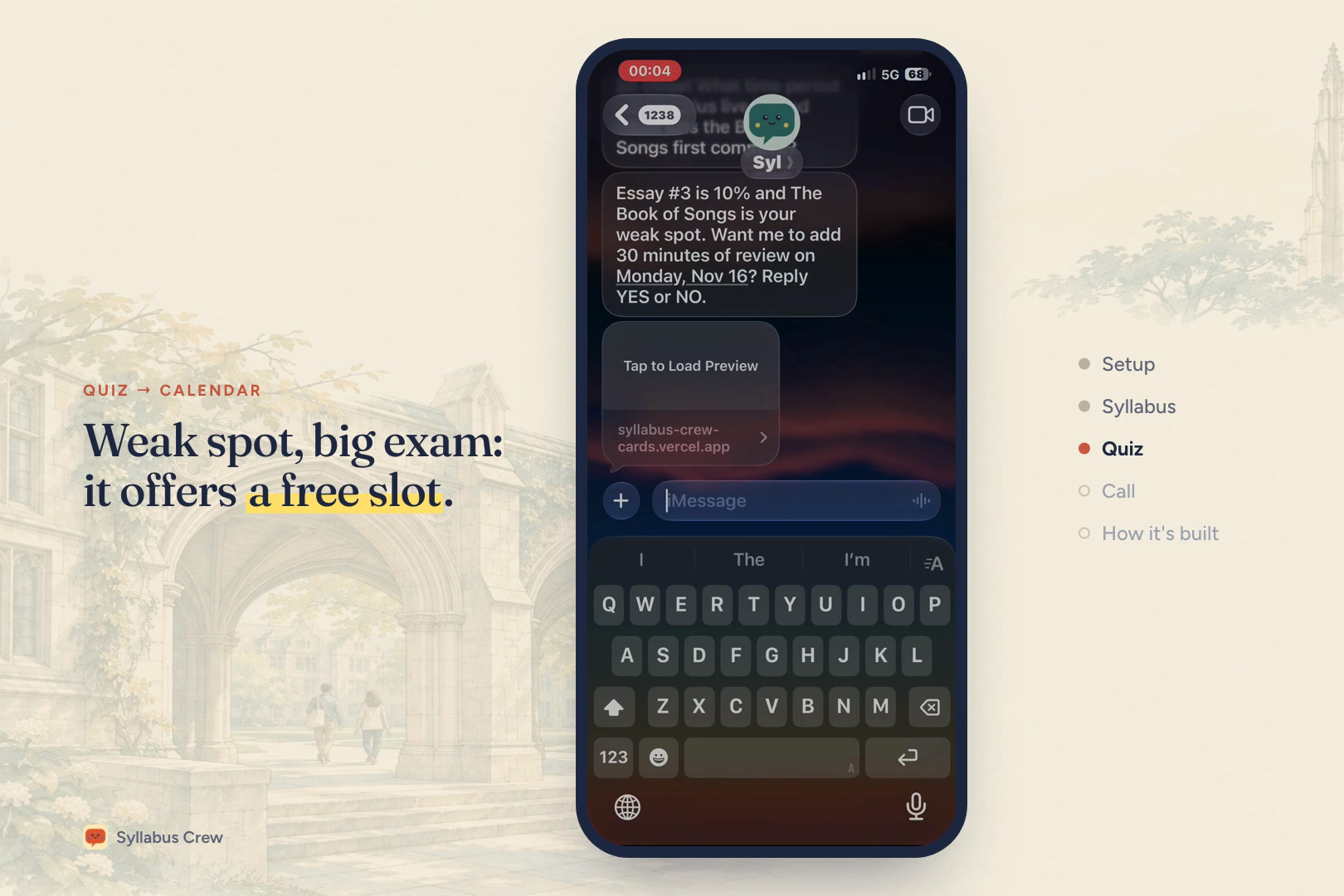
Weak spot, big exam: the Planner offers 30 minutes of review in a free slot. Reply YES or NO.
-
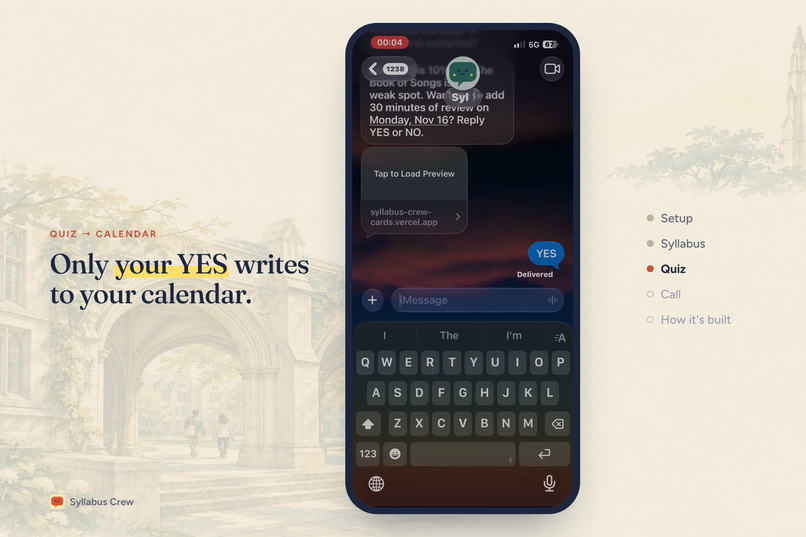
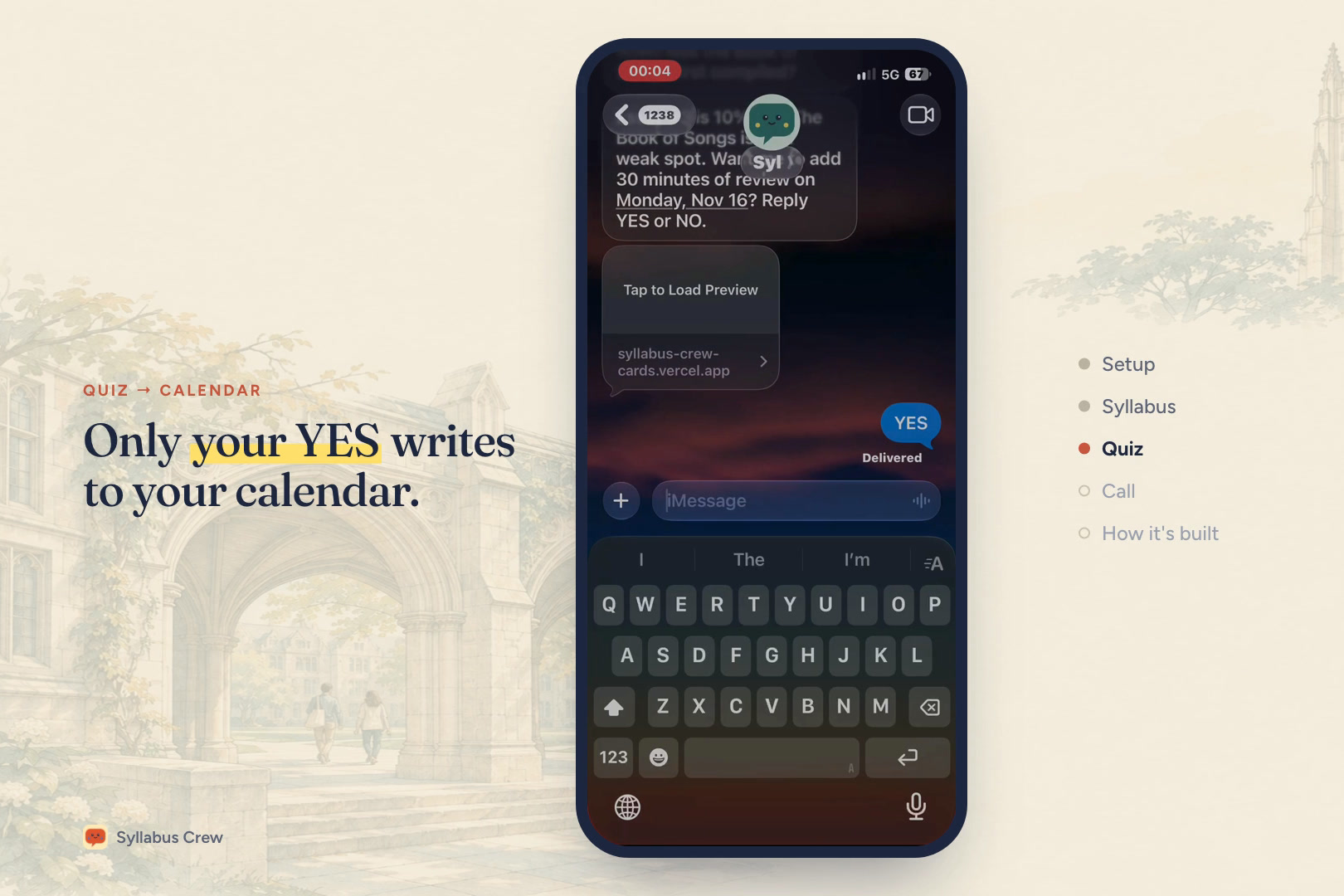
Only your YES writes to your calendar. One path in the code can write, and it runs after YES.
-
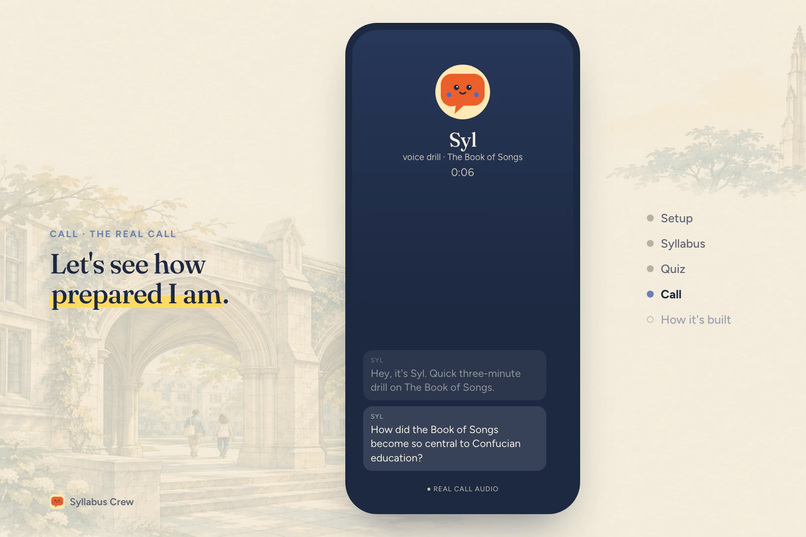
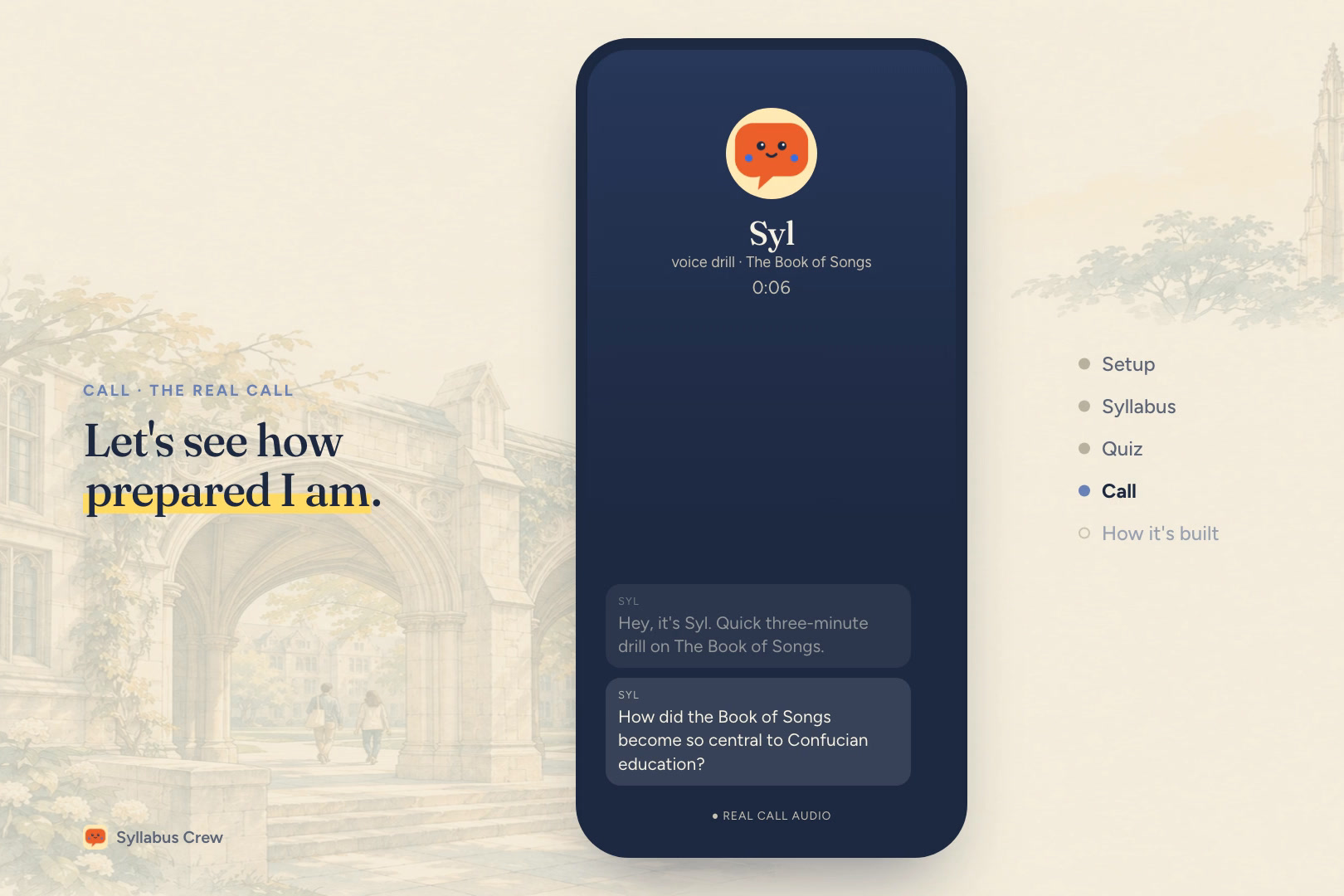
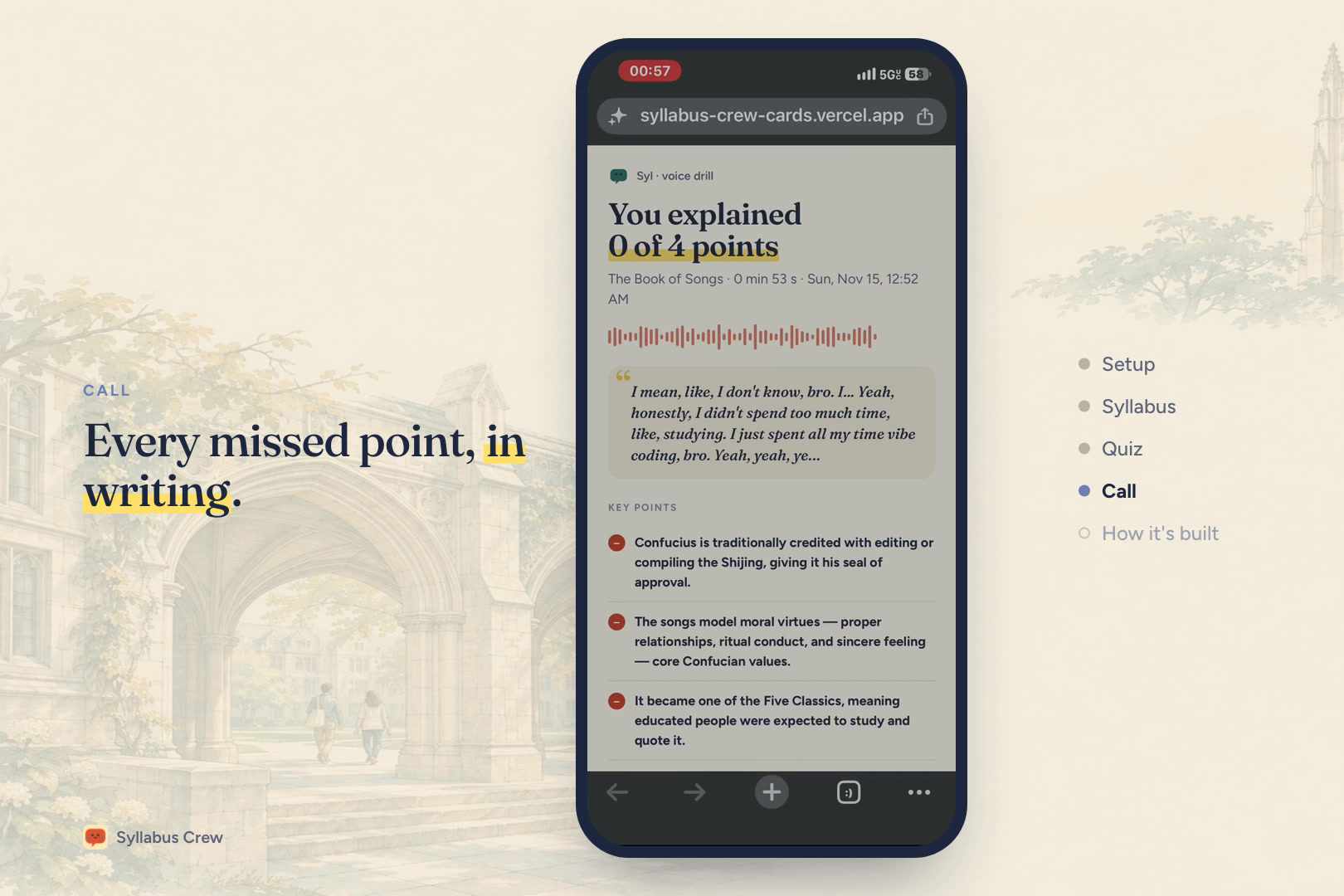
Reply CALL and your phone rings: a 3-minute voice drill where you explain it out loud (ElevenLabs on a Photon number).
-
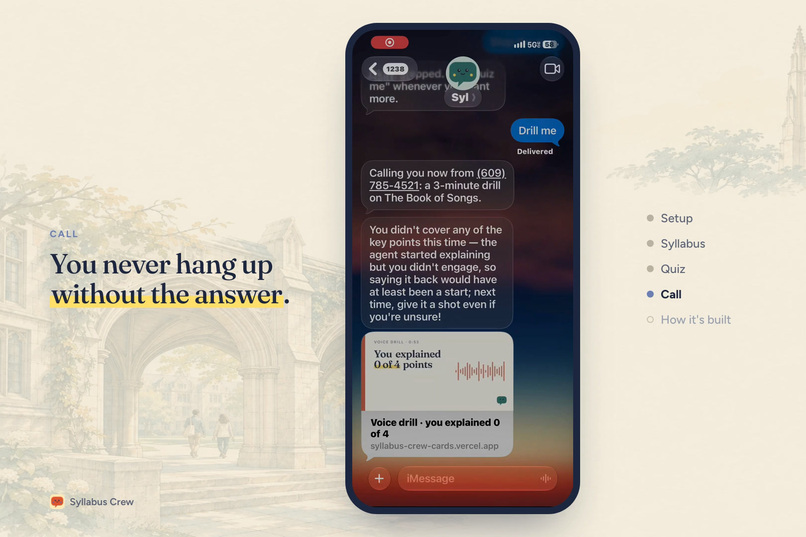
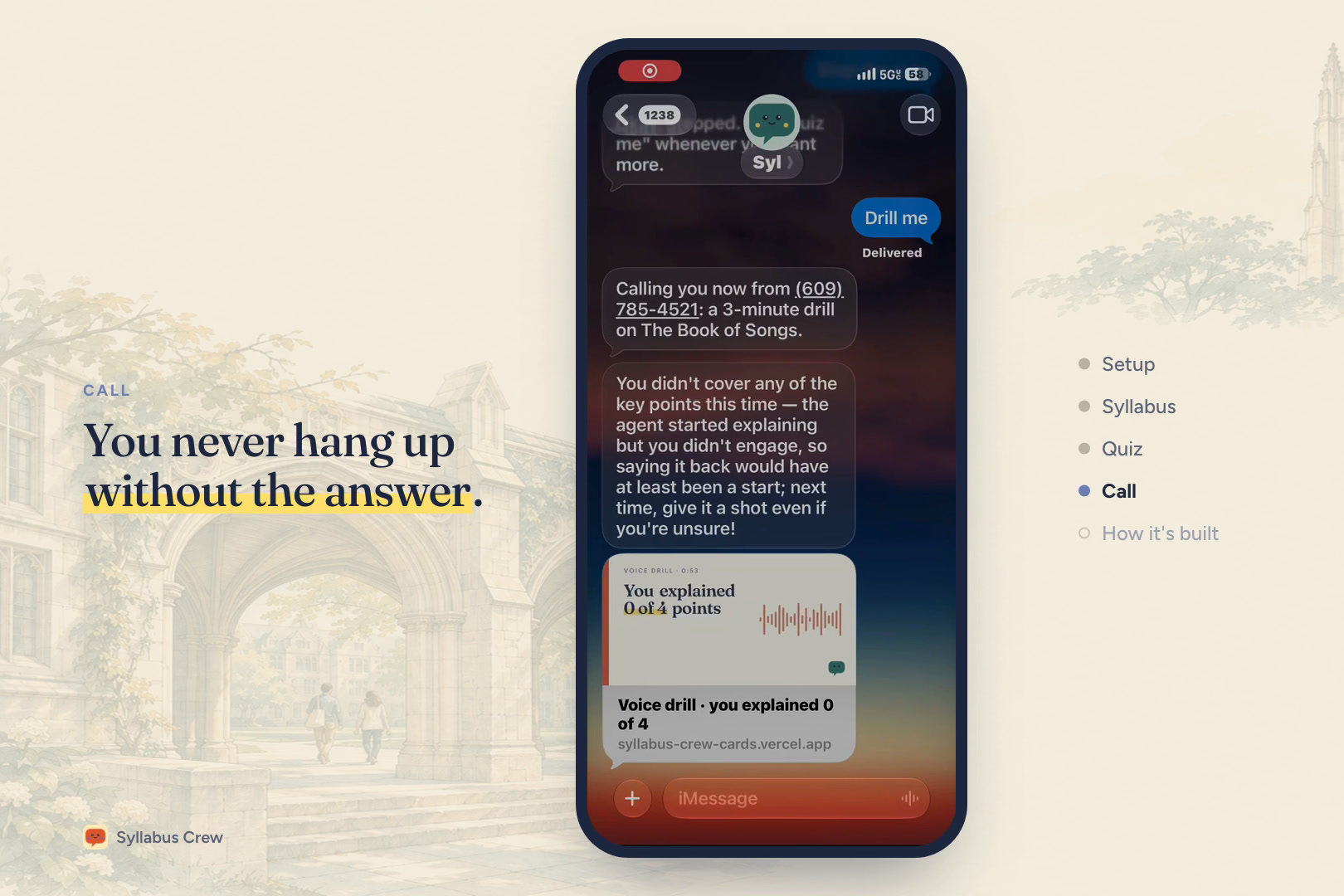
You never hang up without the answer. The recap text spells out what you missed.
-
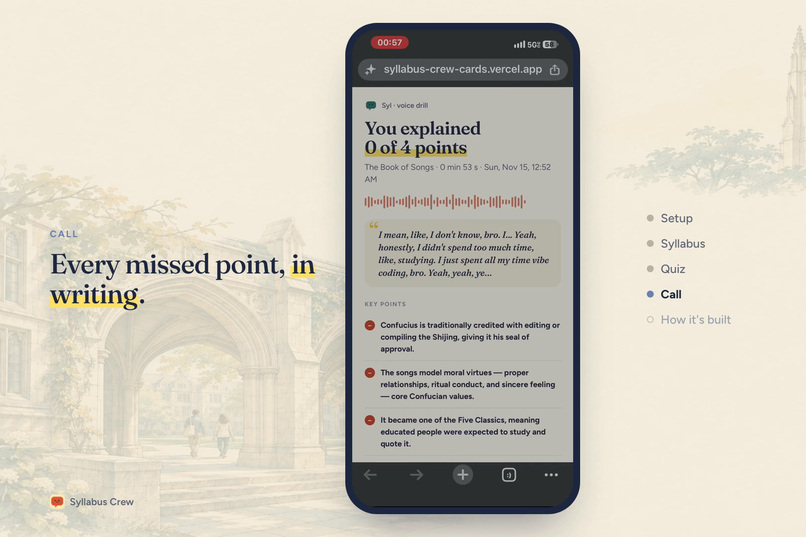
Every missed point, in writing: the drill recap is graded on key points, and mastery moves by a formula in code.
-
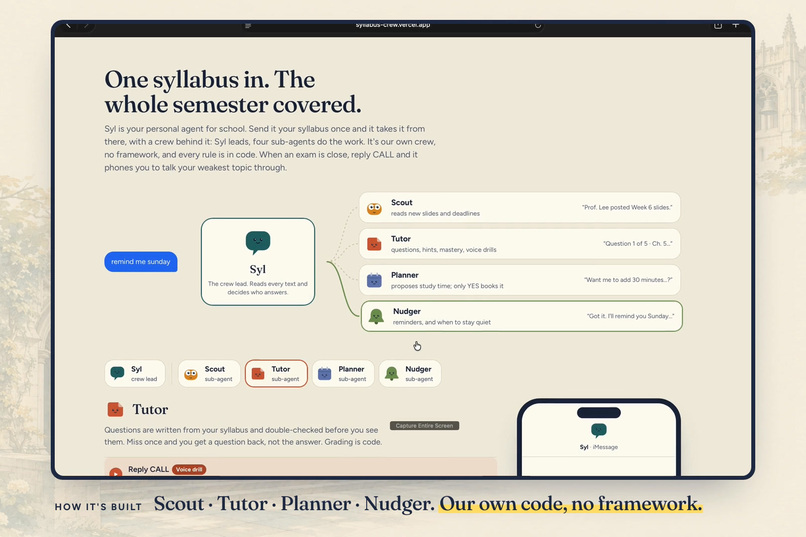
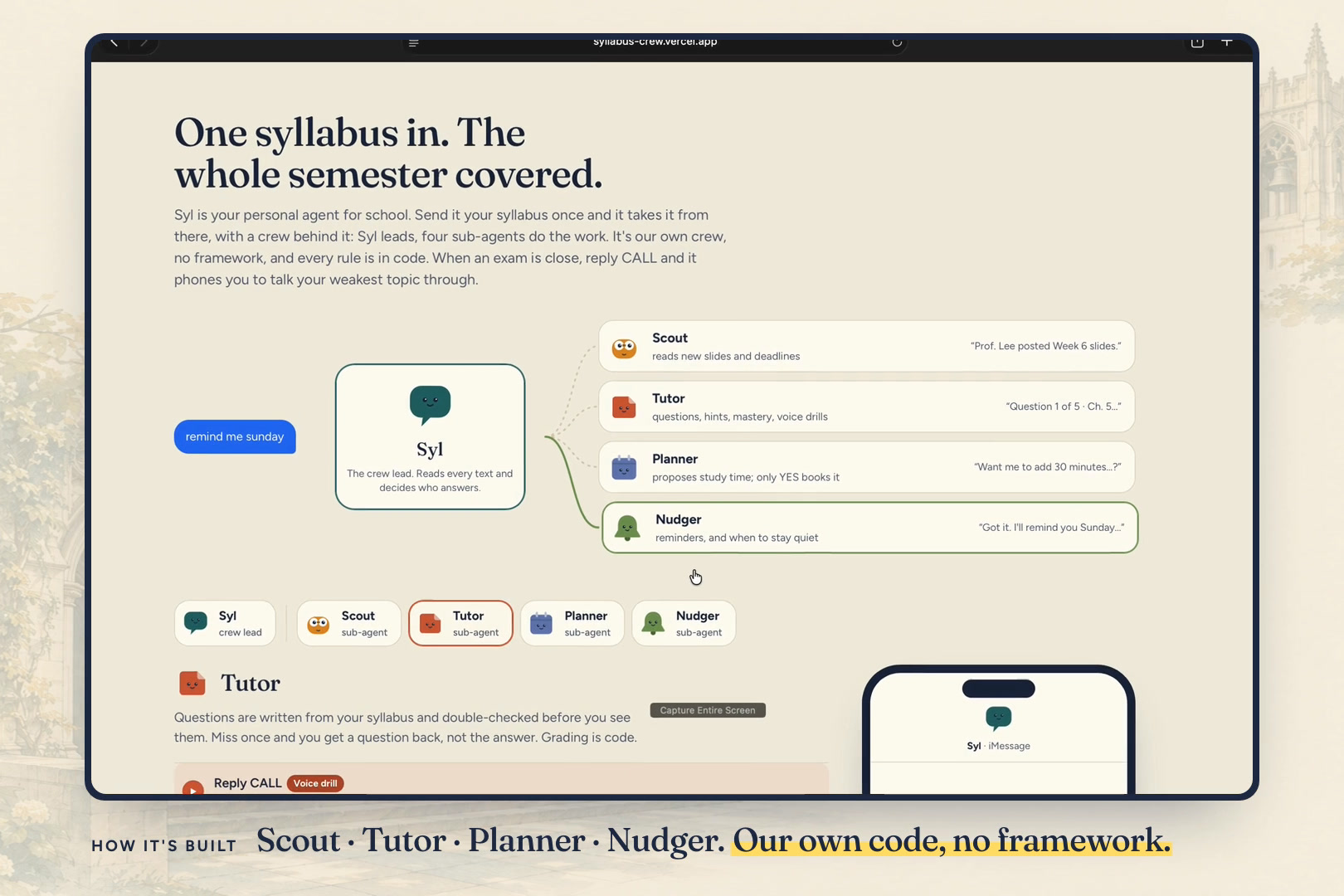
One thread, a crew behind it: Syl routes to Scout, Tutor, Planner and Nudger. Our own TypeScript, no framework, 246 tests.
Inspiration
What if college students had their own on-campus agent, one they could text on the way to class?
I wanted to build that for myself. Every time I needed to know when an exam was or what I had to read for the next class, I’d open Brightspace, find the syllabus, and scroll until I got to the right page. It only took a few minutes, but doing it over and over felt like busywork.
Finding the exam date still left me with the harder question. If I had 30 minutes between classes, what should I actually study? Knowing an exam was worth 25% of my grade made it feel urgent. I still had to figure out which topic I was weakest on and find a way to practice it.
At the same time, I kept seeing personal agents that could do everything from reading emails to booking tickets. That was cool, but honestly, I wanted to narrow it down. I wanted to text my syllabus once, ask what I should focus on, and get a quiz right there in iMessage. If I got something wrong, I wanted a hint. If I needed more time to review, I wanted the agent to suggest a study block and let me decide whether to book it.
That’s why I built Syllabus Crew.
What it does
Syllabus Crew is a personal study agent that lives in iMessage. A student texts their syllabus as a PDF, and the agent, Syl, pulls out exam dates, grade weights, and course topics. If a detail is missing, Syl asks for it in the same thread.
A student can ask, “What should I focus on this week?” Syl looks at how much each upcoming exam is worth, how soon it is, and which topics the student has struggled with. If an exam is worth 25% of their grade and they keep missing questions about interest rates, Syl can suggest starting there and give them a practice question right away.
Students can answer A, B, or C by text. If they miss a question, Syl gives them a hint so they can try again. They can also reply CALL for a short voice drill, explain an idea in their own words, and get a text recap of the points they covered and what they missed.
The part I cared most about was keeping the student in control of their schedule. Syl can suggest a 30-minute review block, and the student can text back something like “make it Monday at 2pm.” Syl adds the block to the connected calendar after the student replies YES.
Claude helps read the syllabus, write practice questions, and explain concepts. The app’s code checks multiple-choice answers, updates progress by topic, and decides what to recommend studying next.
How we built it
iMessage and Photon
I built Syllabus Crew as a Node.js and TypeScript service and used Photon 2.0 to connect it to iMessage. Incoming messages arrive over a WebSocket, with polling as a fallback. The service keeps track of which messages it has already handled so that receiving the same message twice doesn’t advance a quiz twice.
Photon’s shared lines couldn’t display a different name and photo for each student’s agent. I worked around that by having Syl text a contact card after the student picks a name and a vibe. Saving that card gives Syl the chosen name and avatar in Messages.
Reading the syllabus and building quizzes
I used Claude Sonnet 4.6 on Amazon Bedrock to read syllabus PDFs and extract course topics, exam dates, and grade weights. TypeScript validates the extracted data. If something important is missing, like the date of the final, Syl asks for that detail in the thread. Claude Haiku 4.5 handles everyday chat.
For quizzes, I make a second model call answer each generated question independently. If the two answers disagree or the second call is unsure, I drop the question. When a student replies A, B, or C, the code checks their choice against the stored answer and updates their progress on that topic. The topic ranking uses the exam’s grade weight, the student’s progress, and the number of days until the exam.
Study planning and calendar approval
I built Planner to turn a weak topic into a specific study proposal. For example, if interest rates are giving a student trouble and the exam is close, Planner looks for an open slot and suggests 30 minutes of review. The student can move the proposal by texting a different time.
I kept the calendar write in a dedicated approval handler. When a student replies YES in iMessage, the service matches that reply to the pending proposal and sends the approved event to the Google Calendar API. It records the approval so a second YES doesn’t create another event.
Voice drills and the demo
I used the ElevenLabs Agents API and a Photon voice number for phone drills. When a student replies CALL, Syl prepares a question and a list of key points, then starts the call. Afterward, the service checks the transcript against those points, calculates the score in code, and texts the student a recap.
I used Claude Code while building and testing these flows. For the hackathon demo, I ran the agent and dashboard on my laptop, tested the full conversation on an iPhone, and hosted the tap-to-open recap cards on Vercel.
Challenges we ran into
Thankfully Claude Code made the coding part a lot easier. If I had to pick the hardest part, it was coming up with an idea I actually wanted to use and staying excited about it once I got past the fun part of starting something new. The project clicked for me when I narrowed it down to one thing I’d actually do between classes: text my syllabus and ask what I should study next.
Getting Photon to work the way I wanted
I wanted students to pick a name and face for their agent, but Photon’s shared iMessage line wouldn’t let me set a different profile for each person. So I had Syl text a contact card that students could save. Tapbacks didn’t work on the shared line either, which is how I ended up with the simple “reply YES” flow for booking a study block.
My favorite bug was switching the demo to Week 6 and suddenly getting no replies. The switch reset the study data and took the Photon thread IDs with it, so Syl had nowhere to send its next text. I kept those IDs across demo switches and added a test for it.
Getting the first AWS call through
The hackathon AWS account blocked Bedrock API-key authentication, and my first attempts with plain model IDs failed too. I eventually got Claude Sonnet 4.6 and Haiku 4.5 working with Anthropic’s Bedrock client, IAM credentials, and the US inference profile IDs. The same account also blocked DynamoDB, so I used the local file store for the demo and kept building.
Accomplishments that we're proud of
i’m proud I got the whole thing working in iMessage. I could text it a real syllabus, get quizzed on it, and reply YES to put a study block on my Google Calendar. I even got it to call me for a voice drill and text me a recap afterward.
One of my favorite parts was getting a hint when I got a quiz question wrong. It felt like something I’d actually use while studying because I could take another shot at the question right there in the thread. I also got the agent to text little cards I could tap to see my semester, my week, or how I did on a quiz.
What we learned
i also learned how much of building an agent is deciding what should happen after a really short reply. A text like “YES” feels obvious when you’re the one sending it, but the agent has to know exactly what you’re saying yes to. Trying the flow on my phone made me pay way more attention to what the agent says right before it asks me to reply.
ofc I learned how to do the “agent orchestration” (honestly i recently fell in love with this term and it's my personal replacement for “vibe-coding”) and how to manage a product from start to end. More importantly, I learned how genetically unlucky I am that I can’t stay sane without enough sleep lol.
What's next for Syllabus Crew
A lot. The agent itself is still running on my laptop. Next up is figuring out how to let more students use it while keeping their data safe lol.
i'd love to try it with students from different majors and see how it handles syllabi that are organized completely differently from mine. I also want to find out what people would actually text it after the first week. Do they mostly want to know what’s due, or would they keep coming back to talk through a reading before class? That would help me figure out what to build next.
Built With
- agentic-framework
- amazon-bedrock
- amazon-dynamodb
- anthropic-sdk
- aws-iam
- bedrock
- claude
- elevenlabs
- google-calendar-api
- imessage
- multi-agent
- next.js
- node.js
- oauth
- photon
- react
- react-native
- tool-use
- typescript
- vcard
- vercel
- vercel-blob
- websockets

