What it does
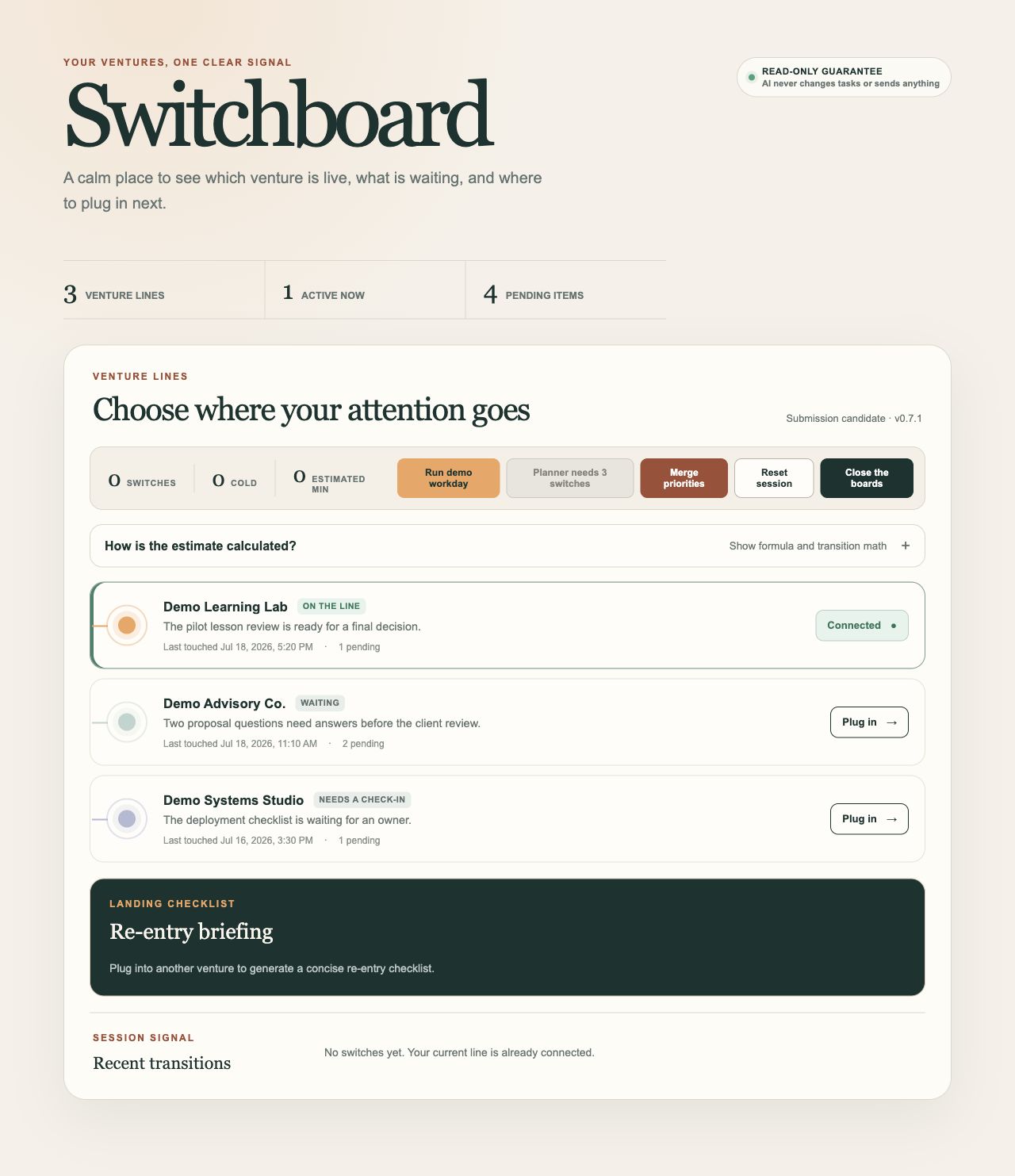
Switchboard is a read-only command center for people operating across several ventures. It records deliberate venture transitions, estimates the re-orientation budget from explicit assumptions, explains every cost contribution, and helps redesign a fragmented day.
The working application includes:
- an in-memory switch session;
- structured venture re-entry briefings;
- a validated cross-venture priority merge;
- a lower-switch venture-block planner;
- daily closeout narration;
- an inspectable measurement explanation; and
- a fixed fictional judge workday requiring no account or credentials.
Measured result
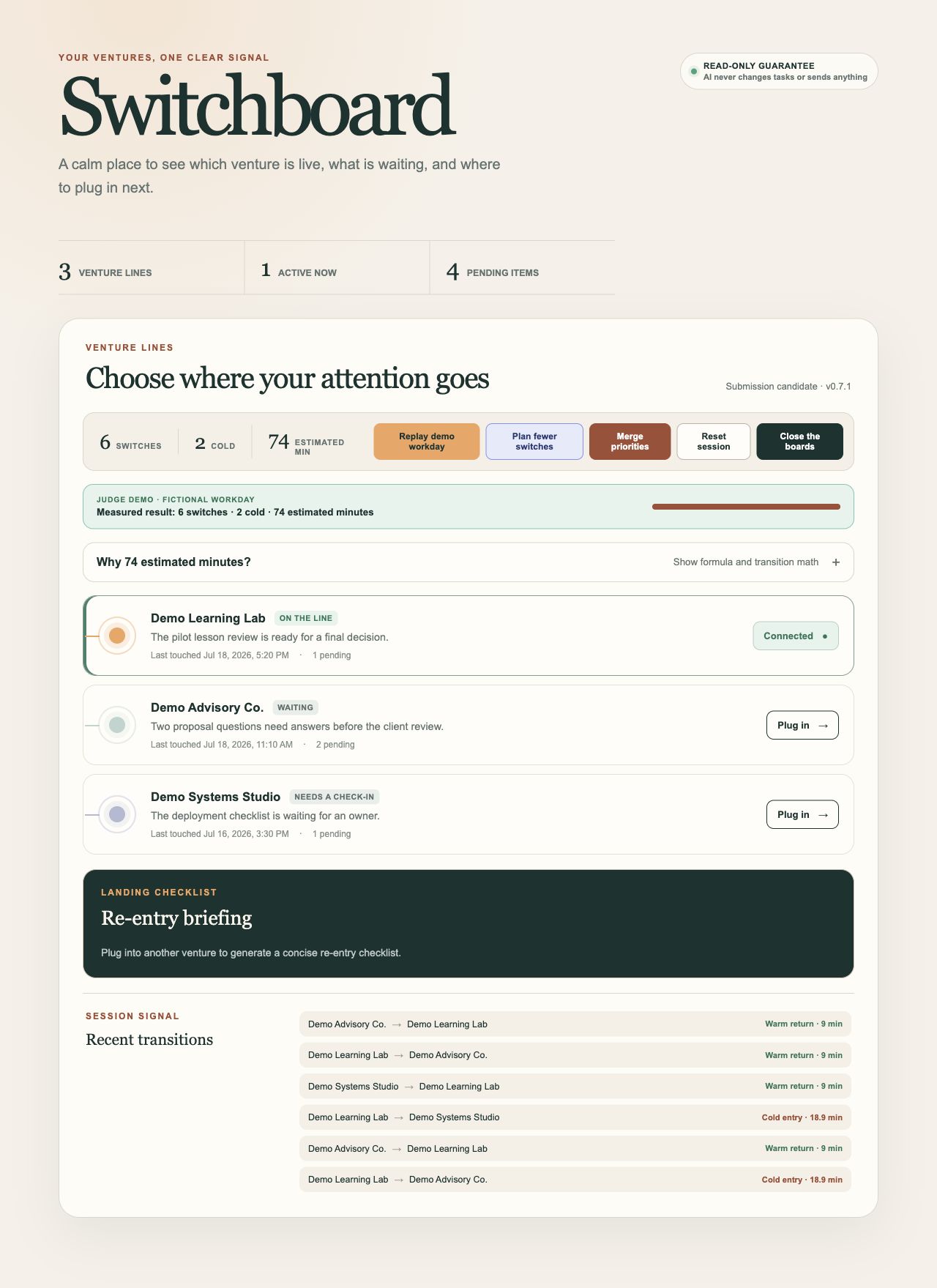
The checked-in fictional workday produces 6 venture switches, 2 cold entries, and 74 estimated minutes. Six transition contributions total 73.8 minutes before one final whole-minute rounding.
Reproduce the exact result with:
pnpm benchmark:switch-cost
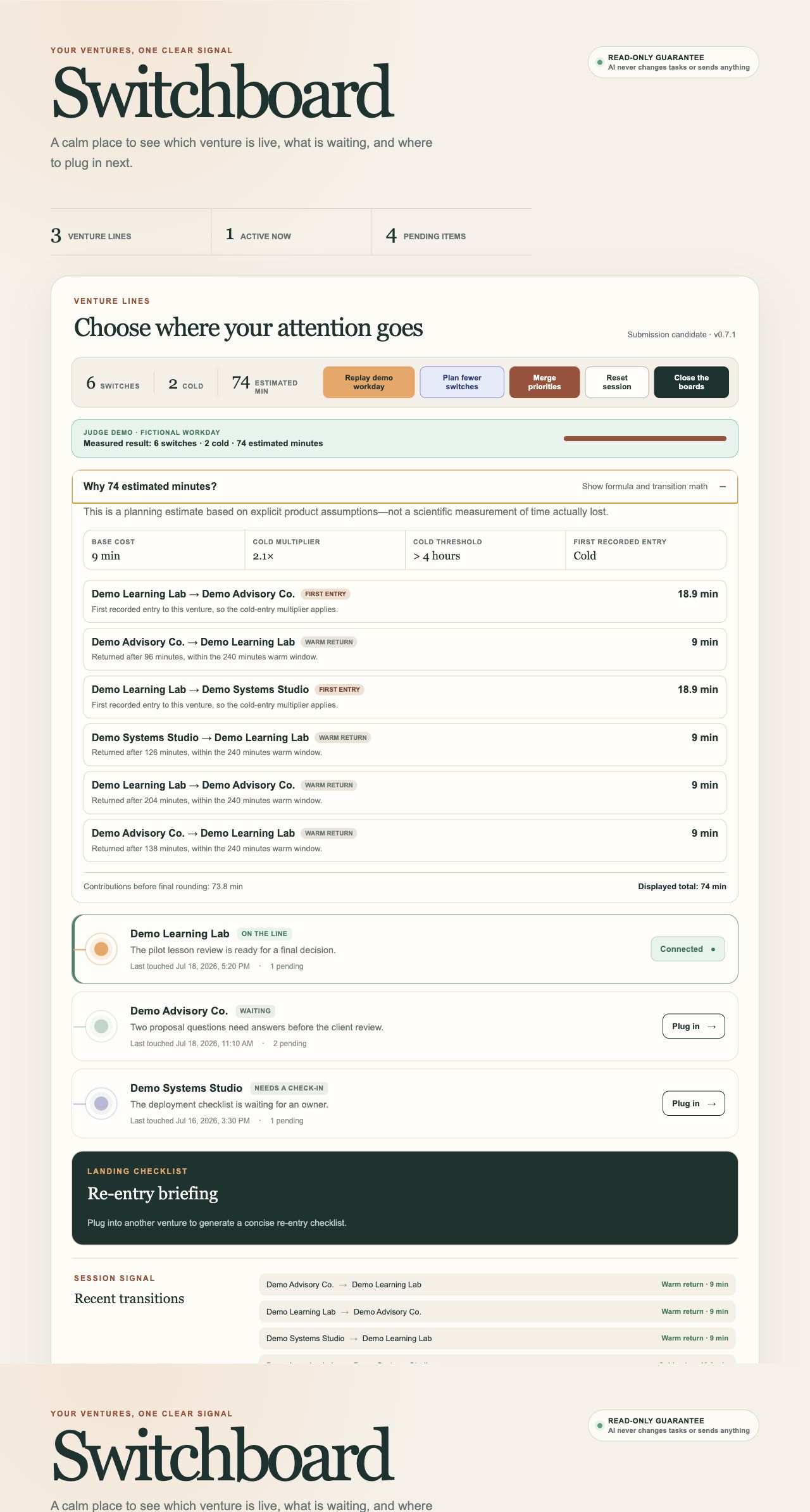
This is an explicit planning model, not a scientific claim about human productivity loss. Its default assumptions are 9 minutes per warm transition, a 2.1× cold multiplier, a strict cold threshold of more than four hours, and cold treatment for the first recorded entry.
How it was built
Switchboard is a Next.js 16 and React 19 application written in TypeScript. Zod validates every assisted request and structured response. Four server routes support the OpenAI Responses API for briefing, ranking, planning, and narration.
The measurement spine remains deterministic. AI may propose a complete venture order, but it cannot supply the success metric. Switchboard validates venture and task identities, then computes both the recorded baseline and proposal locally with computeSwitchCost.
A shared Read-Only Guarantee excludes task completion, messaging, scheduling, deletion, and venture-data mutation. Missing API credentials return conspicuously labeled deterministic GPT-5.6 mock envelopes. Real provider or validation failures use deterministic fallbacks.
How Codex was used
Codex helped:
- review the original idea and create versioned milestones;
- implement the foundation, estimator, switch session, and judge fixture;
- build the re-entry, priority, planning, and closeout flows;
- write schemas and edge-case tests;
- diagnose and fix the first GitHub Actions failure;
- prepare release gates, evidence, README content, and demo plan; and
- deploy and verify the public judge flow.
The repository history keeps these changes in small issue-linked milestones from v0.1.0 through v0.7.1.
Important decisions made with Codex
- Replace an aspirational “14 switches / 2.3 hours” headline with the fixture's actual measured result.
- Treat exactly four hours away as warm; only strictly more than four hours is cold.
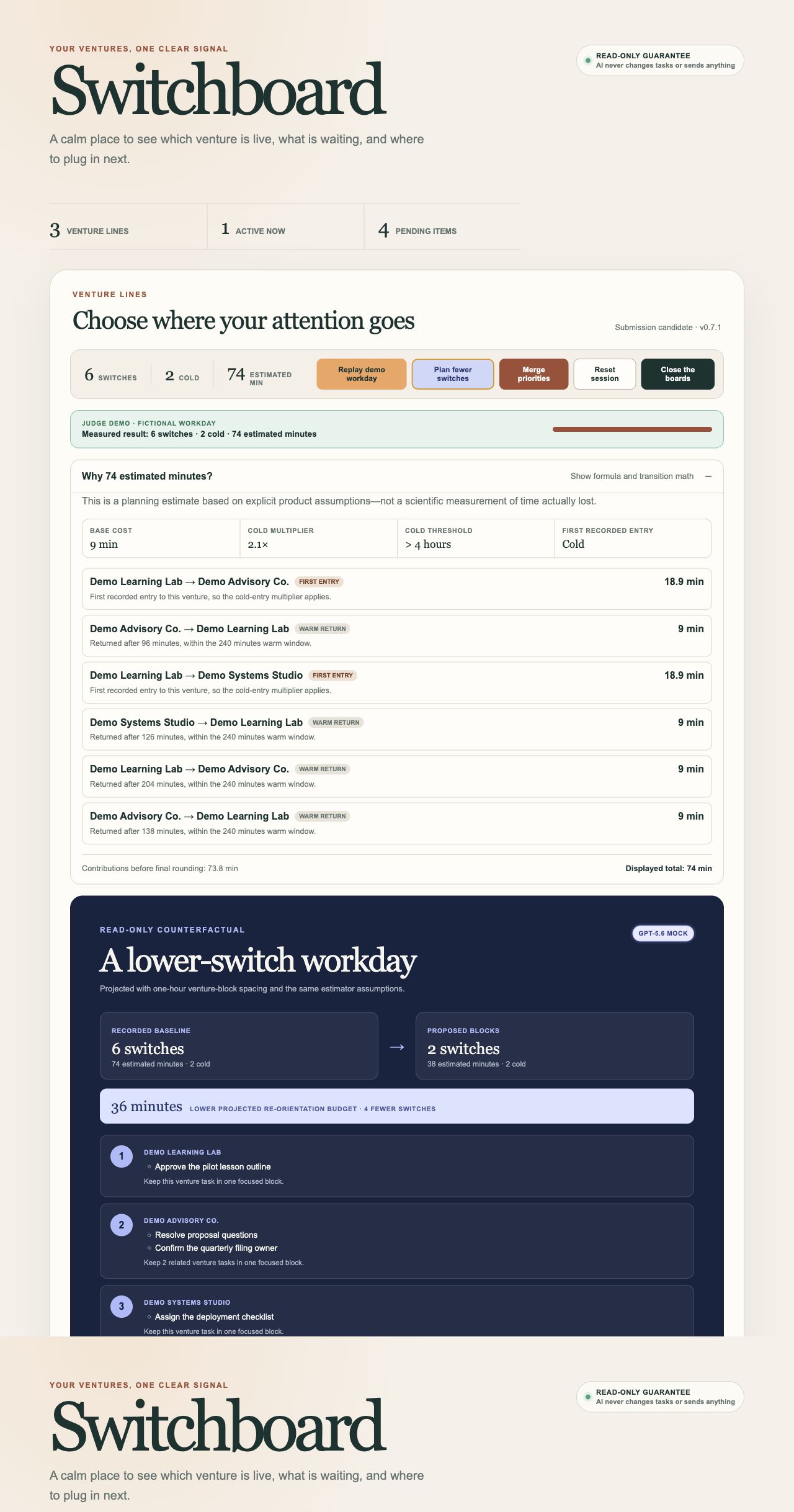
- Calculate planner improvement locally instead of accepting model-supplied savings.
- Reject incomplete, duplicate, renamed, or identity-changing structured output.
- Keep all assisted capabilities read-only.
- Clearly distinguish a credential-free mock from a live GPT-5.6 API response.
Precise GPT-5.6 contribution
In Codex session 019f74c9-1371-75a3-976e-45923e093dde, GPT-5.6 shaped and implemented Switchboard's measurement spine:
- deterministic switch counting;
- first-entry and strict greater-than-four-hours cold semantics;
- the fixed fictional workday fixture;
- transition-level explanation and 73.8 → 74 rounding;
- independently scored planner comparisons; and
- tests defining the estimator's observable contract.
The same session integrated this spine into re-entry, ranking, planning, closeout, CI, documentation, release verification, and deployment.
The public deployment intentionally has no OPENAI_API_KEY. Its highlighted mock data is not presented as a live GPT-5.6 response. The competition contribution cited here is GPT-5.6's use inside Codex to build the project, anchored by the required /feedback session ID.
Evidence and commit checkpoints:
https://github.com/manojmallick/switch-board/blob/main/GPT56_EVIDENCE.md
Architecture
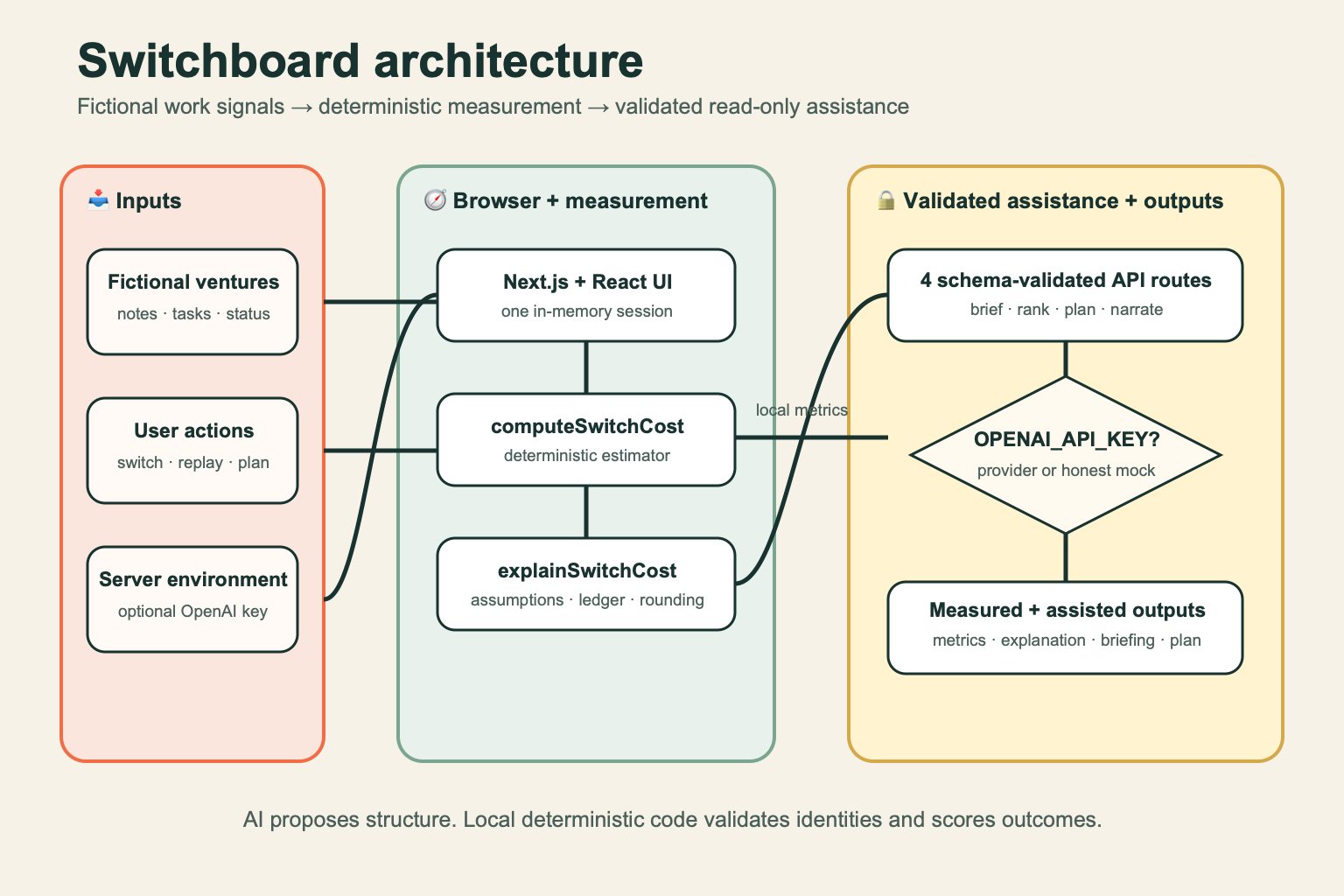
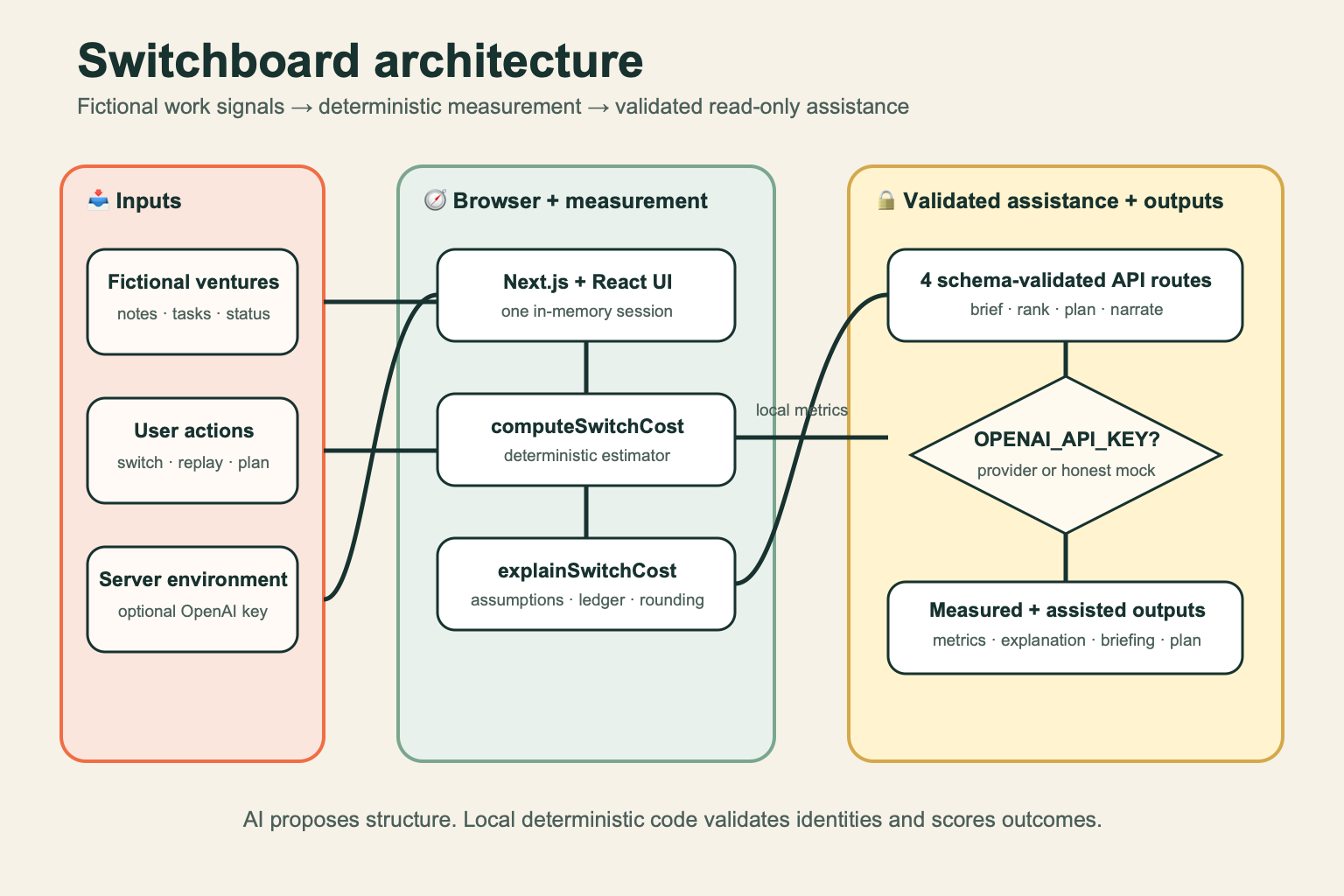
Switchboard separates deterministic measurement from optional generative assistance:
- Fictional venture notes, tasks, and user actions enter the React client.
- The in-memory session records deliberate venture transitions.
- computeSwitchCost calculates switch count, cold entries, and estimated minutes.
- explainSwitchCost derives assumptions, per-transition reasons, contribution totals, and rounding.
- Four Zod-validated server routes support briefing, ranking, planning, and closeout narration.
- With a server-side OpenAI key, routes use structured Responses API output. Without one, the public demo returns a clearly labeled deterministic mock.
- AI-generated plans never score themselves; the local estimator validates and compares the recorded and proposed schedules.
How it looks
Measured fictional workday
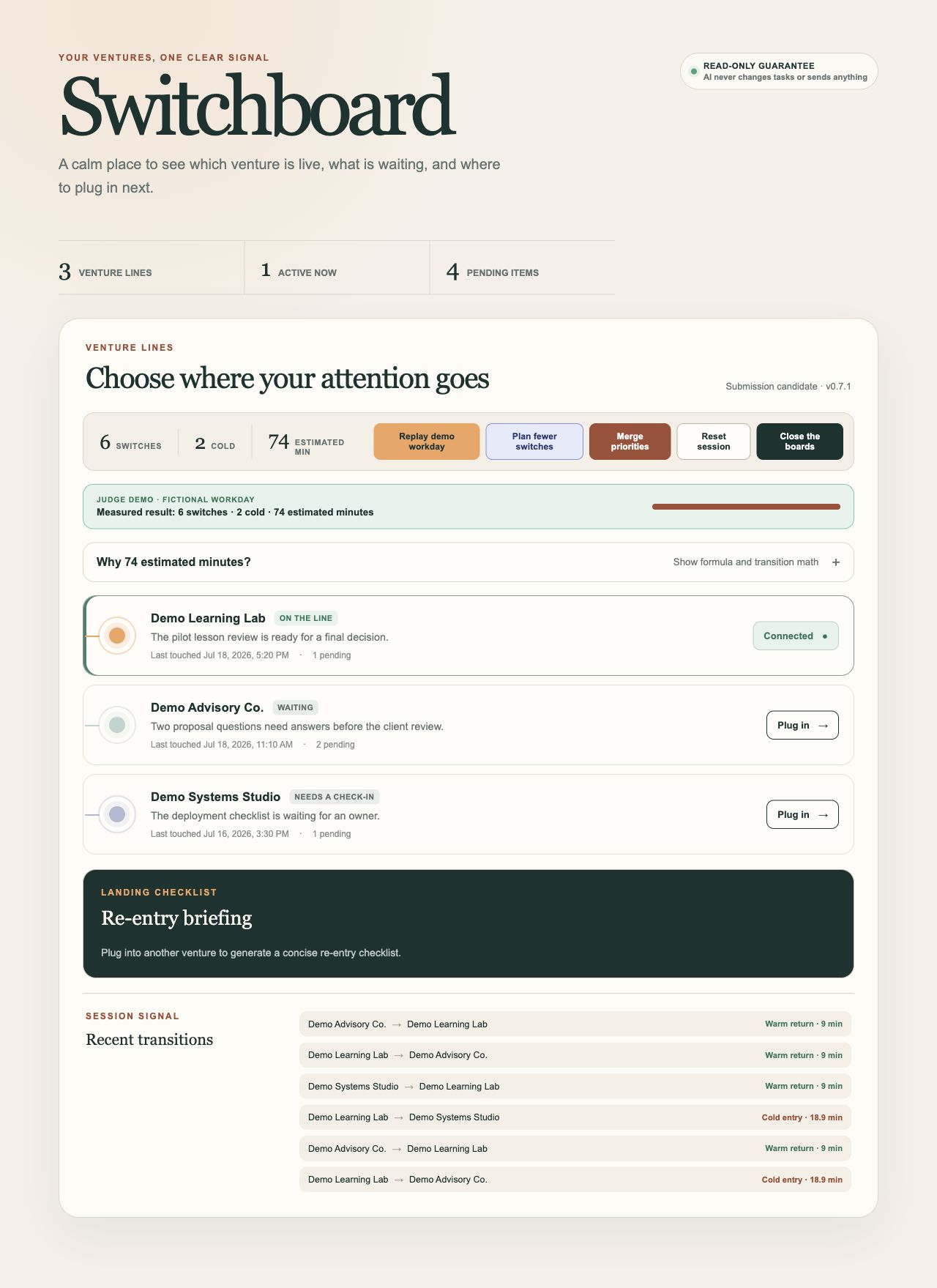
The judge fixture runs through the normal session code and produces the reproducible 6 switches / 2 cold / 74 estimated minutes result.
Inspectable measurement
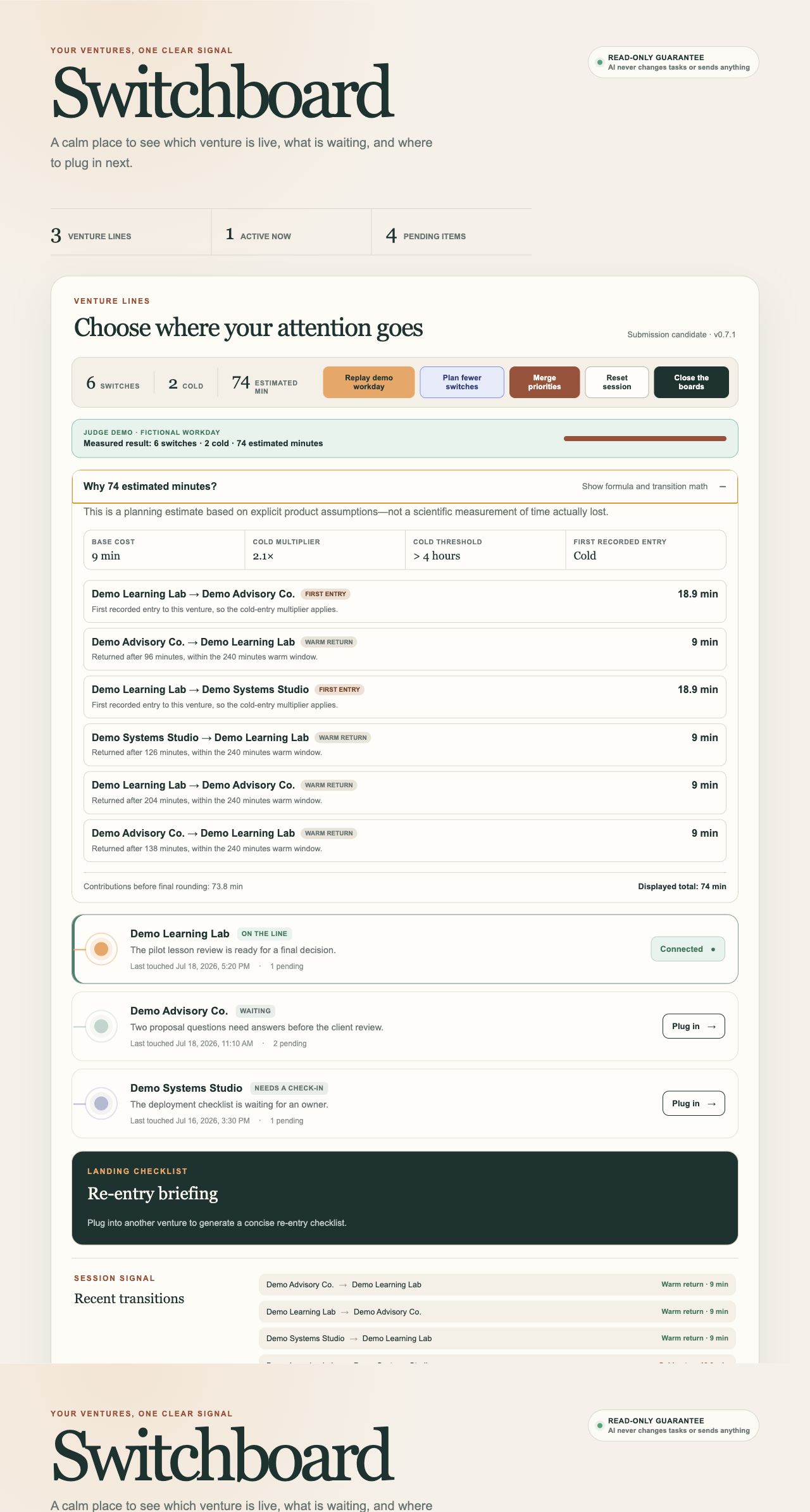
Every assumption, classification, transition contribution, and the final 73.8 → 74 rounding is visible.
Switch-reduction planner
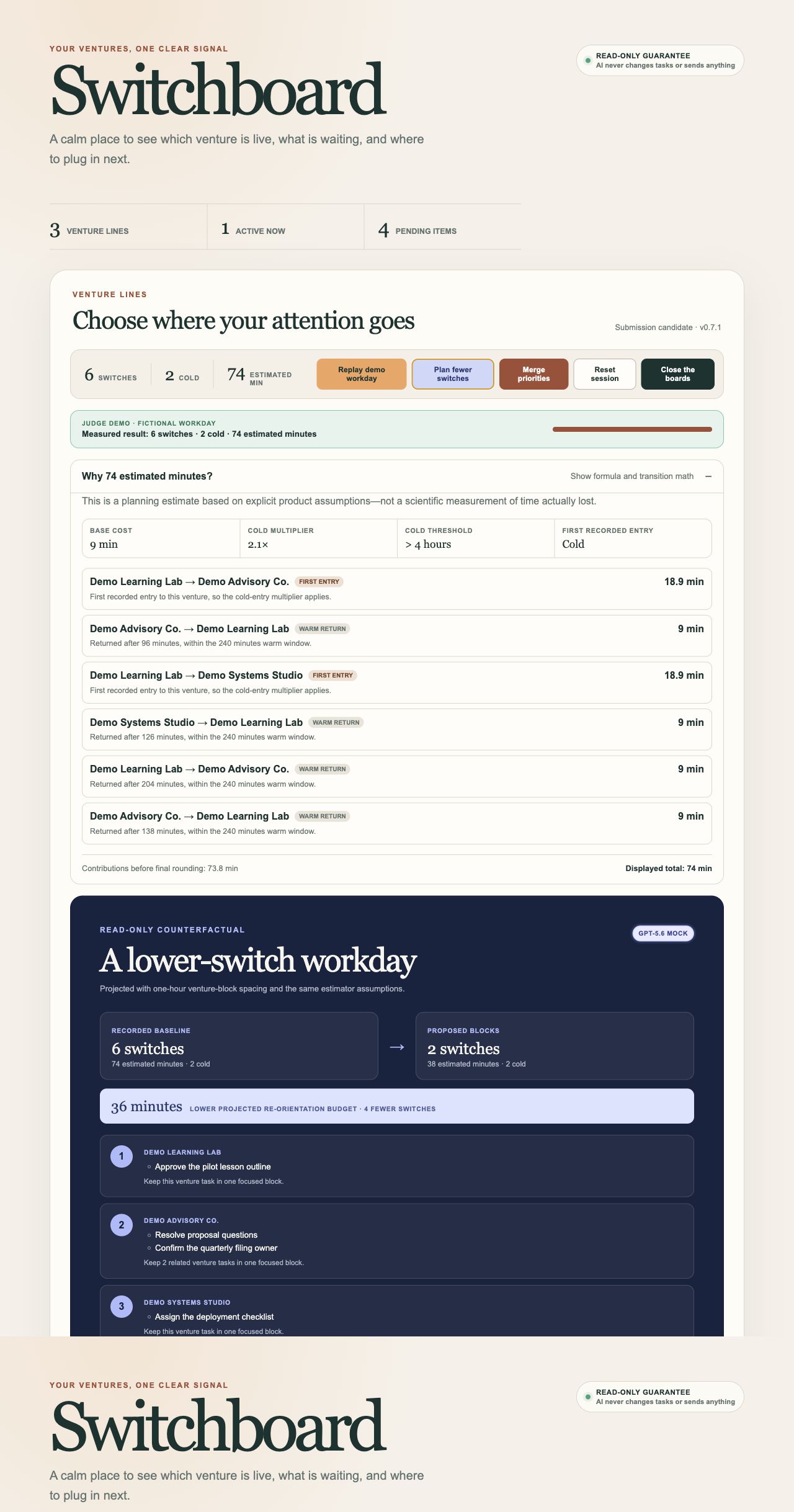
The planner proposes focused venture blocks; Switchboard validates identities and scores both schedules locally with the same estimator.
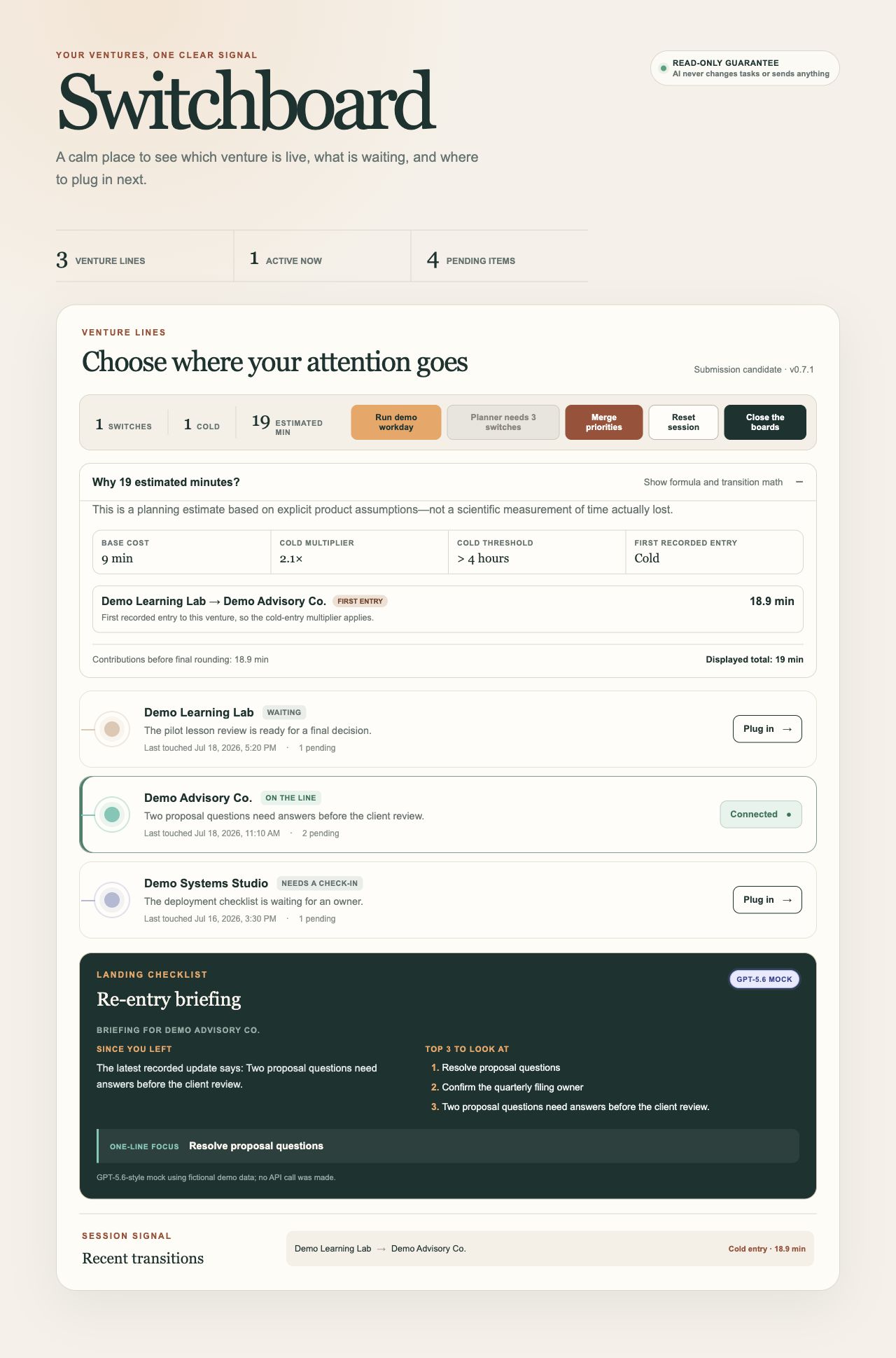
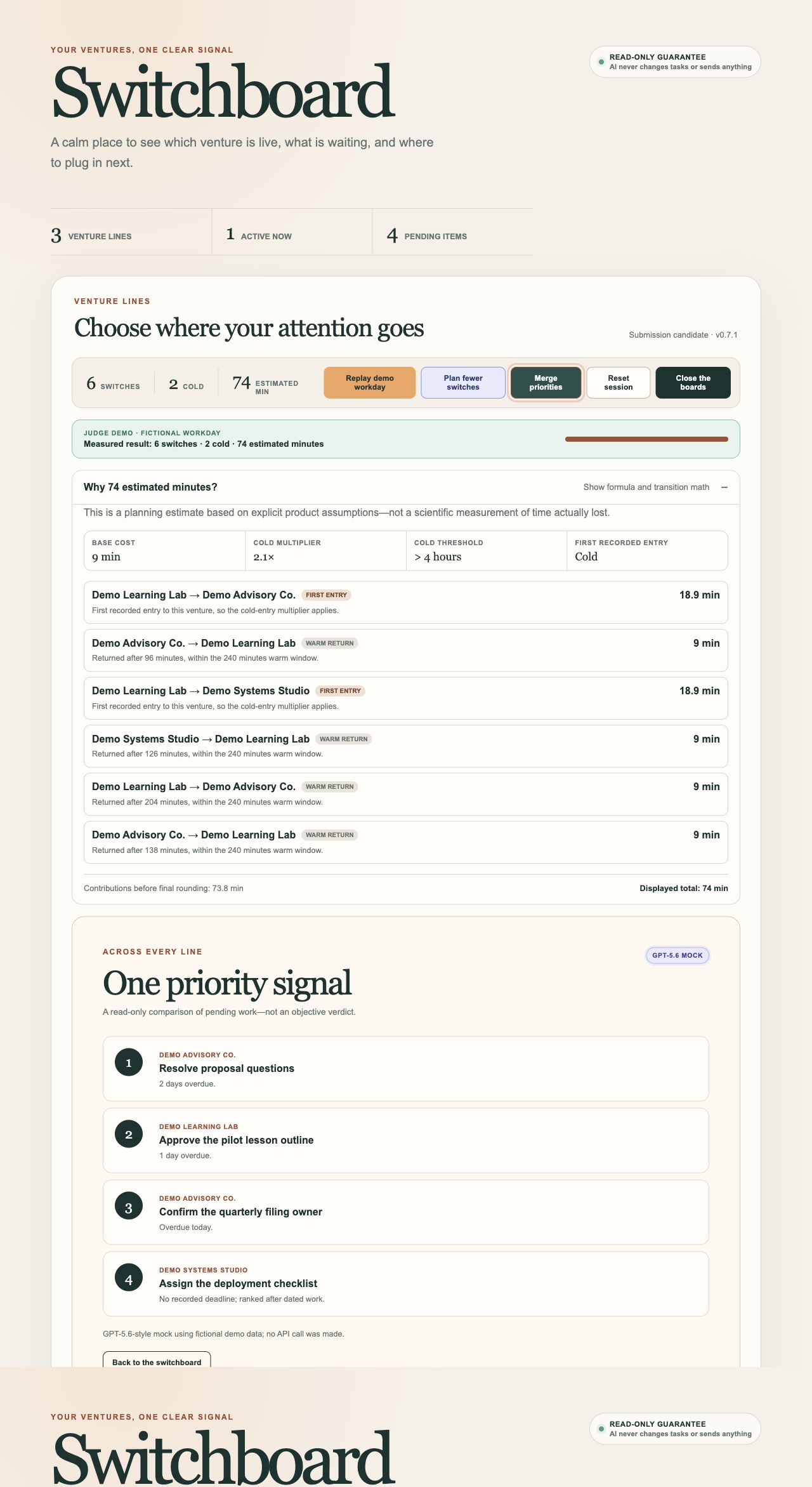
Priority merge and re-entry
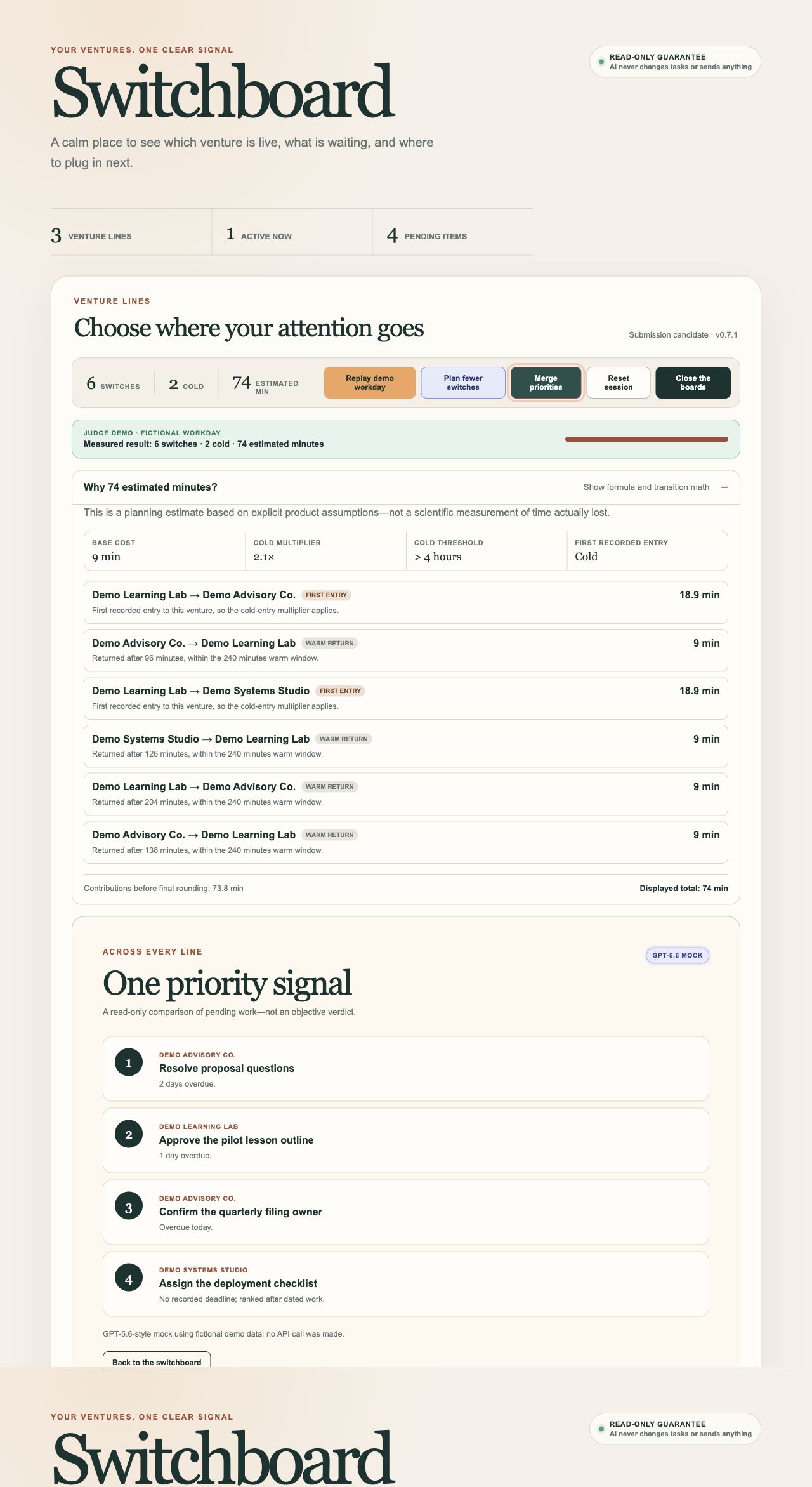
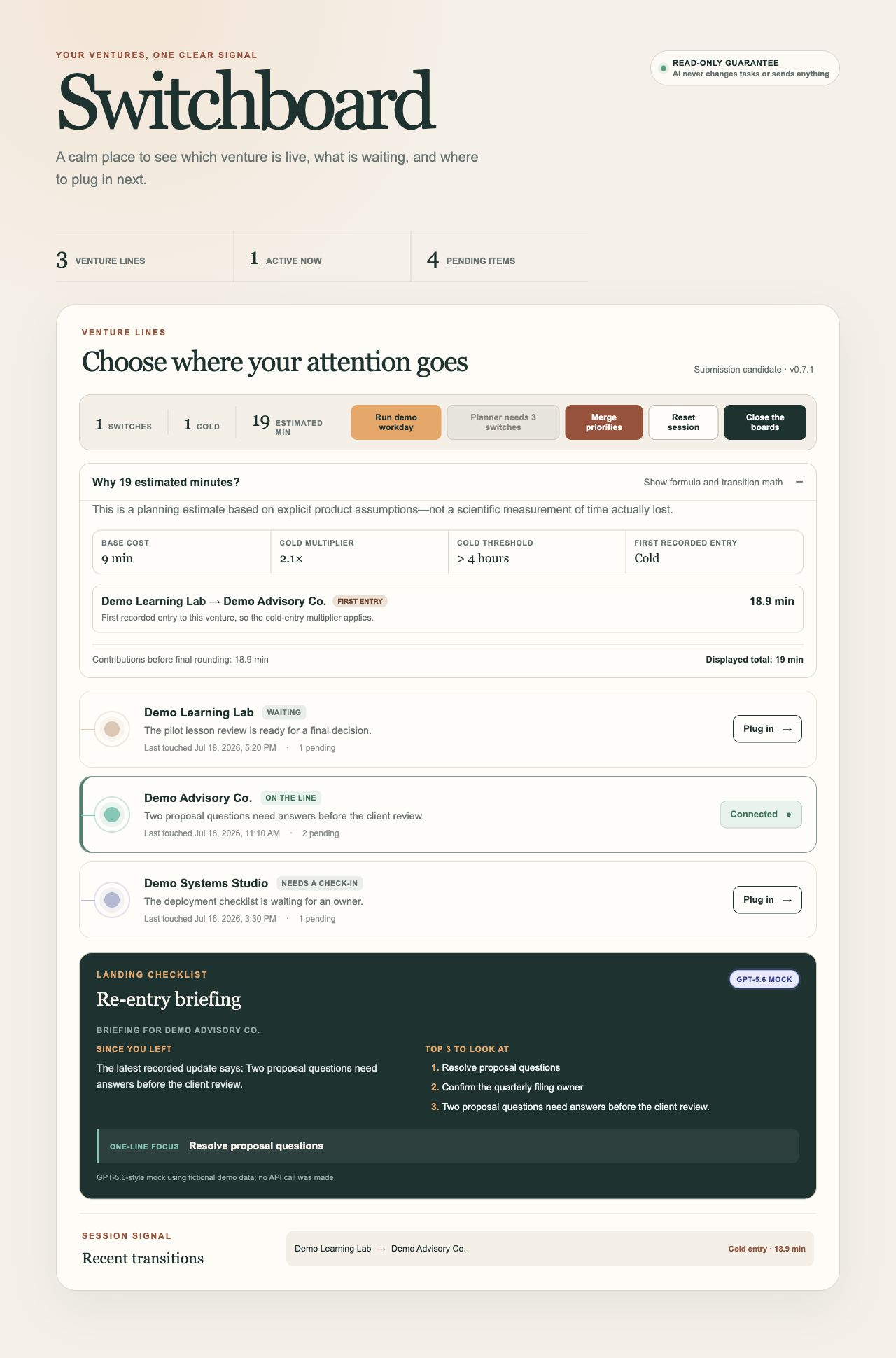
The credential-free assisted flows preserve venture identity and visibly disclose the GPT-5.6 mock source.
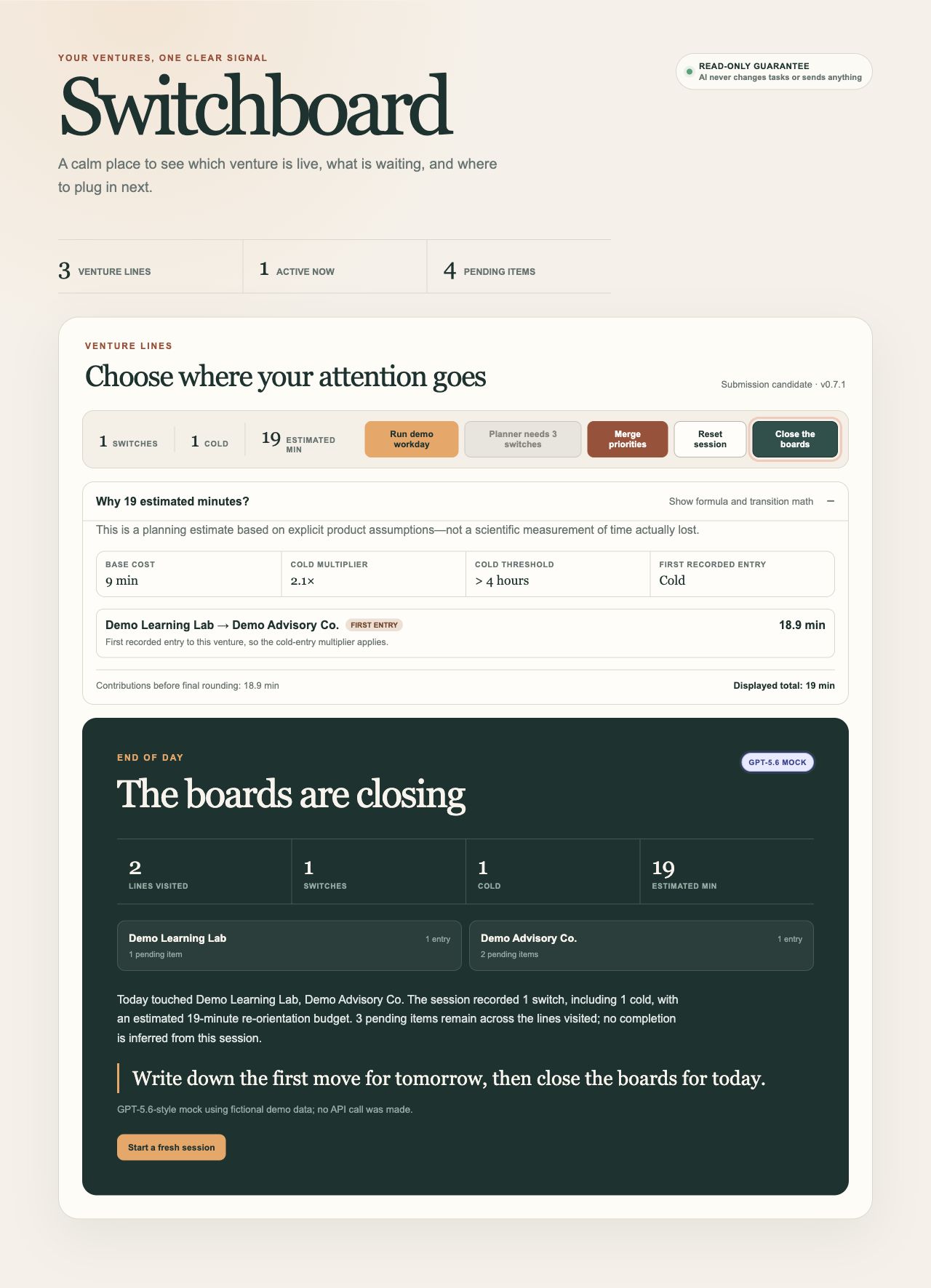
Daily closeout
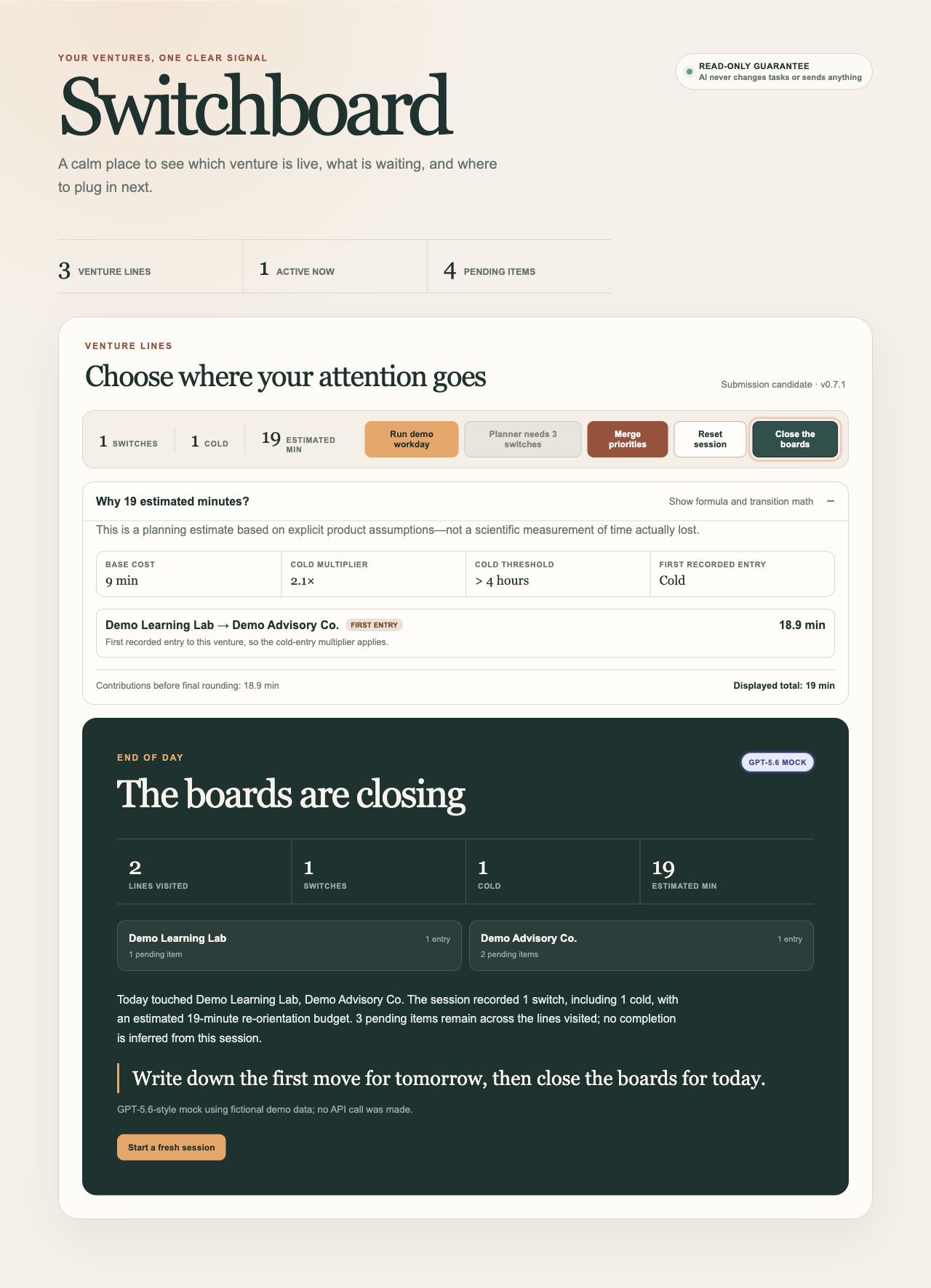
Closeout summarizes visited lines, measured switching, remaining work, and a shutdown prompt without inferring task completion.
Challenges
The initial CI workflow could not reliably infer the pnpm version, so commit c39049c pinned the package-manager setup used by GitHub Actions.
The headline number also had to follow the fixture rather than the product pitch. That decision produced a less dramatic but reproducible result shared by the demo, benchmark, planner, closeout, README, and tests.
Finally, boundary semantics and rounding had to be inspectable. Tests prove exactly four hours is warm, one millisecond beyond is cold, inputs are not mutated, and rounding happens after all contributions are summed.
Accomplishments
- One estimator powers live metrics, demo replay, explanation, planning, and closeout.
- The complete fictional workflow runs without an account, API key, or test credentials.
- All assisted paths validate input, structured output, source provenance, and fallback behavior.
- Judges can test the deployed sandbox without rebuilding.
- The repository provides lint, typecheck, 63 tests, production build, benchmark, CI, and public-artifact gates.
What was learned
A trustworthy productivity assistant should expose its assumptions and keep outcome metrics outside generative output. Honest mocks and deterministic fallbacks also improve evaluation: judges can use the complete experience while immediately seeing which responses did not come from a provider.
How judges can test it
Hosted sandbox: Any current desktop or mobile browser.
Open:
https://switch-board-vert.vercel.app
No account, API key, test credentials, or rebuild is required.
- Click Run demo workday.
- Confirm 6 switches · 2 cold · 74 estimated minutes.
- Expand Why 74 estimated minutes? to inspect the transition ledger.
- Run Plan fewer switches and compare the recorded and proposed schedules.
- Try Merge priorities, switch to another venture, and run Close the boards.
- Note that assisted cards are explicitly marked GPT-5.6 mock and state that no API call was made.
Local audit: macOS, Linux, or Windows with Node.js 24 and pnpm 10.
git clone https://github.com/manojmallick/switch-board.git
cd switch-board
corepack enable
pnpm install --frozen-lockfile
pnpm benchmark:switch-cost
pnpm verify
Repository
Public source, tests, fixtures, evidence, demo plan, and MIT license:
https://github.com/manojmallick/switch-board
What's next
After the submission artifacts are verified, plausible next steps are authenticated persistence and user-configurable estimator assumptions. These are roadmap items, not current features.
Built With
- codex
- gpt-5.6
- next.js
- openai-responses-api
- react
- typescript
- vercel
- zod

Log in or sign up for Devpost to join the conversation.