Inspiration
More often than not, colleges offer only a limited number of meal plan options, and they are rarely one-size-fits-all. As a result, students must plan ahead to make their meal plans last throughout the quarter. However, this planning process is often inconvenient and difficult to maintain. In fact, 78.9% of UCI students we surveyed reported that actively managing their meal swipes is inconvenient.
At the start of this quarter, for example, Harini set a goal to conserve her meal swipes early on so she could rely on them more heavily later, when academic deadlines became more demanding. Over time, however, she lost track of how many meals she needed to preserve. This led to over-conservation and ultimately, a surplus of unused swipes at the end of the quarter.
SwipeSmart was inspired by this common challenge faced by college students: managing meal plans effectively over time. Without a clear system or structure, students often either exhaust their swipes too quickly or finish the quarter with unused meals. Our goal was to create a solution that helps students optimize their meal plan usage and maximize the value of what they’ve already paid for.
What it does
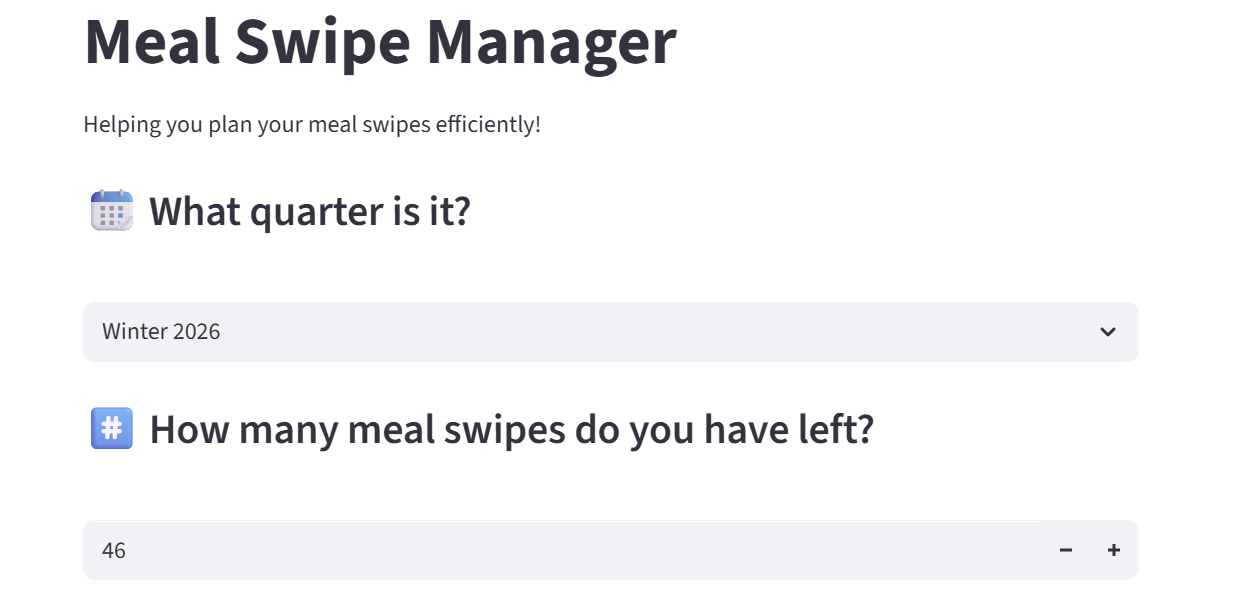
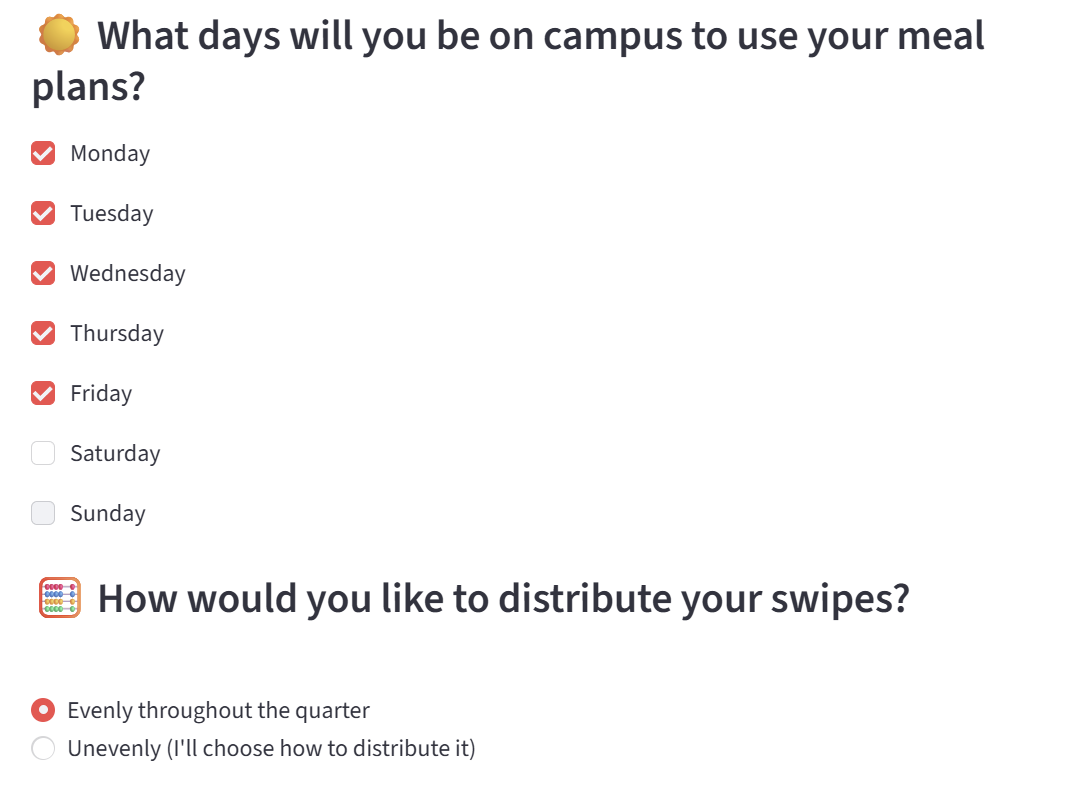
SwipeSmart helps students strategically distribute their meal swipes throughout the academic quarter. Users enter their total number of swipes, select the days they plan to be on campus, choose their academic quarter, and specify their food preferences.
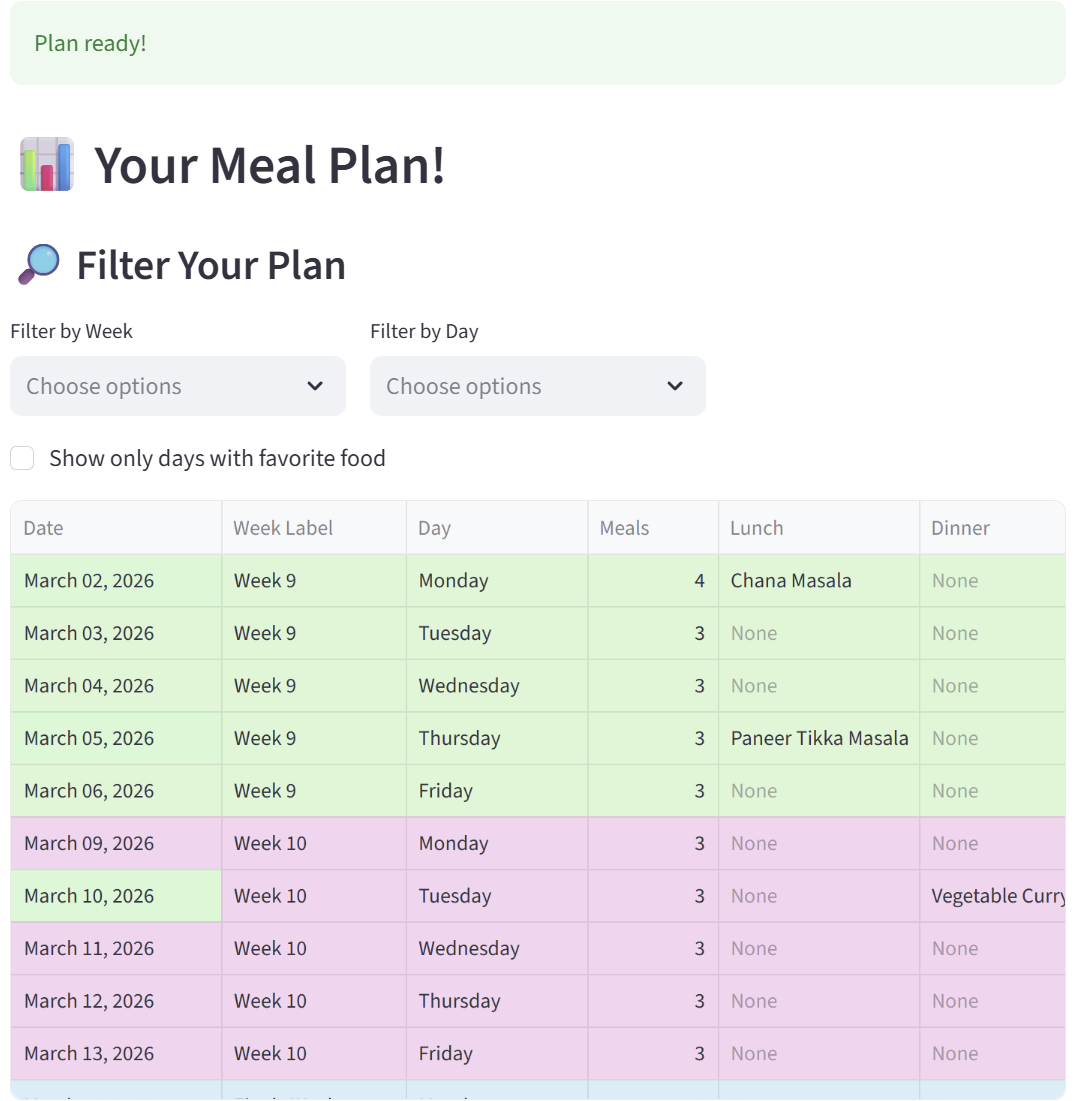
Using this information, SwipeSmart calculates the number of remaining valid weeks and allocates meals accordingly. When a student is at risk of running low on swipes, the application leverages AI to analyze when their favorite meals are being served and recommends optimal dining days and times. This ensures they maximize the value of their remaining swipes.
SwipeSmart delivers a deeply personalized experience by balancing logistical constraints, such as schedule and swipe limits, with individual preferences. The result is a smarter way for students to spread out their meal plan usage while still prioritizing the meals they love.
How we built it
To build SwipeSmart, we divided the project into three main workflows. Chloe developed the Streamlit frontend, Harini implemented the AI meal personalization logic, and Shamikta implemented the backend meal allocation system. We built SwipeSmart using Python and Streamlit, combining an interactive user interface with structured backend logic. The Streamlit frontend allows users to input their total swipe count, select the days they’ll be on campus, choose their academic quarter, and mark dates featuring their favorite meals. On the backend, we integrated AI to map user preferences to available dining options, helping students make the most of their meal plans.
Throughout development, we collaborated closely by refining core functionality, discussing edge cases, and whiteboarding complex scenarios. The problem proved to be more layered than we initially anticipated, but strong communication and consistent collaboration allowed us to build a thoughtful and well-structured solution.
Challenges we ran into
The primary challenge we faced was integrating the different components into a cohesive system. While each module worked well independently, bringing them together, especially merging the Streamlit frontend with the backend meal allocation logic, was more complex than we anticipated. We had to iterate several times to properly sync user inputs with the core algorithm, maintain consistent data formats, and resolve mismatches between the UI and backend logic. Integrating the AI component added another layer of complexity, as we needed to carefully structure and validate its outputs to align with our backend system. Although the AI module currently runs independently, this experience taught us the importance of designing for integration from the start.
Overall, this process taught us about modular design and the importance of communication when building collaborative projects.
Accomplishments that we're proud of
We’re proud of building a functional system that addresses a real student problem. From designing a working meal distribution algorithm to integrating it with a dynamic Streamlit interface, SwipeSmart evolved into a cohesive and reliable tool.
We’re especially proud of how much we learned along the way. Prior to this project, we had no experience with Streamlit, AI integration, or developing a full-scale personal application. Throughout the process, we explored new technologies, designed our own solution from the ground up, and navigated complex technical challenges. Building SwipeSmart gave us not only a working product, but also valuable experience in problem-solving, collaboration, and system design.
Overall, considering that we have only attended one prior hackathon and are beginners, we're proud of putting together this program!
What we learned
Through building SwipeSmart, we learned the importance of structuring a project with a clear separation between frontend and backend logic, and thoughtfully designing the overall architecture before diving into individual components. Integrating AI features and aligning them with both the frontend and backend systems highlighted the importance of consistent data formatting and strong communication between modules.
We gained hands-on experience with new technologies such as Streamlit and the Gemini API, along with strengthening our general programming skills. This included setting up virtual environments and learning how to use GitHub effectively for version control in a collaborative setting. We also developed stronger teamwork skills. While we initially focused heavily on small details, we eventually stepped back, clarified the system structure, and worked more cohesively toward delivering a polished final product.
What's next for SwipeSmart
In the future, we plan to introduce deeper personalization features that allow the app to adapt to individual habits and evolving dining preferences. For example, we hope to provide insights into whether students are getting their money’s worth from plans such as a 7-day unlimited meal plan.
We also plan to integrate real-time data directly from UCI Dining’s website, rather than relying on locally stored files. This would allow SwipeSmart to provide up-to-date menu information, improve recommendation accuracy, and make the system more dynamic and scalable.
We also aim to more tightly integrate the AI components with the backend logic and frontend interface to create a fully cohesive system. Another major goal is Google Calendar integration, enabling users to automatically sync their meal schedules and receive reminders. This would help students stay on track with their swipe usage throughout the quarter while making the experience more user-friendly.


Log in or sign up for Devpost to join the conversation.