-
-
-
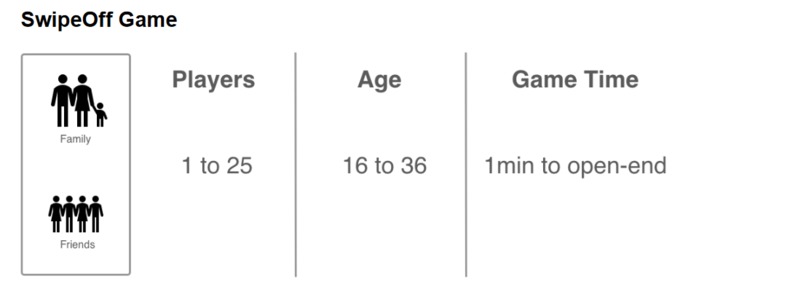
SwipeOff game
-
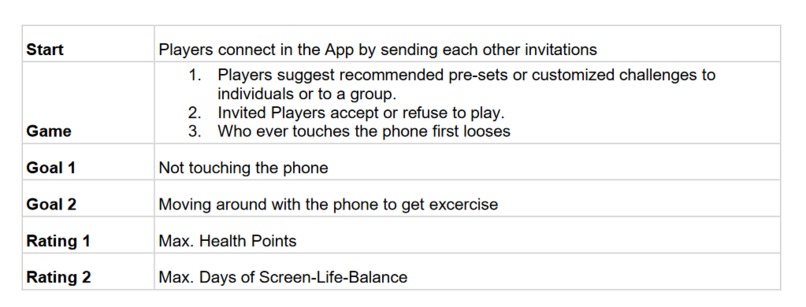
Table SwipeOff
-

logo


Presentation
SwipeOff Concept
Health Problems occurring with Digitalisation
In 2019, the proportion of households with at least one cell phone or smartphone in Germany was 97% (Federal Statistical Office, 2020). The increasing use of smartphones and other digital media brings with it benefits, but also health risks, which can vary in severity depending on age, usage time and frequency (Reid Chassiakos et al., 2016). At present, a median prevalence of 23.3% (14.0-31.2%) for "problematic" smartphone use is assumed for children, adolescents and adults up to 25 years of age (Sohn et al., 2019). The use of digital media is not problematic per se, but empirical research strongly suggests adverse health effects caused by high screen usage (Rumpf et al., 2017). In different reviews and studies high screen-times correlated with attention deficit disorders (Poulain et al., 2018; Reid Chassiakos et al., 2016), shorter sleep duration (Buxton et al., 2015; Carter et al., 2016; Chaput et al., 2017; Chindamo et al., 2019; Hale et al., 2018; Hale & Guan, 2015), behavioral disorders (de-Sola et al, 2017; Poulain et al., 2018, Poulain et al., 2019), a higher perceived stress level (Sohn et al., 2019), a higher incidence of depression (Reid Chassiakos et al., 2016; Sohn et al., 2019; Teo et al., 2015) and increased anxiety (Sohn et al., 2019).
The use of mobile devices also offers potential for family conflicts (Wagner et al., 2016) and can have a negative impact on parent-child interaction (McDaniel & Radesky, 2018; Poulain et al., 2019). A special role in family health promotion is therefore played by parents, whose role model function in the media has been proven many times (McDaniel & Radesky, 2018; Poulain et al., 2019). The role of the media has also increased in families, especially during the Covid 19 pandemic, and is part of everyday life. The parental media consumption has direct and indirect effects on children and parent-child interaction, such as family conflicts. Furthermore, parents often show unrestricted use of mobile devices imposing rules on their children at the same time (Wagner et al., 2016). In 2015 a study showed: When there were fixed rules on media use and sleep routines, children had significantly longer sleep duration (presence of smartphone rules: +19.2 min sleep (p= .002)) (Buxton et al., 2015). These and other authors recommend establishing interventions on sleep health and media (see Cain & Gradisar, 2010). In addition to the influence of role models and media education, parents' attention and responsiveness to their children's use of smartphones changed (Beamish et al., 2019), which in another study was associated with behavioral and emotional problems (Poulain et al., 2019). A cross-sectional study also showed correlations between problematically high media and smartphone use among parents with a higher technology preference, which correlated with more pronounced behavioral symptoms in children (McDaniel & Radesky, 2018). In a survey, parents of younger children showed a more carefree use of the smartphone compared to their children, often making it available to them for playing and less frequently taking advantage of counselling services (Wagner et al., 2016). Another vulnerable group is the group of young adults as college- and university students and people currently undergoing training/apprentenceships. (Text aus health facts (target group, thus important).
Problem
- School kids, students and young adults spend a lot of time looking on screens, disconnecting with real-life.
- Digital Education and Home Office increase the deficits of daily movement.
Solution
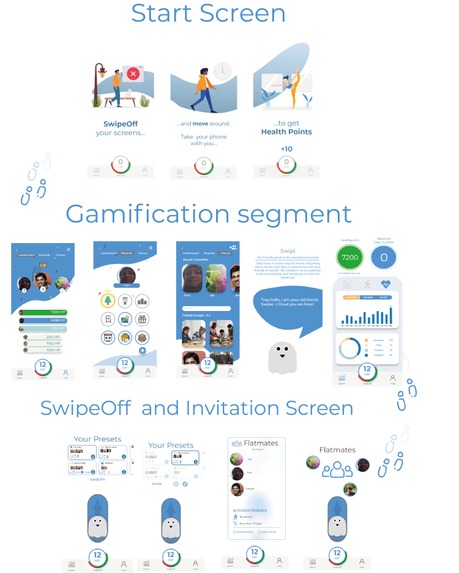
SwipeOff is a Health Application which helps people to balance their screen-time with time engaged in real-life actions. The Main goals are to reduce screen-time to a moderate level and to increase daily movement time. Structural and social Gamification are used to motivate People to develop a healthier lifestyle.
- Healthy screen-life-balance
- Frequent Movement incentives
- Social Support by achieving health goals Move for a healthy screen-life-balance.
SwipeOff Game


Technical Aspects
Every instance of SwipeOff creates a personalised phone time coefficient based on the previous usage. The data of previous usage can be taken directly from the phones operating system. This individual coefficient works as an upper limit. During the gameplay and activities, the App expects the player to keep total phone uses below this number and continue doing so daily. We develop SwipeOff for Android and iOS devices such as smartphones, tablets and wearables. Google and Apple fitness API provide the player’s activity data. The Backend is deployed on an existing cloud platforms such as Google Cloud or AWS for higher reliability and reachability. In this way the digital health product is highly scale able and available for people around the globe. Furthermore, we tend to use the serverless system for real-time processing at a lower cost. No personal data is exposed or read from a 3rd party system. This makes our software very secure and protects personal data of players. The player is provided transparent information of collected data and its usage.
UI and UX
The app’s interface is designed in Adobe XD for better analysis and flow understanding. Each icon is carefully selected, and the clean layout design is expected to reduce the screen time. The User interface aims to be very intuitive for the expected target audience. “Swiping” is a characteristic motion which is seen a lot among smartphone users. Turning the “Swipe” into a motion of closing the smartphone screen tackles the problem on the root. There are multiple pre-sets which increase fast usability. It is possible to start in just a few clicks, understand the app’s features and capabilities. Predefined as well as customizable challenge options connect the game with concrete real-life situations. The app reaches out to the player’s everyday life habits. This way players feel addressed and have an easy access to the game. Game design and structural gamification mechanics nudge players to adapt a healthier lifestyle naturally.
Implementation Health System
This App may help many people to adapt a healthier lifestyle. Possible key partners in the health system could be European and German health state departments, health insurances and the BZgA.
Team
- Franziska Carow (Health Communication) – Research Communication
- Johannes Vollbehr (Educational Science) – UX and Game Design
- Laurenz Blömer (Industrial Economics) – UI Design
- Sanjeet Raj (Computer Science) – UX Development


Log in or sign up for Devpost to join the conversation.