Inspiration
The idea for Swipe / Smart was conceived during a routine commute that was rudely interrupted by a Texas rainfall. This was the type of storm that would black out your windows while you are in motion, but left your windshield wipers scraping across dry glass at red lights. With stop and go traffic, it became necessary to babysit the wiper controls.
Rainfall during driving creates a problem for drivers by creating slippery roads and obscuring vision. The addition of windshield wipers aided in safety by keeping the windshield free of excess water, but maintaining the proper speed now becomes a new responsibility for the driver.
Heavy rainfall will require faster wiper speeds, but when you stop at a red light (or pass through a sunny-day pocket), the wipers will begin to scrape against the glass. This damages the wipers and will reduce the lifespan, resulting in extra costs throughout the years for replacements. To mitigate this damage, the driver will need to constantly adjust the speed. This may be a minor distraction, but small distractions while driving could ultimately result in very large consequences.
Luxury cars solve this problem by using a sensor to measure the density of the rainfall and determine the correct setting for the oscillation. However, many individuals and families are unable to afford newer vehicles and package upgrades. While it is a feature that can improve safety for drivers, it is ultimately not considered necessary.
Fortunately, we have the opportunity to create an after-market add-on that can be installed in a variety of makes and models to upgrade your existing car functionality at very little cost.
Vision
This add-on accessory for your vehicle will enable you to modify any car to dynamically control the speed of the windshield wiper based on the resistance against the wipers. The device will be supported through the company website, which will offer kits for purchase, forums for crowdsourcing and sharing, libraries with curated documents, and learning workshops partnered with Austin Community College. The following are the specifications for each specific category of the product.
The hardware kit would include a motor, a sensor, a micro controller, and the assorted cabling needed to interface with the vehicle. Kits can be customized to the customers’ needs for their specific car, or could have a variety of options for multiple cars.
The micro controller would be pre-loaded with the open source code that would control the speed of the wipers. Anyone is able to edit this code for finer control or specific patterns. The code for the micro controller is built using Python.
The website is where the real magic happens. Swipe / Smart is based on community involvement and growth. The website will offer starter hardware kits that have all you need to get started at a reasonable cost. The customer is also able to register an account that can be used to access the other resources on the website. The web forum will provide an open community where customers can discuss code, hardware, car modifications, and more. A curated library will contain guides for the equipment, setup processes, car repair manuals, and more. Finally, membership will grant access to learning courses that can improve your knowledge of programming, car repair and interfacing, and hardware hacking. These courses would have a premium cost, but provide thorough learning opportunities backed by professional educators.
We will use a hosting platform like SquareSpace to house our domain and to set up the simplicity of our web pages. Then, we will use a payment tracking system like PayPal to retrieve payments for starter kits and premium memberships. Our web development team will design modules for the learning courses with interactive activities. Logins and user data would need to be secured using an authentication API like
Current Product
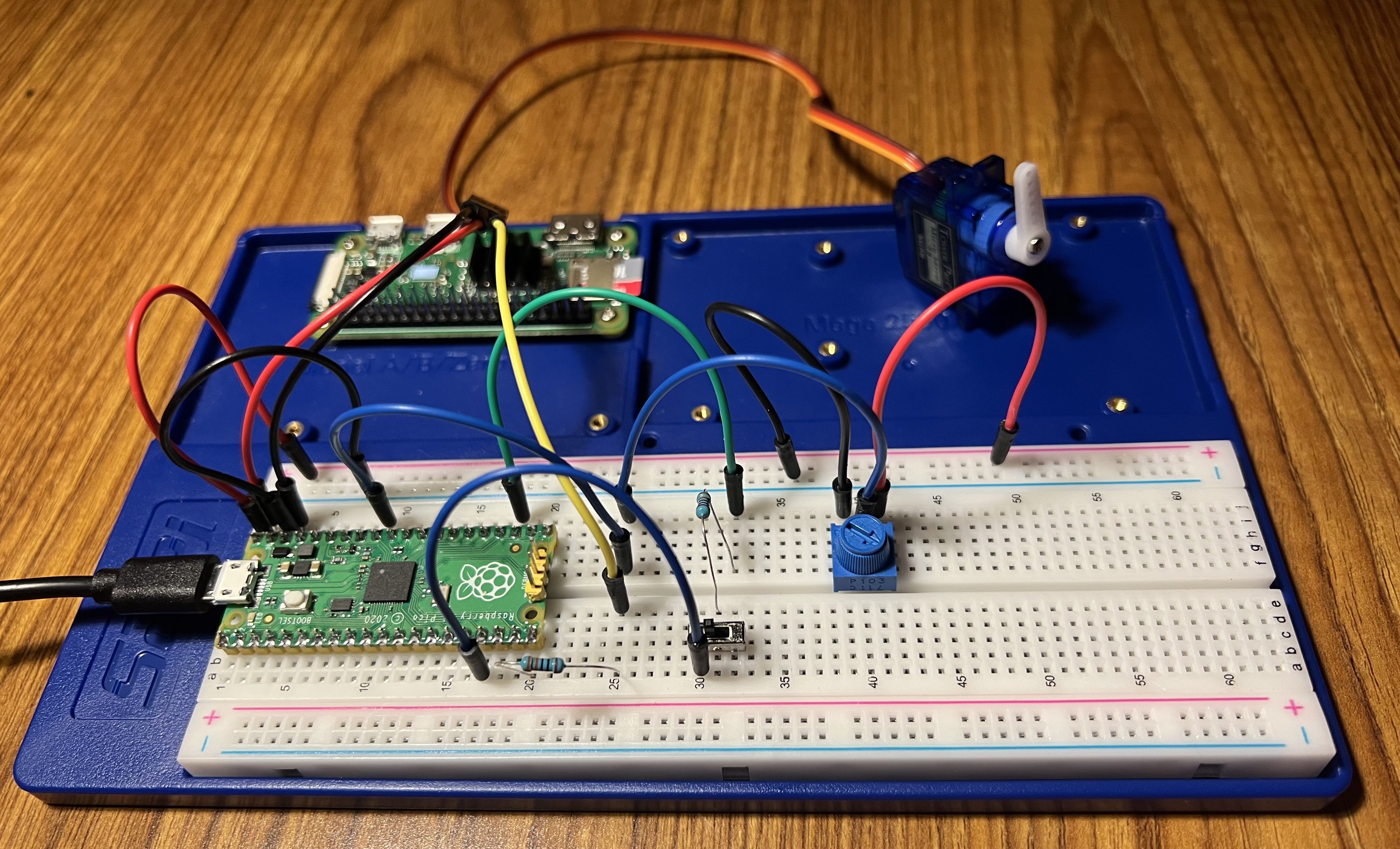
Our current build of Swipe / Smart uses a python based code that allows the microcontroller to regulate the timing speed of a servo (in place of a motor and wiper setup) by evaluating the voltage being manipulated by resistance causing the timing to change. The function is controlled by an on/off switch that can be used at any time to manually start or end the wiper oscillation.
The code reads the input voltage from the potentiometer to set the variable that will determine the interval of the oscillation. Our current setup controls resistance via a dial which can manually be changed. Each setting on the potentiometer dial relates to its own if/else statement which sets the interval length.
What’s next for Swipe / Smart?
Now that our product is functioning based on resistance, our next step is to determine resistance against the motor based on the drag on the wipers when a windshield is dry. A wet windshield provides little friction, and the motor will need to expend less effort to move the wipers than when a windshield is dry. Once we are able to measure this resistance, we can rewrite the code to perform using the input from the motor resistance instead of a setting on a dial.
We still need to work out the correct way to interface with vehicles. This will probably be one of the more difficult steps, because the way that the windshield wipers interacts with vehicles is extremely varied. The staff would need to include dedicated gear heads who could provide more technical knowledge.
Our website will need to be fleshed out much more thoroughly, and we will need to create a full database for the back end. To support our users, we will need to determine the user authentication for website logins and payment tracking.
Our ideal support would start with 3-5 of the most common makes and models of vehicles that we are able to support with roughly plug-and-play capability. The community will drive further development as we are able to crowdsource and fine tune more vehicle setups.
Challenges we ran into
Because none of us had ever built a Raspberry Pi before, our weekend started off slow. We ended up utilizing make.playpiper.com to build out our prototype code and create something that worked. Unfortunately, the website has a lot of built in and hidden libraries that make the programming process easier for beginners, but would not function to run outside of the website. This meant that we needed to break that code down and build it back up for a stand-alone product. We are submitting both our PlayPiper code and our production code to track our learning process.
Our original idea was extremely complicated and involved IR and moisture sensors that would have given a fairly fallible result and be susceptible to multiple environmental factors. A lot of our research and development went into these specialty sensors and interfaces, so this was time we lost. Luckily, our current prototype was much easier to implement, so we were able to make up that time.
Hacker Bios
Nathan Kuenstler -
Nathan is a computer programmer from Austin Texas with an AAS in software testing. He spends his spare time watching Anime and gaming. Currently, he is a Security Analysis in DPD at VISA. This is his first hackathon, and he assisted with procurement, hardware support, graphic design, and comic relief.
Challenges: This was Nathan’s first time working with a Raspberry Pi, and he needed to learn how to combine coding and machine programming. Using GitHub was also something he had never touched before. The hardware used for this project is not the highest quality, and there are limitations to quality
Successes: It had been a while since Nathan had worked on websites, and he was able to help Sonia get everything set up and teach her more.
Trevor Collard - Trevor is a Software Development student at ACC and works full time at Q2 Software as an Application Support Analyst. This is his first hackathon, and he worked on the coding for this project using python, web development, and heavily googling how to get things done.
Challenges: We started from ground zero knowledge on how to use a raspberry Pi, and it is not as intuitive as we originally thought it would be. Trevor spent a significant portion of the 24 hours learning about both the Python and Raspberry Pi Working within the time crunch created a challenge for managing progress.
Successes: Trevor has grown significantly in his skills with integrating hardware and software. He has gained a new love for Raspberry Pi and plans to purchase his own starter kit when he goes home.
Sonia Tovar - Sonia is a Software Development student at ACC, holds an AS in Computer Science, and currently works full time as an IT support specialist with a SaaS startup, Hearth. This is her fourth Hackathon, but don’t be fooled; she is a serial n00b! She managed the GitHub repository, DevPost, and server hosting, as well as working on the main web development.
Challenges: Editing HTML and CSS is a time intensive process, and Sonia spent a lot of this time learning on the fly. This took much longer than she originally expected.
Successes: Sonia attended the web development seminar and found it useful for creating the website. She solidified more of her GitHub skills.
Mars Loredo - Mars is a Software Development student at ACC and works full time as a Software Quality Test Engineer. When not working or studying, she enjoys overcomplicating the little things in life. She created the original concept and branding for Swipe / Smart. During the project, her main contributions were to project management, researching, supply gathering, and software testing.
Challenges: Mars had a dream but no idea how to put it into action. While she is an accomplished software tester, she is still weak in programming skills. During the competition, she needed to maintain a balance of general team support, copy writing, and software testing.
Successes: Mars stepped into the role of project manager well, having practiced herding cats with her 4 children at home. She was able to balance the need for productivity with the communal desire to have a fun weekend vacation with the people we had shared class and study group with all semester. She also taught GitHub skills to the teammates.


Log in or sign up for Devpost to join the conversation.