-
-
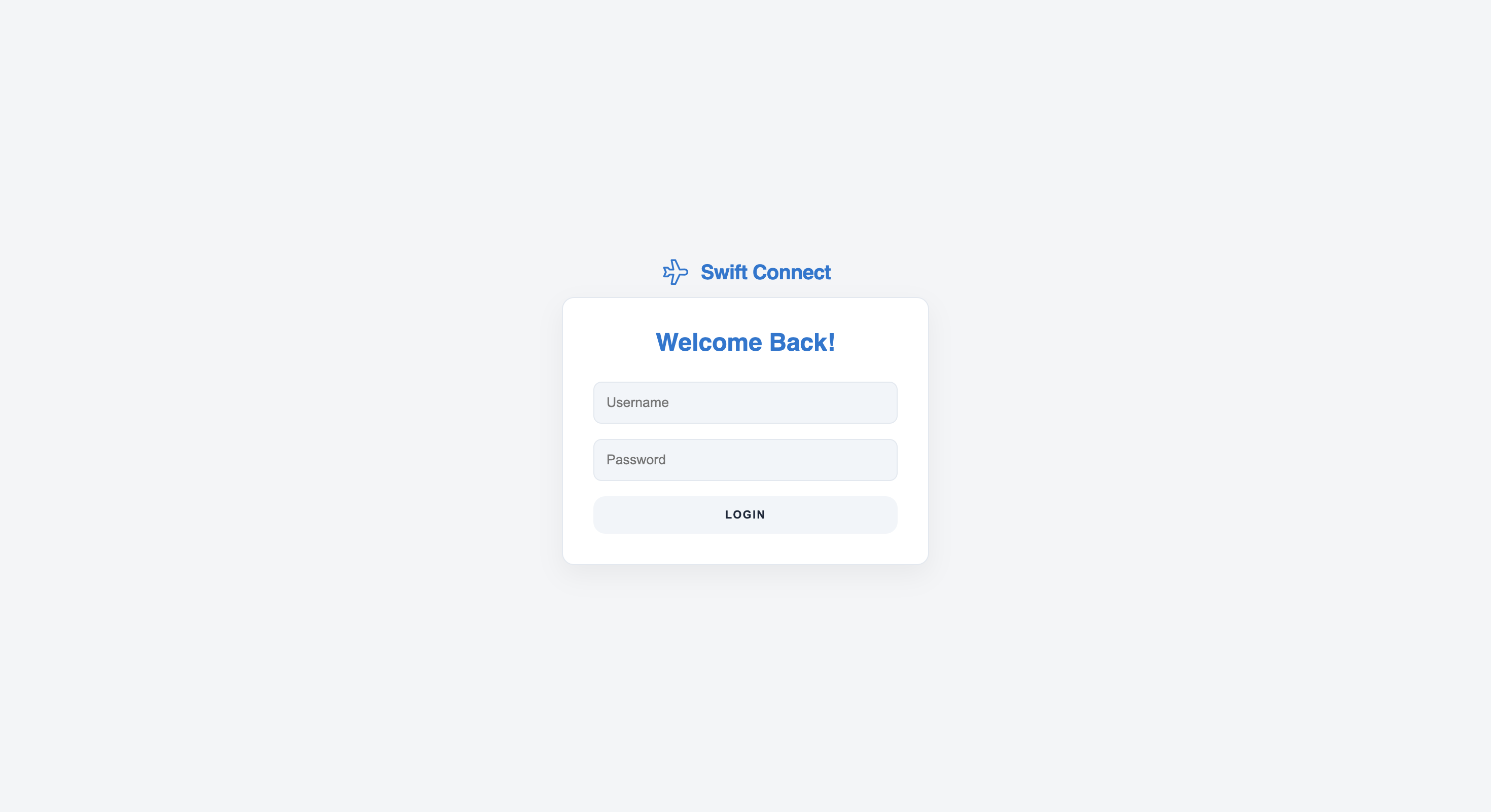
login page
-
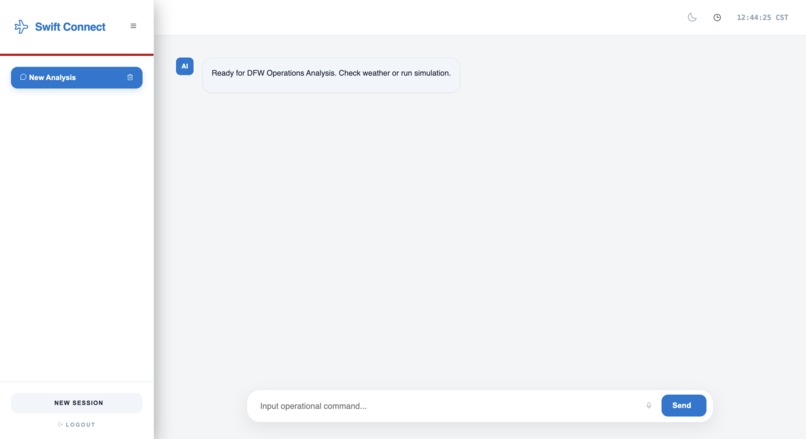
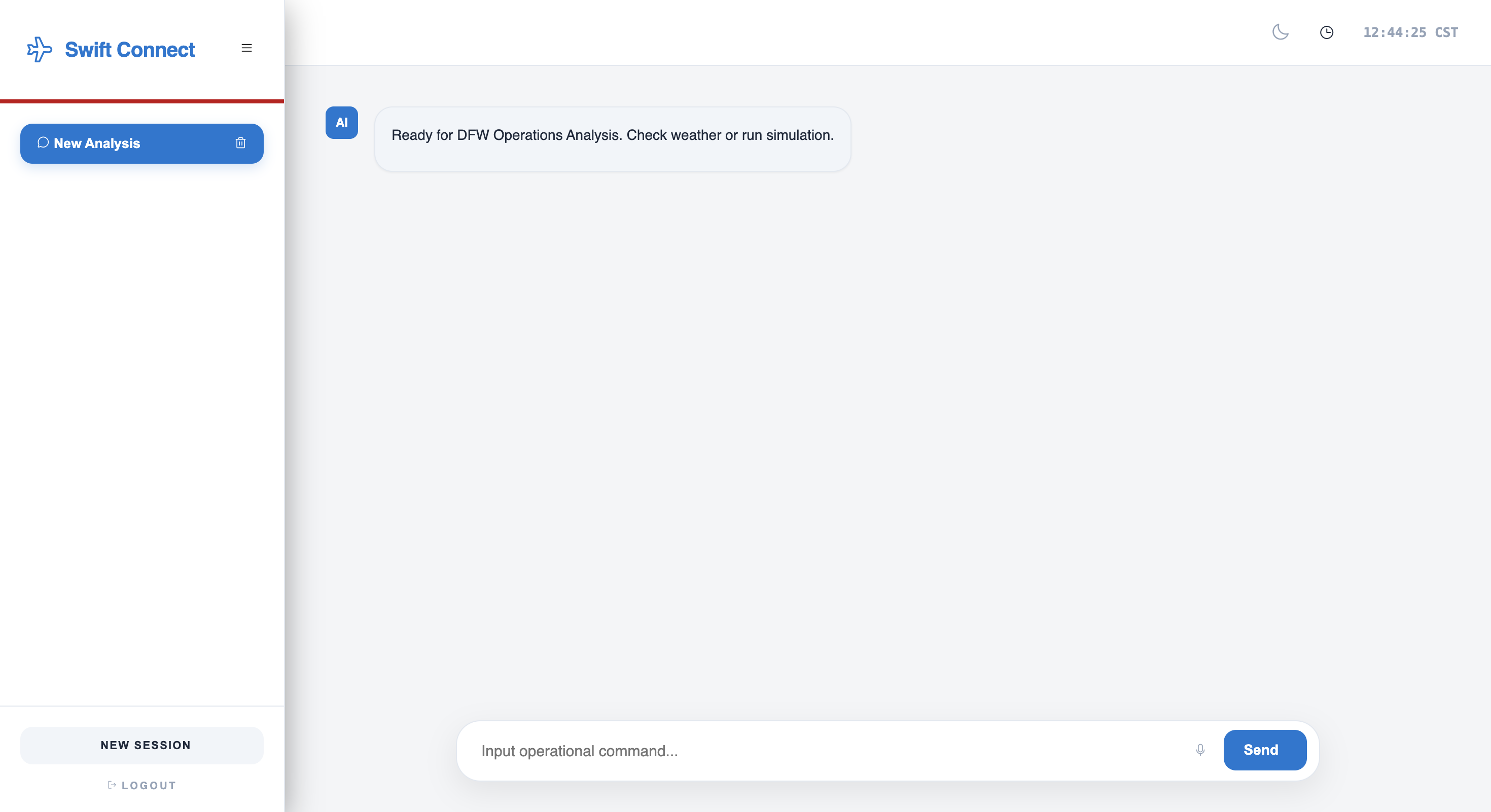
UI
-
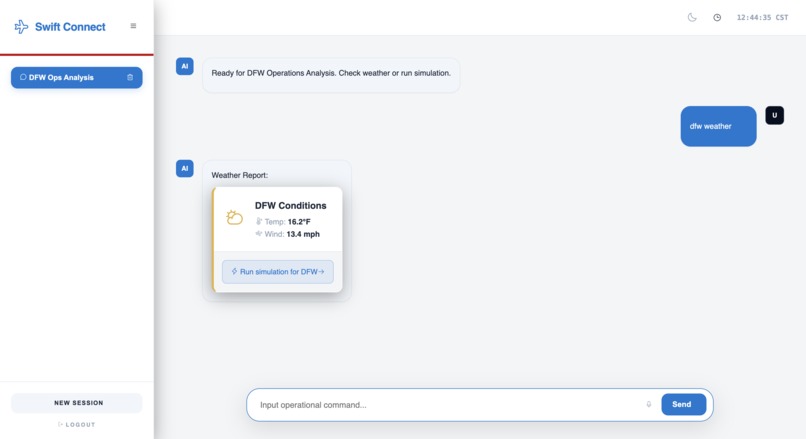
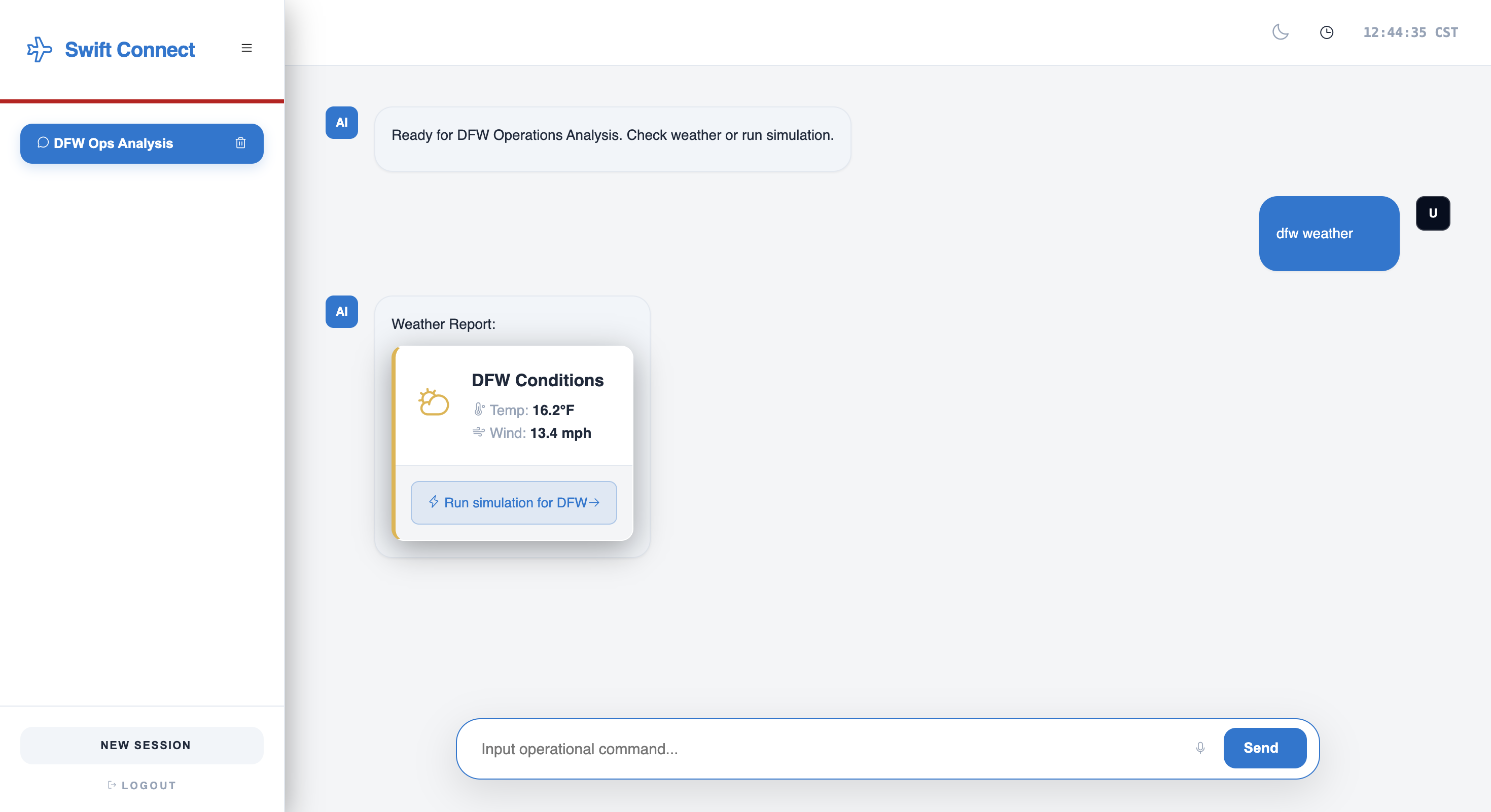
weather
-
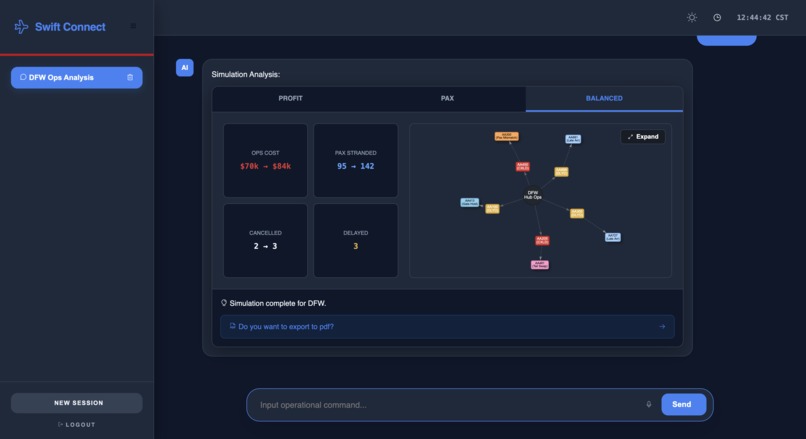
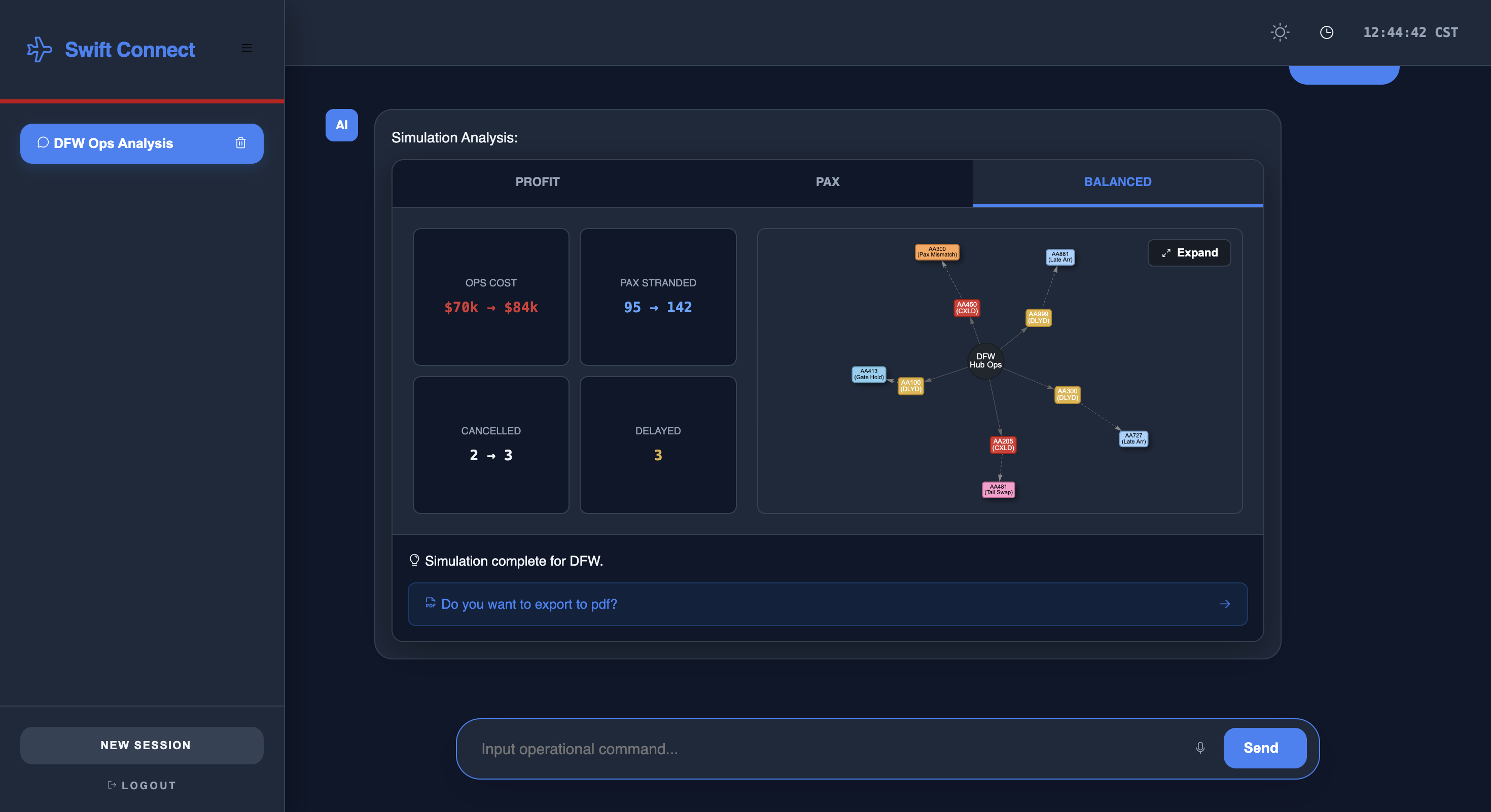
dark mode + simulation
Inspiration
All of us have dealt with delayed or canceled flights, especially during busy travel periods like December. What stood out to us is how one small disruption can spiral into a system-wide problem. Even though powerful computing tools exist, they aren’t built for the people who actually have to make these decisions in real time. SwiftConnect came from the idea that advanced decision support should feel simple, fast, and usable when it matters most.
What it does
SwiftConnect allows users to describe airline disruptions, like hub closures or severe weather events, in plain language, by typing or voice-to-text. We use Google Gemini API to translate this input into parameters that are fed into a high-performance engine that evaluates thousands of recovery scenarios in parallel. Managers can:
- Interact Naturally: Ask the system questions like, "Show me the ripple effect of cancelling AA205."
- Simulate Futures: Run real-time Monte Carlo simulations to see how a single decision impacts network profitability, passenger satisfaction, and operational costs.
- Visualize Logic: View visual charts that show downstream consequences, like how a delay in Dallas triggers a "Crew Timeout" in London, before finalizing decisions.
The system calculates operational cost, passenger impact, and delay tradeoffs, and returns a small set of clear, actionable strategies that stressed managers can immediately use.
How we built it
We built SwiftConnect using Python and Flask for the backend, with local parallel processing to simulate HPC-style workloads. The Gemini API is used to interpret natural language inputs and summarize large simulation outputs into concise recommendations. The frontend is built with HTML, CSS, and JavaScript, providing a lightweight dashboard that connects user input, simulation execution, and result visualization into a single workflow. We also leveraged Vis.js for the interactive “Flight Network Map,” showing the impact of decisions in real time.
Challenges we ran into
One major challenge was integrating the backend and frontend seamlessly, especially when transitioning from a React-based stack to a lightweight HTML/CSS/JS solution. Another was ensuring the Gemini API could reliably extract actionable simulation parameters from complex, real-world operator queries.
Accomplishments that we're proud of
We successfully demonstrated how high-performance computing concepts can be made usable by non-experts through natural language, including voice-to-text input. We built a working system that runs parallel simulations, integrates generative AI for both input and output, and presents results in a way that supports real operational decision-making for airlines.
What we learned
We learned that the biggest barrier to using high-performance computing is not computation itself, but accessibility. Clear abstraction, explanation, and presentation are just as important as raw processing power when designing decision-support tools. Using generative AI as a bridge between humans and HPC systems dramatically reduces cognitive load and accelerates decision-making.
What's next for Swift Connect
Next, we want to connect SwiftConnect to real airline data, expand the simulation model to include crew and maintenance constraints, and move toward a live decision-support tool for airline operations teams.


Log in or sign up for Devpost to join the conversation.