-
-
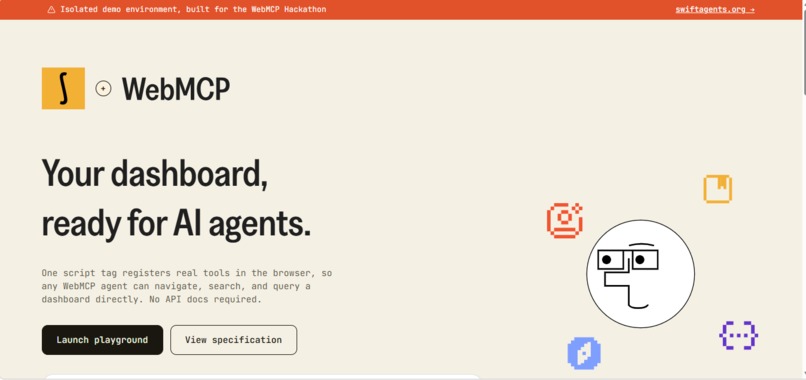
Hero section
-
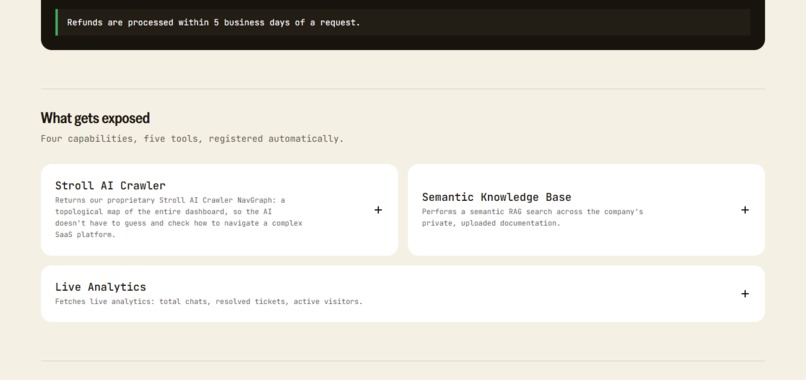
Try it section
-
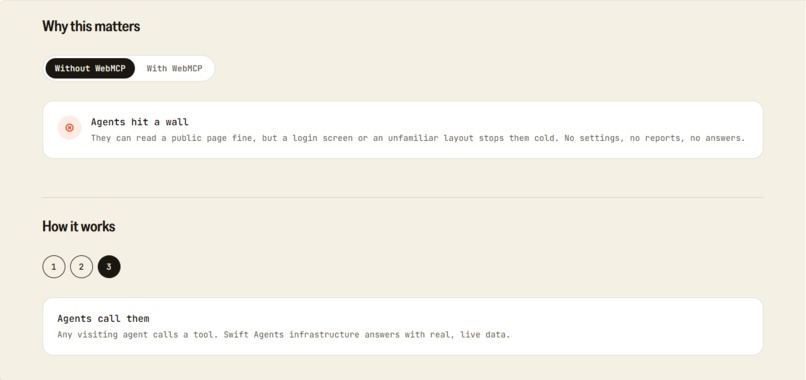
How it works
Inspiration
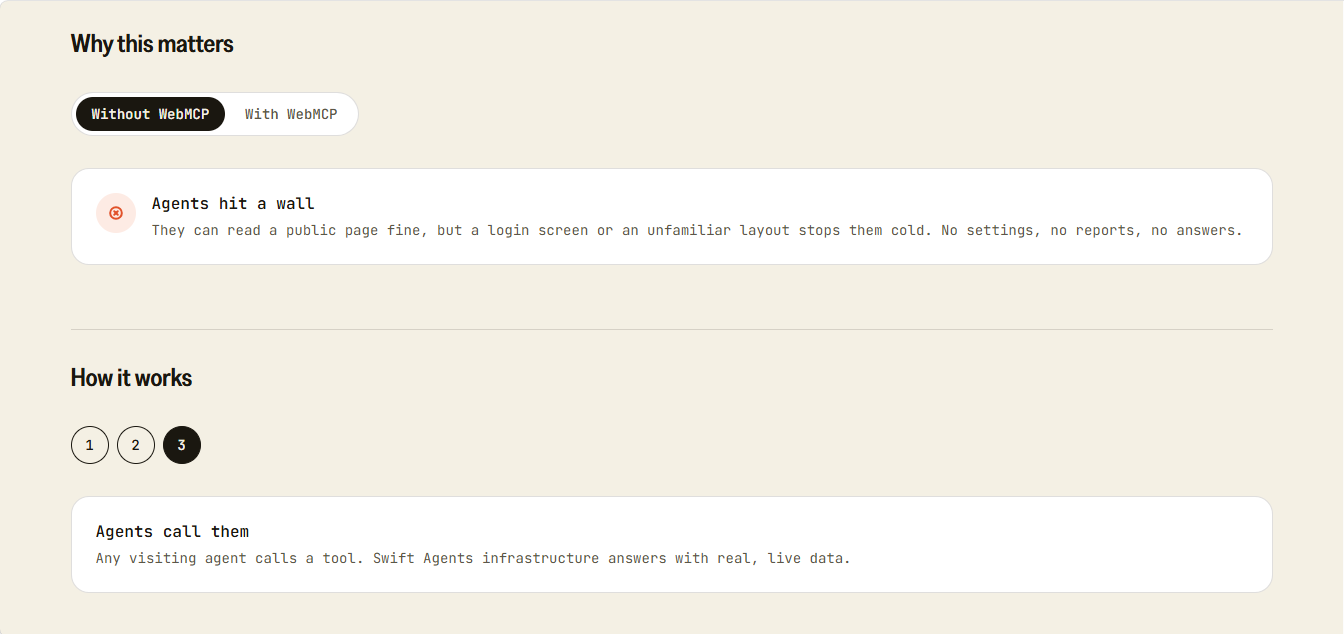
Today, if a user wants an AI to help them navigate a complex SaaS platform, find a specific API key, or analyze their dashboard data, the AI is completely blind. AI agents cannot see behind logins, which then makes building custom integrations for every single software platform an impossible task.
We were inspired to solve this "blind spot" for AI. We asked ourselves: "what if we could give any AI agent a complete, real-time map of a company's internal dashboard and private knowledge base, without requiring the company to build expensive custom API integrations or complex OAuth flows?" We wanted to build a bridge that makes any authenticated web application instantly "AI-Ready" and as simple as pasting a widget script.
What it does
Swift Agents WebMCP is a universal integration that transforms any traditional, complex web dashboard into an interactive environment for AI agents.
By simply pasting one line of code onto their website, a company instantly unlocks superpowers for their users. When a user visits the dashboard with a WebMCP-enabled AI assistant (like ChatGPT Desktop), our widget acts as a translator, allowing the AI to:
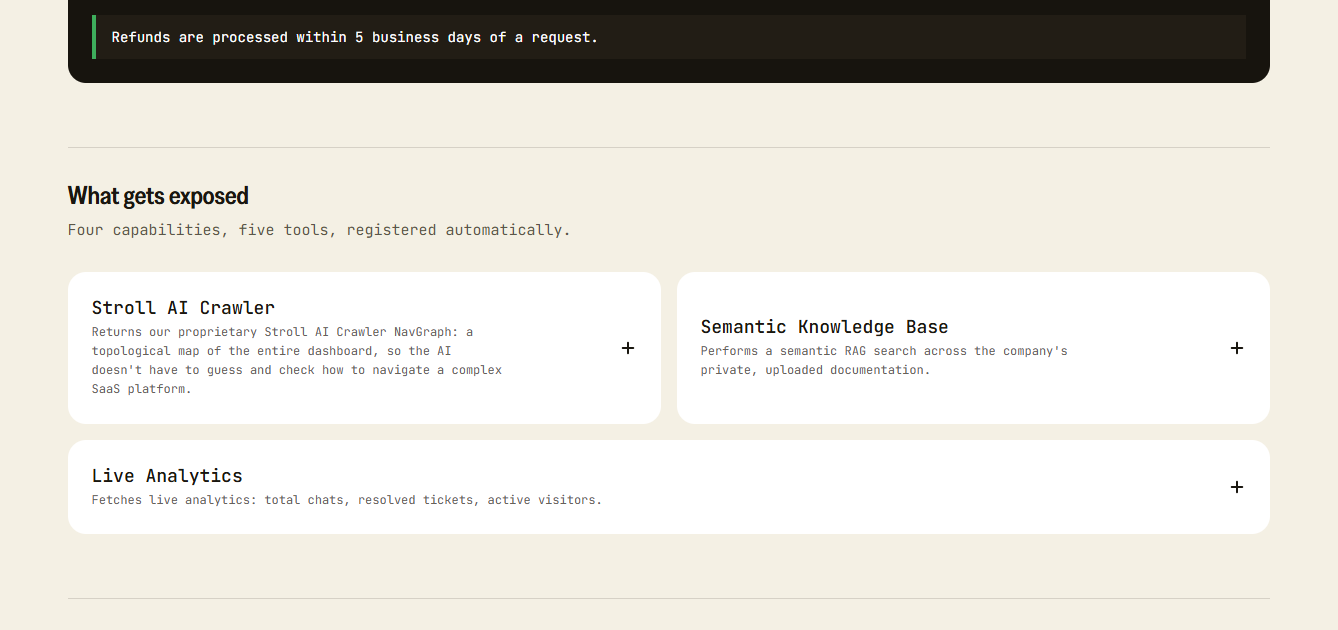
- "See" the dashboard: The AI receives a complete navigation graph of the platform, instantly understanding where pages are and how to traverse them.
- Read the docs: The AI can execute semantic searches across the company's private, gated documentation to instantly answer the user's questions.
- Analyze private data: The AI can pull live analytics and metrics (like visitor counts) directly from the user's dashboard to generate reports or insights.
It turns a passive web page into a fully autonomous assistant environment.
How we built it
We focused entirely on creating a frictionless "time-to-value" experience for businesses:
- Zero-configuration onboarding: We designed the system so that companies do not need to read API docs, manage API keys, or rewrite their backend. The entire integration is handled by dropping a single, lightweight script onto their site.
- Secure data proxying: We built a secure translation layer that intercepts the AI agent's questions, routes them to our backend infrastructure, and safely returns the contextual data back to the browser.
- Interactive playground: To demonstrate this vision, we built a modern demo dashboard where judges and users can interactively see exactly how an AI agent discovers and uses these tools in real-time. ## Challenges we ran into
- Bridging two worlds: The biggest challenge was conceptually and technically bridging traditional web security (authenticated user sessions) with the needs of autonomous AI agents. We had to ensure that the AI could access exactly what the user could see, without exposing underlying architecture.
- Pioneering a new standard: Because the WebMCP protocol is so new, we had to design entirely new user experiences. We spent significant time figuring out how to make the presence of these AI tools discoverable and intuitive for everyday users, rather than just developers.
- Contextual relevance: It wasn't enough to just give the AI data; we had to structure the navigation graph and knowledge base responses so that the AI could immediately understand and act upon them without getting confused by raw data dumps.
Accomplishments that we're proud of
- Democratizing AI integration: We're incredibly proud that we've leveled the playing field. Now, a small startup can offer the same deep AI-integration capabilities as a massive enterprise, simply by copying and pasting a script tag.
- The "invisible" upgrade: We successfully built a tool that is entirely invisible to regular users, but instantly comes alive with rich capabilities the moment a WebMCP-enabled agent connects to the page. It enhances the experience without cluttering the UI.
- The "Aha!" moment: Successfully watching a generic AI agent connect to our isolated dashboard, discover our tools, and instantly answer a hyper-specific question about our visitors stats was a massive breakthrough for our team.
What we learned
- *The future is universal agents: We learned that the future of AI isn't companies building thousands of custom chatbots for their individual websites. Instead, the future is protocols like WebMCP that allow users to bring their own preferred AI to any website and have it work seamlessly.
- Data structuring is everything: We discovered that providing tools to AI is only half the battle, formatting the data (like our navigation graph as a comprehensive markdown formatted text) so the AI can intuitively reason about it is the true key to a successful agentic experience. ## What's next for Swift Agents
- *Autonomous actions: Currently, our tools allow the AI to read and navigate. The next major leap is allowing the AI to write and act, such as creating tickets, responding to specific tickets, social media integrations, and so on.
- Dynamic tool generation: We plan to automatically generate WebMCP tools on the fly based on a company's specific database schema (based on spec), meaning every single feature a company builds instantly becomes an AI tool without any extra work. This is especially useful to companies that already have working API layers that they want SwiftAgents to automate for them
Built With
- ai-agents
- anthropic
- artificial-intelligence
- automation
- claude
- cloudinary
- css3
- customer-support
- express.js
- fastapi
- google-gemini
- headless-browser
- html5
- javascript
- langchain
- mcp
- mongodb
- node.js
- openrouter
- playwright
- python
- qdrant
- zero-dependency

Log in or sign up for Devpost to join the conversation.