-
-
merc.sweepy
Inspiration
Our inspiration came from WALL-E (2008), a movie released the same year I was born. Seeing a little robot clean up a world filled with waste made us wonder: could we build something similar, even on a smaller scale? So in the Hackosmos 2026, we decided to bring that idea to life with NEBULASWEEP, our own take on WALL-E with a specific purpose: detecting and collecting small metal debris to help keep workplaces cleaner and safer.
What it does
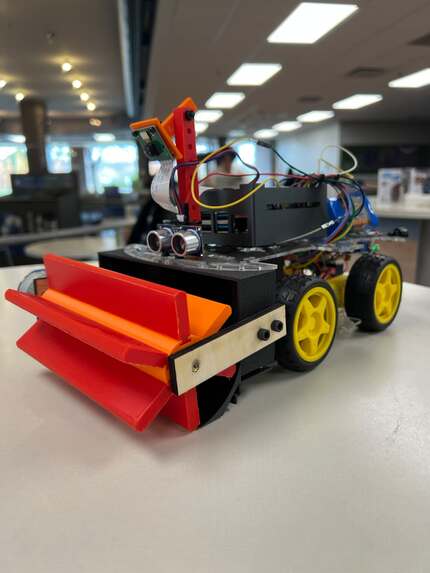
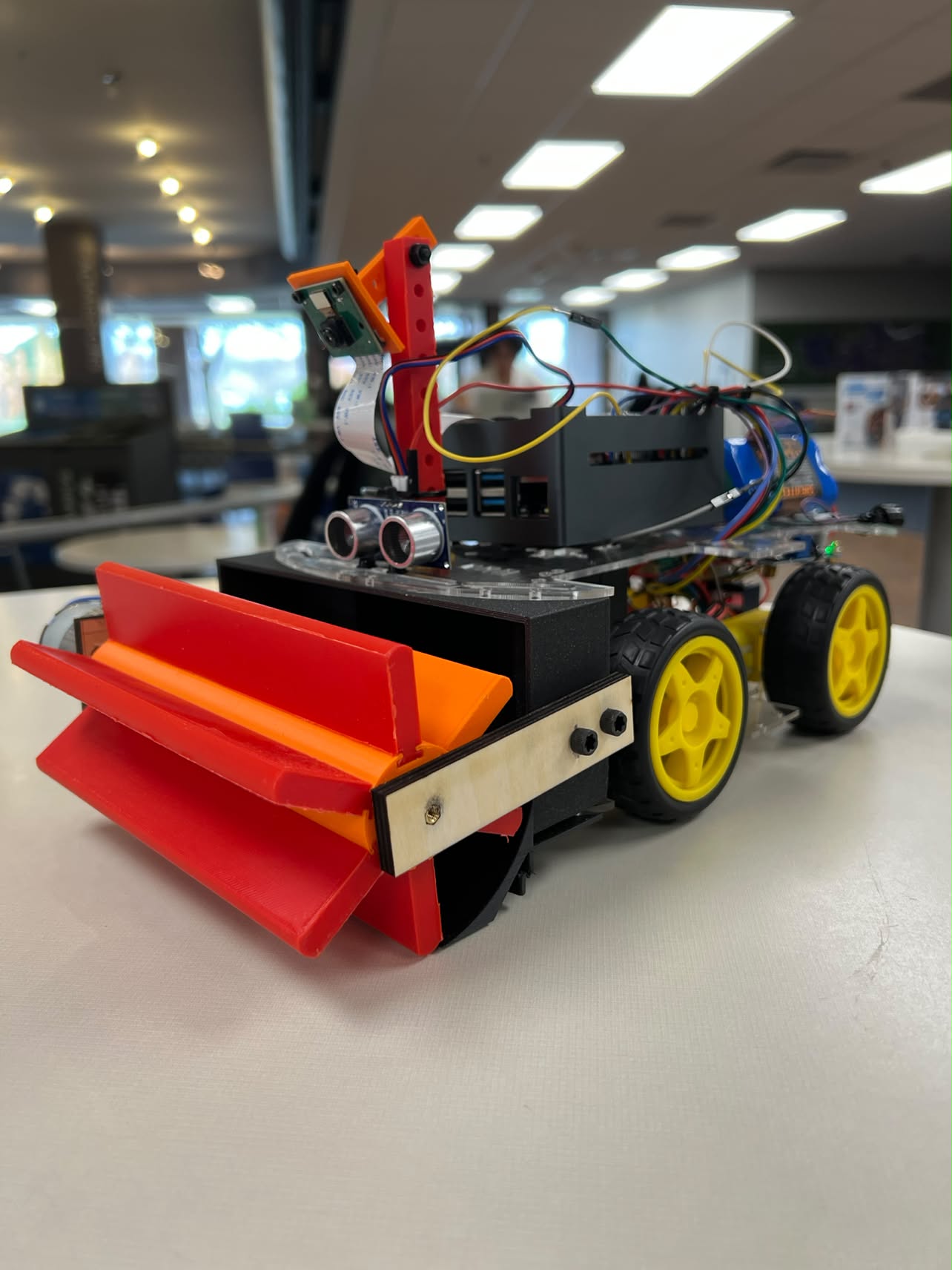
MERC.SWEEPY uses computer vision to spot small pieces of metal debris, then activates rotating cleaning wheels to sweep them up a ramp and into a collection area. It also uses a distance sensor to detect larger obstacles and change direction to avoid crashing. Together, these features form the foundation of a robot that can navigate a space and clean as it goes.
How we built it
We used a Raspberry Pi 4 as the main controller, paired with an Arducam camera and OpenCV for debris detection. When the system detects debris, it sounds a buzzer and activates the cleaning wheels. The collection mechanism combines spinning wheels with a ramp to guide debris into the robot. We also added a distance sensor to help it respond to obstacles and adjust its direction. Building Sweeping Bot meant bringing programming, electronics, and mechanical design together. Getting each part to work was only the beginning—the real challenge was getting them to work together.
Challenges we ran into
We got a lot of challenges during building this project; each part of our building process faced "problems need both engineering and algorithm": Software: Collecting image data, refining our detection approach, and testing it took much longer than we expected. We went through at least 30 rounds of testing and debugging, trying different backgrounds and lighting conditions to understand where detection worked well and where it struggled. Estimating the distance between the robot and a detected object was another difficult part. Hardware: Choosing compatible motors, motor drivers, and operating voltages required careful planning. We had to balance the power needed to move and clean with what our components could safely handle. Mechanical design: Spotting debris was one thing; picking it up was another. We experimented with different cleaning-wheel designs to find a setup that could sweep small metal pieces onto the ramp consistently.
Accomplishments that we're proud of
One of our proudest moments was achieving over 92% metal debris detection accuracy in our tests on a white background. There is still work to do across other surfaces, but this gave us a clear starting point to build on. We also demonstrated that the robot could sweep up metal debris while moving in a straight line. After so much testing and adjustment, seeing it actually collect debris was especially rewarding. Just as satisfying was watching the camera, buzzer, motors, and sensors respond together as planned. We had turned a collection of separate parts into a working prototype.
What we learned
This project gave us hands-on experience with OpenCV, Raspberry Pi, CAD design, and 3D printing. We learned how to process camera data, control motors, and turn a mechanical design into something we could build and test. We also learned how much coordination a robot requires. The motors, LCD, buzzer, camera, and distance sensor all needed to work within the same system, and a change to one part could affect the others. Our biggest takeaway was that a successful test of an individual component does not guarantee a successful robot. Testing the whole system—and being willing to revise our designs—was just as important as building each part.
What's next for Sweeping bot
Our first priority is to improve the camera setup and detection capabilities so Sweeping Bot can recognize metal debris more reliably across different surfaces and lighting conditions. We also want to refine the cleaning mechanism to make collection more consistent. Once those basics are stronger, we hope to build a larger version that can collect a wider range of metal debris, including sharp scraps that can create hazards in workplaces. Sweeping Bot is still an early prototype, but it has helped us turn an idea inspired by a movie into something real. Our next step is to make it more reliable, more capable, and ready for more demanding environments.

