-
-
-
Sweepybara: never get a San Francisco street-sweeping ticket again
-
-
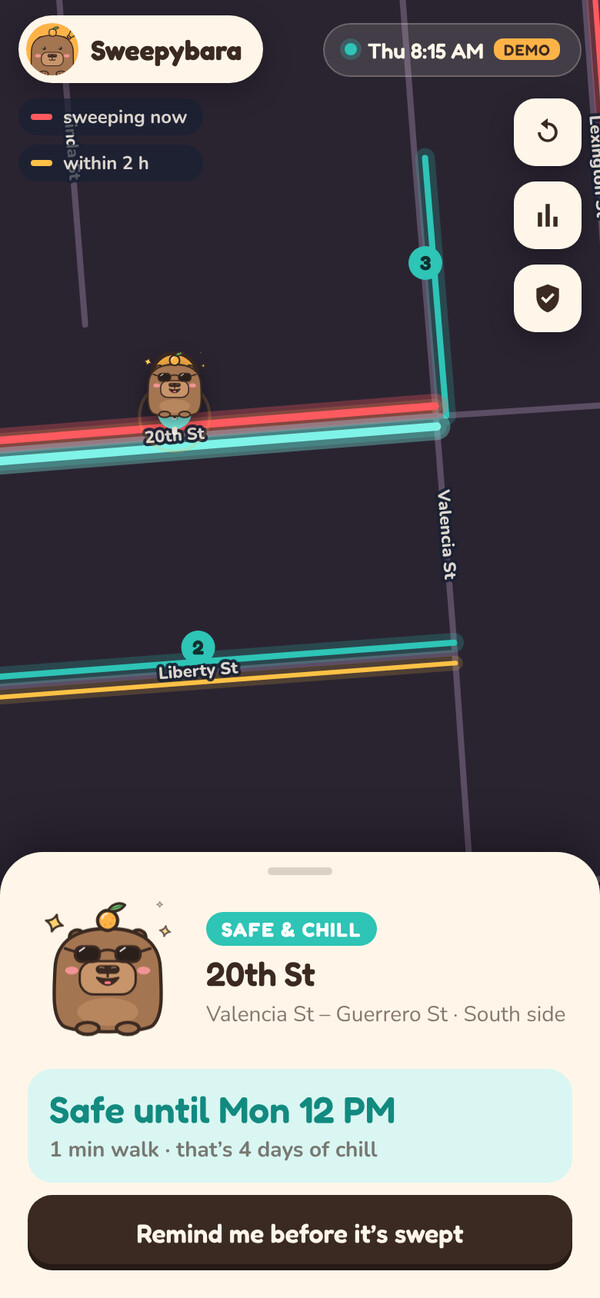
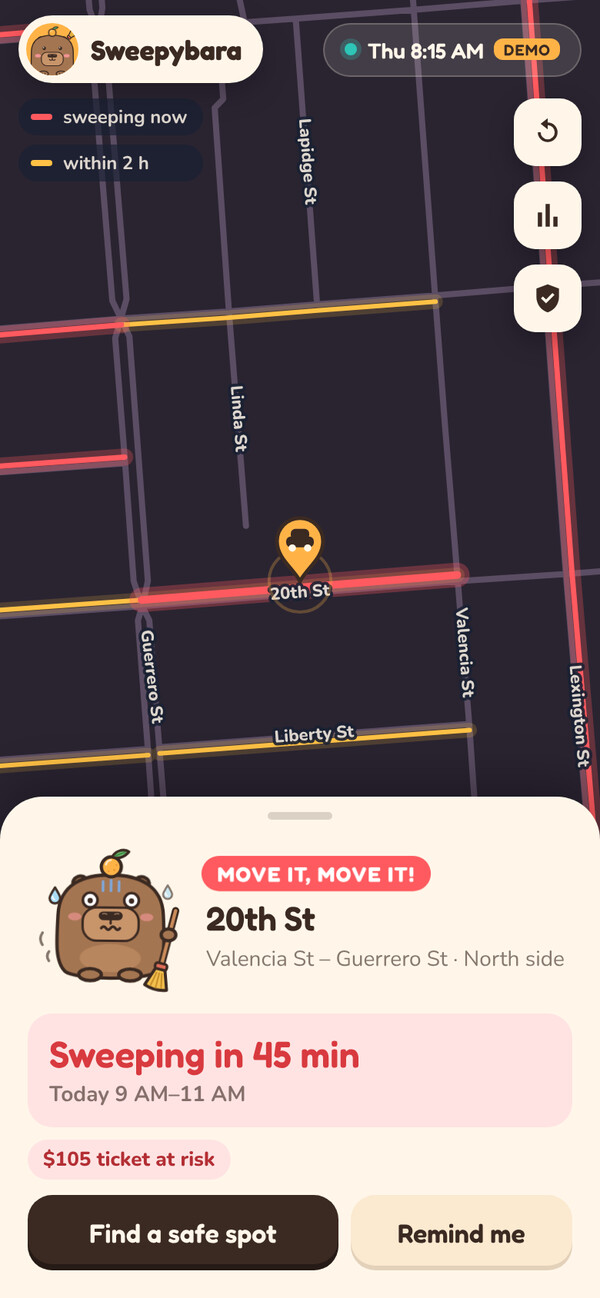
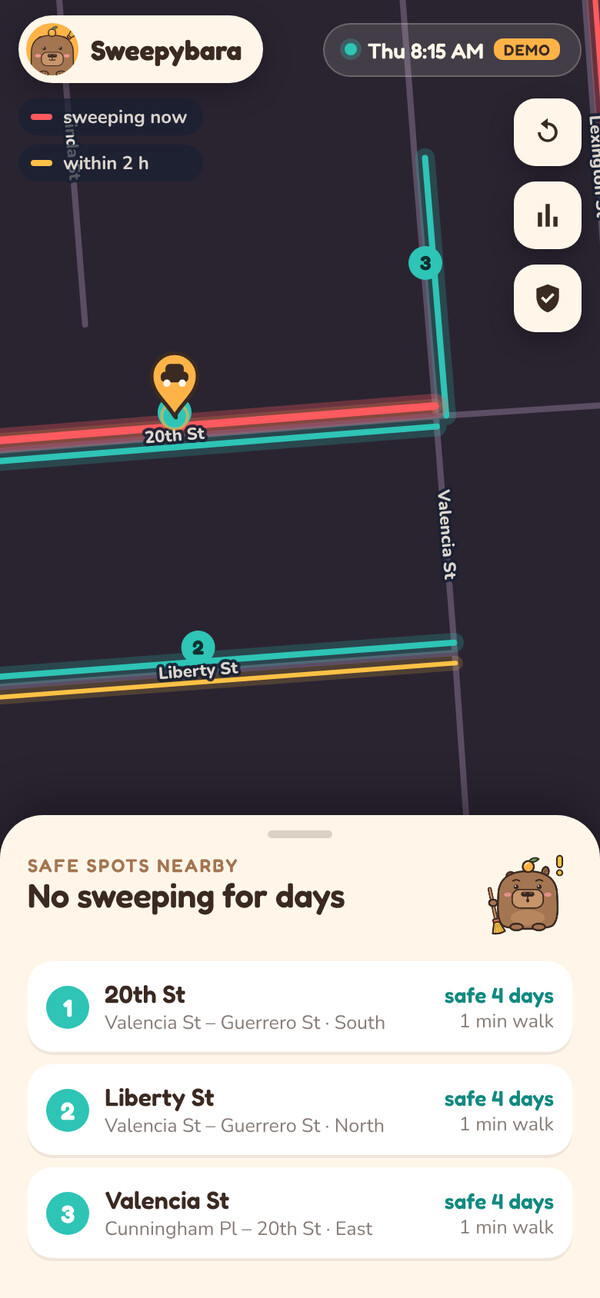
Sweepybara is a capybara that knows San Francisco's nearly 38,000 street-sweeping rules. Tell it where you parked. It tells you when your side of the block gets swept and finds the nearest spot that's safe for days. That spot is often just across the street. Then it reminds you before the sweeper arrives. It runs entirely on your phone from the city's open data, so your location never leaves your device. Built in one day at the National Renaissance Hackathon @ super{set} for Track 1: Hacking with Public Data APIs.
▶ 2-minute demo · 4-minute walkthrough · Pitch deck · Offline web demo
The problem
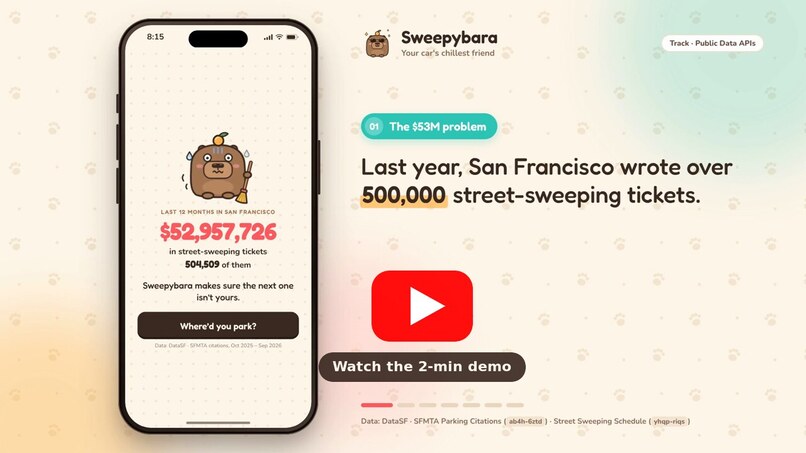
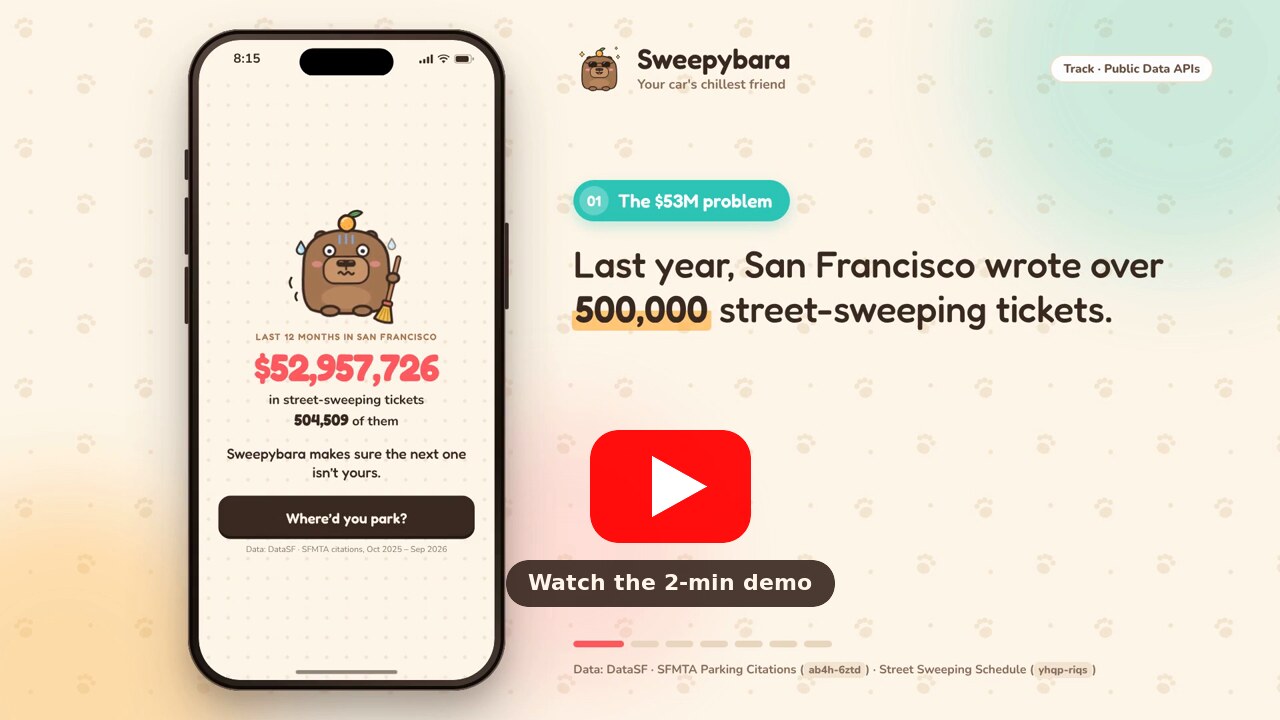
San Francisco wrote 504,509 street-sweeping tickets between October 2025 and September 2026, worth $52,957,726 in fines. That's about $105 per ticket and roughly $1 million every week.
- 2,407: tickets on one ordinary Thursday (Oct 15, 2026)
- 9–10 AM: the worst hour of the day: 99,518 tickets over the year
- $5.6M: in fines in the Mission alone
- 37,878: separate sweeping rules across 12,000+ street segments
The rules are hard to keep in your head. A real one reads "2nd & 4th Fridays, 6–8 AM, west side only." The other side of the same block runs on a different schedule, and city holidays suspend sweeping. Nobody checks all of that every time they park, so good drivers pay anyway.
Source: DataSF, SFMTA Parking Citations (ab4h-6ztd, violation STR CLEAN) and Street Sweeping Schedule (yhqp-riqs).
Our solution
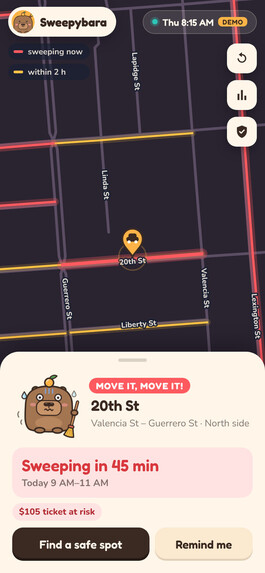
- I parked here. Finds your exact side of the block and counts down to the sweep. The capybara's mood is the countdown.
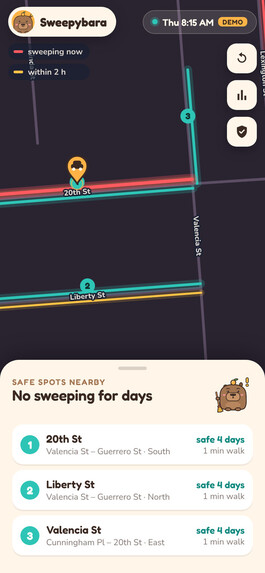
- Find a safe spot. Lists nearby block sides with no sweeping for days, closest first.
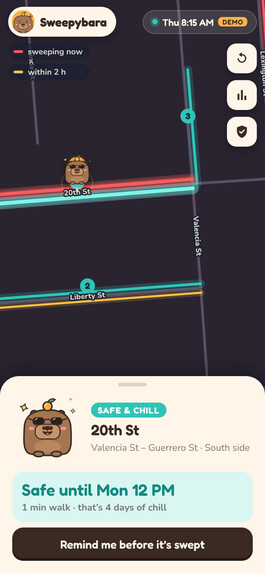
- Cross the street. The capybara hops to the safe spot: safe until Monday, 1 minute away.
- Remind me. The phone itself schedules a notification for 30 minutes before the sweeper.
- The $53M hook. Real numbers from the city's own records.
- Replay a sweep day. Every swept block glows, and each of the day's real tickets sparks.
- Ticket weather. When and where SF tickets, by hour, block and neighborhood.
- Privacy receipt. Shows exactly what left the phone: nothing.
Try it yourself: download this repo and double-click web-demo/index.html. The real app opens in a phone frame with one-click demo steps. It runs offline with nothing to install.
What makes it different
- Exact side of the street. The two sides of a block are often swept on different days. Sweepybara uses the dataset's street geometry to tell you which side you're on.
- Holiday-aware from the data itself. We found SF's no-sweeping holidays by looking for weekdays with zero or near-zero sweeping tickets in 504k citations.
- Zero servers, zero accounts. The whole city's rules ship inside a 2.5 MB app. Matching happens on the phone, and so does reminder scheduling.
- A mascot people share. The capybara turns a stressful chore into something people actually open, and want to show their friends.
Go-to-market
- Beachhead: SF drivers who park on the street. The pain is weekly and the cost is $105 at a time.
- We launch where people already complain: neighborhood subreddits, Nextdoor and local press. "SF wrote $53M in sweeping tickets last year" is a headline.
- Every user can share their own block's "ticket weather".
- Own the search. Be the first App Store and Google result for "SF street sweeping" and "street cleaning ticket".
- Fleets as the first B2B customers. Car-share, delivery and rideshare fleets operating in SF pay these tickets across hundreds of cars. A per-vehicle plan with a fleet dashboard sells on avoided fines.
- City by city. Chicago, Boston and Los Angeles publish sweeping schedules as open data, and New York publishes every parking sign. Our pipeline turns a city's open data into an offline rule set, so each new city is a data job, not a rebuild.
Commercial viability
- Free ($0): Park check, countdown, safe spots, reminders
- Sweepybara Plus ($2.99 / month): Automatic "you parked" detection, lock-screen countdown, tow-away and street-event alerts, every car in the household
- Fleet (per vehicle / month): Car-share, delivery and rideshare fleets: dashboard, API, avoided-fine reporting
Partners (licensing): Insurers, auto clubs and parking apps that want to offer sweeping alerts
The value is easy to see. One avoided $105 ticket pays for almost three years of Plus.
The market is proven in the data. SF drivers paid $53M in one year for this single violation, and every sweeping city repeats the pattern.
Near-zero marginal cost. There is no backend to scale: matching runs on the phone and the data refresh is a nightly script. Gross margins stay high from the first user.
Trust as a moat. No ads and no selling location, ever. In a category built on knowing where your car is, privacy is the brand.
How it works
DataSF open data (sweeping schedule · citations · neighborhoods) → nightly script → Compact city rule set (37,856 rules · 2.5 MB) → On-device engine (block side · week-of-month · DST · holidays) → Capybara app (map · safe spots · 24 h replay) and Phone OS (local scheduled notifications)
TypeScript · React · Canvas 2D + d3-zoom · Vite single-file build · Expo SDK 58 (iOS + Android) · DataSF Socrata API. The demo videos were recorded from the real app with Playwright and narrated with ElevenLabs.
Responsible data use
- Your location never leaves your phone. The full schedule ships with the app, so no request ever contains where you parked.
- No push server. Reminders are scheduled by the phone's own OS, so no server knows your routine.
- No license plates. The citations dataset includes plates. Our queries ask only for time, location and fine.
- Every number is sourced. Each statistic traces to a public DataSF dataset ID.
- Honest limits. Temporary signs, tow-away zones and permits aren't in the data, so the app tells you to check posted signs.
More: developer guide · demo contract · data from DataSF
Built With
- qwen

Log in or sign up for Devpost to join the conversation.