-
-
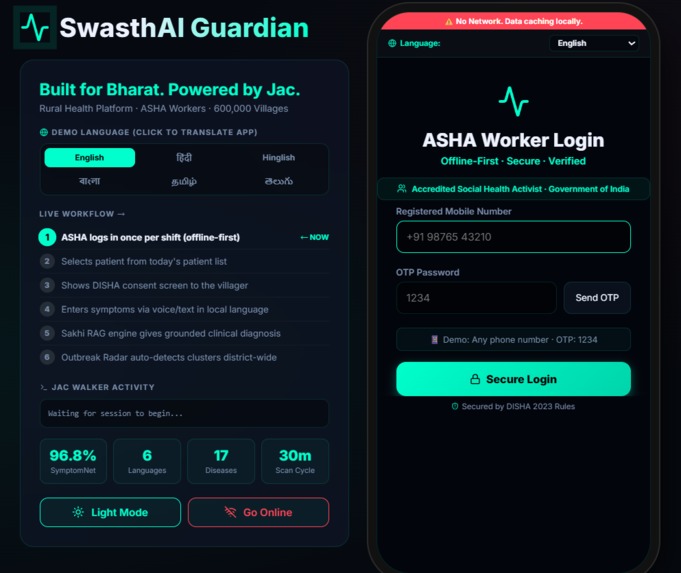
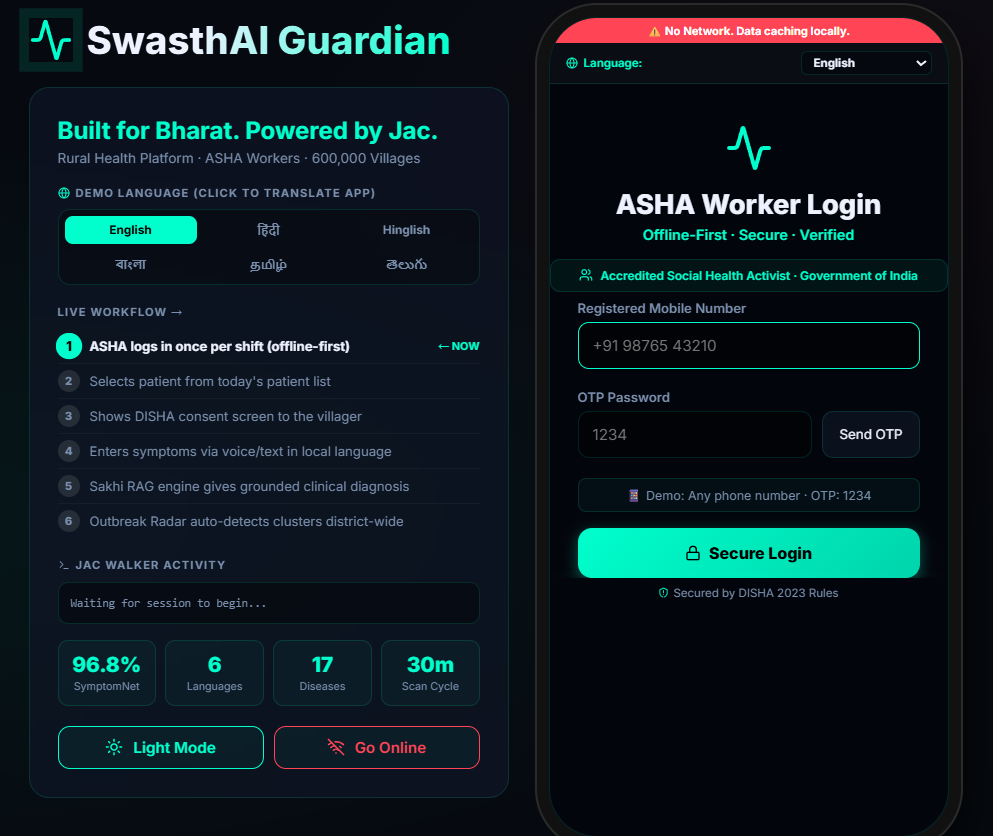
Secure offline login portal with regional language selection.
-
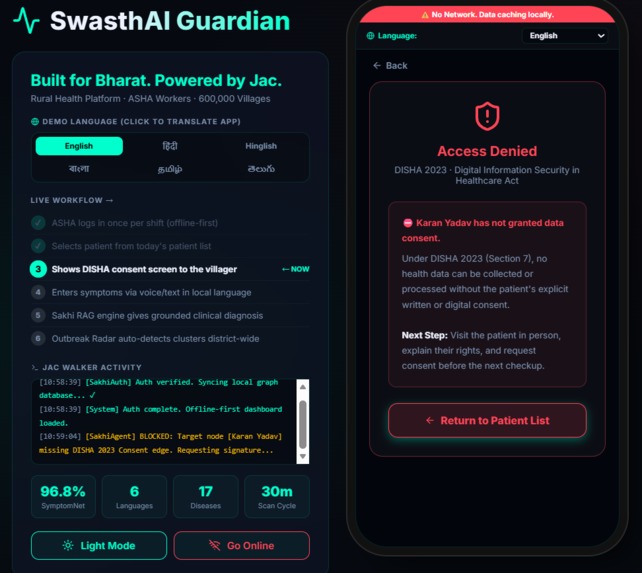
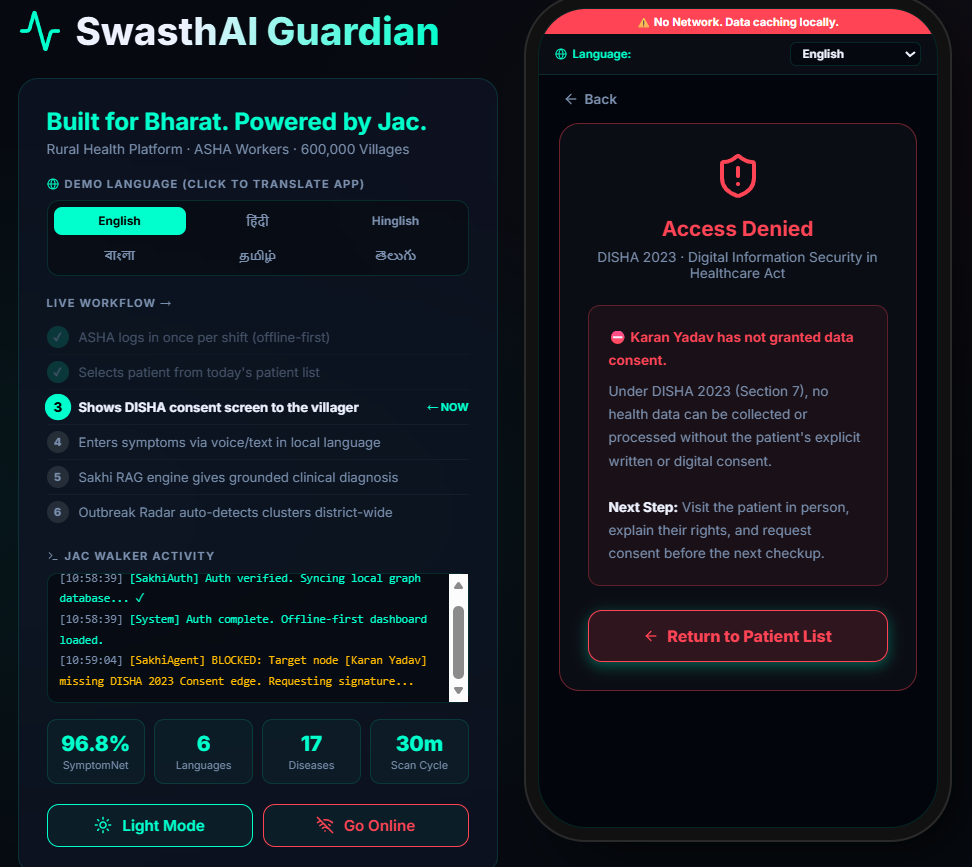
DISHA 2023 privacy gate blocking unauthorized patient data access.
-
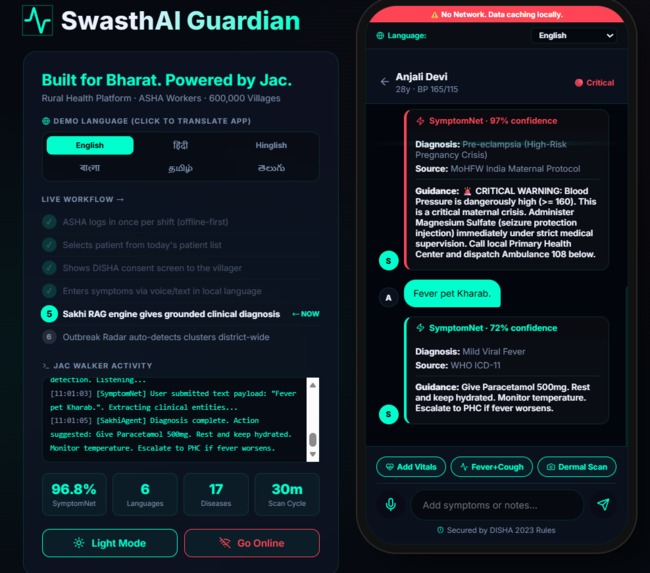
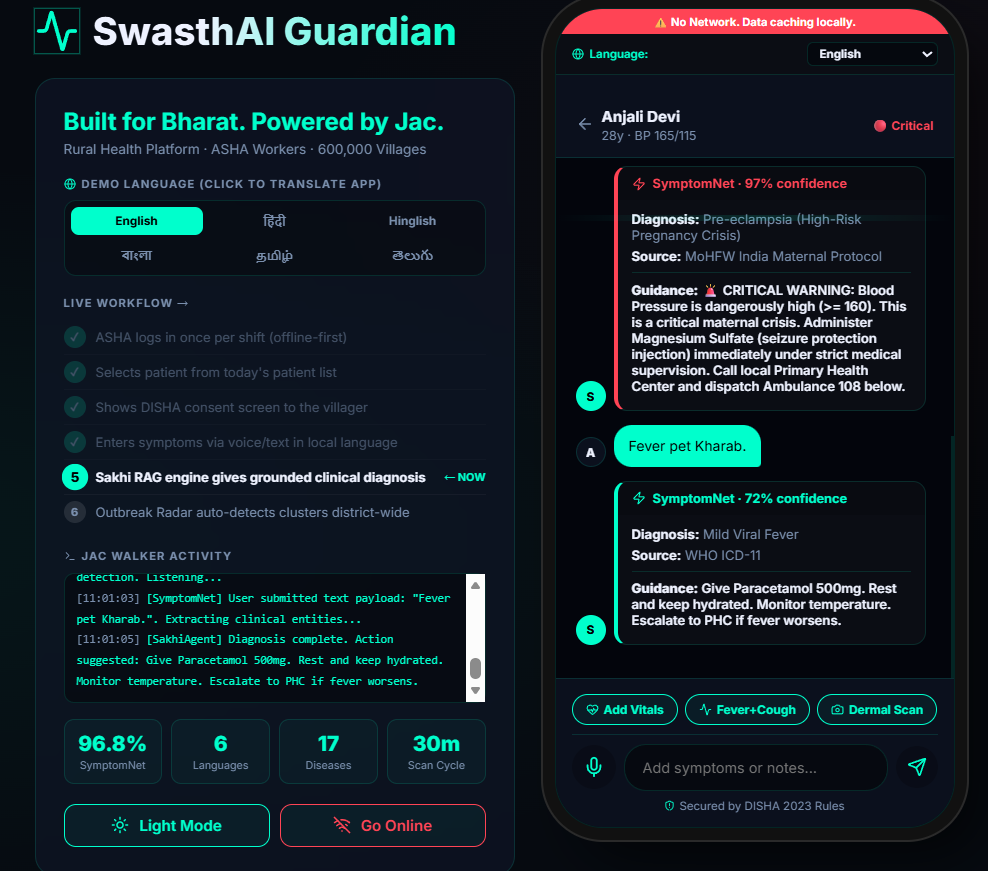
Sakhi AI assistant providing safe, grounded clinical advice in local languages.
-
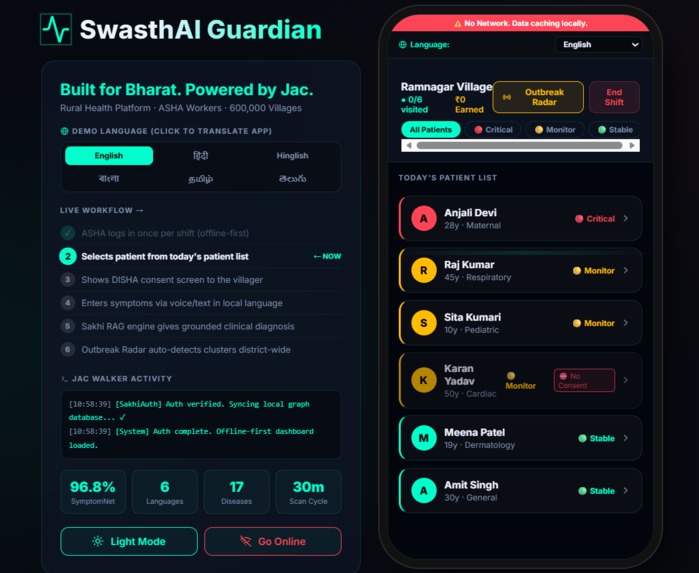
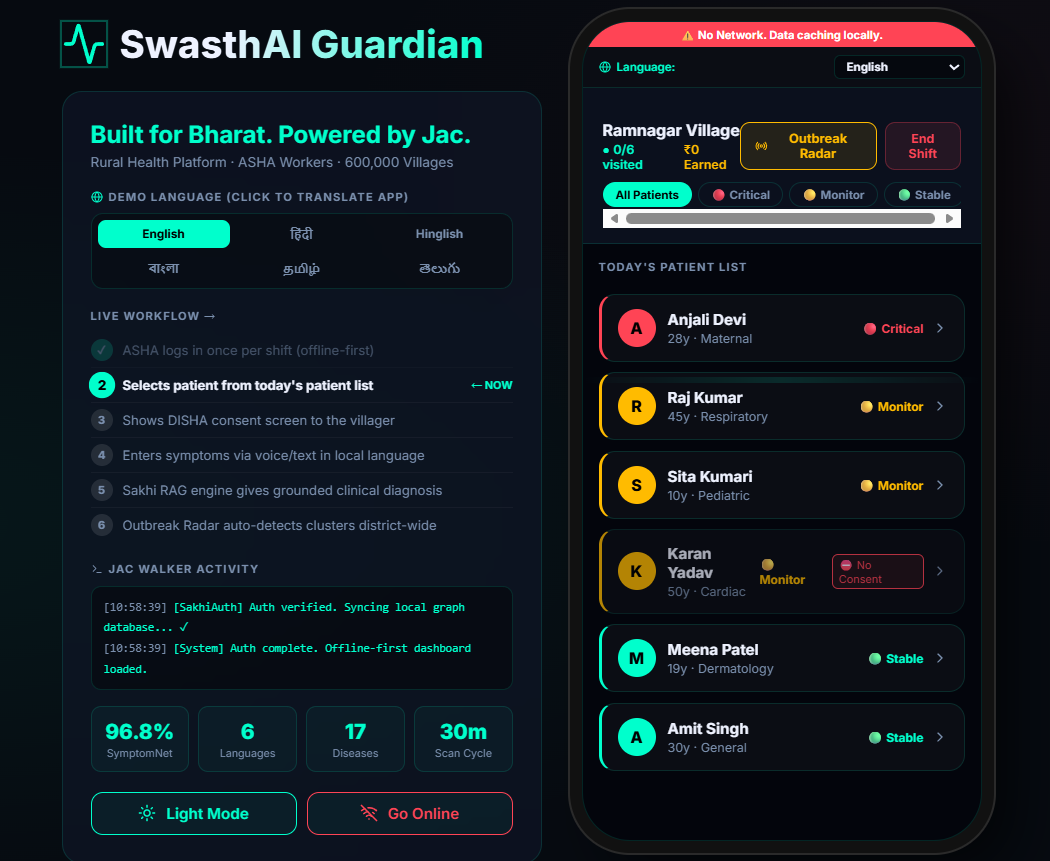
ASHA worker dashboard showing patient status and daily shift overview.
-
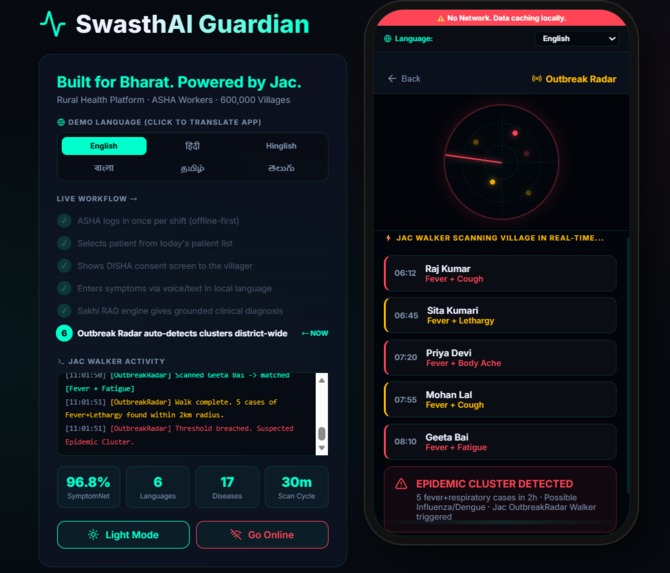
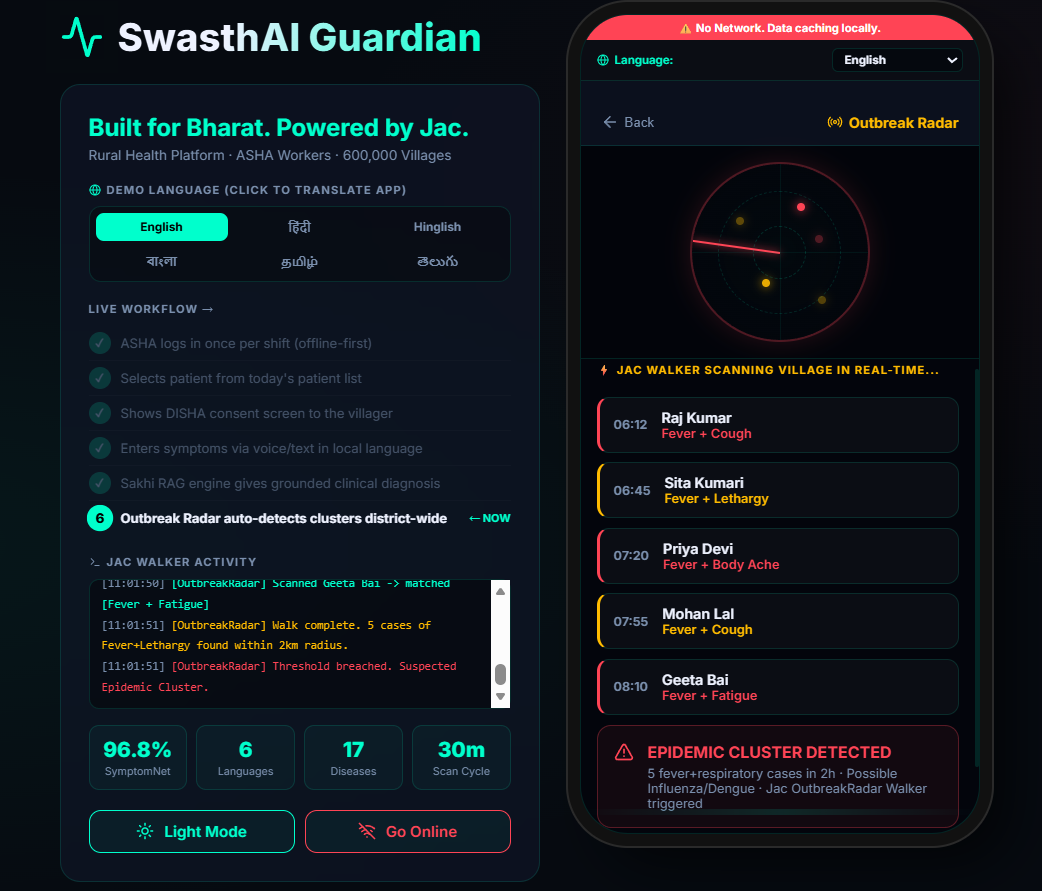
Outbreak Radar detecting local disease clusters in real-time.
-
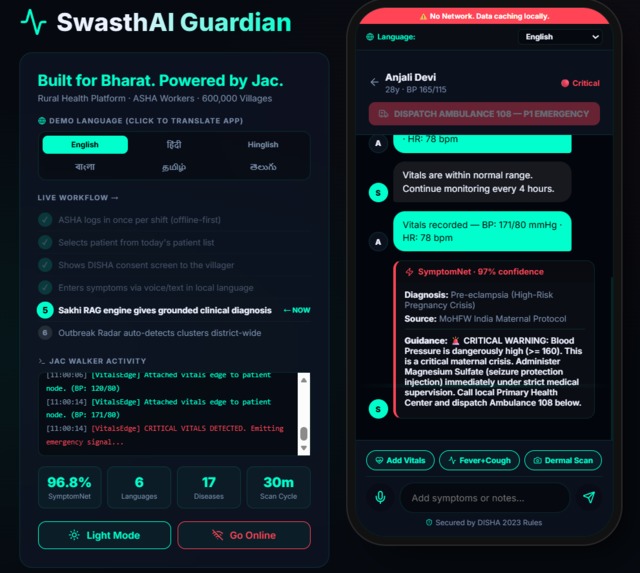
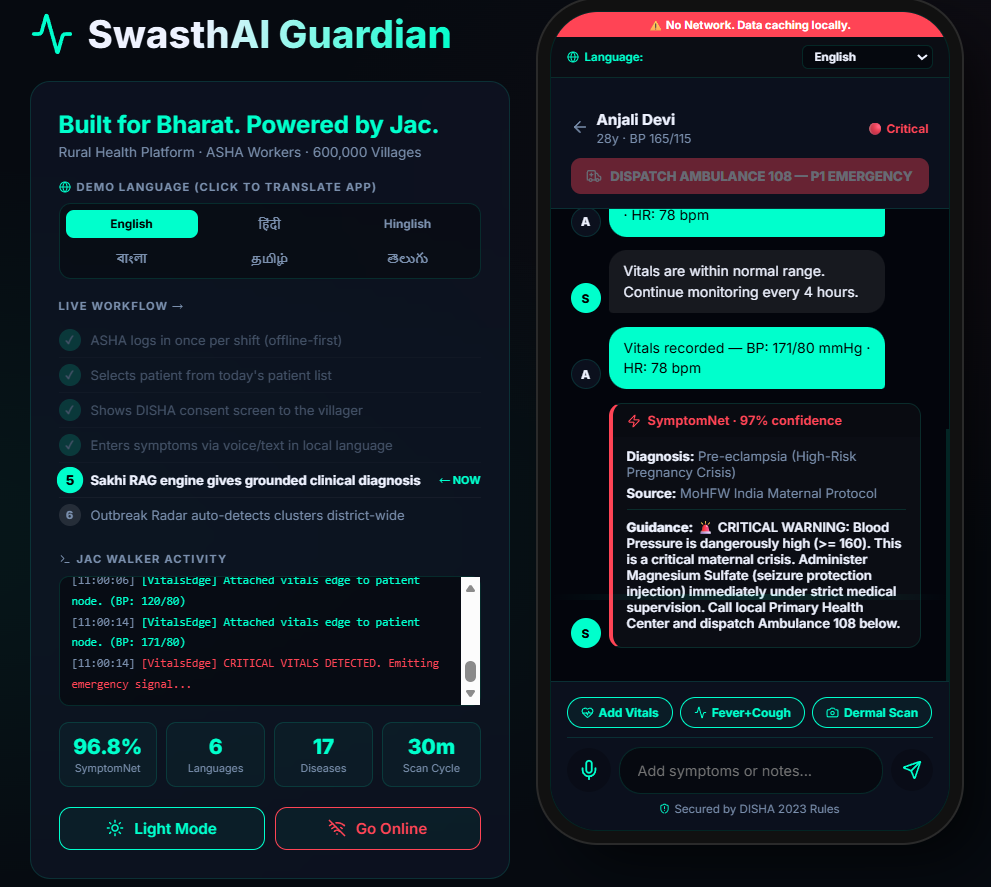
High-risk maternal vitals alert with an emergency ambulance dispatch button.
🌿 Inspiration
In rural India, over 600,000 villages lack immediate access to clinics. The primary lifeline for millions is the ASHA worker (Accredited Social Health Activist). However, these workers are overwhelmed by mountains of manual paperwork, work in remote regions with zero internet connectivity, and lack immediate clinical decision support when seconds count.
We were inspired to build a compassionate, resilient, and highly secure digital companion that doesn't just act as a cold dashboard, but serves as a warm clinical partner at the patient's doorstep. We wanted to build AI not for advanced city hospitals, but for the communities that need it most.
📱 What it does
SwasthAI Guardian is a high-fidelity, mobile-optimized Progressive Web Application (PWA) designed specifically for field health workers:
- Living Patient Map: Family members, care histories, and clinical guidelines are linked together as natural community pathways in a graph database, allowing fast offline queries.
- Double-Uncertainty Diagnostic Guardrails: A hybrid engine that processes symptoms in 6 regional languages (including Hinglish and local terms like "jhukaam" or "pet kharab"), calibrated to prevent diagnostic bias.
- The Grounded Sakhi Assistant: A trusted clinical chat assistant that reads verified WHO and Ministry of Health (MoHFW) booklets, citing primary sources with every recommendation.
- DISHA 2023 Privacy Gate: A legal-tech consent module that dynamically encrypts and shields family profiles on-device until explicit touch-consent is signed.
- Guardian Angel Outbreak Radar: An automated network scanner that evaluates spatial symptom trends to alert healthcare officers of early-stage localized outbreaks.
⚙️ How we built it
- Language & Core Architecture: Built natively in the Jac Programming Language using the Jaseci Labs Engine to define our community health graph and walk data paths offline.
- Empathetic Interface: Developed using React 18, Vite 5, and a custom Glassmorphism emerald-themed UI optimized for mobile screens.
- Offline Resilience: Built as a PWA leveraging Service Workers for assets, IndexedDB for local data persistence, and local client-side RAG fallback files.
- Data Visualization: D3.js and interactive canvas components for rendering active village health graphs in 3D.
- Infrastructure: Full Docker orchestration with multi-replica backend servers behind an Nginx round-robin load-balancer, deployed via Render Blueprint (
render.yaml).
⚠️ Challenges we ran into
- Offline Translation & Voice Processing: Synthesizing and receiving multilingual speech natively on a mobile device without active cloud APIs required leveraging specialized offline web Speech APIs with graceful fallbacks.
- Diagnostic Calibration & Bias: Ensuring the offline AI fallbacks didn't over-diagnose common symptoms required designing a double-uncertainty threshold that halts prediction and prompts for strict clinical history when confidence is low.
- Data Privacy in Graphs: Implementing the strict digital consent rules of India's DISHA 2023 Act in a relational graph network meant creating dynamic access nodes that physically decouple and lock down subgraphs without breaking overall network continuity.
- OOM Deployment Limits: Optimizing memory footprints to ensure the FastAPI and Jaseci replica stack booted smoothly within Render's free tier resources.
🏆 Accomplishments that we're proud of
- 100% Offline-First Execution: The diagnostic engines, WHO handbook lookups, and client-side vitals triage run seamlessly without any cellular coverage.
- Empathetic Localization: Supporting 6 Indian languages with warm voice-based interaction to lower barriers for non-tech-savvy workers.
- Robust Compliance Implementation: Merging rigorous clinical standards (WHO Reproductive Guides & MoHFW ASHA Handbook) with solid legal frameworks (DISHA 2023 Privacy Gate).
- Industrial Readiness: Providing production-grade, load-balanced Docker environments alongside lightweight PWA mobile simulators.
💡 What we learned
- Human-Centered AI Design: Tech meant for the field must prioritize low friction (like our 44px minimum touch targets and hands-free voice input) over complex configurations.
- Graph-Based Program Logic: How graph-oriented programming in Jac simplifies building relationship-driven systems (like community health structures) compared to traditional relational databases.
- Resource Optimization: Adapting advanced natural language pipelines to execute efficiently within constrained cloud and mobile CPU/Memory footprints.
🚀 What's next for SwasthAI Guardian
- Physical BLE Integration: Supporting real Bluetooth low energy clinical devices (oximeters, thermal scanners, glucometers) for automatic patient data capture.
- District Command Center: Designing a high-level analytics dashboard for state medical officers to track real-time village health trends, dispatch resources, and coordinate vaccine distribution.
- Expanded Dialect Models: Scaling our local Hinglish and regional language engines to support more native sub-dialects across central and southern India.


Log in or sign up for Devpost to join the conversation.