-
-
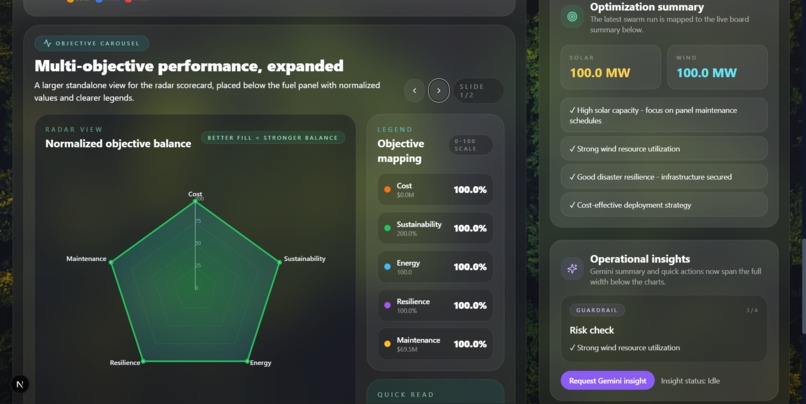
RESULTS 2
-
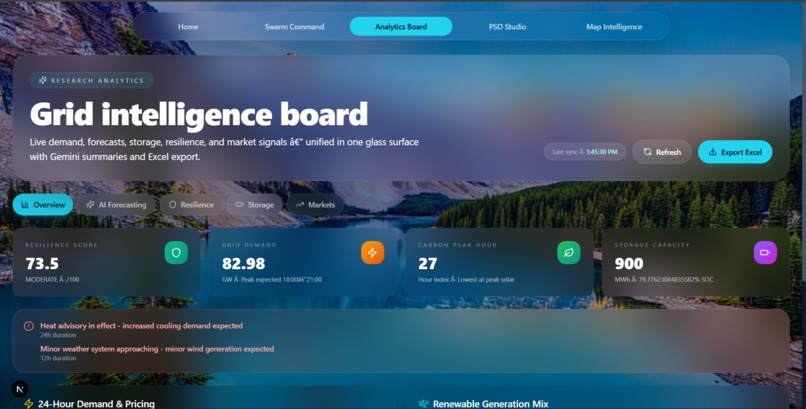
ANALYTICS 1
-
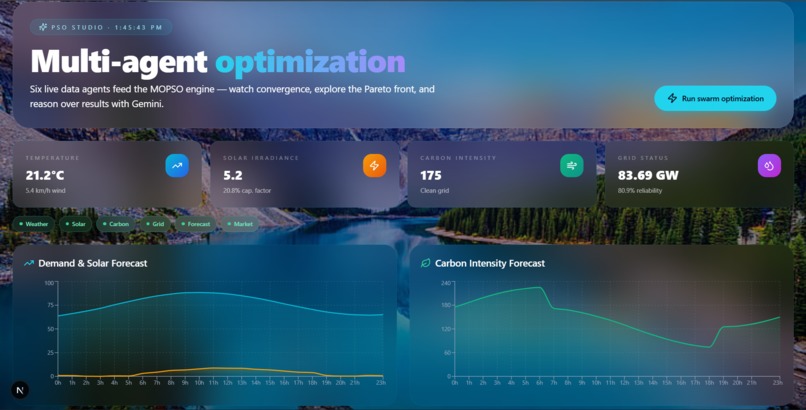
PSO OPTIMISATION
-
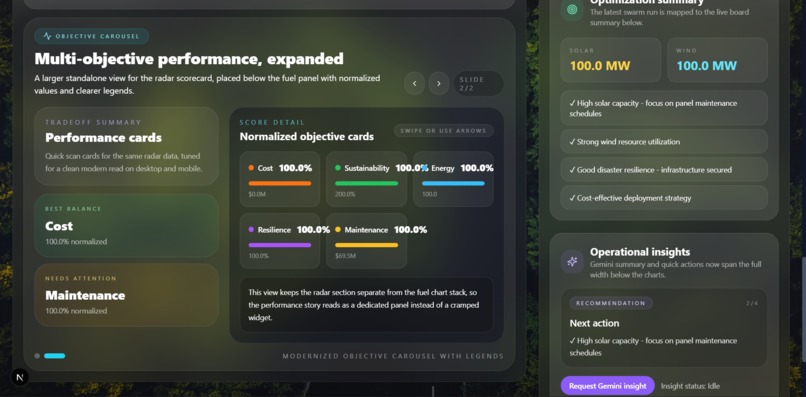
RESULTS 1
-
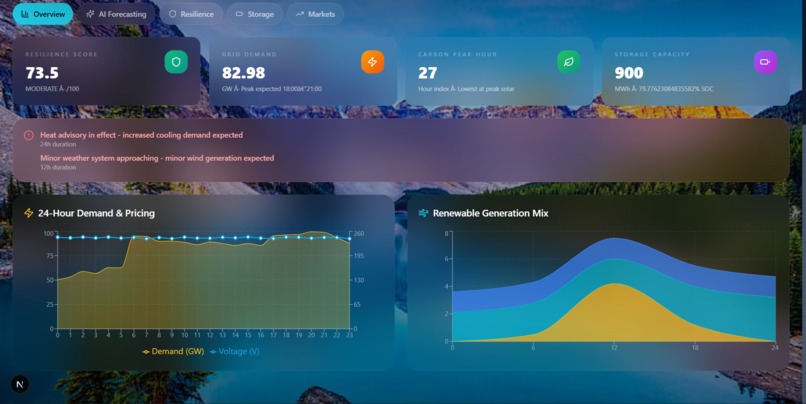
ANALYTICS 2
-
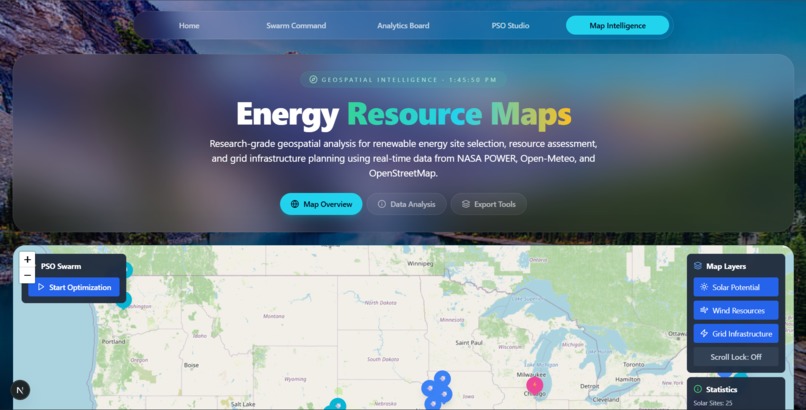
MAIN DASHBAORD
-
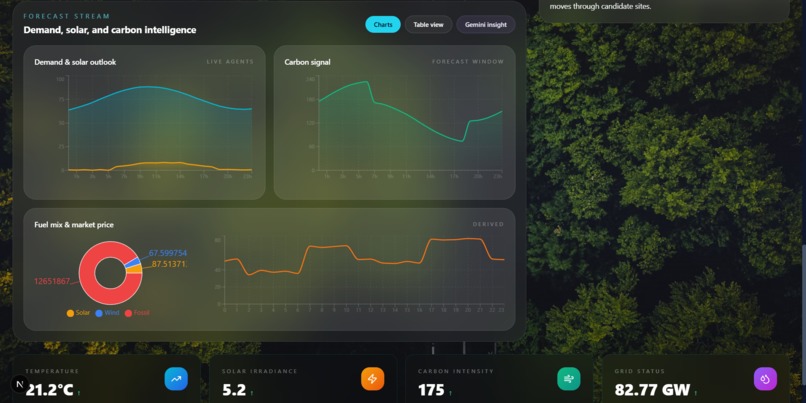
DEEP INSIGHTS OF SWARM COMMAND
-

LANDING PAGE 6
-
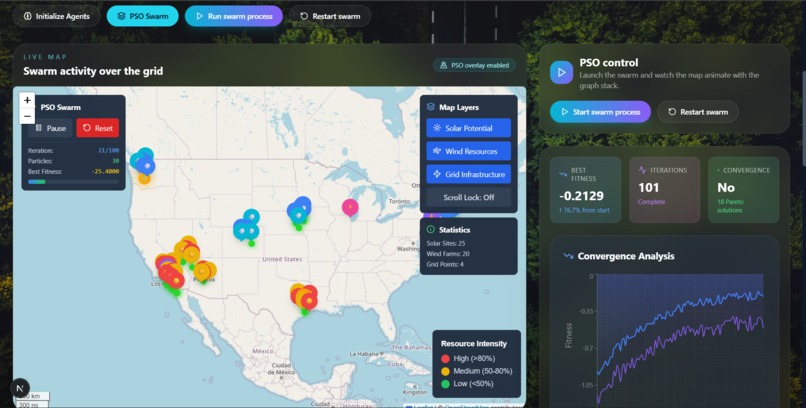
SWARM RUNNING
-
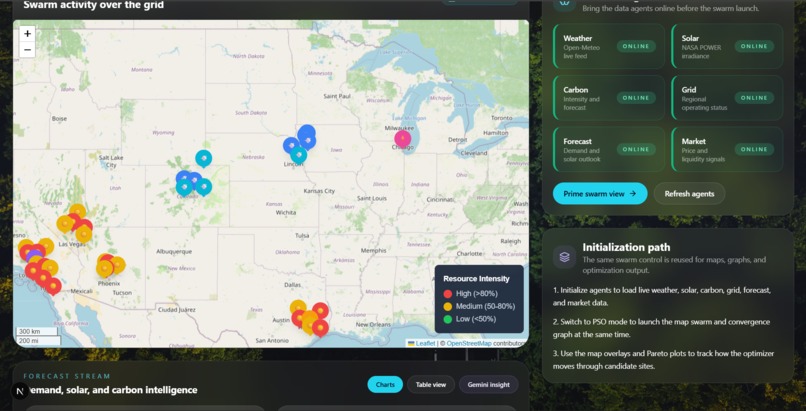
SWARM COMMAND MAP FEATURE
-
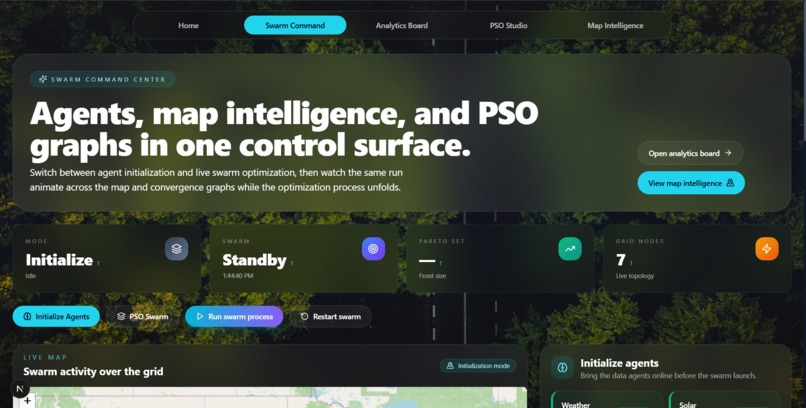
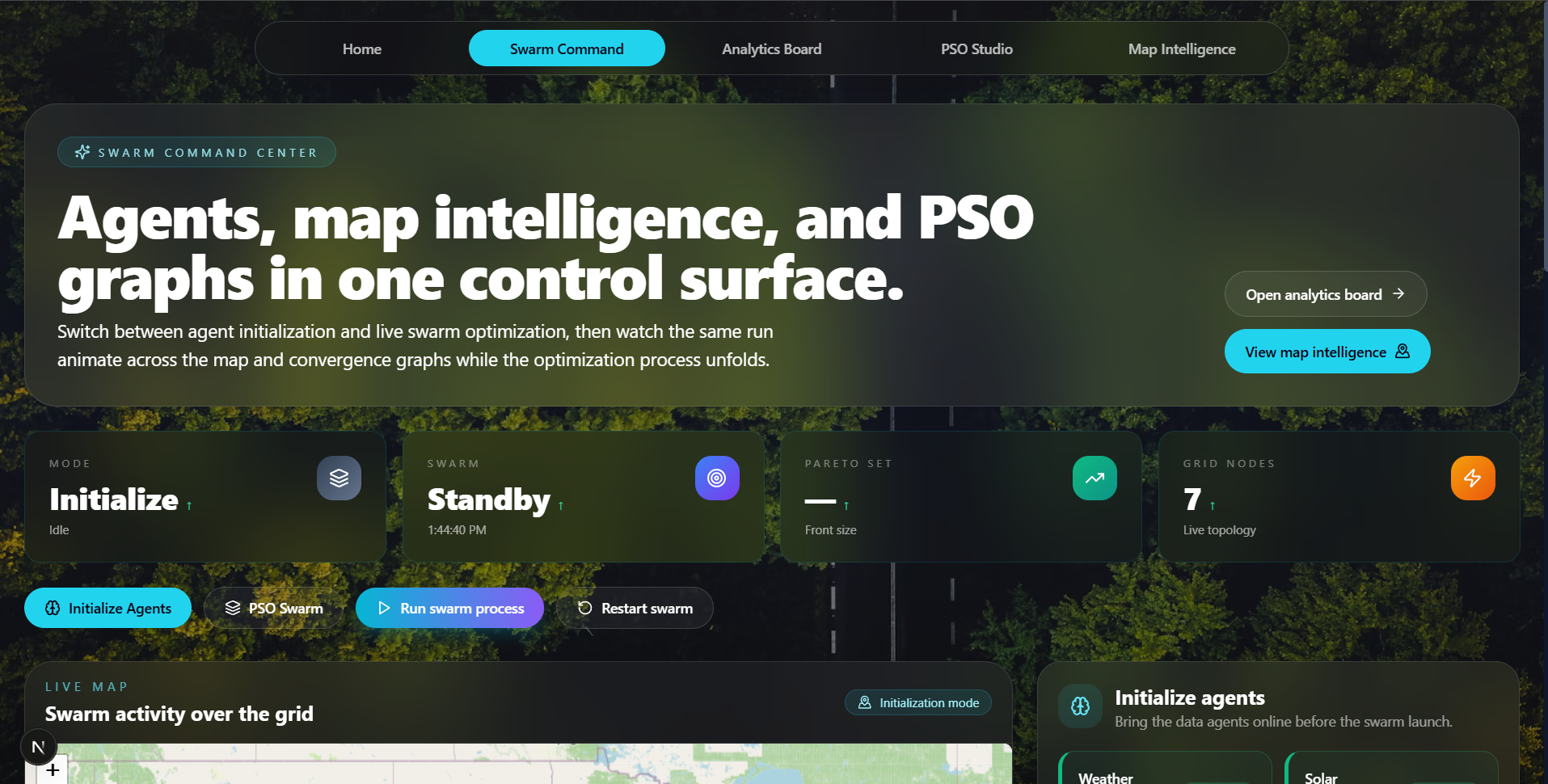
SWARM COMMAND UI
-
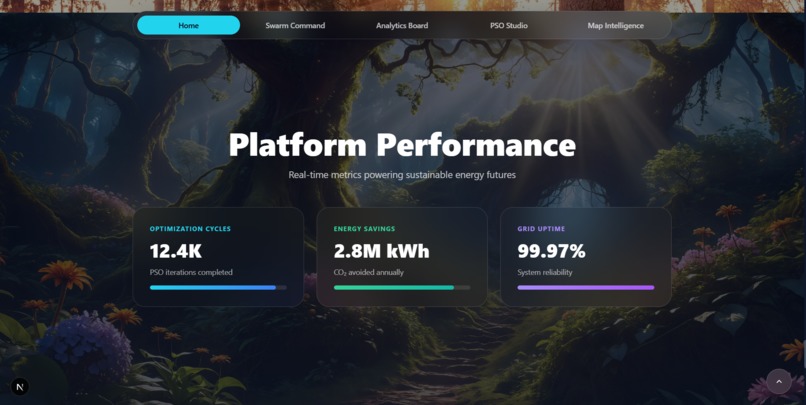
LANDING PAGE 5
-

LANDING PAGE 2
-

LANDING PAGE 3
-

LANDING PAGE 4
-

LANDING PAGE 1






Inspiration
Our inspiration comes from observing nature’s efficient problem-solving abilities, particularly the collective intelligence found in swarms of insects, flocks of birds, and schools of fish. This "swarm intelligence" allows groups of simple individuals to achieve remarkably complex goals, from optimal foraging routes to building intricate structures. We wondered if this same principle could be applied to one of humanity’s most pressing challenges: optimizing energy grids for renewable sources.
We recognized a fundamental parallel: a renewable energy grid is inherently decentralized, just like a natural swarm. Individual solar installations, wind turbines, and energy storage systems act as independent agents, contributing to the overall output of the grid. Conventional centralized optimization methods, while effective for rigid systems, struggle to handle the dynamic, multi-factor nature of renewable energy integration.
Further inspiration came from our observations of the global energy transition. It's not just a technical challenge; it’s a multi-faceted decision-making process. Governments, utilities, and communities need tools that don't just find a single, "best" solution, but explore the full trade-space of competing objectives: cost-efficiency, sustainability, maximum energy output, disaster resilience, and maintenance feasibility.
What it does
SWARMGRIDAI is a nature-inspired platform designed to revolutionize the planning and optimization of renewable energy grids. It uses advanced Swarm Intelligence algorithms, specifically a multi-objective variant of Particle Swarm Optimization (PSO), to tackle the complexity of creating sustainable, efficient, and resilient energy systems.
In essence, SWARMGRIDAI does the following:
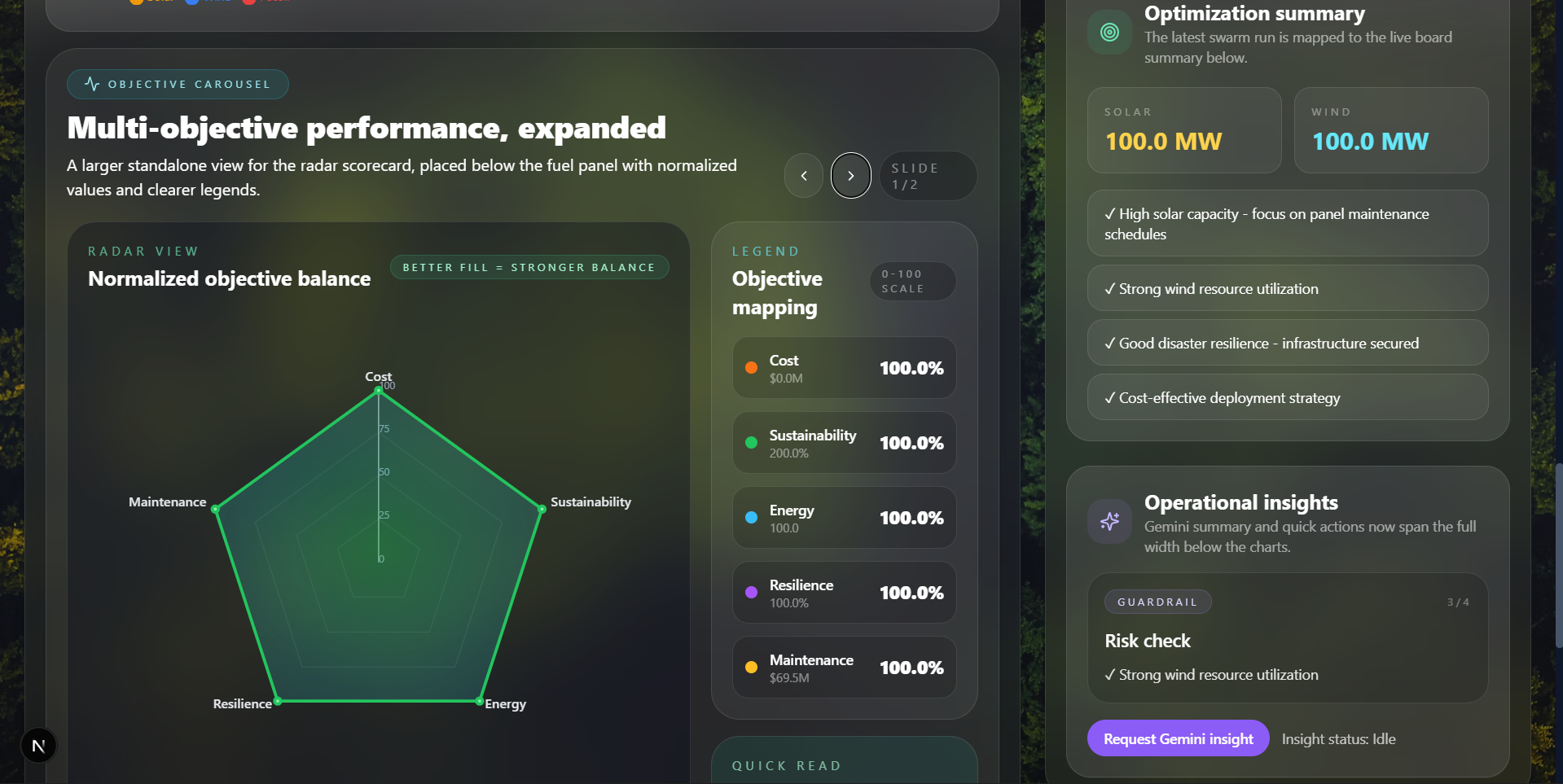
- Multi-Objective Optimization: Unlike single-objective optimizers that might only focus on cost, SWARMGRIDAI optimizes five key objectives simultaneously:
- Cost: Minimizing infrastructure and operational expenses.
- Sustainability: Maximizing the integration of renewable energy sources.
- Energy Output: Optimizing total power generation capacity.
- Disaster Resilience: Designing redundant, fault-tolerant grid topologies.
Maintenance Feasibility: Ensuring accessibility for operation and service.
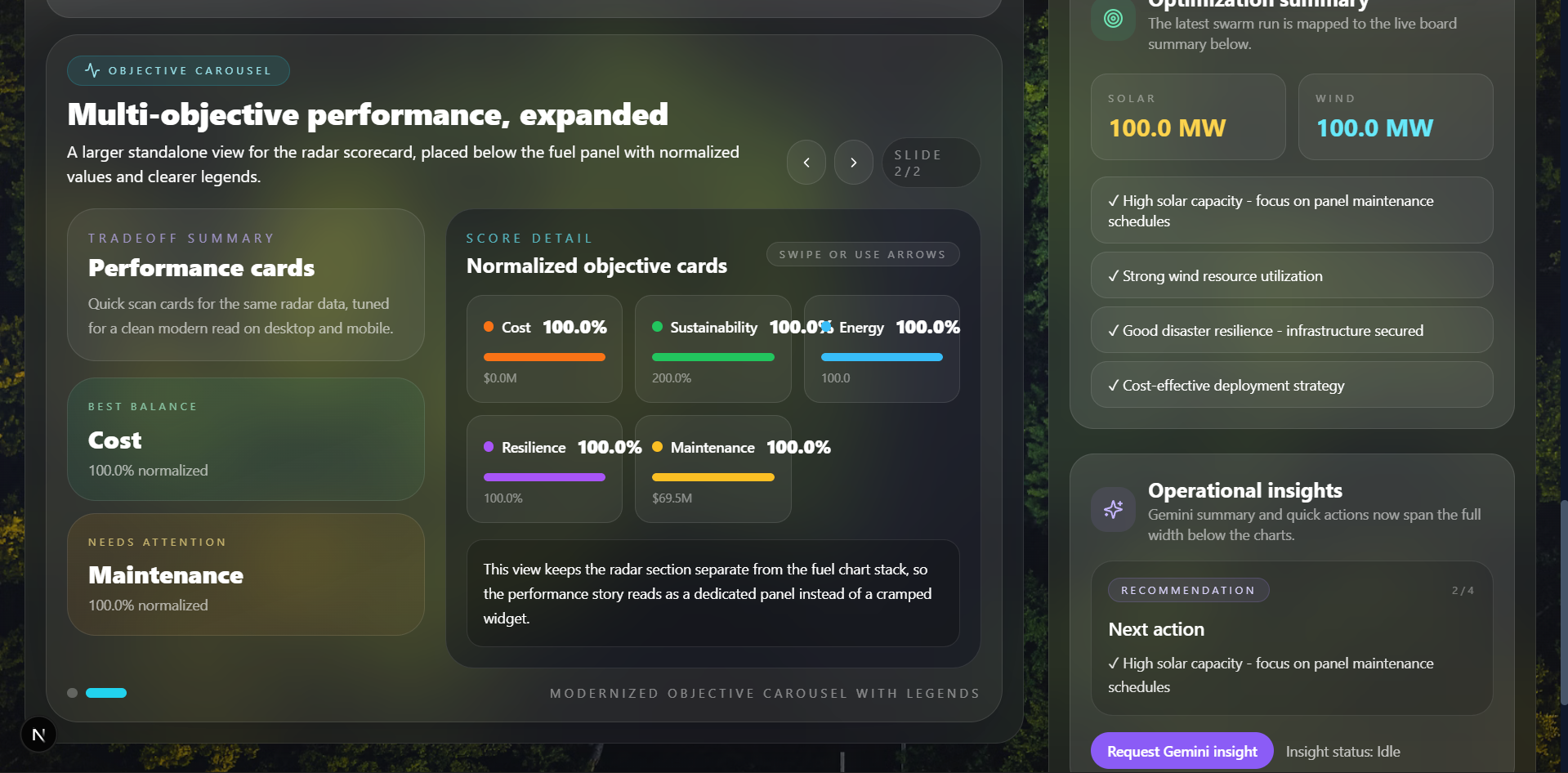
Pareto Frontier Exploration: It doesn't present a single solution. Instead, it generates a range of non-dominated solutions (the Pareto front), allowing decision-makers to visualize and understand the inevitable trade-offs between different goals. This empowers informed decisions rather than single-metric solutions.
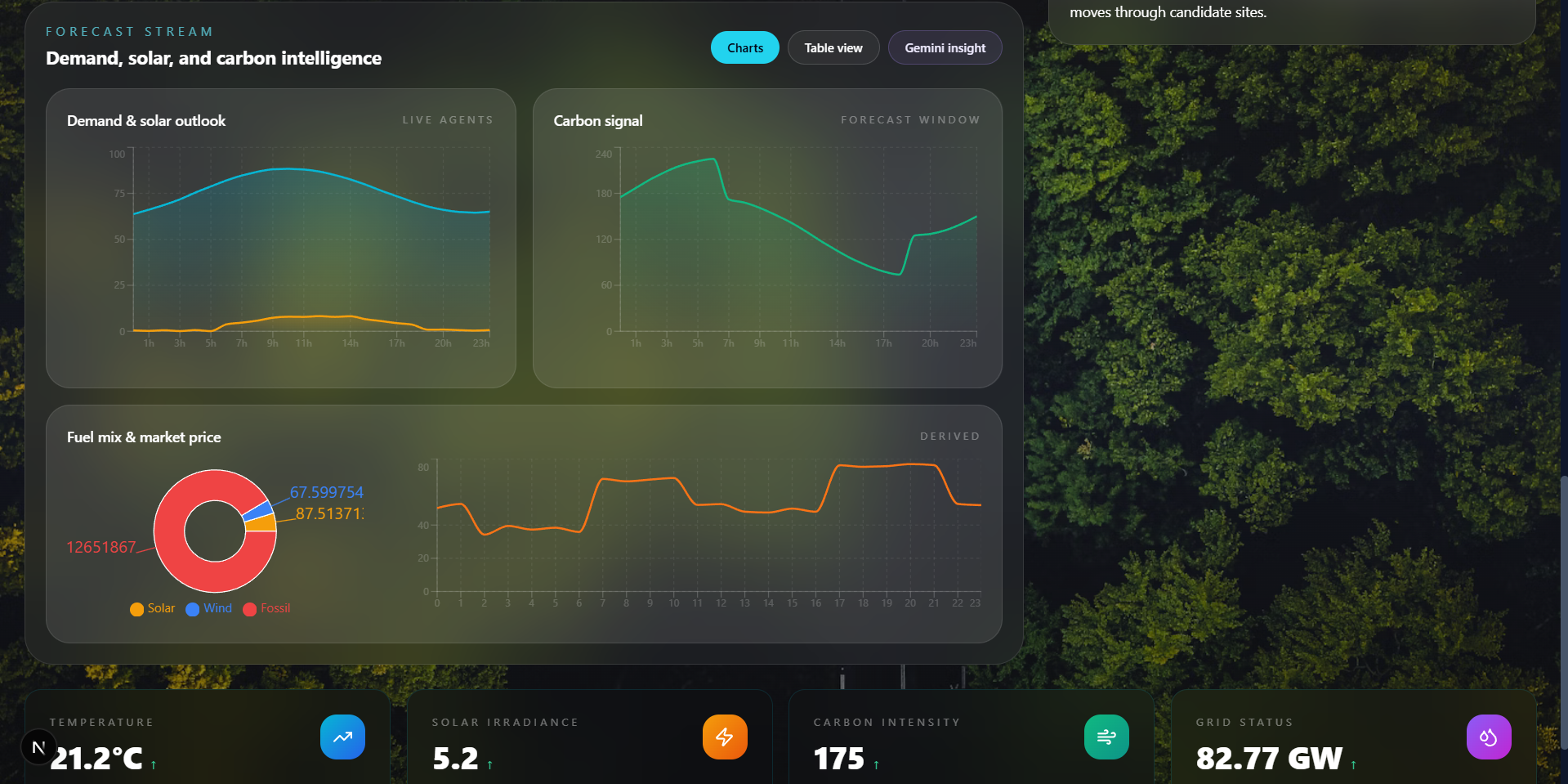
Real-Time Data-Driven Analysis: It integrates with live, open-source APIs (NASA POWER, Open-Meteo, EIA, USGS) to incorporate real-world factors:
Current and historical weather patterns for solar and wind generation estimates.
Real-time energy demand and grid reliability metrics.
Carbon intensity forecasts for local grids.
Geological data for resilience assessment against natural hazards (earthquakes, floods, etc.).
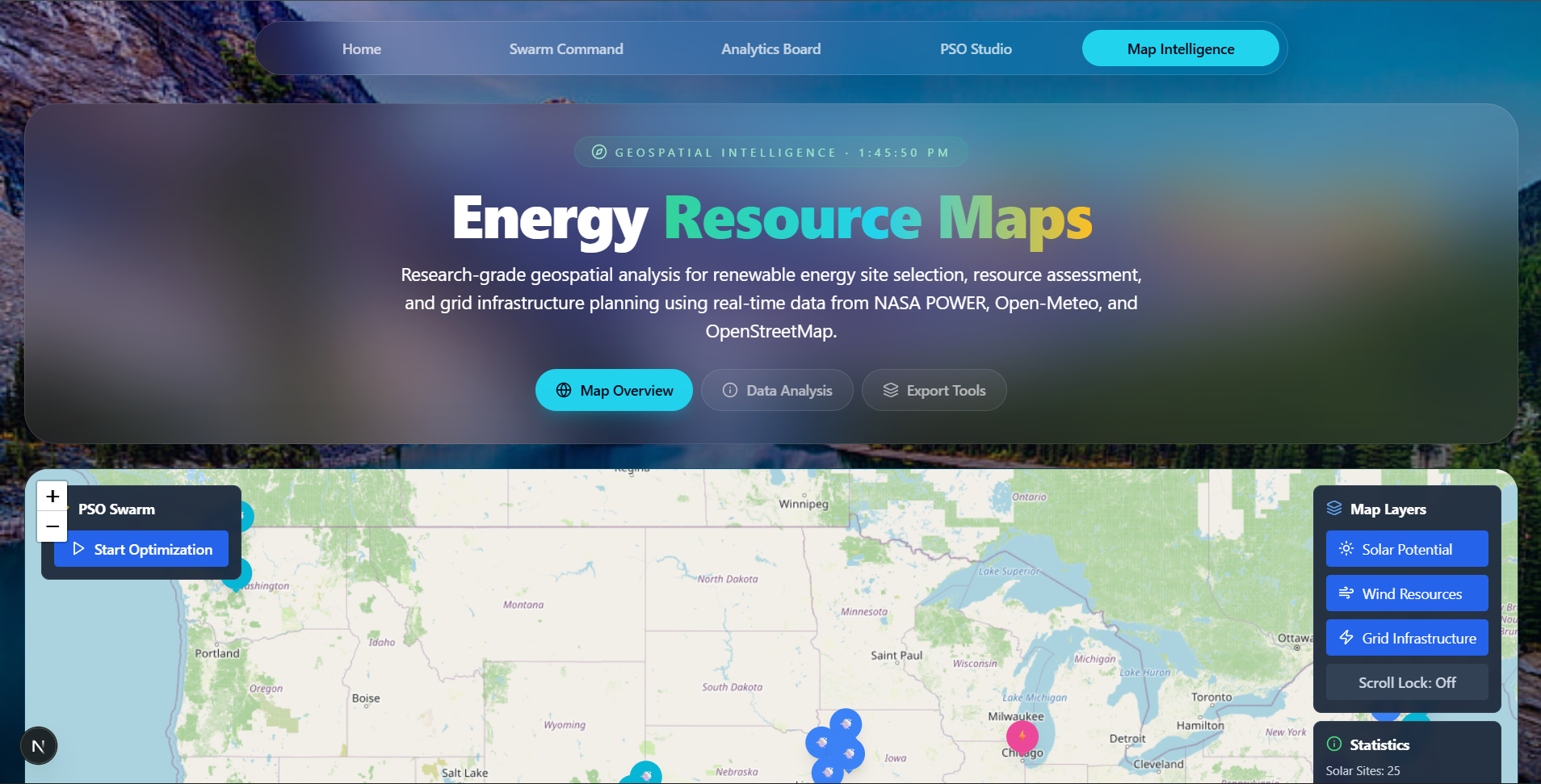
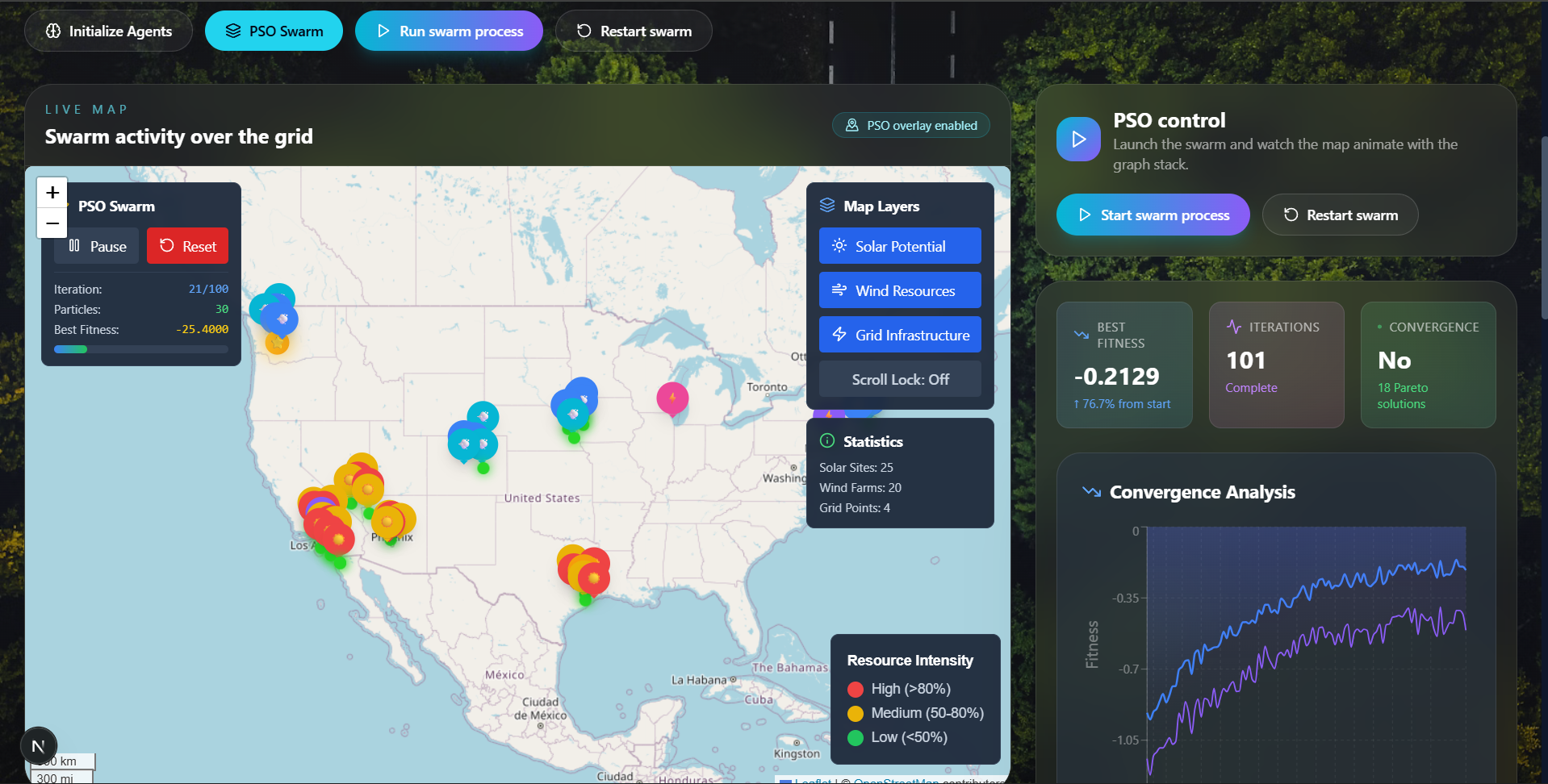
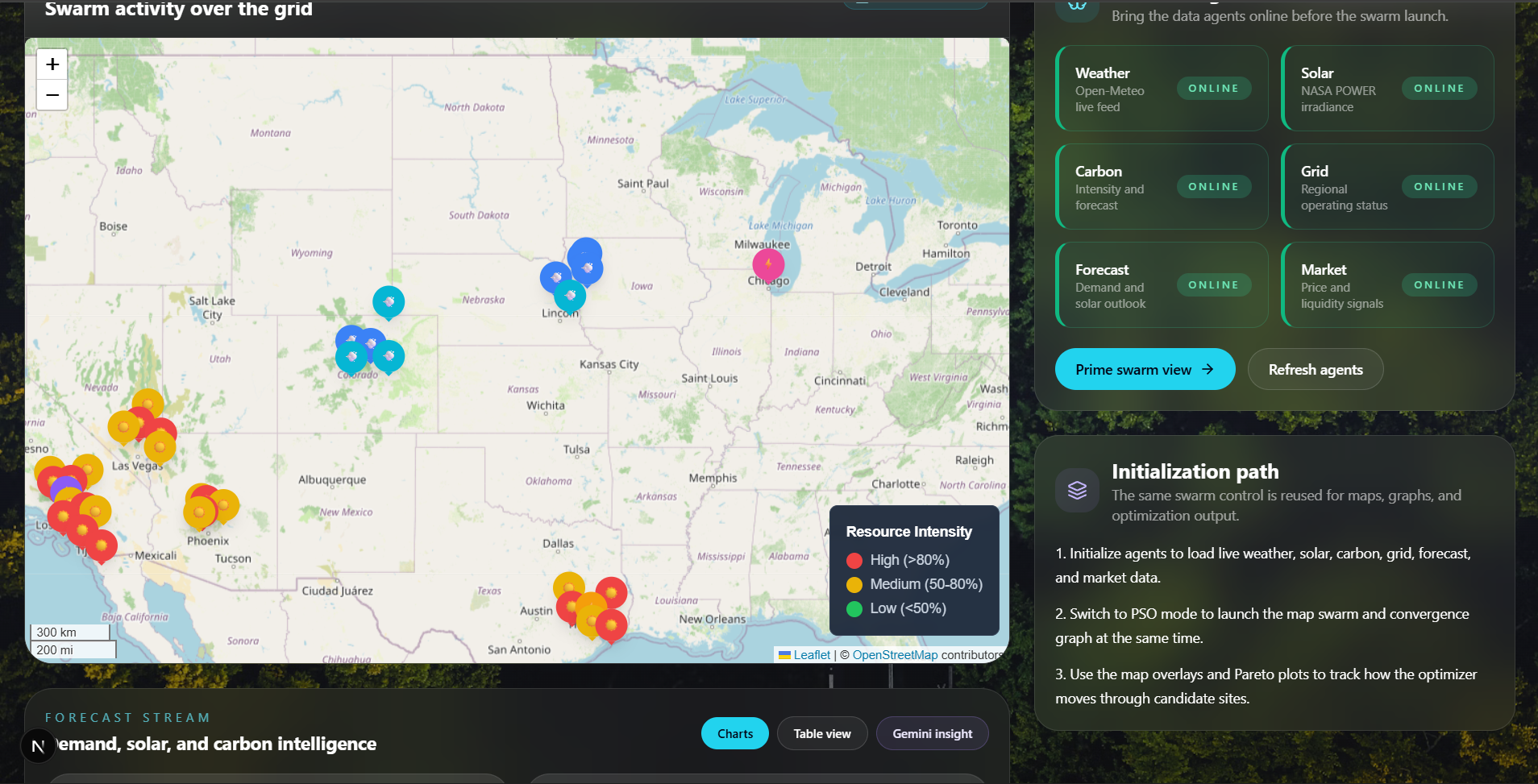
Geospatial Visualization: An interactive Leaflet map allows users to visualize optimal site selections for renewable installations based on real-world geospatial data. The swarm visualization itself is overlaid, illustrating the particles converging on the most viable locations.
AI-Powered Decision Support: It optionally uses Google Gemini to analyze the optimization results and provide structured recommendations, adding an extra layer of intelligence to guide users through the decision process.
How we built it
The creation of SWARMGRIDAI was an intensive process, demanding expertise across algorithmic development, data engineering, full-stack web development, and AI integration.
The Optimization Core: The heart of the project is the core PSO engine. We didn't just use a generic library; we built and refined two variants: a classic PSO with stagnation escape and a robust Multi-Objective PSO (MOPSO) with a Pareto archive. This core is developed from the ground up, allowing for the precise encoding of grid configurations and multi-objective trade-offs. We encoded each particle as a 5-dimensional vector representing key parameters: solar capacity allocation, wind capacity allocation, cost budget, risk mitigation investment, and maintenance budget allocation.
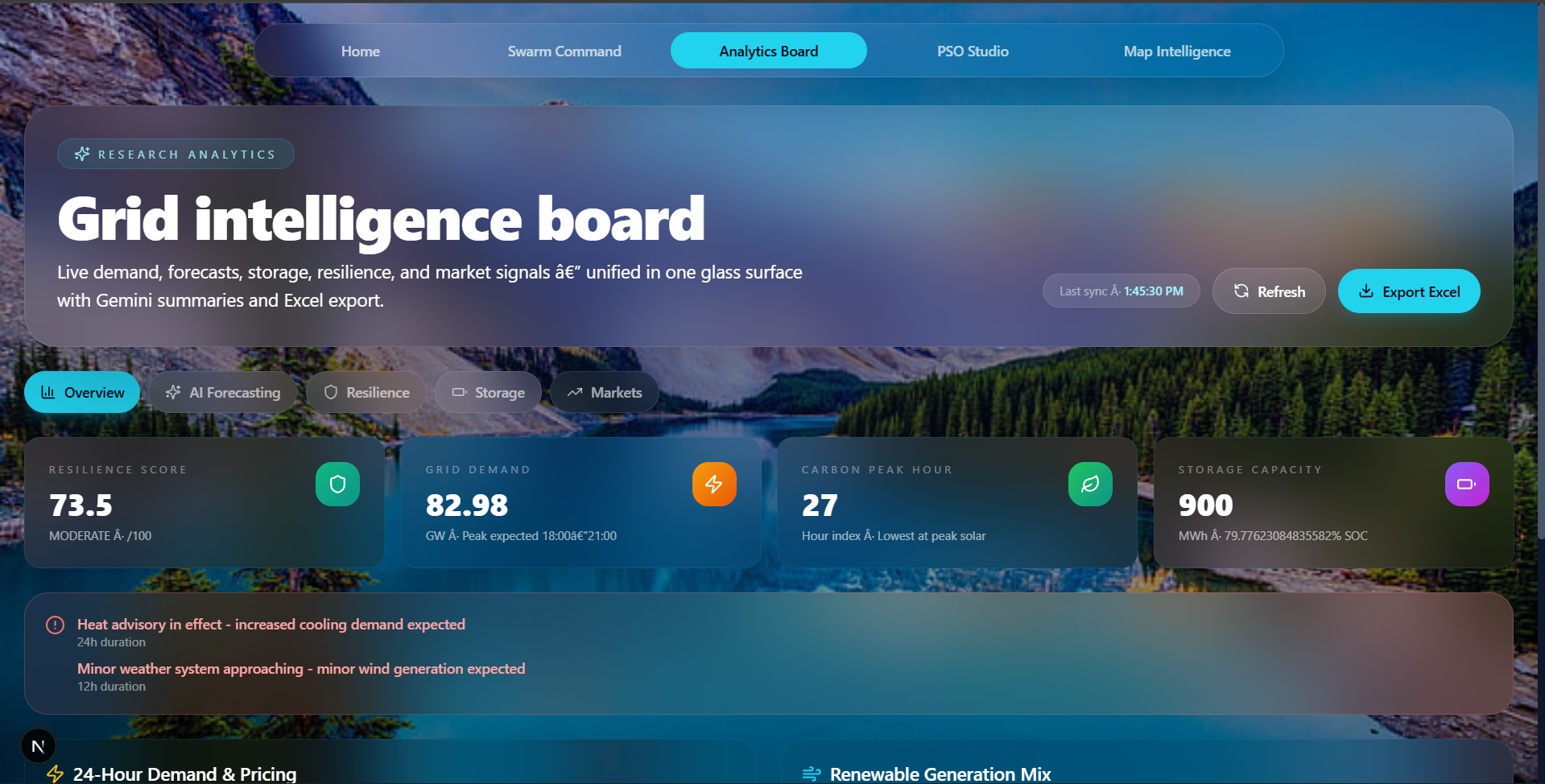
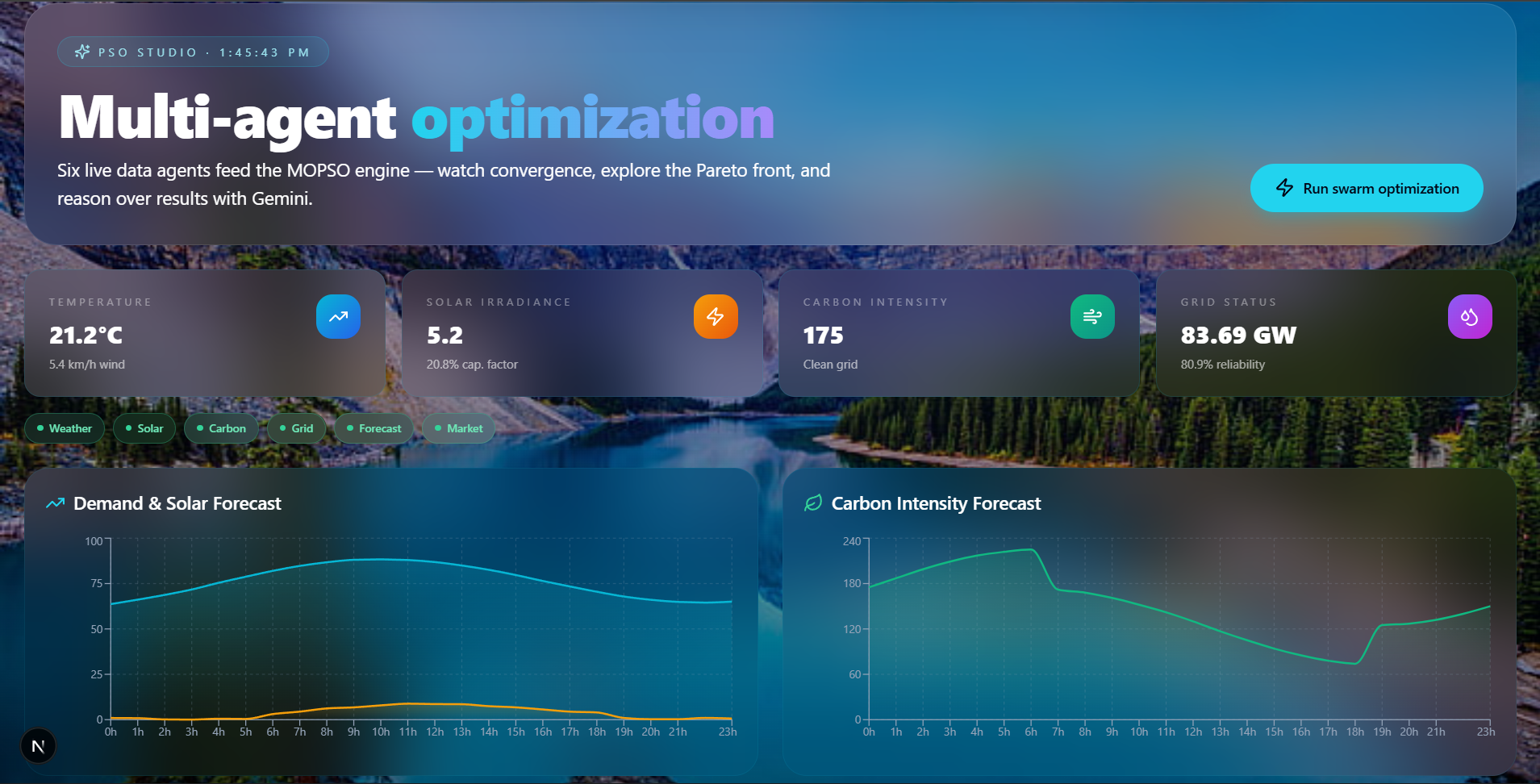
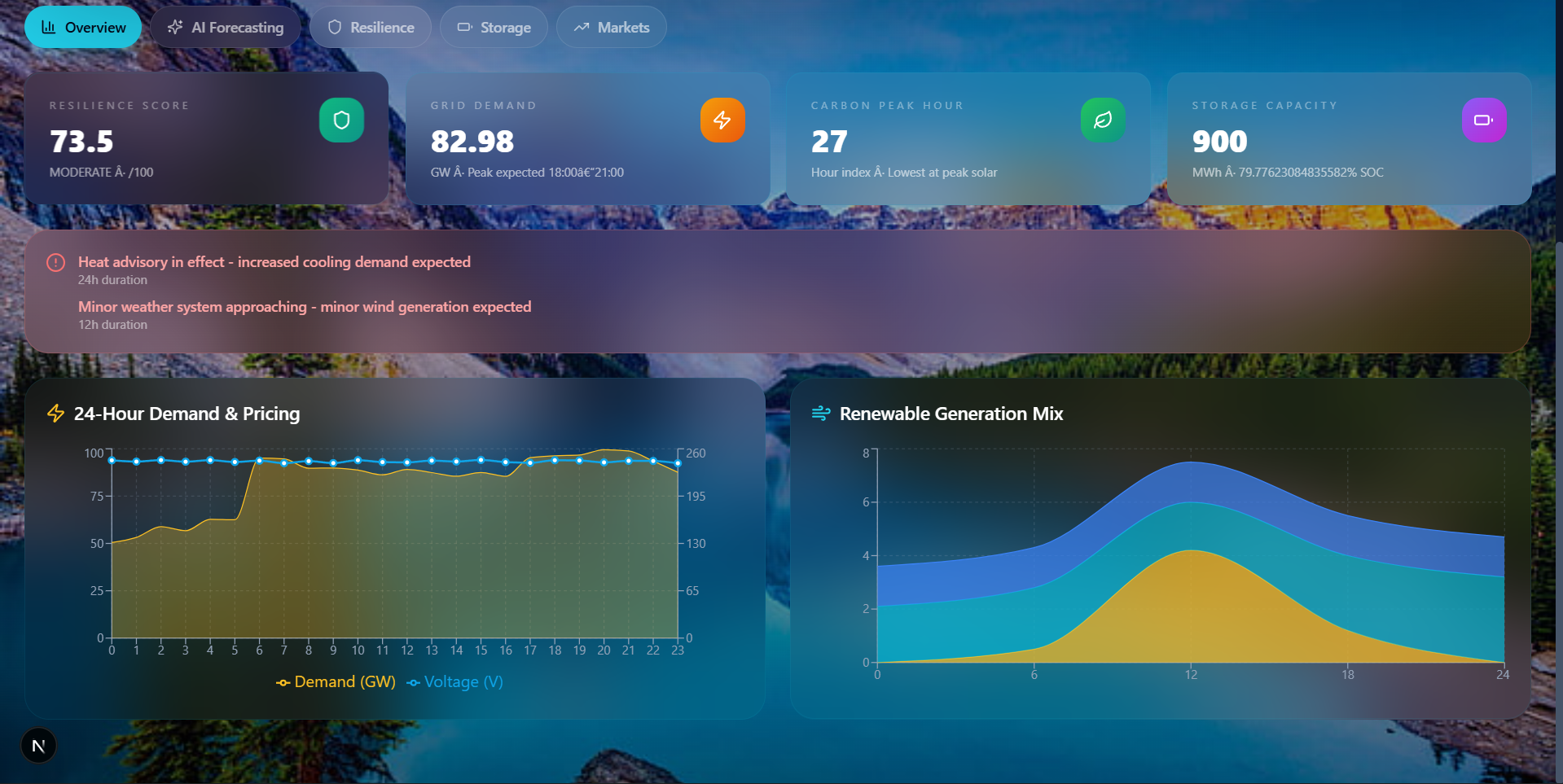
Data Engineering and Integration: The project's efficacy depends entirely on real-world data. We developed six dedicated data agents that poll multiple open APIs (NASA POWER for solar data, Open-Meteo for weather and carbon forecasts, EIA for electricity pricing, and USGS for geospatial terrain analysis) on page load. Creating a reliable and efficient pipeline to aggregate, process, and make this diverse data readily accessible within the platform was a significant technical task.
Front-End and Back-End (Next.js):
We chose Next.js for its modern framework, server-side rendering capabilities, and efficient API route handling. We structured the application into clear modules: agents for command and control, optimize for the PSO studio, dashboard and analytics-board for visualization, and maps for the geospatial layer. The back-end consists of 13 API endpoints that handle everything from running the MOPSO optimization and querying Gemini for recommendations to retrieving the live weather, solar, and resilience data.
User Interface and Visualization:
The interface was designed to be informative and interactive, presenting complex data in an accessible way. We leveraged shadcn/ui for high-quality base components and used Framer Motion for smooth animations and transitions. For data visualization, we used Recharts to render convergence curves and Pareto charts. Leaflet, combined with React Leaflet, was crucial for the geospatial maps, displaying resource site selections, grid infrastructure, and wind/solar potential zones.
AI Decision Reasoning (Gemini):
The /api/suggest endpoint leverages Google Gemini. It takes the output of the MOPSO algorithm and the current real-time grid context and sends it to Gemini. The model analyzes the data and returns structured analysis (verdict, confidence score, key strengths, risks, prioritized actions).
Deployment and Production Readiness: For deployment, we chose Vercel for its seamless integration with Next.js, performance optimization features (compression, image optimization, edge network), and robust security headers. The vercel.json configuration ensures a secure and high-performance production environment.
Challenges we ran into
- Data Sourcing and Reliability: Relying on free APIs presents challenges. We had to ensure we were using reliable sources and managing API rate limits effectively. Handling potential inconsistencies and making sure the data across different APIs (from weather to grid status) could be meaningfully aggregated was complex.
- Complexity of PSO for Multi-Objective: Developing and tuning a MOPSO algorithm, specifically managing the Pareto archive and crowding distance sorting, is inherently complex. Achieving convergence and finding a diverse and representative Pareto front required significant iterations and algorithmic refinements.
- Real-time Performance of MOPSO: Running a swarm-based optimization algorithm in real-time (120 iterations with 42 particles) on the Next.js server, particularly with real-world data, posed potential performance bottlenecks. We had to ensure our PSO implementation and data processing were highly optimized.
- Integrating AI Decision Reasoning: Tying Google Gemini to the structured results of the optimization was not simple. We had to carefully craft the prompt to extract the desired structured analysis and ensure the Gemini-provided context was genuinely grounded in the specific data provided by our optimization run.
- Geospatial and Swarm Visualization Interaction: Integrating the dynamic, shifting position of thousands of insects in a natural swarm alongside the glowing algorithmic nodes, all over a real geographic map in Leaflet, was a complex UI and visual integration challenge.
Accomplishments that we're proud of
- Successful Implementation of MOPSO: Building a robust, functional, and performant Multi-Objective Particle Swarm Optimization engine from scratch is a significant algorithmic achievement. We successfully implemented Pareto archive management and crowding distance sorting.
- End-to-End System: We are incredibly proud of building a complete, functioning system that connects natural-inspired intelligence, complex optimization algorithms, live real-world data, and a modern, interactive web interface.
- Actionable and Insightful Visualization: We successfully created a platform where users can visually understand the trade-offs between different goals and inspect the full Pareto frontier, making the optimization results more transparent and usable for decision-makers.
- Integration of AI-Augmented Reasoning: We believe adding Google Gemini to analyze the optimization outputs and provide structured decision support is a powerful feature that sets SWARMGRIDAI apart, providing true intelligence rather than just data.
- Open Source Extensibility: We are proud of building an open-source project that is auditable and modifiable, crucial for the highly regulated energy industry and academia.
What we learned
- The Power and Limitations of PSO: We learned firsthand the effectiveness of Swarm Intelligence in handling complex, multi-faceted problems, but also the intricacies of tuning parameters and managing archives for multi-objective optimization. We gained a deeper understanding of convergence and diversity in evolutionary computing.
- Real-World Data is Dynamic: The complexities of sourcing, cleaning, and aggregating live data from disparate APIs taught us critical lessons in data engineering and system robustness. We learned to handle potential data inconsistencies and implement effective caching strategies.
- AI is more than a black box: We learned that the effectiveness of AI decision support depends on careful prompt engineering and tight integration with specific data contexts. We saw that Gemini can provide genuinely structured analysis when given the proper inputs.
- The Importance of Transparent Decision Support: We recognized that single-objective optimization is often insufficient for complex human-centric problems. Building a system that exposes the Pareto frontier and trade-offs taught us about the value of human-in-the-loop decision-making and algorithmic transparency.
What's next for SWARMGRIDAI
- Data Persistence: Introduce a backend database (Supabase/PostgreSQL) to store project history, allow for long-running optimization simulations, and enable collaborative features.
- Global Scope: Expand geographic coverage by integrating region-specific API sources beyond the current US-centric coordinates.
- Optimization Scalability: Increase the potential size of swarms (more particles and iterations) through potential GPU acceleration or cloud-based optimization services.
- Comparative Algorithm Analysis: Implement alternative multi-objective evolutionary algorithms, such as NSGA-II, to allow users to compare and evaluate the performance of different swarm intelligence approaches.
- Authentication and Role-Based Access: Add user authentication to support collaborative workflows with distinct user roles (Operator, Analyst, Planner).
- Enhanced Reporting and Export: Develop more robust export features, including PDF report generation and GeoJSON/CSV exports.
- Phase 2 and Production Scale Roadmap: Implement the proposed scalable architecture featuring dedicated swarm engines, time-series data storage, and team collaboration capabilities.
Built With
- autoprefixer
- base-ui
- eia-api
- framer-motion
- gdacs-api
- google-gemini-api
- leaflet.js
- lucide-react
- nasa-power-api
- next.js-16
- noaa-api
- nrel-pvwatts-api
- open-meteo-api
- postcss
- react-18
- react-leaflet
- recharts
- shadcn/ui
- spline
- tailwind-css-3.4
- typescript
- usgs-api
- weather.gov-api
- xlsx
- zod


Log in or sign up for Devpost to join the conversation.