Inspiration
Choosing what to work on is the hardest part of research, and it's exactly where an advisor matters most. Most people who want to do research don't have one.
A chat model will happily invent research ideas, but you can't tell which ones are real. A 2025 study found that model-generated ideas scored worse than expert ideas once people actually carried them out.
So we asked a different question. The experts have already written down what they couldn't solve, in the limitations and future-work sections of this year's papers. What if you could read all of them at once?
What it does
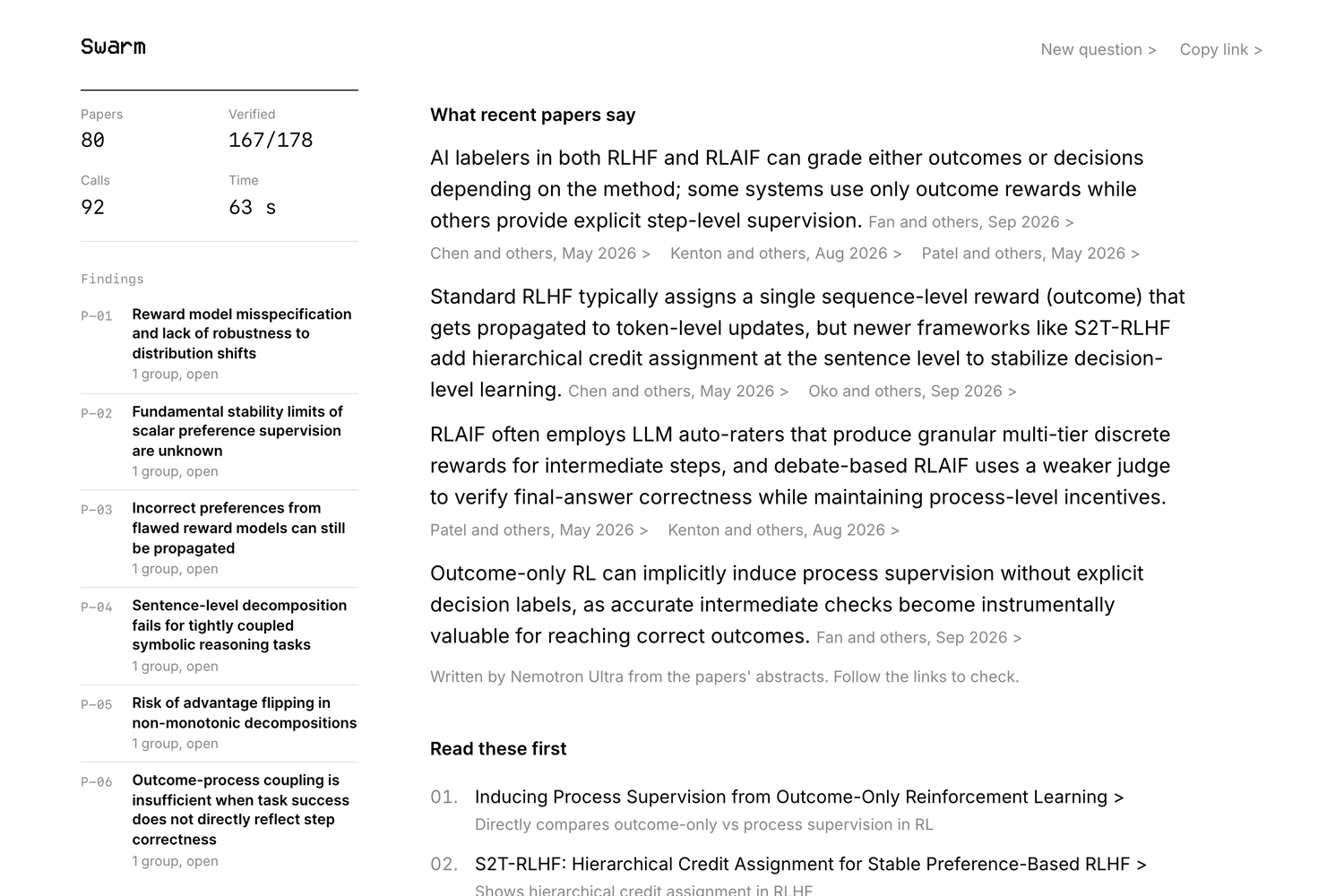
Swarm finds what's still unsolved in your field, in the authors' own words. You ask in plain language, for example "I'm a master's student interested in diffusion models for audio, and I have one GPU." About a minute later you get:
- A direct answer to your question, with every sentence cited to recent papers, plus up to five papers to read first.
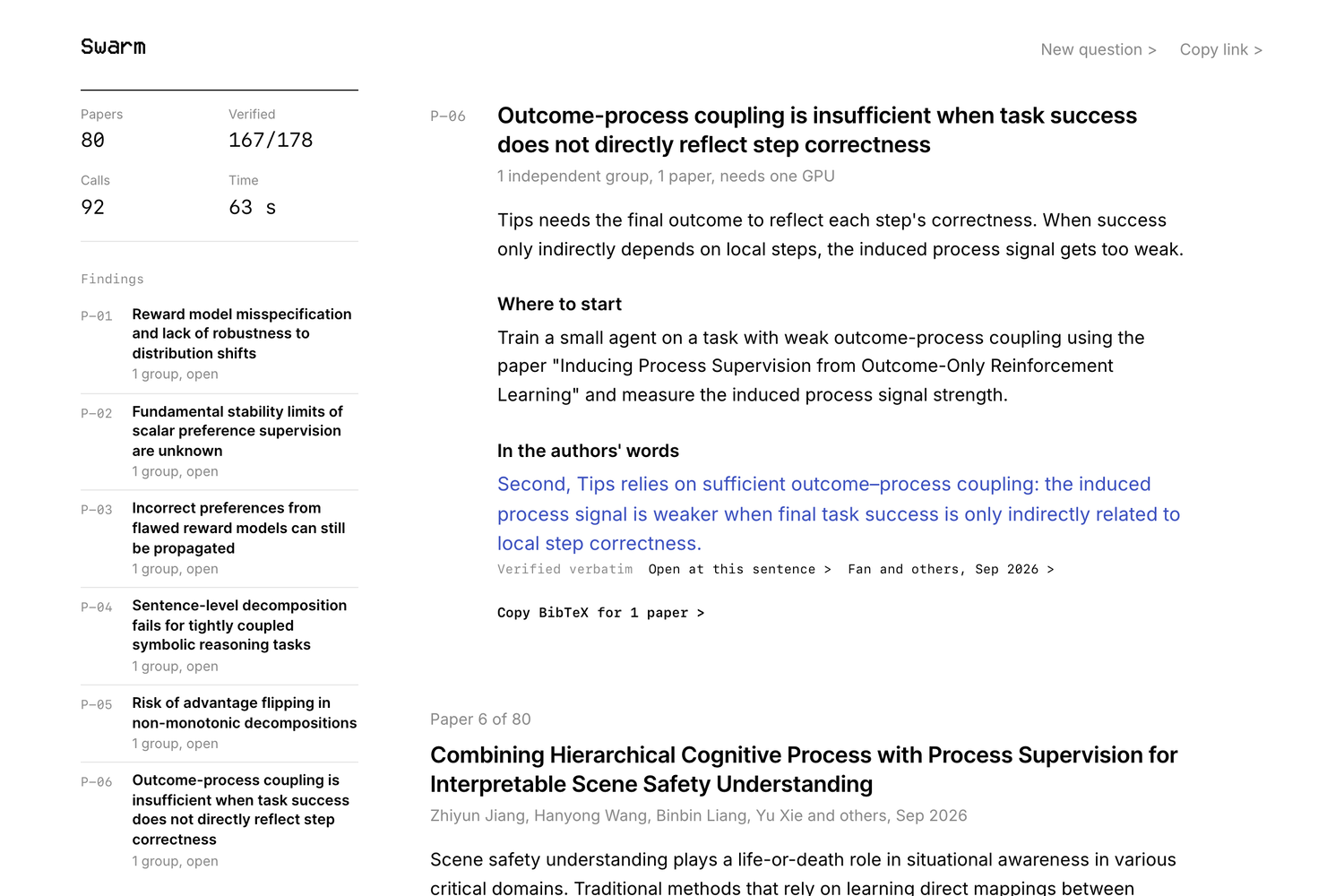
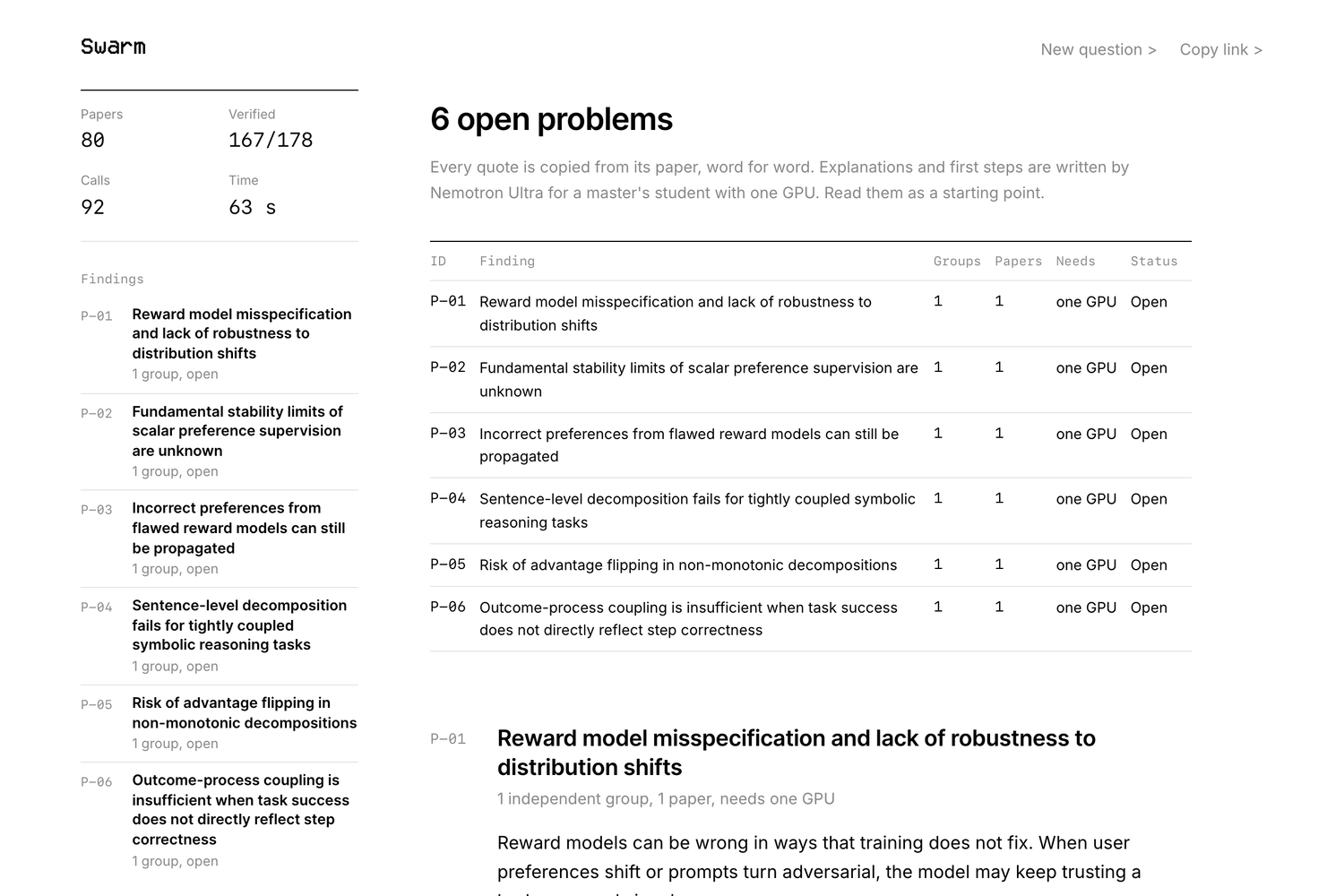
- The open problems, each quoted word for word from the paper that states it.
- A ranking by independent labs. Papers that share an author count once, so one lab repeating itself can never look like a whole field.
- A freshness check. Each problem gets its own search for newer work, and a claimed fix is shown only with a sentence checked against that paper.
- An explanation written for you: your level, your hardware (a laptop, one GPU or a lab), and a first experiment you could start this week, naming the exact paper to start from and its code when the paper links it.
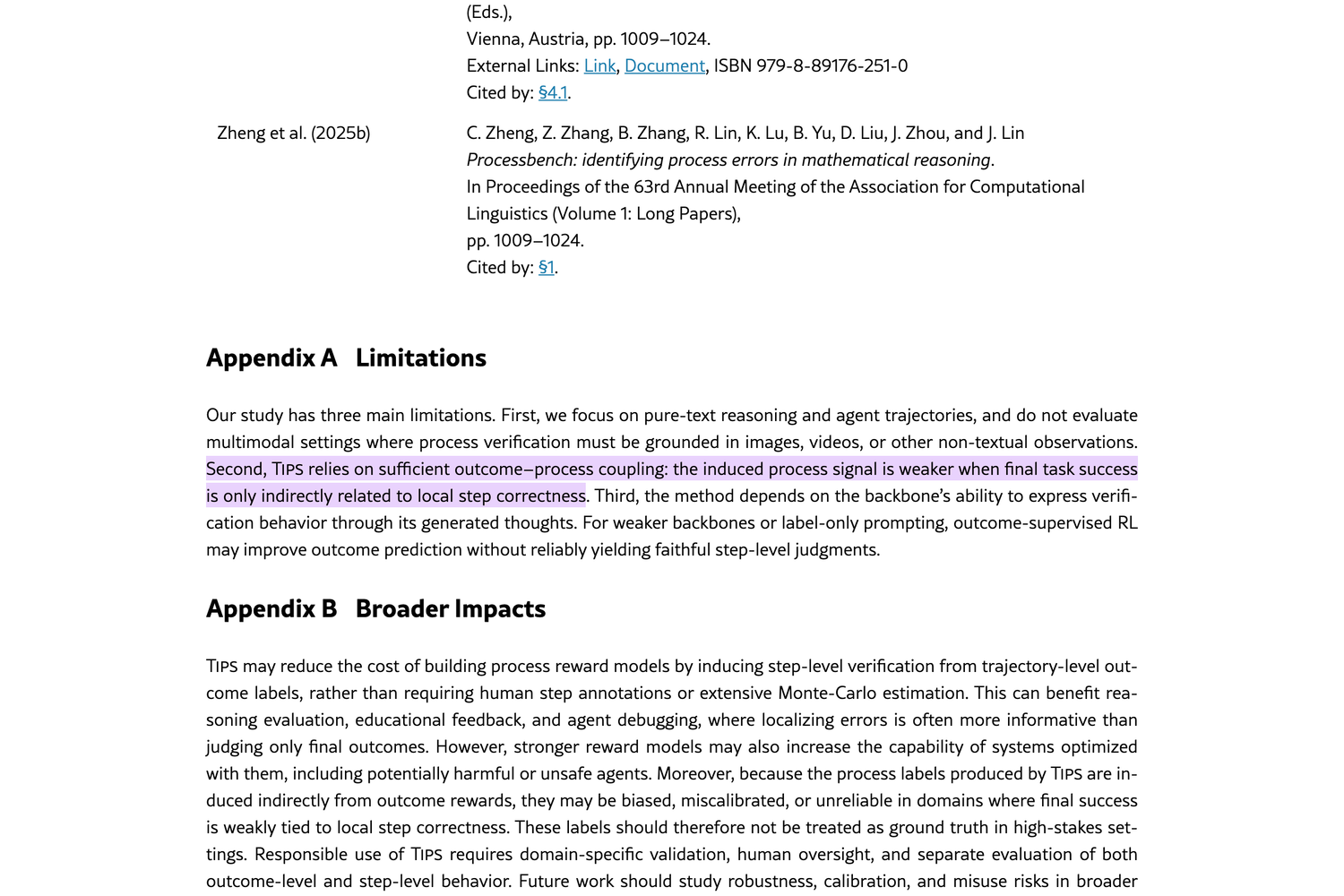
- Proof on every quote. "Open at this sentence" opens the paper with that sentence highlighted.
- Exports: a Markdown report and a BibTeX file for every paper.
How we built it
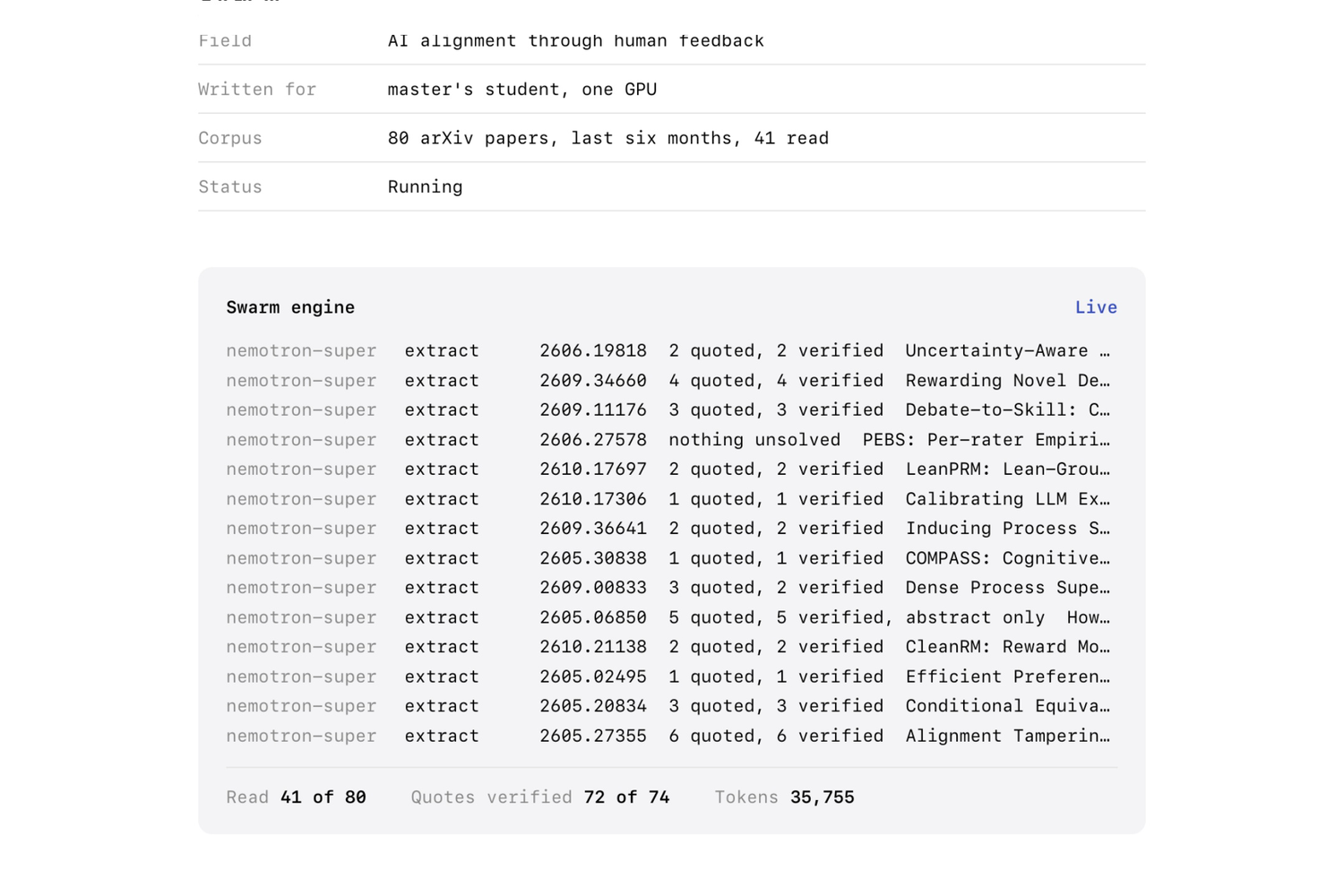
One question sets off about 92 Nemotron calls, most of them at the same time:
| Step | What happens | Model |
|---|---|---|
| Understand | Your words become the field's own vocabulary and 2 or 3 arXiv searches | Nemotron 3 Super |
| Find | The 80 most relevant arXiv papers from the last six months, by exact phrases | arXiv API, OpenAlex as fallback |
| Read | Each paper's limitations, future work and discussion sections, from its arXiv HTML page | Tavily Extract |
| Extract | One call per paper, all 80 at once, copying sentences that state an unsolved problem | Nemotron 3 Super, thinking off |
| Verify | Every quote is matched against its paper in code. A quote that isn't there word for word is thrown out | Code, not a model |
| Group and rank | Statements naming the same problem are grouped; each cross-paper group is checked again before it counts; problems rank by independent author groups | Nemotron 3 Super, then code |
| Answer and explain | A cited answer from the 15 most relevant abstracts, and an explanation for each problem | Nemotron 3 Ultra |
Why Super does the parallel work: on our account, Token Factory allowed Nemotron Super 1,000 requests a minute against Nano's 100. A test of 1,000 parallel Super calls finished in 25.7 seconds, so reading 80 papers at once is a single burst, not a queue. Ultra handles the two steps where careful writing matters.
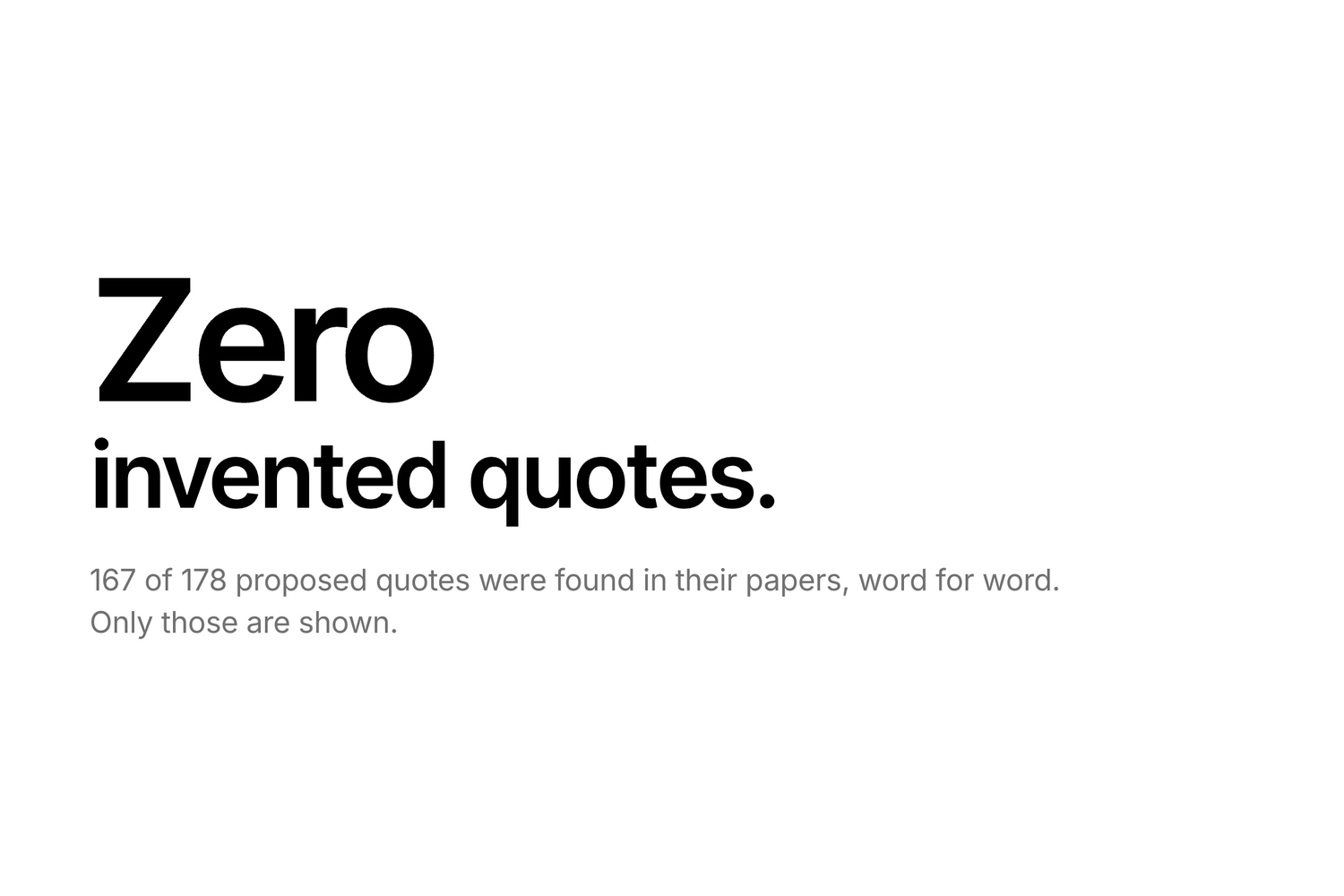
The example run on the home page: 80 papers, 78 read in full, 92 model calls, 128,218 tokens, 63 seconds from question to ranked problems. 167 of the 178 quotes Nemotron proposed were found in their papers word for word. The other 11 were discarded, and the page says so.
The backend is Python and FastAPI, and streams every step to the page as it happens. The frontend is Next.js with no UI libraries. Every run is saved and replays from a link. A stand-in mode runs the whole pipeline with no keys and no cost, so all 119 automated tests are reproducible.
Challenges we ran into
We made 13 real runs and kept the full record of each in the repo. Every failure became a fix and a test:
- Models invent quotes. We solved this in code rather than in the prompt: a quote is shown only if it appears in the paper word for word.
- Models invent citations. In one run, Nemotron Ultra named paper titles that don't exist. Every title, spelled-out abbreviation and link in a first step is now checked against the real papers.
- Searches drift. The first run's papers were mostly off topic. Exact phrases, date ranges, relevance order and a fallback search for thin results fixed it.
- arXiv stopped answering us. We added a one-day cache, polite retries, and an automatic switch to OpenAlex's index of arXiv.
- Agreement is easy to fake. Grouping by topic made catch-all problems, and grouping by shared words merged boilerplate like "a fixed prompt". Now a problem counts agreement only after a second Nemotron call names the shared claim and every lab's quote is checked against it.
Accomplishments that we're proud of
- Zero invented quotes reach the page. Every quote shown is in its paper word for word, and you can check it in one click.
- Honest ranking. When no two labs agree on a problem, Swarm says so plainly rather than dressing up one lab as a consensus.
- A record anyone can audit. All 13 runs are in
reports/, with what went wrong and what changed. - A newcomer can actually start. First steps fit your hardware, start in a simulator or on public data when you don't own the equipment, and link the paper's own code.
What we learned
- Verification belongs in code, not in prompts. Every guarantee that held up was enforced after the model answered.
- In limitations sections, labs agree on boilerplate far more often than on a specific problem. Real agreement is rare and valuable, so Swarm shows it only when every quote supports it.
- The bigger model was the faster choice. Rate limits, not model size, decided our throughput.
What's next for Swarm
- Fields beyond arXiv: bioRxiv, medRxiv and SSRN.
- Full-text checks of newer work, not just abstracts.
- A weekly digest of new open problems in the areas you follow.
Swarm is the research advisor most people never get.
Built With
- arxiv
- fastapi
- nebius
- nebius-token-factory
- nemotron-3-super
- nemotron-3-ultra
- next.js
- nvidia-nemotron
- openalex
- python
- react
- render
- server-sent-events
- tavily
- typescript
- vercel


Log in or sign up for Devpost to join the conversation.