
Inspiration
An independent owner gets one try at every change. A chain can pilot a new price in a handful of stores and quietly roll it back. A single café or corner shop can't. Every new price, promotion or layout is a bet placed with real customers, and there is very little room for a bad one:
- 1 in 5 new US businesses closes within its first year, and about half are gone within five years (US Bureau of Labor Statistics, Business Employment Dynamics).
- The median restaurant holds just 16 days of cash in reserve (JPMorgan Chase Institute, Cash is King).
- 84% of US business owners have no degree in business management, and nearly half are running their first business (US Census Bureau, Annual Business Survey, 2023 data).
These owners are experts at their craft, not at running pricing experiments. We wanted to give them what big chains already have: a way to see how a change lands before it goes live.
What it does
Jev'd lets an owner test a change before their customers see it. Describe the change you're weighing, such as moving a sandwich from \$12 to \$14, running a two-for-one Tuesday or rearranging the menu, and Jev'd runs it against simulated customers (independent Jev agents)
You get a side-by-side of each version with expected revenue and how many customers it keeps. Instead of betting the shop on one guess, you try every version first and only roll out the one that holds up.
How we built it
- Frontend: No framework and no build step: plain HTML, CSS and JavaScript modules. The floor plan and the crowd replay are drawn on
<canvas>, the owner's charts are plain HTML and CSS, and Matterport's Showcase SDK opens the 3D tour of a scanned building. - Backend: JavaScript on Node.js 22, with a plain
node:httpserver and no framework. For the demo it runs locally on a laptop; there's no hosted deployment yet. - The testing engine:
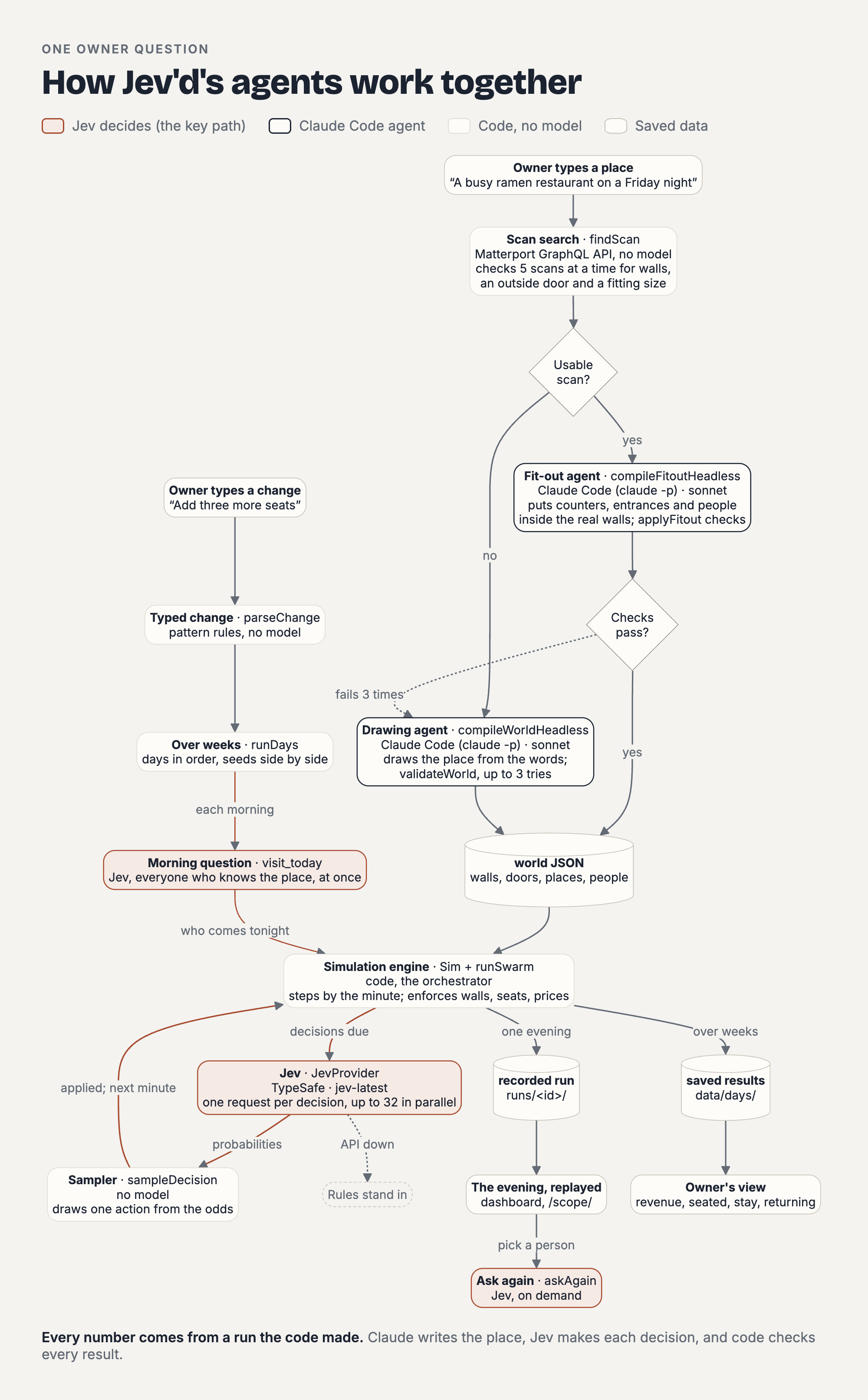
- Every customer decides through Jev, TypeSafe's decision model. A Node simulation walks the crowd through the floor plan minute by minute, respecting walls, seats, capacity and prices. Each decision that comes due (join this line, keep waiting, come in today) goes to Jev, up to 32 at a time. Jev returns a probability and we sample one action from it, so similar people still behave differently.
- A change is tested over weeks, with the same people. Each simulated day, everyone who knows the place starts from their usual visit rate, and Jev, reading their memory of past visits, moves it up or down. A few human habits Jev doesn't show on its own, such as a price rise hurting more than a cut helps, are added as rules.
- Today and the change run on the same random seeds, so the change is the only difference. We run each version 3 times and report a result only when all 3 runs agree on its direction; otherwise the screen says "about the same".
- The owner types the change in plain words. Seats, meal speed, price, a discount, a stamp card or a "sorry" card for people turned away become that lever, with the number given. Anything else is passed to the customers as news, for Jev to weigh person by person.
- Claude Code builds the place. Run headless with Sonnet, it fits the business into a real Matterport scan, or draws a floor plan from the description when no scan fits.
- Data:
- Real buildings: Matterport 3D scans from the hackathon's data, read through Matterport's API for floor plans and walls.
- Customers: for the demo, a hand-written neighborhood of diners for MTea Princeton, with assumed visit rates. We don't import sales data yet: the owner's own counts are meant to replace the assumptions, and point-of-sale import is next.
- CoStar property data: used to build a list of independent, single-location businesses to talk to.
- Published research, to check Jev: it matched 12 of 16 published effects of a past visit on whether a customer comes back, with none in the wrong direction, and its line decisions behaved like a published supermarket-deli study (Lu, Musalem, Olivares and Schilkrut, Management Science, 2013).
Challenges we ran into
- Ensuring that probabilistic nature of Jev agents accurately reflect natural human decisions
Accomplishments that we're proud of
- Grounding the problem in primary data. We pulled owner-education figures directly from the Census Bureau's Annual Business Survey tables instead of relying on secondhand statistics.
What we learned
- The gap is business training, not effort. Only 16% of the 4.2 million owners of US employer businesses studied management or administration. Most owners learn pricing and promotion by trial and error, with real customers.
- Owners overrate their own financial skills. In a 2024 Xero survey of 1,021 US small-business owners, 55% rated their financial literacy as high, yet half said a lack of it had caused money problems in their business.
What's next for Jev'd
- Recording real-life data for the next 2 months to verify our simulation data.
Built With
- claude
- codex
- costar
- css3
- github
- html
- javascript
- jev
- matterport
- python
- typesafe
- vexcel
