-
-
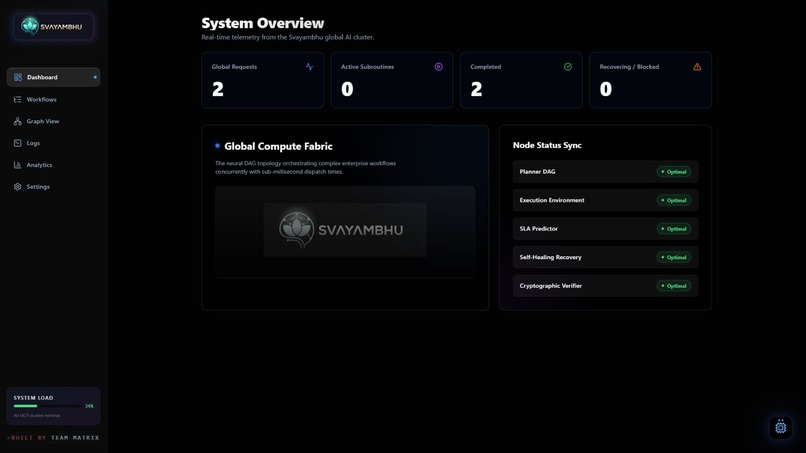
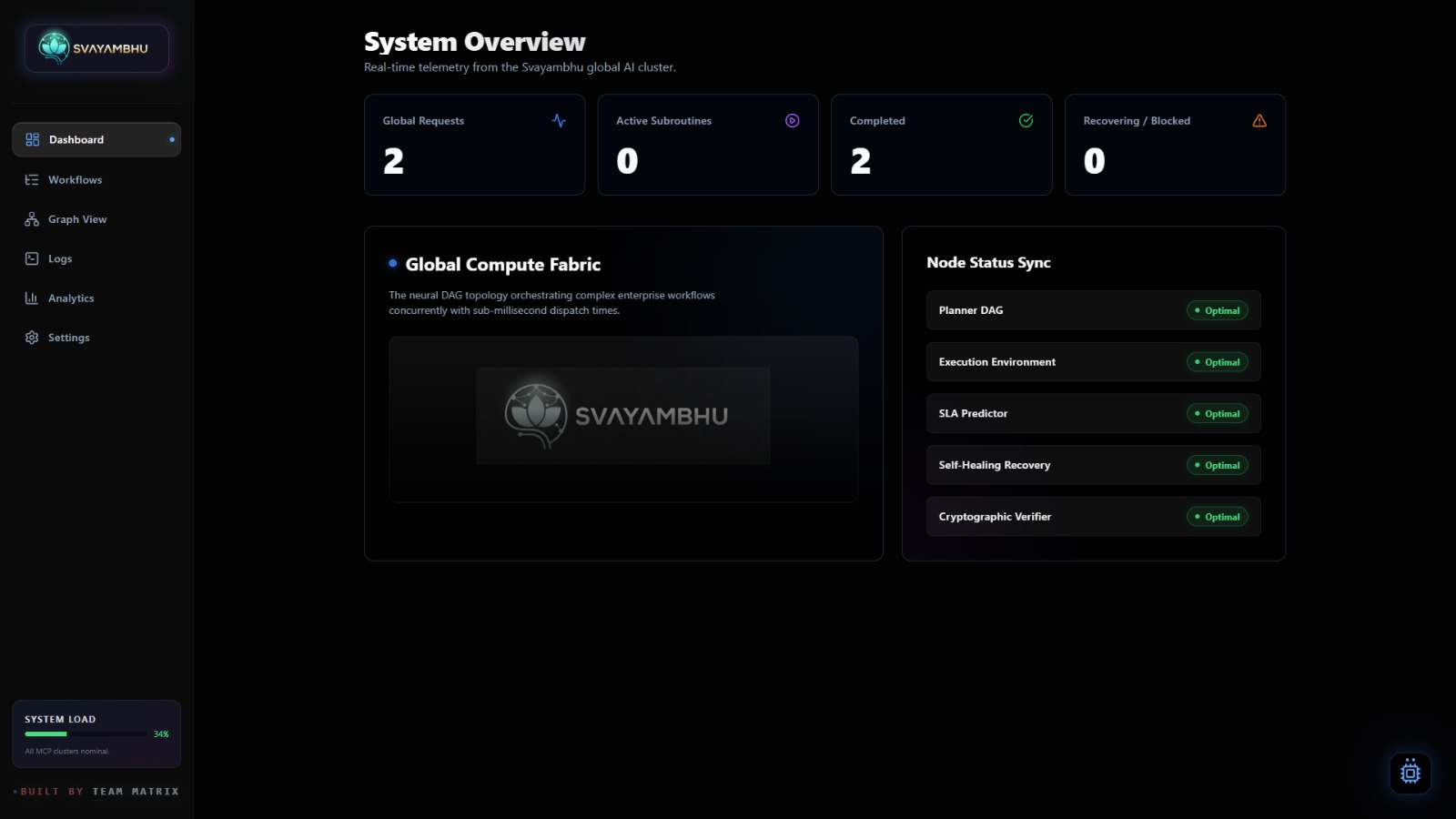
Global Compute Fabric — System Dashboard
-
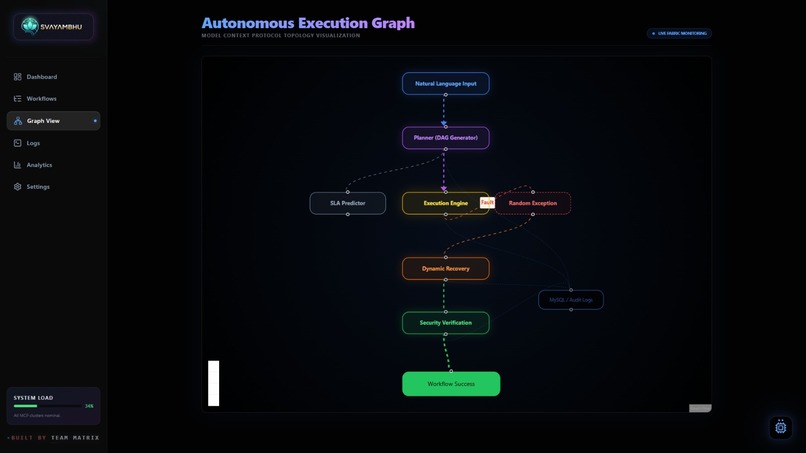
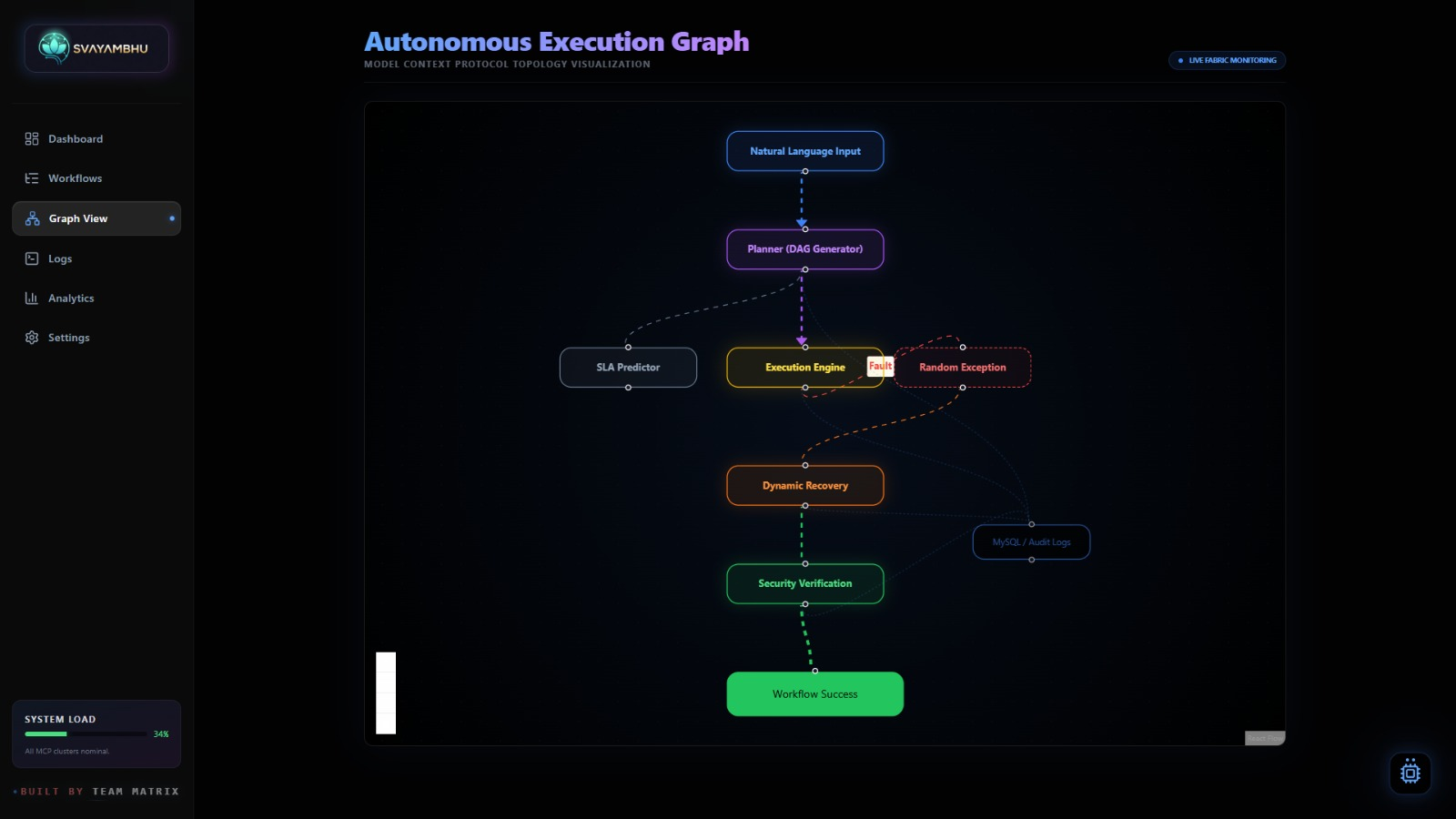
Autonomous Execution Graph — DAG Visualization
-
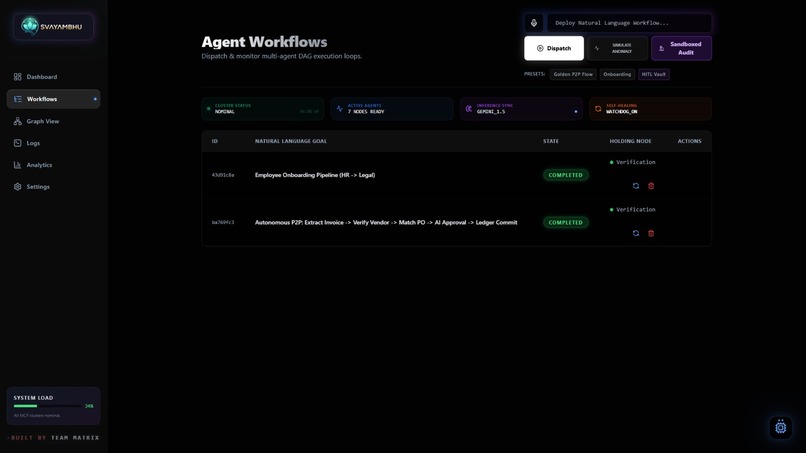
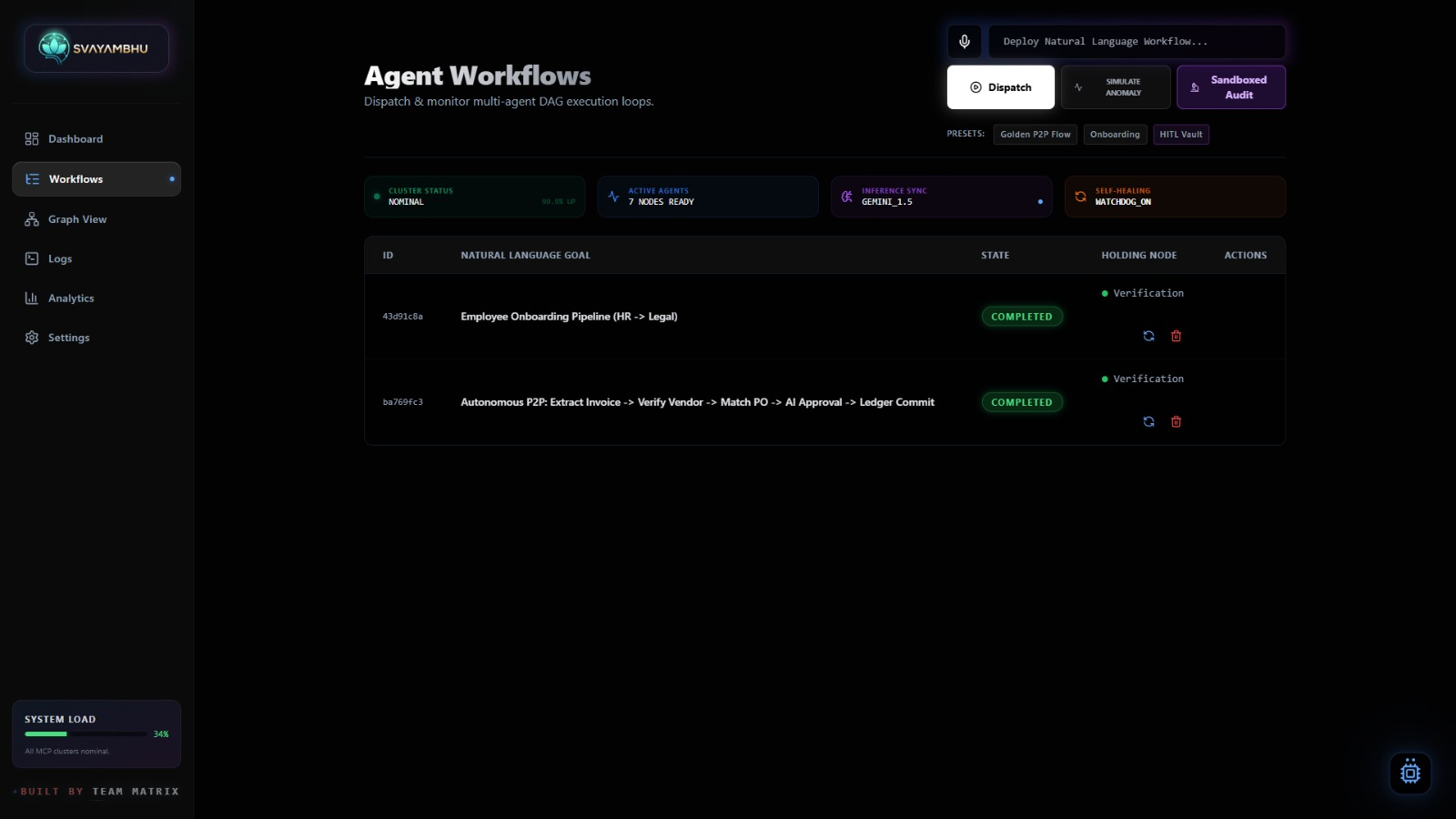
Agent Workflows — Anomaly Toggle and NL Dispatch
-
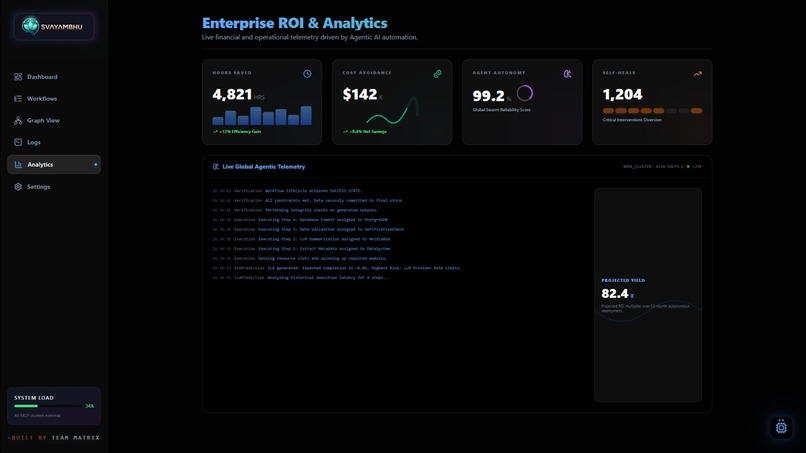
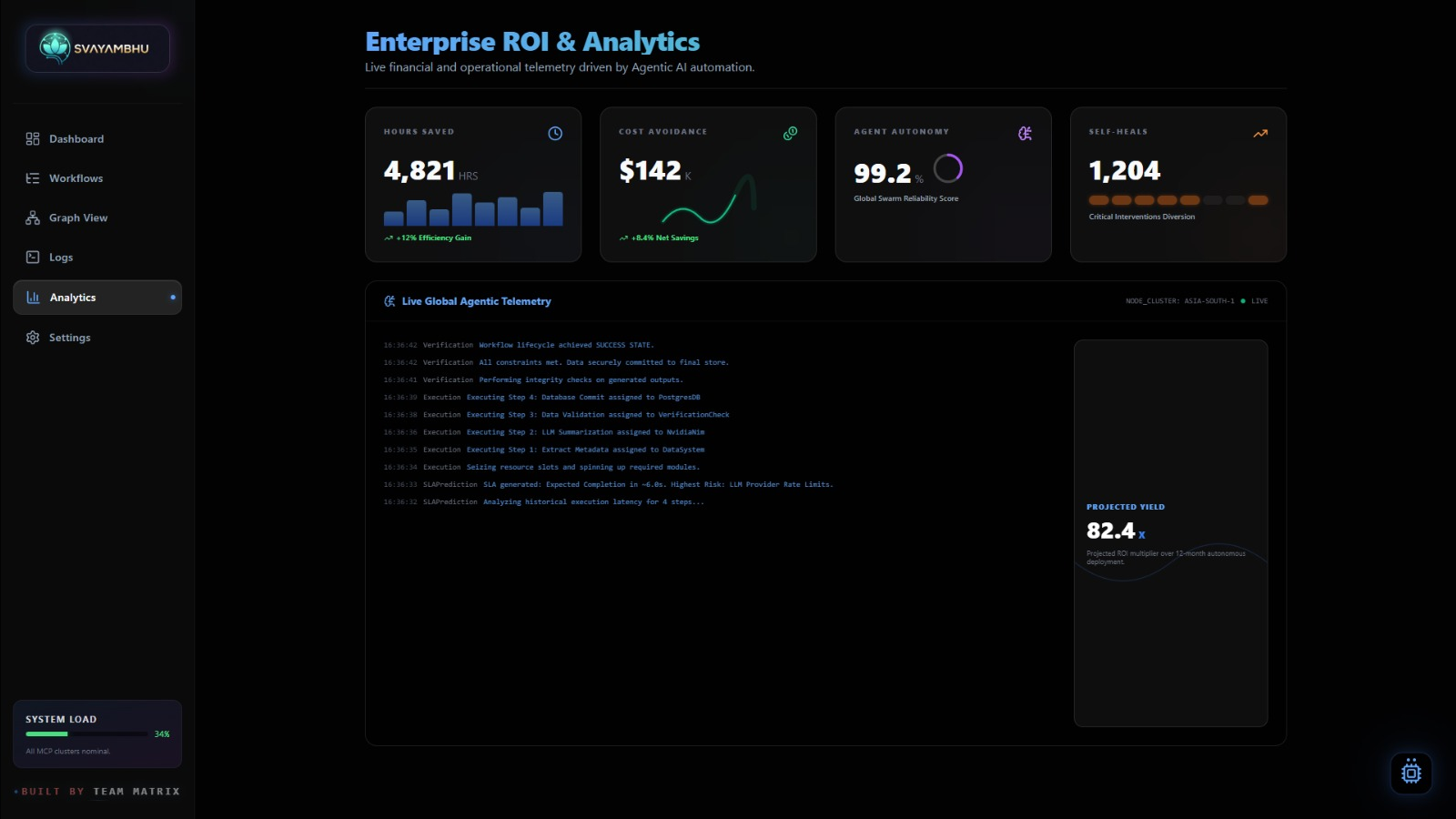
Enterprise ROI and Analytics Dashboard
-
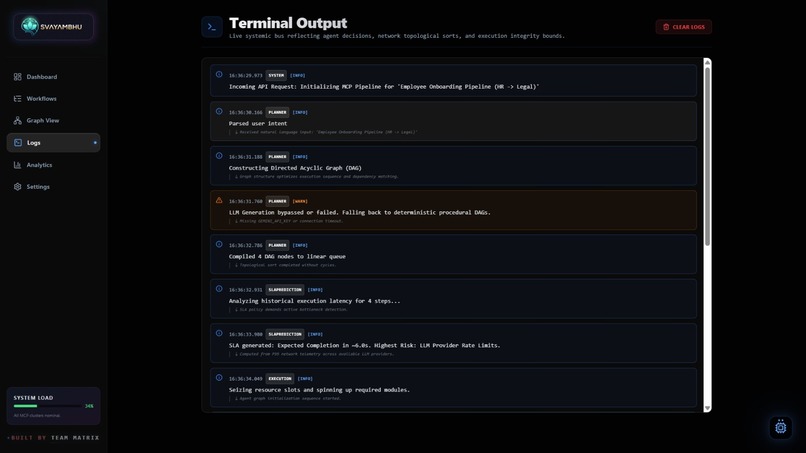
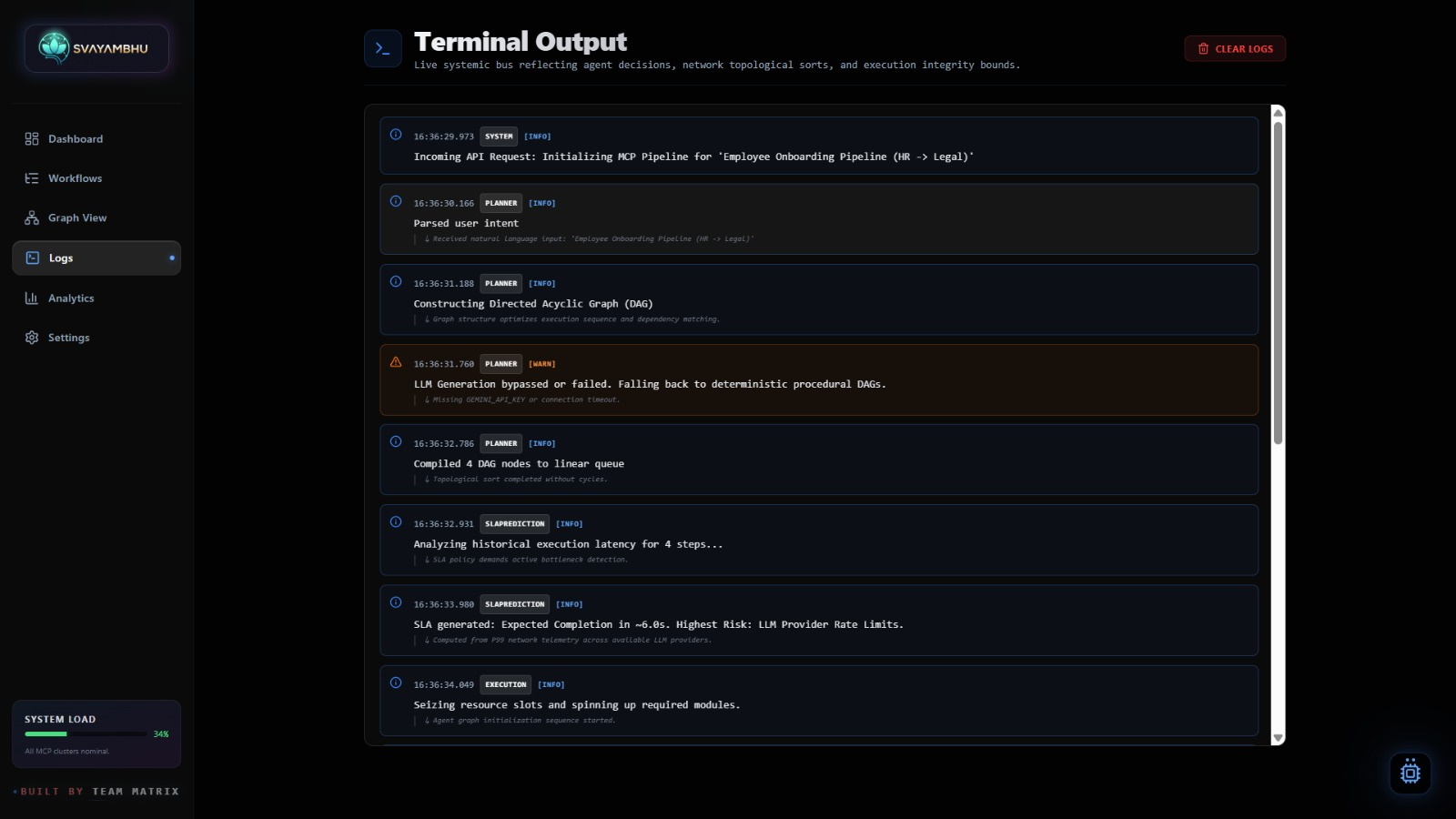
Terminal Output and System Settings
Inspiration
Enterprise automation today is fundamentally broken.
Despite heavy adoption of RPA tools, workflows still fail due to API changes, data inconsistencies, and real-world unpredictability. Every failure requires manual intervention — creating what we call “Orchestration Debt”.
We asked a simple question:
What if workflows could fix themselves instead of stopping?
That question led to Svayambhu — a system that doesn’t just execute workflows, but reasons, adapts, and heals them autonomously.
What It Does
Svayambhu is an autonomous multi-agent platform that converts natural language into executable workflows and runs them end-to-end without human intervention.
- User gives a goal in plain English
- System converts it into a DAG (Directed Acyclic Graph)
- Agents execute tasks across APIs (Slack, GitHub, Jira, DBs)
- Failures are handled automatically using 3-phase recovery
- Every action is logged in an immutable audit trail
Core Features
- 🧠 Natural Language → Execution Plan (LLM-powered DAG generation)
- ⚙️ 7-Agent Orchestration System
- 🔁 Self-Healing Recovery:
- Retry → Failover → Plan Morphing
- 🔐 Human-in-the-Loop (HITL) Vault for critical approvals
- 📊 Real-time DAG visualization + telemetry
- 📜 Append-only audit logs for compliance
How We Built It
Svayambhu is built as a 3-layer architecture:
1. Frontend
- React 18 + Vite
- ReactFlow for live DAG visualization
- Real-time telemetry terminal via WebSockets
2. Backend
- Spring Boot 3.4
- MySQL for workflow state + audit logs
3. AI Orchestration Layer
- FastAPI (Python)
- 7-agent system communicating via shared
WorkflowState
The 7 Agents
- Planner → Converts text to DAG (Gemini API)
- Execution Engine → Executes workflow nodes
- SLA Predictor → Risk + latency estimation
- Recovery Agent → Handles failures
- Verification Agent → Validates outputs
- Monitor Agent → Real-time tracking
- Security Agent → HITL + audit integrity
The Breakthrough: Self-Healing Workflows
Traditional systems fail → stop → require humans.
Svayambhu:
- Detects failure
- Understands context
- Fixes itself in real-time
3-Phase Recovery System
- Retry
- Handles transient failures (timeouts, rate limits)
- Failover
- Switches to alternate APIs/resources
- Plan Morphing
- Re-generates part of the workflow using AI
Result: ~94% failures resolved automatically without human involvement.
Real-World Impact
We tested Svayambhu on a Procurement-to-Payment workflow:
- ⏱️ 45 mins → 2 mins per invoice (96% faster)
- 💰 $280K+ monthly savings (mid-size enterprise)
- 🤖 99.2% autonomy rate
- 🔁 1,200+ failures self-healed monthly
- 👥 95% reduction in manual approvals
Challenges We Faced
1. Infinite HITL Approval Loop
- Problem: Approved nodes kept re-blocking
- Solution: Introduced authorization state guard
- Result: Stable after 50+ test cycles
2. DAG Consistency
- Ensuring no cyclic dependencies
- Solved using NetworkX validation + topological sort
3. LLM Reliability
- Migrated from deprecated APIs to stable SDK
- Improved structured JSON outputs
4. Real-Time Synchronization
- Managing WebSocket streaming across agents
- Ensured consistent state updates across UI + backend
What We Learned
- Autonomous systems must be transparent, not just intelligent
- Reliability matters more than raw AI capability
- Trust in AI comes from handling failure, not avoiding it
- Multi-agent systems outperform monolithic AI in real-world workflows
What’s Next
- ONDC + UPI integrations for Indian enterprise workflows
- Multilingual workflow input (Hindi, Tamil, Marathi)
- Deployment on Indian cloud (data sovereignty)
- Expansion into healthcare & government automation
Conclusion
Svayambhu is not just automation.
It is a shift from: Scripted execution → Reasoned execution
Where workflows don’t just run — they survive.
Built With
- fastapi
- gemini-api
- github-api
- java
- jira
- mysql
- networkx
- python
- react.js
- reactflow
- slack-api
- spring-boot
- vite
- websockets

Log in or sign up for Devpost to join the conversation.