Svasthya — Making Cognitive Care More Human
Inspiration
Dementia care is not only a clinical challenge — it is also a communication, accessibility, memory, and caregiver-support challenge.
We wanted to build something that an elderly person could actually use without having to learn a complicated digital system. Instead of treating technology as another barrier, we wanted it to adapt around the patient: larger interactions, familiar cultural experiences, regional-language voice, simple cognitive activities, and support that can continue even when connectivity is unreliable.
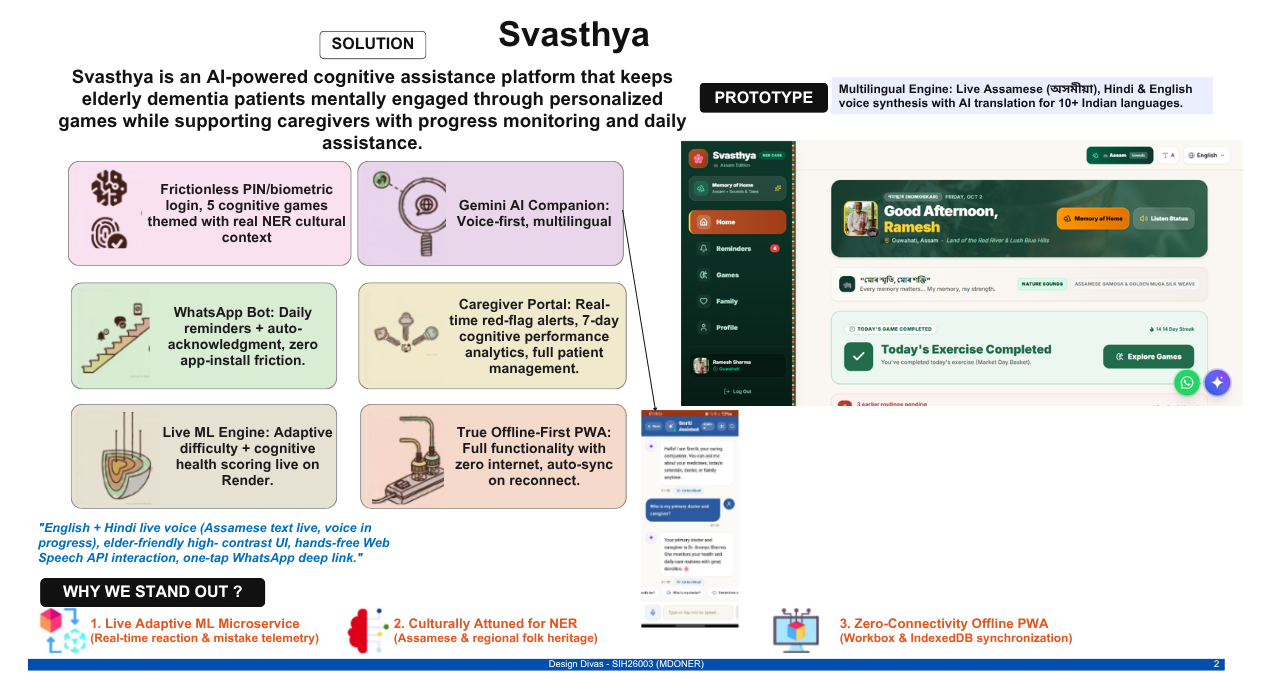
That idea led us to build Svasthya, our AI-powered cognitive care platform built around the Smriti cognitive-care system.
Our goal was simple:
Make cognitive care more accessible, personalized, culturally familiar, and practical for both patients and caregivers.
What Svasthya Does
Svasthya connects three important parts of dementia care:
Patient → Caregiver → Intelligent Support System
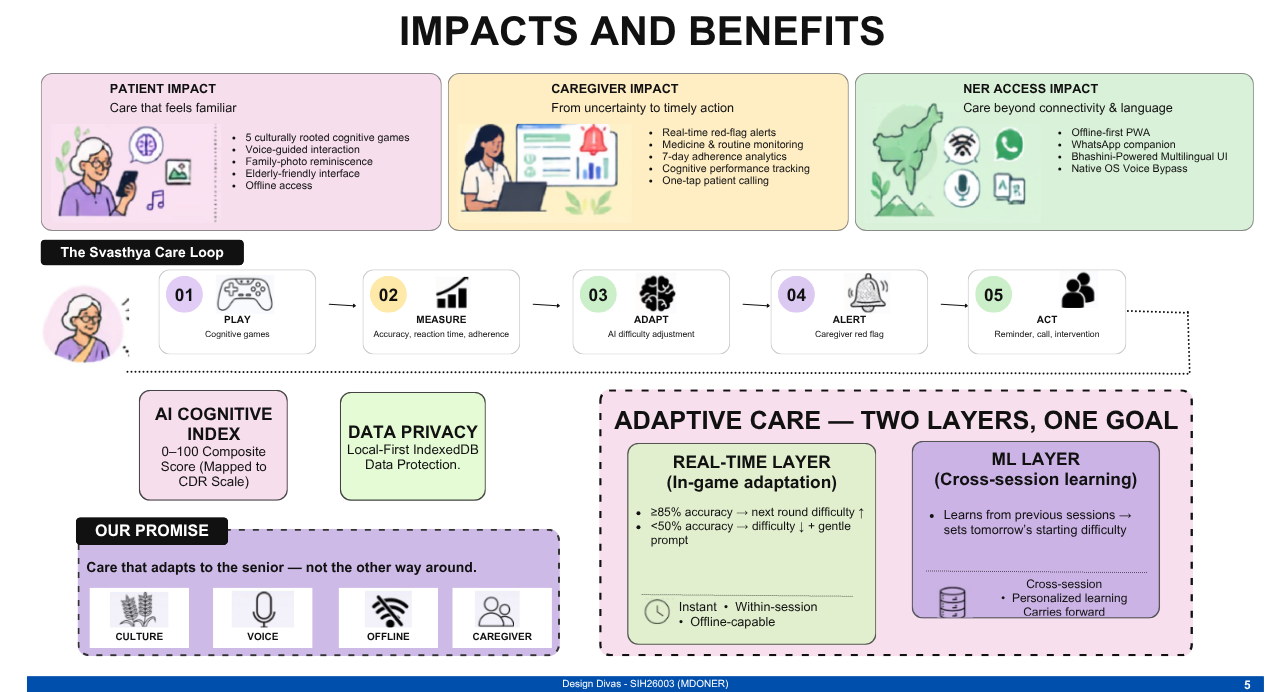
👵 Patient Experience
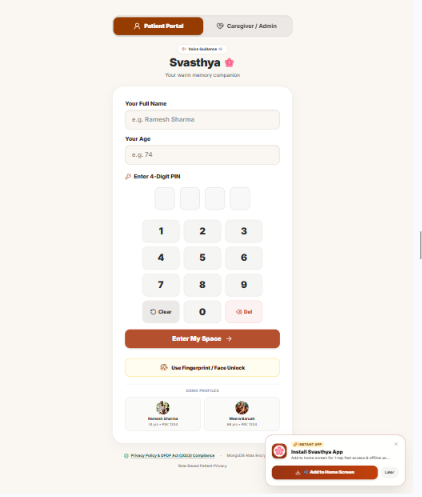
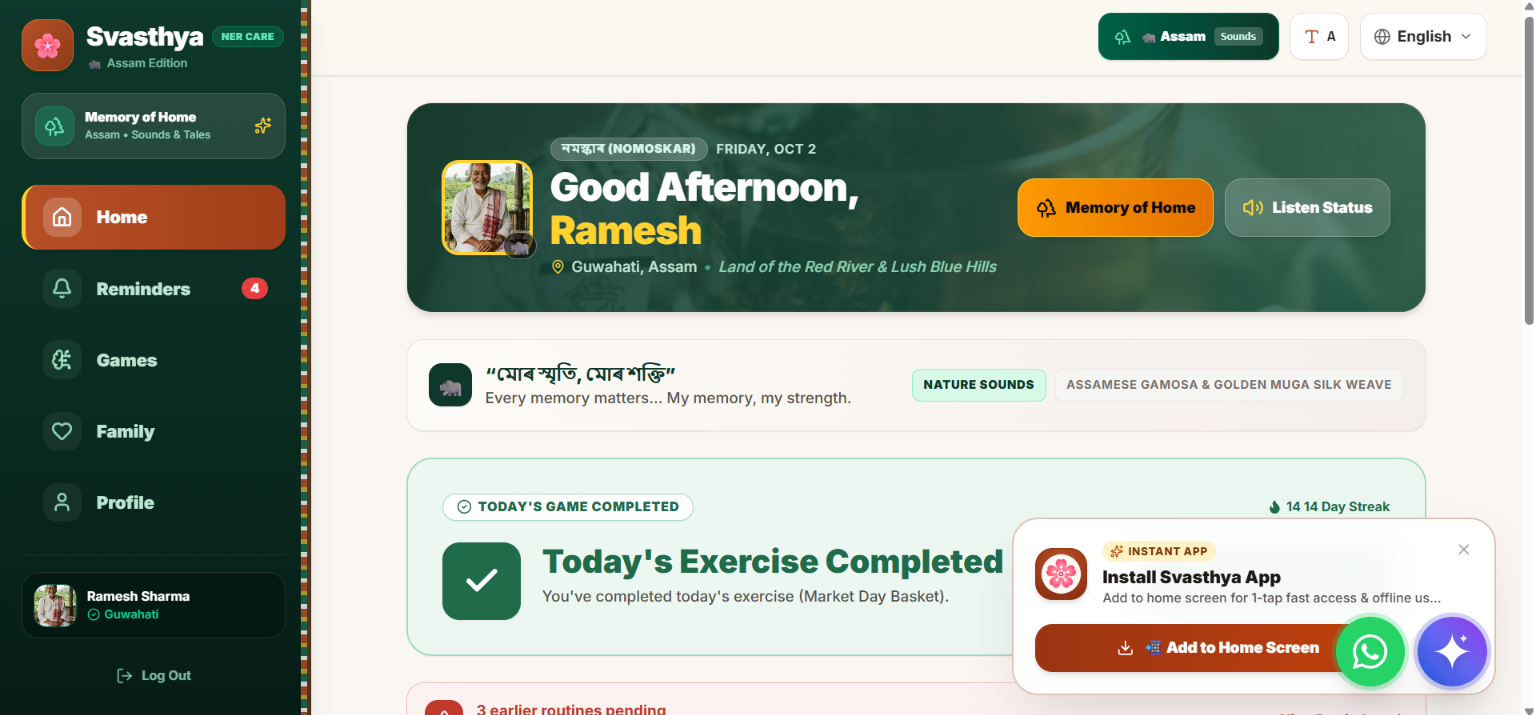
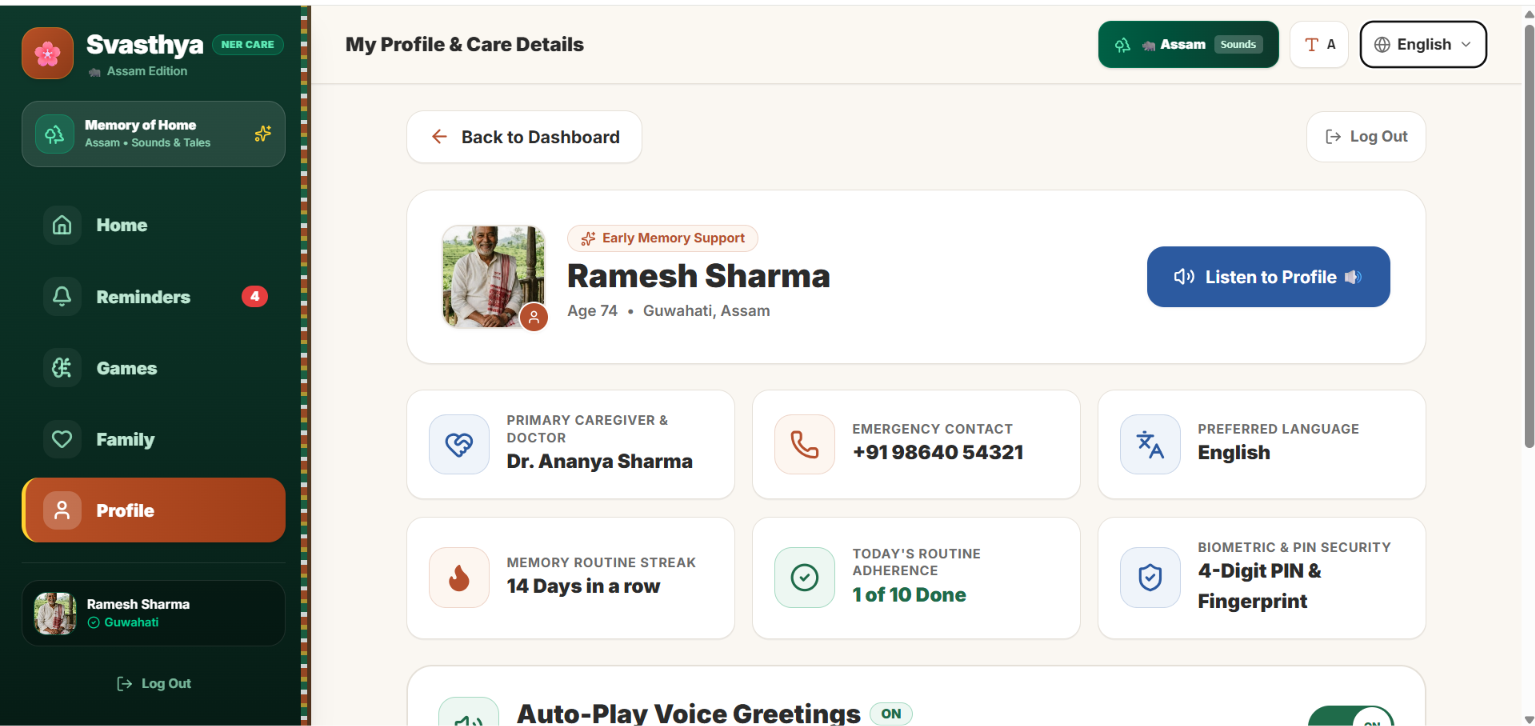
The patient portal is designed specifically for elderly users.
Instead of dense menus and small controls, it uses:
- High-contrast interfaces
- Large buttons
- Simple navigation
- PIN-based access
- Voice interaction
- Culturally familiar cognitive activities
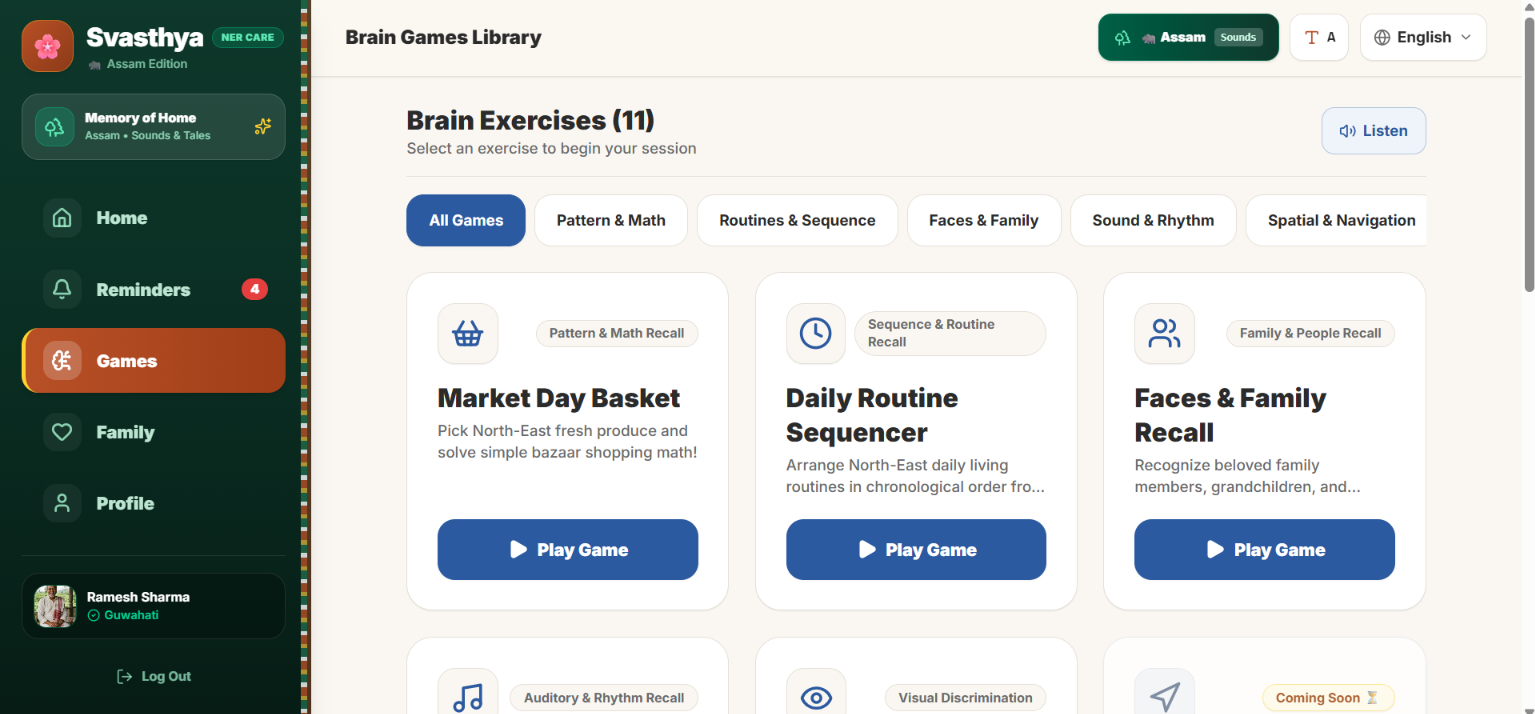
The platform includes five cognitive activities:
- Market Day Basket — memory and selection-based interaction inspired by everyday shopping.
- Daily Routine Sequencer — arranging familiar daily activities in the correct order.
- Faces & Family Recall — recognizing and recalling familiar people.
- Sound & Rhythm Match — identifying and matching sounds and rhythms.
- Odd One Out — identifying differences and exercising attention.
The purpose is not to make the patient learn a complicated game system. The interface and activities are designed around familiar interactions.
🧠 Adaptive Cognitive Engine
One of the core parts of Svasthya is its adaptive learning system.
The platform monitors interaction signals such as:
- Accuracy
- Reaction time
- Recent performance
The ML service uses these signals to dynamically adjust the difficulty of cognitive activities.
We use an 85% performance target as an adaptive reference point. If a user consistently performs above or below the target, the difficulty can be adjusted accordingly.
This turns the experience from a fixed collection of games into a personalized cognitive-support workflow.
The system also generates a longitudinal cognitive health score from 0–100 for caregiver monitoring. It is designed as a support and monitoring signal, not as a medical diagnosis.
🗣️ Regional-Language AI
Accessibility is not only about the screen.
Svasthya integrates Bhashini for regional-language translation and speech synthesis, allowing the platform to provide localized voice interactions including Assamese, Hindi, and English.
The platform also includes the Smriti AI Assistant, powered by Google Gemini, which allows patients to ask questions and receive conversational responses that can be presented through voice.
This is especially important for elderly users who may be more comfortable communicating in their familiar language than interacting with a conventional English-first interface.
👩⚕️ Caregiver Dashboard
The system is designed for caregivers as much as for patients.
The caregiver dashboard provides:
- Patient roster and alerts
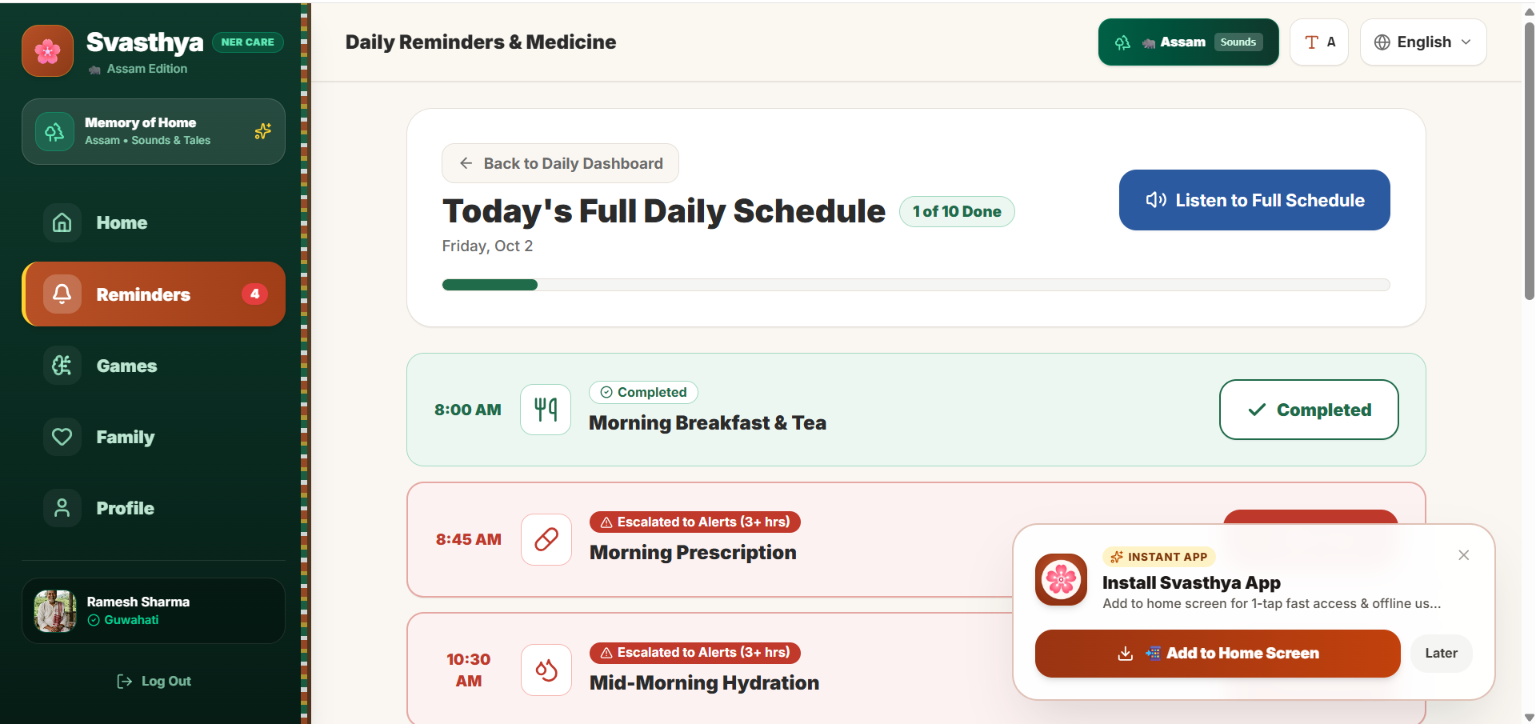
- Medication and hydration routine monitoring
- Missed-routine notifications
- 7-day adherence visualization
- Cognitive performance analytics
- Red-flag overdue alerts
- Exportable telemetry
This creates a bridge between what happens during patient interaction and what caregivers need to understand over time.
📱 Support Beyond the Web App
We also designed Svasthya as a multi-channel care system.
WhatsApp Companion
A WhatsApp companion can provide:
- Medication reminders
- Routine reminders
- One-click access to cognitive activities
- Patient check-ins
Offline-First PWA
Connectivity should not become a complete barrier to care.
The patient application uses:
- Progressive Web App architecture
- Workbox
- IndexedDB
- Local data caching
- Background synchronization
This allows supported activities to continue during temporary connectivity loss and synchronize when the connection becomes available again.
The broader architecture can also extend toward IVR/SMS support and frontline healthcare-worker access for environments where smartphones or stable internet are limited.
🧠 Memory Bank
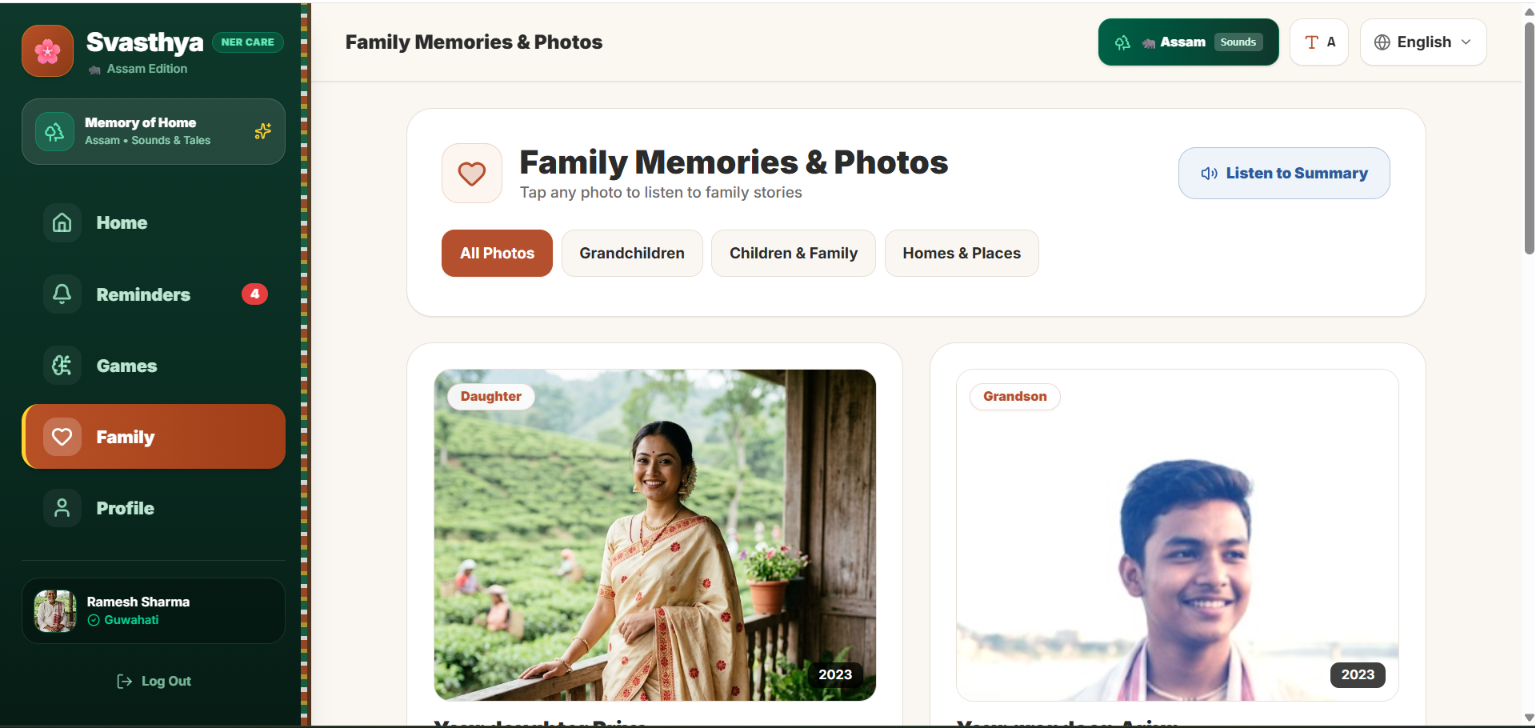
Another part of the system is the Memory Bank, a family-photo reminiscence space designed to bring familiar people and memories into the patient's digital environment.
Instead of making the experience completely clinical, we wanted the platform to retain a sense of familiarity and personal identity.
🏗️ How We Built It
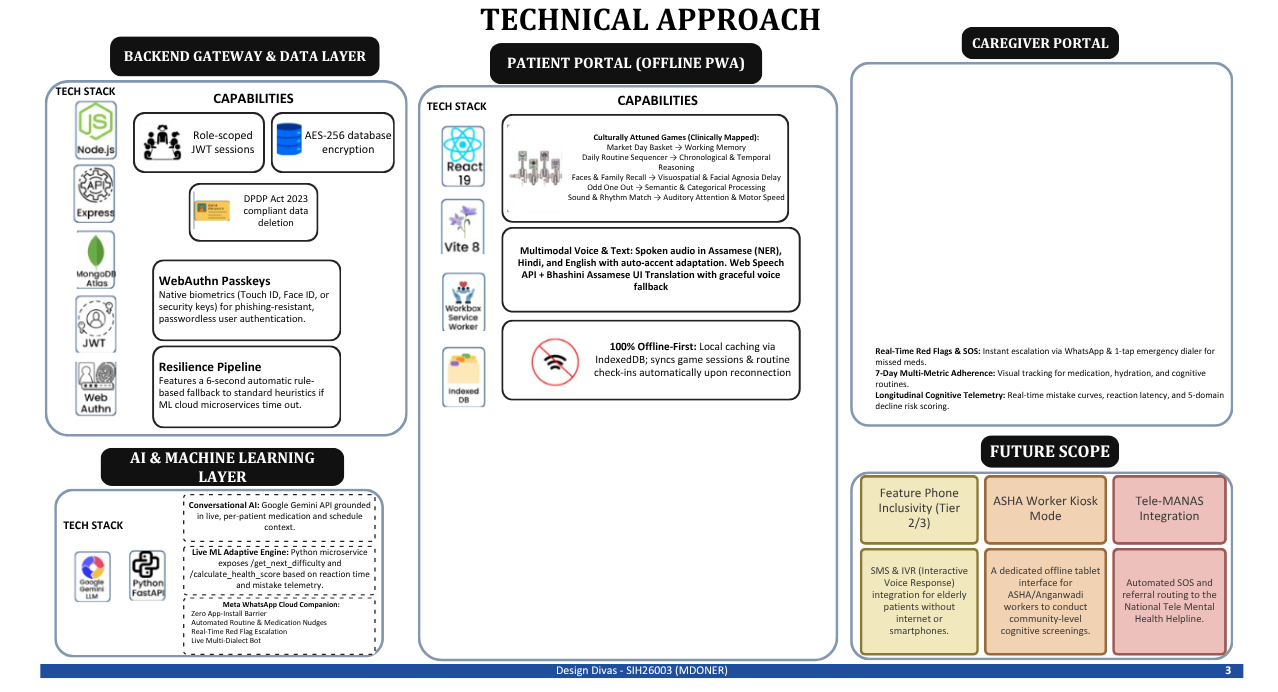
Svasthya combines several technologies into one connected system.
Frontend
- React 19
- Vite
- Tailwind CSS
- React Router
- Lucide
- i18next
- Recharts
- Web Speech APIs
Offline & PWA
- Vite PWA
- Workbox
- IndexedDB
- Background synchronization
Backend
- Node.js
- Express.js
- Mongoose
- MongoDB Atlas
- JWT authentication
- bcrypt
- Node-Cron
AI & Machine Learning
- Google Gemini AI
- Python
- FastAPI
- scikit-learn
- Adaptive difficulty engine
- Cognitive performance scoring
Integrations
- Bhashini API
- Meta WhatsApp Business Cloud API
- Google OAuth 2.0
- WebAuthn / FIDO2
The architecture separates the user-facing application, backend services, and ML engine so that cognitive adaptation and AI capabilities can evolve independently.
🔧 Challenges We Faced
1. Designing for elderly users
A normal modern web interface is not automatically accessible to an elderly person.
We had to rethink navigation, button sizes, contrast, interaction complexity, and the amount of information shown at once.
2. Making localization meaningful
Simply translating text is not enough.
The cognitive activities themselves need to feel familiar. That is why we explored culturally rooted interactions such as Market Day Basket and Sound & Rhythm Match.
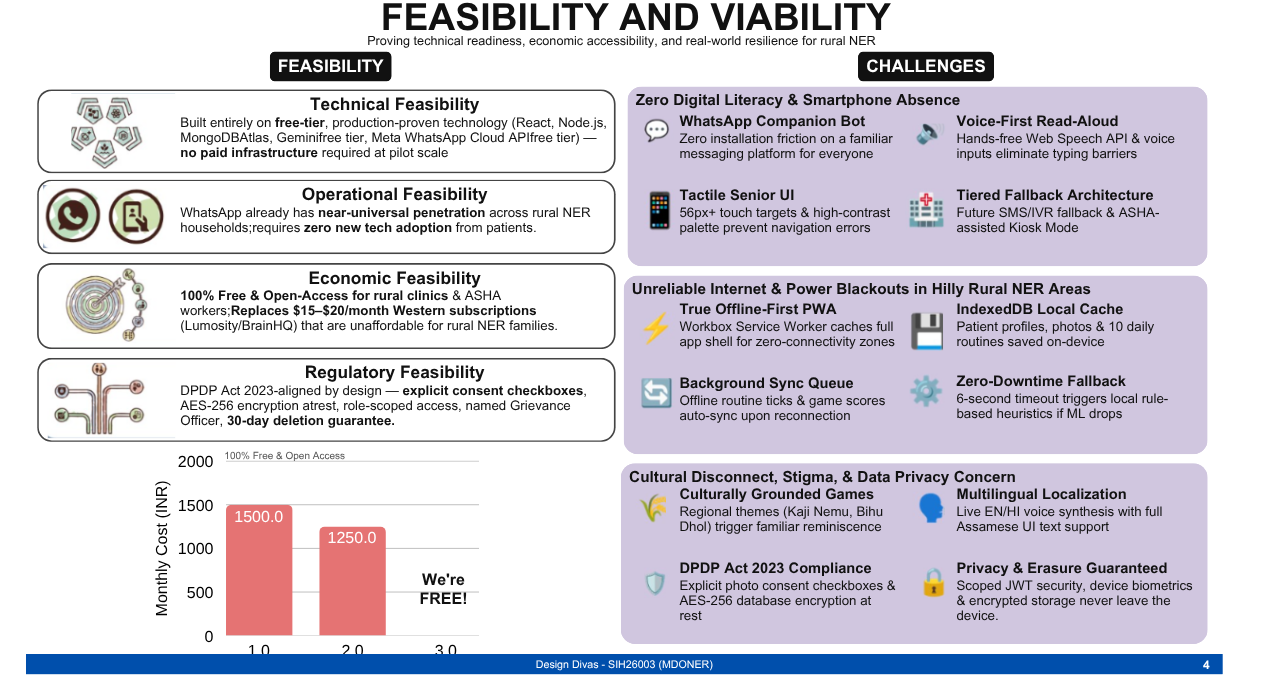
3. Combining AI with unreliable connectivity
AI services generally depend on network access, while our target environment may not always have reliable connectivity.
This led us toward an offline-first architecture, where local functionality and synchronization are treated as core parts of the product rather than optional features.
4. Keeping patient and caregiver workflows connected
The patient needs simplicity, while the caregiver needs useful information and alerts.
Designing both experiences without making either side unnecessarily complicated was one of the biggest product challenges.
5. Building adaptive interactions
A fixed difficulty level does not work equally well for every user.
We therefore built an ML layer that considers interaction performance and adjusts difficulty dynamically instead of using the same experience for everyone.
💡 What We Learned
Building Svasthya taught us that accessibility is a product behavior, not just a visual design choice.
We also learned that:
- AI becomes more useful when it solves a specific workflow problem.
- Localization means adapting experiences, not just translating words.
- Offline support has to be considered from the architecture stage.
- Healthcare technology needs reliability and simplicity alongside innovation.
- Elderly-focused design requires reducing cognitive load at every step.
- A useful system must support both the person receiving care and the person providing it.
Most importantly, we learned that technology for healthcare does not always need to look complicated. Sometimes the most important innovation is making a complex system feel simple, familiar, and human.
🚀 What's Next
Svasthya can be extended with:
- SMS and IVR support for feature-phone users
- More regional Indian languages
- More culturally localized cognitive activities
- ASHA/frontline-worker tablet mode
- Telehealth integrations
- Additional patient telemetry
- Speech-based cognitive indicators
- Larger-scale clinical validation
Our long-term vision is to build a cognitive-care ecosystem that can adapt to different languages, communities, connectivity conditions, and caregiver workflows while keeping the patient experience simple.
Svasthya is built around one idea: technology should adapt to people — not force people to adapt to technology.
Built With
- accessibility
- api
- artificial-intelligence
- atlas
- bhashini
- express.js
- fastapi
- fido2
- healthcare
- indexeddb
- javascript/typescript
- machine-learning
- mongodb
- node.js
- pwa
- python
- react
- tailwind
- vite
- webauthn

Log in or sign up for Devpost to join the conversation.