

SuurAI: AI-Powered Podcast Discovery
Inspiration
The inspiration for SuurAI came from a deeply personal frustration that resonates with millions of podcast enthusiasts worldwide. With over 4 million podcasts and 70+ million episodes available across various platforms, the sheer volume of content has created what we call the "Paradox of Choice" in podcast discovery.
We found ourselves spending more time scrolling through endless podcast lists than actually listening to content. The existing discovery mechanisms were either too broad (trending podcasts) or too narrow (category-based filtering), missing the nuanced context of when, why, and how we consume audio content.
The math behind the problem can be expressed as:
$$\text{Time Spent Choosing} \propto \frac{\text{Number of Options}^2}{\text{Relevance to User Context}}$$
This led us to envision a solution that could understand not just what users want to listen to, but the context behind their listening needs - creating SuurAI to solve the utter confusion created by the vast library of podcasts.
What it does
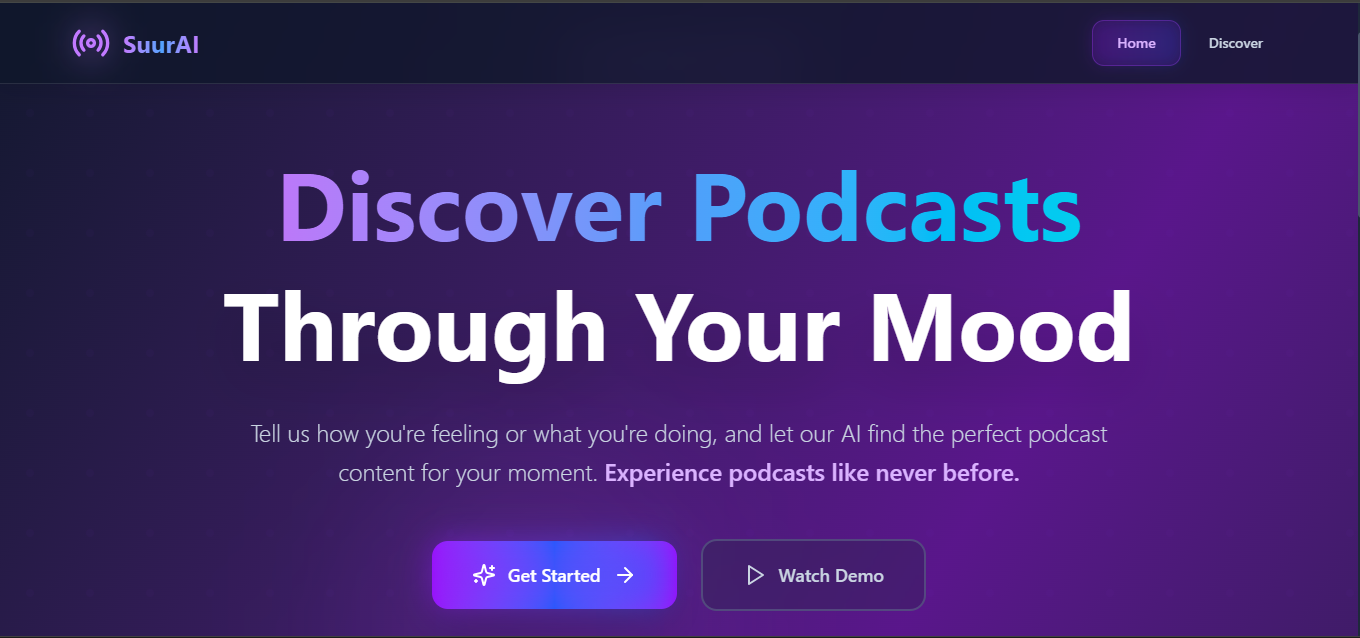
SuurAI is an intelligent podcast discovery platform that transforms how users find audio content by understanding their mood, context, and preferences through natural language.
Core Features:
- Mood-Based Discovery: Users describe their current mood or activity in natural language (e.g., "I need productivity podcasts for focused work")
- AI-Powered Understanding: Gemini AI processes and refines user queries to understand intent and context
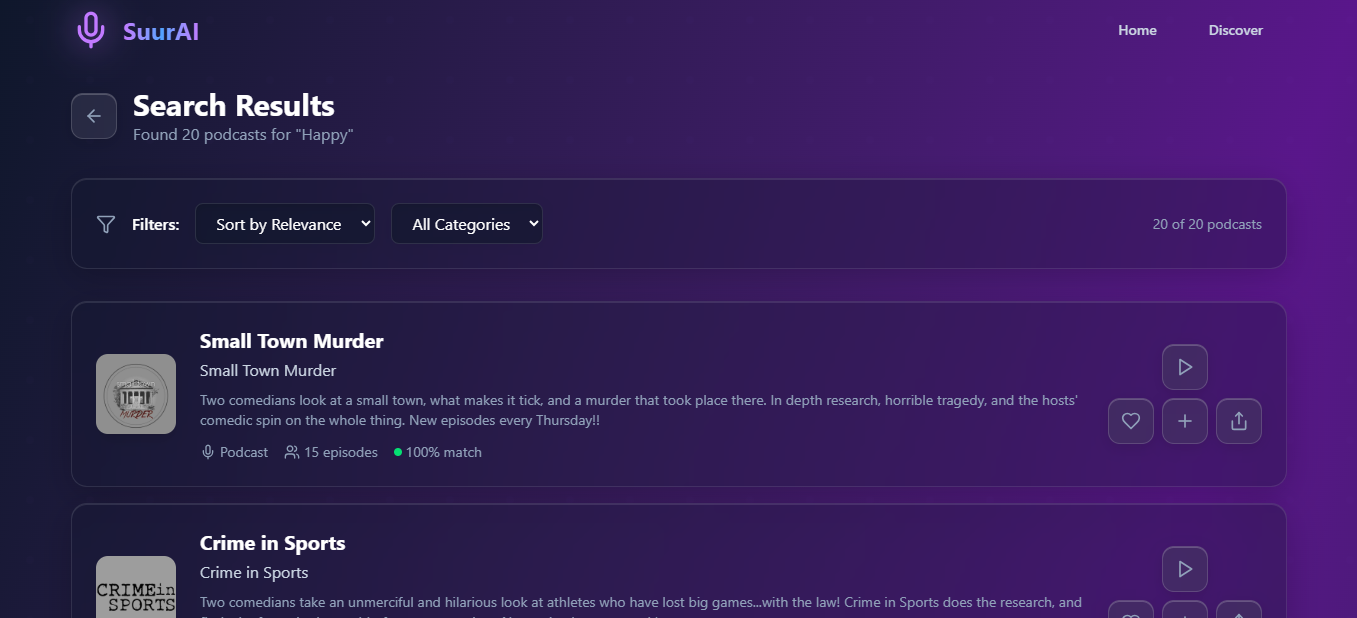
- Curated Recommendations: QLOO API provides intelligent podcast recommendations based on the refined queries
- Seamless Playback: Spotify API integration enables direct podcast episode streaming and playback
- Intuitive Interface: Clean, responsive design built with React and Tailwind CSS for optimal user experience
User Journey:
User Input → AI Processing → Smart Recommendations → Direct Playback
The platform eliminates the decision paralysis of choosing from millions of options by providing contextually relevant, personalized podcast suggestions that match users' specific needs and moments.
How we built it
Architecture Overview
graph TB
    A[User Input: Mood/Context] --> B[React Frontend]
    B --> C[Flask Backend]
    C --> D[Gemini AI Processing]
    C --> E[QLOO API Query]
    E --> F[Spotify API Integration]
    F --> G[Curated Podcast Results]
    G --> B
Frontend Stack
React + TypeScript + Tailwind CSS
- Component Architecture: We built modular, reusable components with clear separation of concerns
- State Management: We implemented efficient state management using React hooks and context
- Responsive Design: We created a mobile-first design system using Tailwind's utility classes
- Type Safety: We leveraged TypeScript for better developer experience and runtime error prevention
interface PodcastRecommendation {
  name: string;
  description: string;
  publisher: string;
  images: Array<{url: string, height: number, width: number}>;
  entity_id?: string;
  properties?: {
    description?: string;
    channel?: string;
    image?: {url: string};
    episode_count?: string;
  };
  popularity?: number;
}
Backend Stack
Flask + Python + AI Integration
- API Gateway: Flask serves as the orchestration layer between frontend and multiple external APIs
- AI Processing: We integrated Gemini AI for natural language understanding and query refinement
- Data Aggregation: QLOO API for podcast discovery and recommendation intelligence
- Media Integration: Spotify API for actual podcast episode serving and playback
Key Technical Implementation
Intelligent Query Processing Pipeline
def process_user_query(user_input):
    # Gemini AI processes natural language input
    refined_query = gemini_ai.refine_query(user_input)

    # QLOO API translates mood to podcast recommendations
    recommendations = qloo_api.get_recommendations(refined_query)

    # Spotify API enriches with playable content
    enriched_results = spotify_api.enrich_podcasts(recommendations)

    return enriched_results
Challenges we ran into
1. System Flow Design
The Biggest Challenge
Designing a clear, intuitive system flow was our most significant hurdle. The challenge was creating a seamless journey from user mood to content delivery while maintaining simplicity.
Problem: Creating an intuitive flow from:
User Mood → AI Understanding → API Queries → Content Delivery → User Satisfaction
Solution: We created detailed user journey maps and iteratively refined the flow based on the principle of progressive disclosure.
2. API Integration Complexity
We worked with three different APIs (Gemini AI, QLOO, Spotify) each with:
- Different authentication methods (OAuth, API keys, bearer tokens)
- Varying rate limits and quotas
- Inconsistent data formats and response structures
- Different error handling patterns
Solution: We built a unified API abstraction layer that normalized responses and handled failures gracefully with comprehensive fallback mechanisms.
3. Context Understanding
We had to teach the AI to understand nuanced contexts:
- Differentiating "I need something while commuting" vs "I want deep focus content"
- Handling ambiguous or incomplete user inputs
- Mapping abstract moods to concrete podcast categories
Solution: We developed context-aware prompt engineering with explicit examples and context instructions for Gemini AI.
4. Performance vs User Experience
Balancing real-time AI processing with user expectations:
- AI processing takes 2-3 seconds
- Users expect near-instant results
- Multiple sequential API calls create cumulative latency
Solution: We implemented optimistic UI updates, skeleton loading states, and strategic caching for common queries.
Accomplishments that we're proud of
🎯 Successful AI Integration
We successfully integrated multiple AI services (Gemini AI, QLOO) to create a coherent, intelligent recommendation system that truly understands user context and intent.
🎨 Exceptional User Experience
We built a clean, intuitive interface that makes podcast discovery feel effortless. The responsive design works seamlessly across devices with smooth animations and clear visual feedback.
🔧 Robust Architecture
We created a scalable, maintainable codebase with:
- Type-safe TypeScript implementation
- Comprehensive error handling across the entire stack
- Modular component architecture
- Clean separation of concerns
🚀 Real-World Problem Solving
We addressed a genuine pain point in podcast discovery that affects millions of users, transforming how people find and consume audio content.
📱 End-to-End Functionality
We delivered a complete solution from mood input to actual podcast playback, integrating multiple complex APIs into a seamless user experience.
💡 Innovation in Content Discovery
We pioneered mood-based content discovery in the podcast space, moving beyond traditional category-based filtering to contextual understanding.
What we learned
Technical Mastery
- Advanced React Patterns: We mastered complex state management without external libraries, using React's built-in hooks effectively
- TypeScript Expertise: We gained deep understanding of type safety, interface design, and preventing runtime errors through proper typing
- API Orchestration: We learned to integrate multiple APIs with different authentication methods, rate limiting, and data formats
- AI Integration: We developed skills in prompt engineering and chaining AI services for coherent user experiences
System Design Principles
- User-Centric Design: We learned to prioritize user experience over technical complexity
- Error Resilience: We implemented comprehensive error handling and graceful degradation patterns
- Performance Optimization: We understood the importance of caching, lazy loading, and efficient API usage
- Scalable Architecture: We designed systems with future growth and maintenance in mind
Code Quality & Maintainability
The most valuable learning was developing habits for writing cleaner and maintainable code:
// Clean, typed, testable code structure
interface SearchParams {
  query: string;
  filters?: SearchFilters;
}

const useSearchLogic = (params: SearchParams) => {
  const processQuery = useCallback(...)
  const fetchResults = useCallback(...)
  const handleErrors = useCallback(...)

  return { processQuery, fetchResults, handleErrors }
}
Problem-Solving Methodology
- Iterative Development: Start with core functionality and progressively enhance
- User Feedback Integration: Design decisions based on actual user needs, not assumptions
- Technical Debt Management: Balance rapid development with long-term maintainability
What's next for SuurAI
🚀 Production-Ready Architecture
Microservices Transformation
# Current: Monolithic Flask
app = Flask(__name__)

# Future: Distributed Architecture
- API Gateway Service (Kong/Nginx)
- AI Processing Service (Celery workers)
- Recommendation Engine (Separate service)
- User Preference Service (PostgreSQL)
- Caching Layer (Redis cluster)
- Real-time Analytics (ElasticSearch)
Scalability Optimization
Mathematical model for system capacity:
$$\text{System Capacity} = \min\left(\frac{\text{API Rate Limits}}{\text{Concurrent Users}}, \frac{\text{Server Resources}}{\text{Request Complexity}}\right)$$
Optimization Targets:
- Caching Strategy: Redis for frequently requested moods and queries
- CDN Integration: Global content delivery for podcast thumbnails and metadata
- Database Scaling: PostgreSQL with read replicas and proper indexing
- Load Balancing: Horizontal scaling with auto-scaling groups
🧠 Enhanced AI Capabilities
- Personalization Engine: Learn from user listening history and preferences
- Sentiment Analysis: Advanced mood detection from text and voice input
- Multi-modal Input: Support for voice queries and image-based mood detection
- Predictive Recommendations: Suggest content based on time of day, location, and context
📊 Advanced Analytics & Insights
- User Behavior Analytics: Track recommendation effectiveness and user satisfaction
- A/B Testing Framework: Optimize AI prompts and recommendation algorithms
- Content Creator Insights: Analytics dashboard for podcast creators
- Recommendation Explanation: Transparent AI that explains why specific podcasts were recommended
🌐 Platform Expansion
- Mobile Applications: Native iOS and Android apps with offline capabilities
- Smart Speaker Integration: Voice-first experience for Alexa, Google Home
- Social Features: Playlist sharing, community recommendations, and social discovery
- Multi-language Support: Global expansion with localized AI understanding
🔒 Enterprise & Reliability
- User Authentication: Secure user accounts with preference persistence
- Content Moderation: AI-powered content filtering and safety measures
- Monitoring & Observability: Comprehensive system health monitoring with Prometheus/Grafana
- Compliance: GDPR, CCPA compliance for global user privacy protection
💼 Business Model Development
- Freemium Model: Basic recommendations free, advanced features premium
- Creator Partnerships: Revenue sharing with podcast creators for promoted content
- Enterprise Solutions: Branded podcast discovery for companies and organizations
- API as a Service: Licensing the recommendation engine to other platforms
SuurAI represents the future of content discovery - where technology understands not just what you want, but when and why you want it.

Log in or sign up for Devpost to join the conversation.