-
-
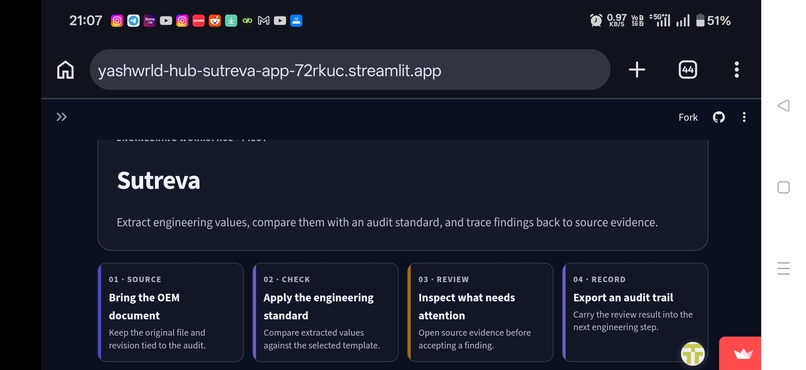
Landing page desktop
-
-
-
-
Inspiration
As an engineer working in the industrial engineering environment, I regularly encounter large volumes of technical documentation, including vendor datasheets, equipment specifications, technical reports and engineering registers.
Conventionally, reviewing these documents involves manually opening PDFs, locating relevant technical parameters, comparing them against engineering requirements and transferring the information into activity-specific registers, comparison sheets and review reports.
This repetitive process consumes considerable engineering man-hours and makes document reviews increasingly time-consuming as project complexity and document volumes grow.
It made me think: What if engineers could spend less time searching through documents and more time solving engineering problems?
That question became the inspiration behind Sutreva.
What it does
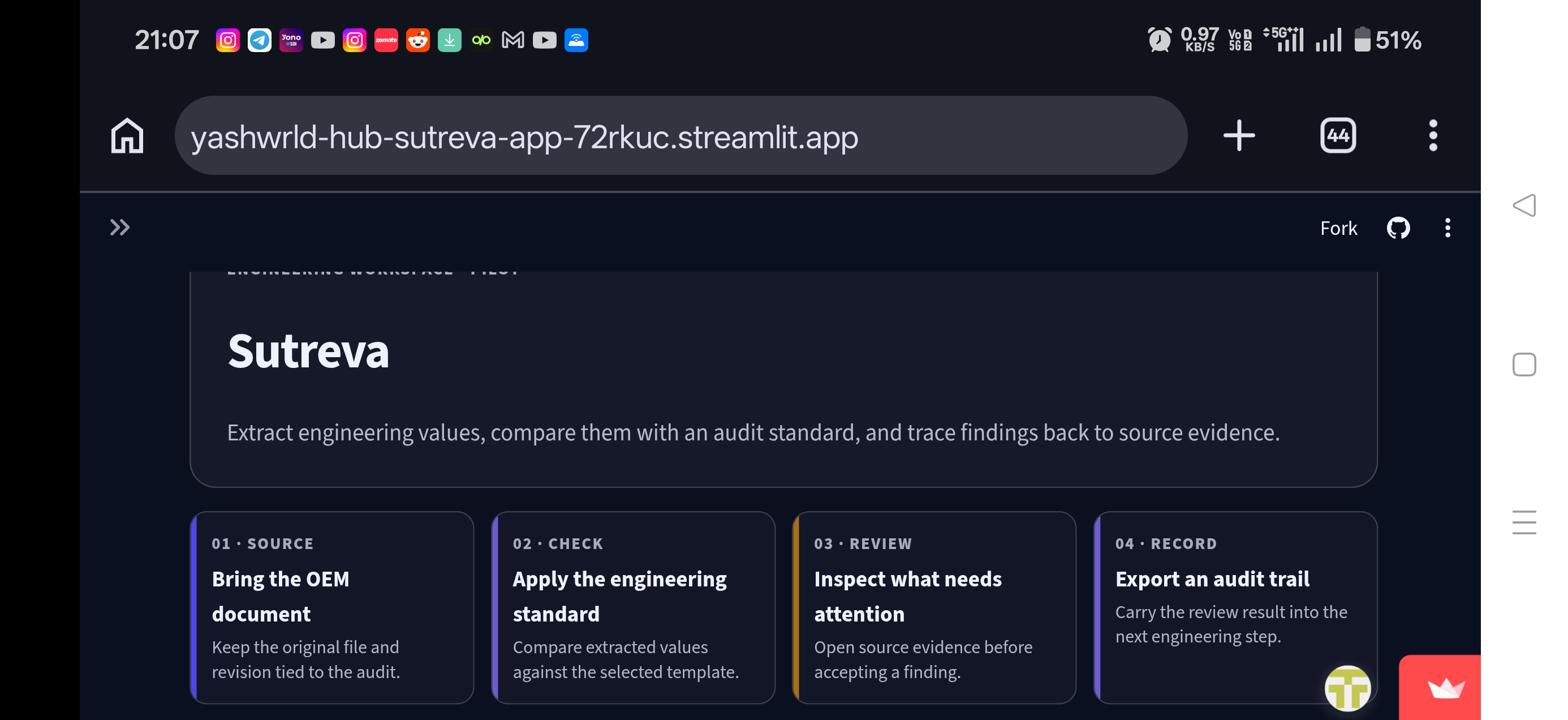
Sutreva is an AI-assisted engineering document intelligence and compliance auditing platform designed to transform technical documents into structured, evidence-backed engineering reviews.
Its core capabilities include:
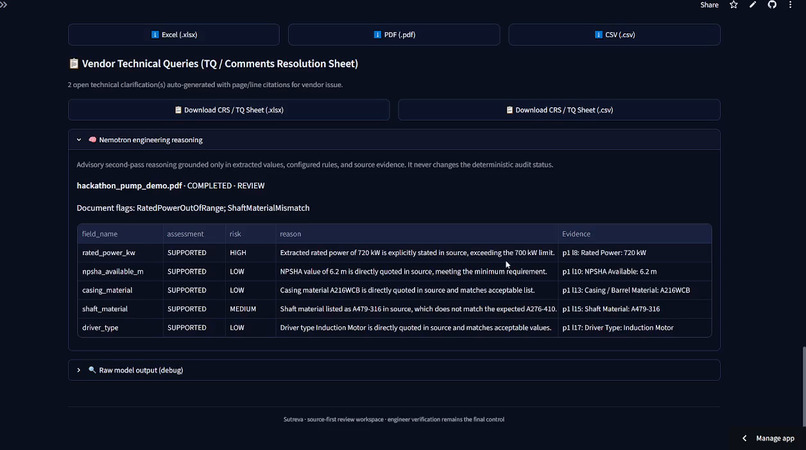
- AI-assisted extraction: Identifies and extracts relevant technical specifications from vendor documents and PDFs.
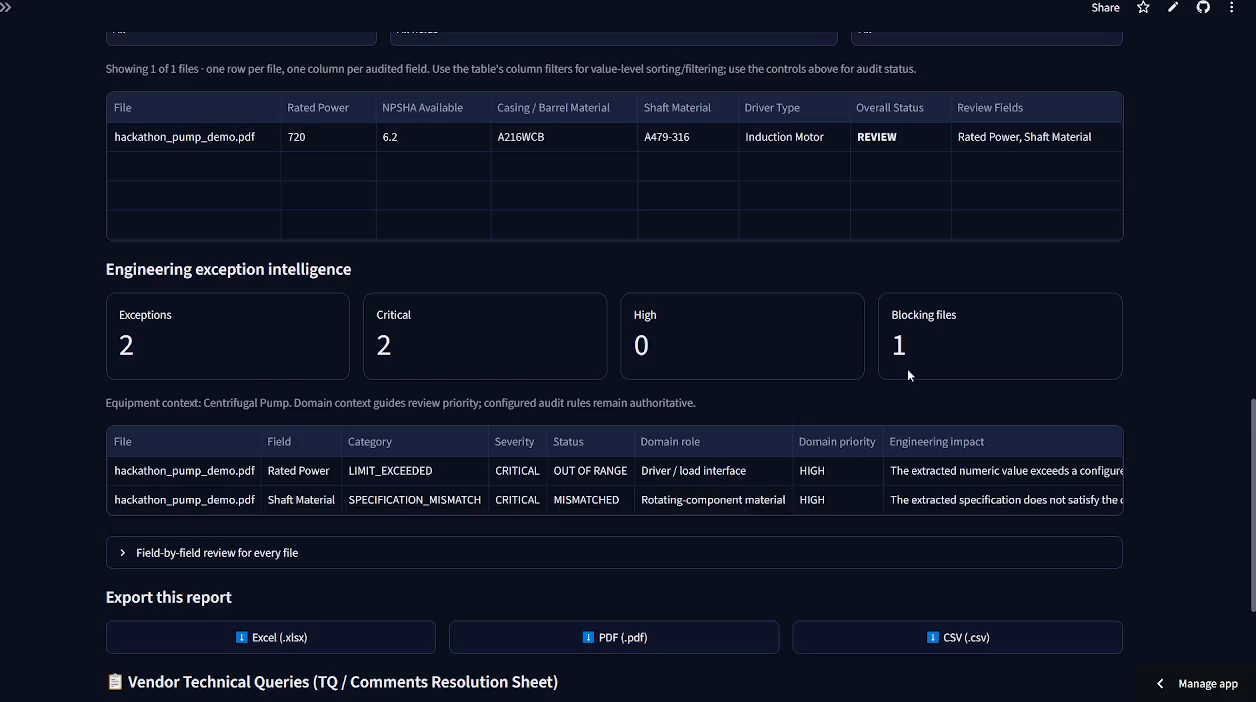
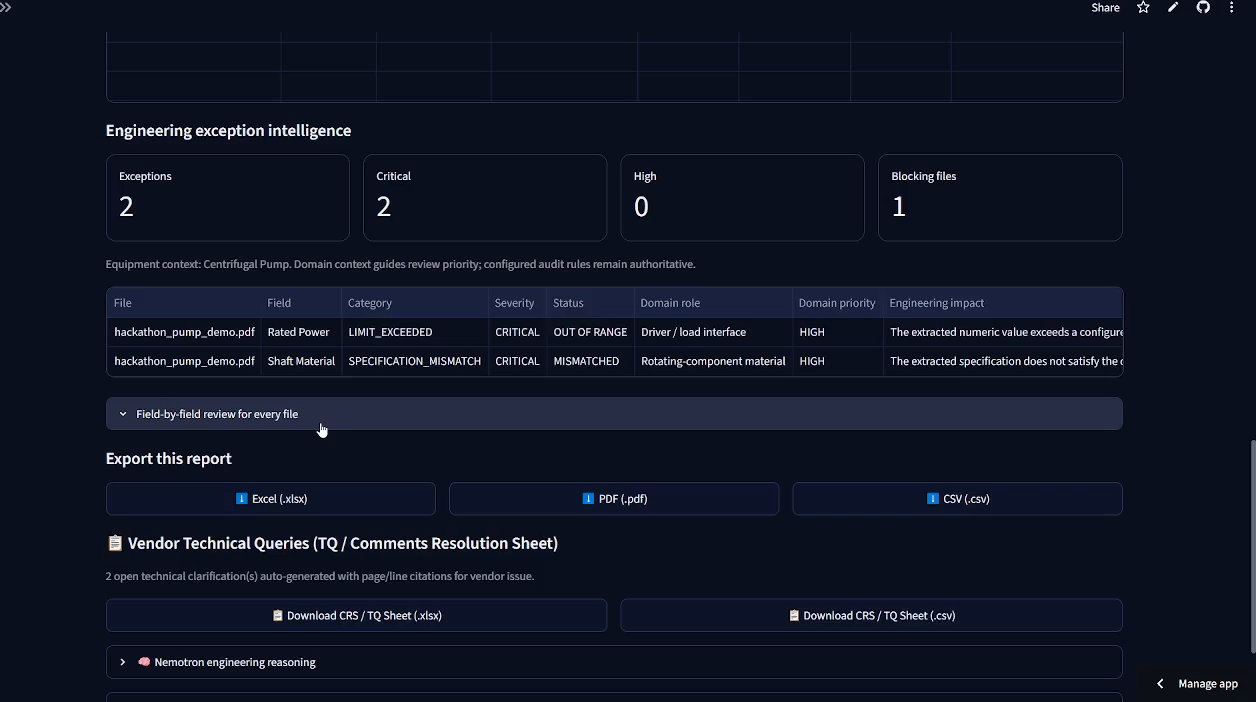
- Deterministic compliance auditing: Normalizes extracted values and compares them against configurable engineering requirements.
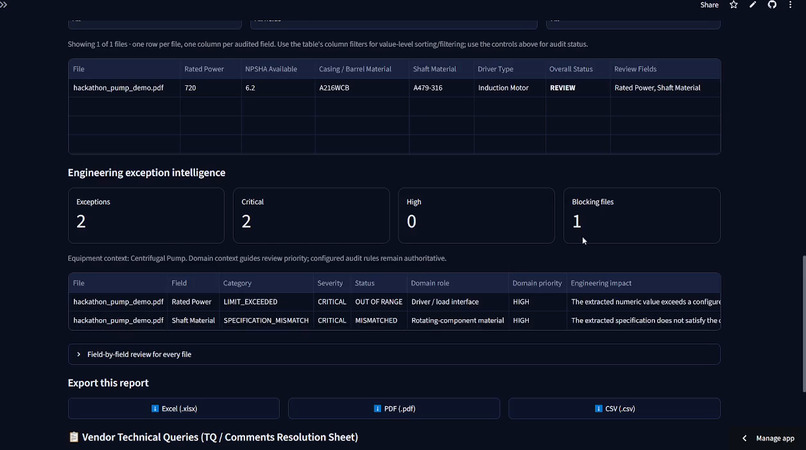
- Discrepancy identification: Flags matched, mismatched, missing and out-of-range parameters.
- Evidence traceability: Connects findings to their supporting source-document references.
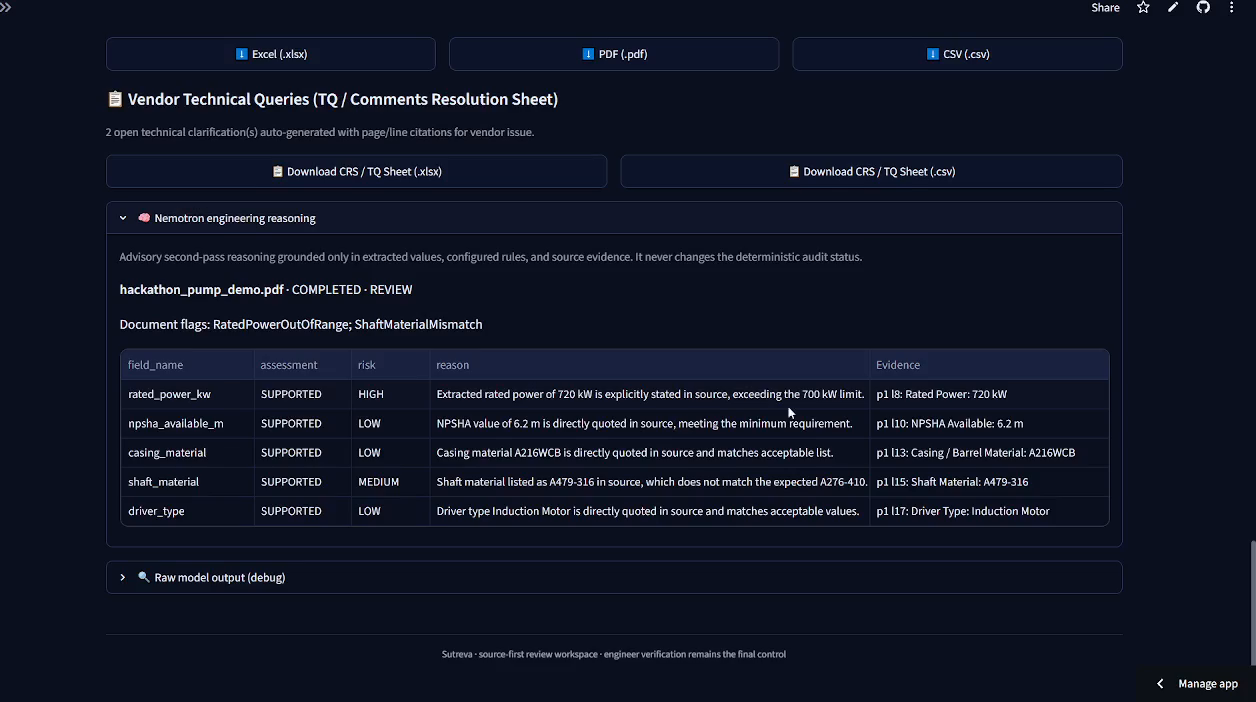
- AI-assisted reasoning: Integrates NVIDIA Nemotron through Nebius Token Factory to provide an additional advisory reasoning layer.
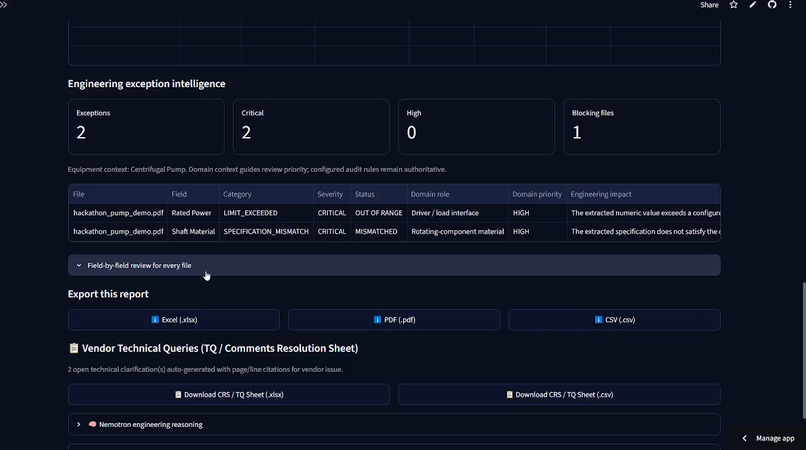
- Engineering review and reporting: Supports human verification and generates downloadable audit reports and technical query sheets.
A fundamental design principle is that AI assists the engineering review rather than replacing engineering judgment. Configured deterministic rules remain authoritative, and engineers retain final control over decisions.
How we built it
Sutreva was developed by combining Python-based application development, document processing, structured extraction, deterministic engineering validation and large language model integration.
The application follows a layered approach:
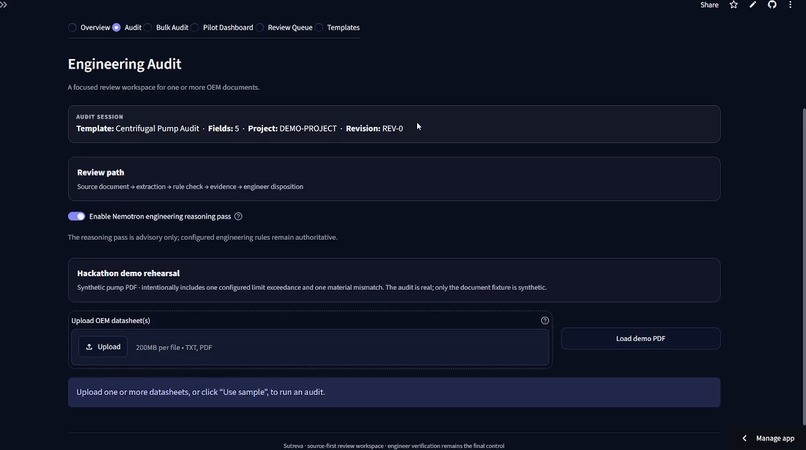
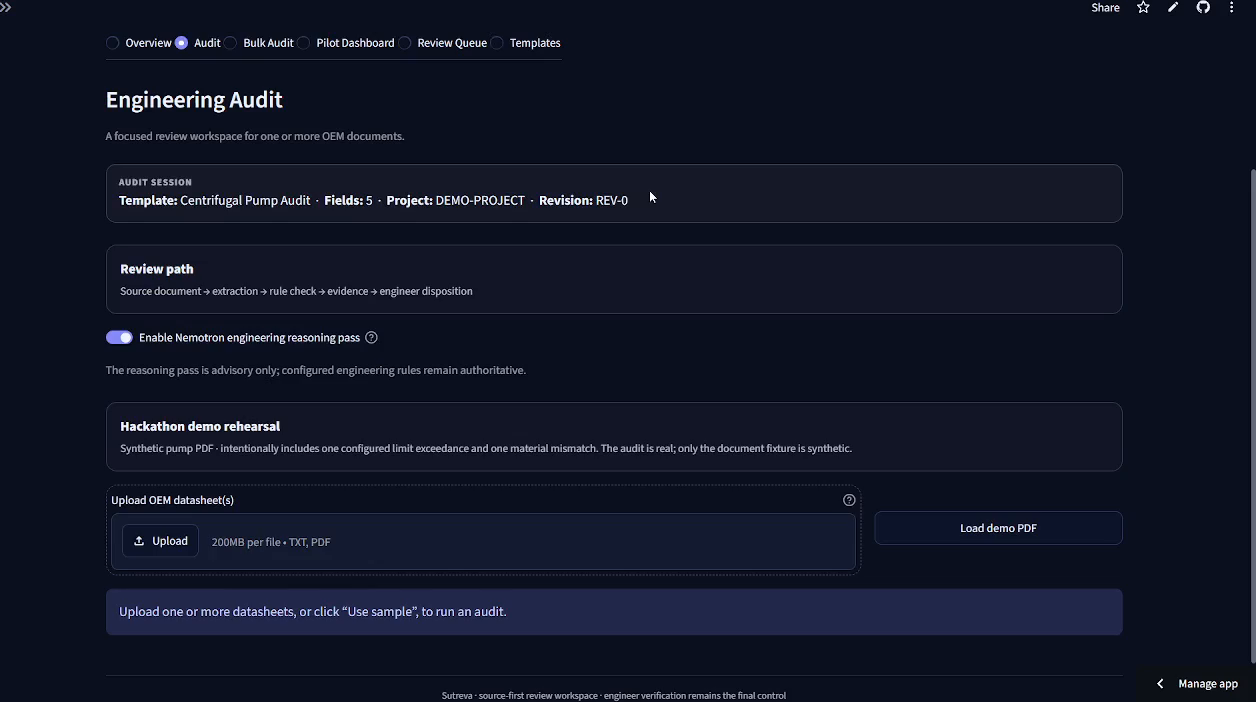
- Documents are uploaded and processed to extract relevant engineering information.
- Extracted values are normalized into structured data.
- A deterministic rules engine compares those values against configured engineering requirements.
- NVIDIA Nemotron, accessed through Nebius Token Factory, provides an additional advisory reasoning pass grounded in extracted information, configured rules and source evidence.
- Findings are presented through an interactive review interface with reporting and export capabilities.
We used Streamlit to build the interactive application and developed configurable templates to support engineering audit workflows.
The current implementation demonstrates centrifugal pump auditing, with an architecture intended to support expansion into other engineering disciplines.
The project was developed through iterative experimentation, AI-assisted coding, debugging, manual validation and automated testing.
Challenges we ran into
One of the biggest challenges was ensuring that AI-generated interpretations did not become the final authority for engineering compliance.
Engineering documents contain technical terminology, different units, inconsistent formatting and sometimes ambiguous information. A generic AI extraction approach alone is not sufficient for dependable engineering audits.
We addressed this by separating information extraction from deterministic rule validation and introducing evidence traceability.
Other challenges included:
- Handling different PDF structures and document layouts.
- Improving extraction reliability and unit normalization.
- Distinguishing missing information from actual non-compliance.
- Preventing AI reasoning from overriding deterministic audit results.
- Maintaining consistency across configurable engineering templates.
- Building and testing a working application while learning unfamiliar development technologies.
These challenges shaped Sutreva's source-first and human-in-the-loop architecture.
Accomplishments that we're proud of
- Developed a working, publicly accessible application rather than stopping at a concept or prototype design.
- Integrated NVIDIA Nemotron through Nebius Token Factory for advisory engineering reasoning.
- Implemented deterministic engineering compliance checks alongside AI-assisted extraction.
- Demonstrated identification of material mismatches and configured operating-limit exceedances.
- Established source-evidence traceability for engineering findings.
- Developed downloadable audit reports and vendor technical query sheets.
- Built an interactive review workflow that keeps engineers involved in the final decision.
- Established an automated test suite and iteratively improved the application's reliability.
Most importantly, we transformed an observation from everyday engineering work into a functioning technology solution.
What we learned
This project taught us that applying AI to engineering is not simply about extracting information or generating intelligent responses.
In engineering applications, reliability, traceability, explainability and human oversight are equally important.
We learned how to integrate large language models into practical workflows, process technical documents, develop deterministic validation systems, build interactive applications, deploy cloud-hosted software and systematically test complex application behaviour.
We also learned the importance of designing AI systems around the actual needs of domain professionals rather than building technology for its own sake.
Building Sutreva has been a journey of learning engineering applications of AI through hands-on experimentation.
What's next for Sutreva
Our long-term vision is to evolve Sutreva from an engineering document auditing application into an integrated engineering intelligence platform.
Our planned development directions include:
- Multi-discipline expansion: Extending support to piping, instrumentation, electrical and other engineering domains through configurable templates and validation rules.
- Document lifecycle management: Supporting revisions, vendor deviations, technical queries and approval workflows.
- Enterprise integration: Developing APIs and integration capabilities for organizations to incorporate Sutreva into existing EPC and industrial workflows.
- ERP connectivity: Exploring integration with enterprise platforms such as SAP to connect engineering document intelligence with established organizational systems.
- SaaS deployment: Developing a scalable architecture that organizations can adopt across projects, departments and locations.
- Continuous compliance: Moving towards connected engineering workflows with improved document traceability and compliance monitoring.
Our ultimate goal is to help organizations reduce repetitive document-review effort, improve information traceability and allow engineers to dedicate more time to engineering decisions.
Sutreva began with a simple observation from everyday engineering work. We envision it becoming a bridge between engineering expertise and intelligent automation.
