-
-
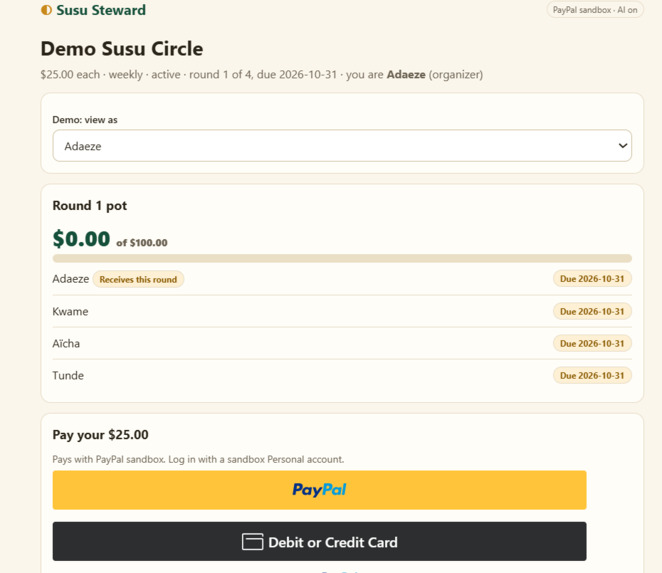
UI 1
-
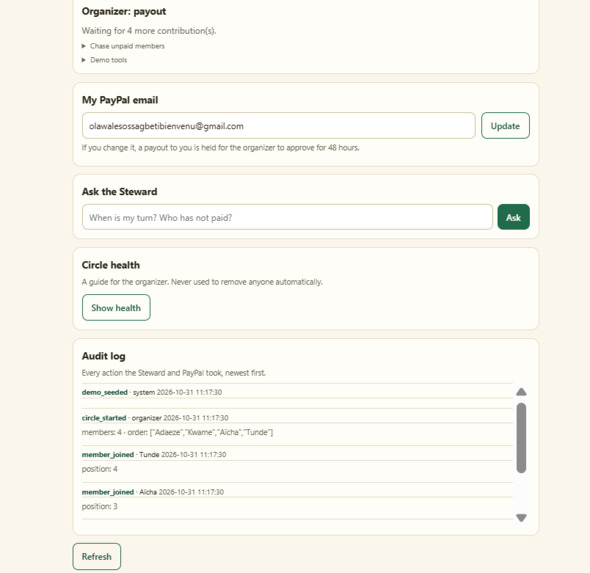
UI 2
Inspiration
Rotating savings circles are one of the oldest ways people save together: susu, ajo and esusu, tontine, tanda. Every member pays in each round, and one member takes the whole pot. They work because of trust, but they usually run on notebooks and chat messages, and one organizer holds everyone's cash. A missed payment, a mistake or a dishonest organizer can end a circle and cost members real money. I wanted to keep the tradition and remove that single point of trust.
What it does
Susu Steward is an AI agent that runs a savings circle on PayPal.
- Circle Planner: describe a circle in plain words ("6 people, $25 each, every Friday") and the AI turns it into a circle you confirm.
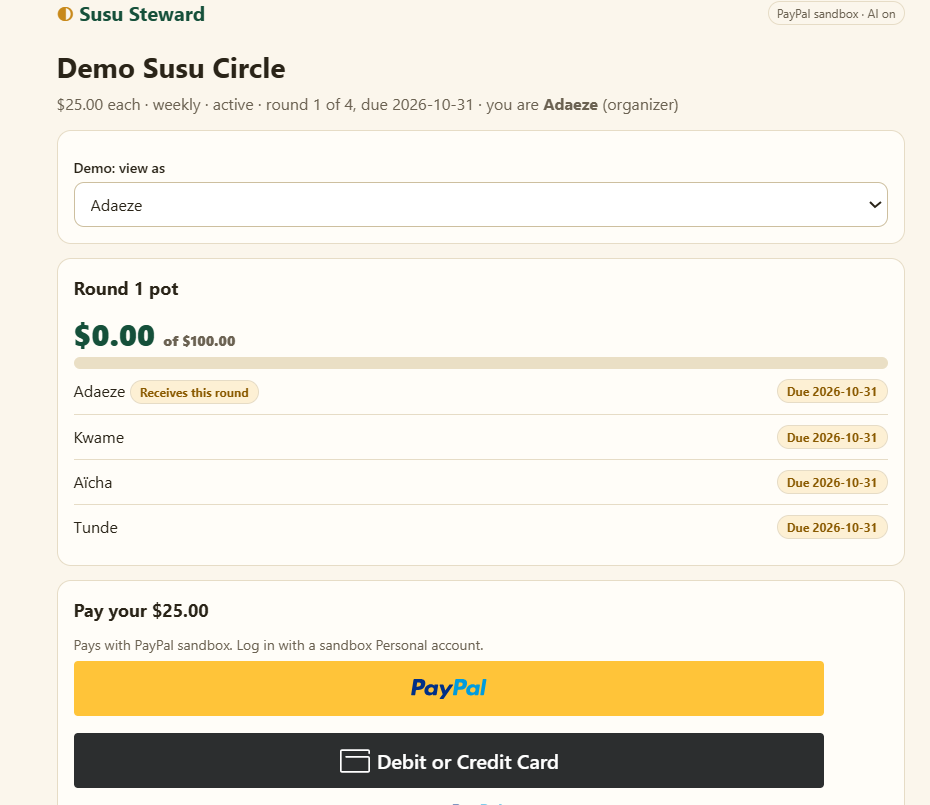
- Contributions: members pay each round through PayPal Checkout. The server checks the payment with PayPal, and a signed webhook backs it up.
- Payout Risk Check: before any payout, hard rules check that the pot is full, the amount is exact and the recipient matches the payout order. Anything suspicious (for example a recipient who just changed their PayPal email) is held for the organizer's approval, with reasons.
- Payouts: cleared payouts are sent through the PayPal Payouts API.
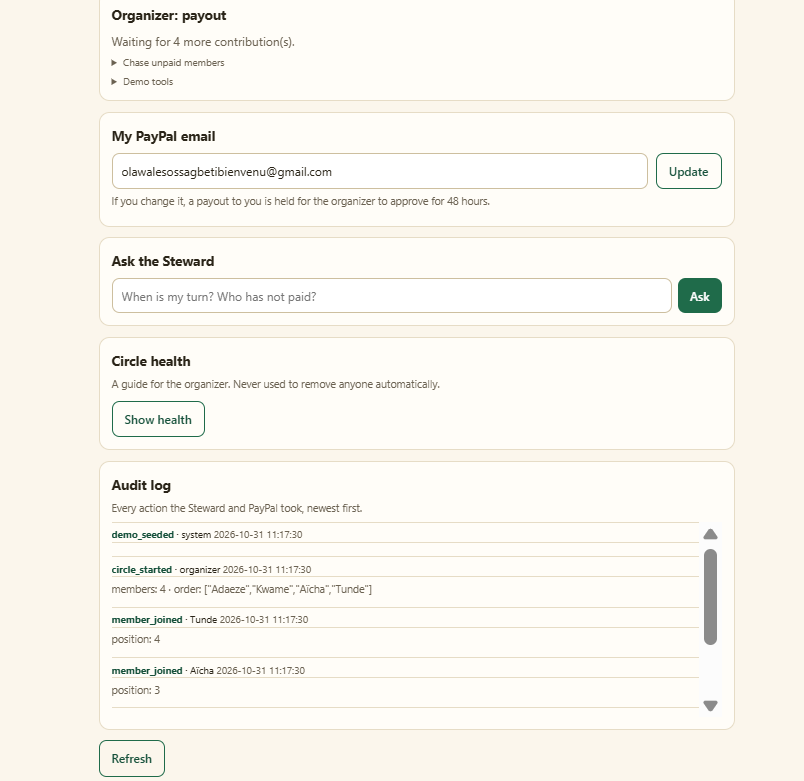
- Steward Chat: members ask "Who has not paid?" or "When is my turn?" and the agent answers from the real ledger, showing which tools it used.
- Late-payment help: reminder drafts in English, French or Yorùbá, and PayPal invoices for missing contributions.
- Audit log: every decision and payment is visible to the circle.
How I built it
Plain Node.js with no dependencies, SQLite for the ledger, and a mobile-first web UI. PayPal powers the money: Orders v2 and the JavaScript SDK for checkout, Webhooks with signature verification, the Payouts API, and Invoicing. The AI model handles planning, tool-calling chat, reminder drafting and a payout review. The key design rule: the AI never moves money. It can only call read-only tools. Money leaves only through one guarded function that re-checks the rules at send time, and the AI review can only escalate a payout to a human, never approve it. It is hosted on Render.
Challenges
- Making the AI useful without trusting it with money, so the rules block and the AI can only raise concern.
- Recording each payment exactly once when both the browser and the webhook report it, so payments are idempotent.
- Handling PayPal sandbox account quirks during checkout.
- Keeping the project simple enough that judges can run it in one command.
What I learned
How to design an agent around guardrails, how to verify PayPal webhooks, and that the most valuable AI feature in a money product is knowing when to stop and ask a human.
What's next
Real-currency support, multiple currencies for diaspora members, group chat reminders, and compliance and licensing review before any production use.
This is a sandbox prototype. No real money moves. It was built during the hackathon submission period.

Log in or sign up for Devpost to join the conversation.